When I Roll Into the Wild Tiled West

It’s safe to say I’m a fledgling Paul Dennen connoisseur. After Clank! Catacombs and the utterly perfect Dune: Imperium, Dennen could design one of those gawrsh-awful “alcohol and vulgarity” party games I’m emailed about every other week, and I’d be game for a few hands.
Wild Tiled West is not about alcohol and vulgarity. Maybe it should have been.

Cows and such.
Welcome to the untamed (by white people) frontier. Where cows need wrangling, bandits need shooting, and folk are all anthropomorphic animals. Hey, gotta plug into that zeitgeist. Nothing absolves the sins of the past quite as readily as the Redwall Effect. Just as well. Wild Tiled West is an airy affair. The closest it gets to western violence is those bandits, feral punks who hide out in the hills and periodically subtract points if you haven’t dealt with them.
But we’re getting ahead of ourselves. This is a tile-drafting and -laying game. Like others of its ilk, it’s preoccupied with adjacencies and overlapping effects. Placing a tile over the top of an icon earns some bonus, usually bullets, gold nuggets, or better income from your gold mines. Outlined spaces are town limits; filling them in awards a heap of points. There are also little horseshoes, which subtract points at the game’s conclusion if you haven’t covered them up. There’s a trend here. This is very much a point salad game, and the win will go to whomever gobbles up the most squirrel-sized morsels.
And then there are the tiles themselves. Dennen provides a nice spread of saloons and hotels and wheelwrights and whatever else a frontier town needs to thrive. Despite there being so many to choose from that you’ll inevitably need to check the rulebook to clarify an effect or two, the vast majority are grazing land filled with a few head of cattle or empty alleyways. Alleyways that do not, in the usual fashion, run between structures.
The resultant landscape doesn’t feel bespoke so much as bare. This, too, is a trend of Wild Tiled West. For all its overtures at imbuing its spaces with a sense of place — unique player boards, all those buildings, varying bonuses and perks — it tends to mash together into an indistinguishable stew. And not an especially hearty one.

Jumping claims at the market.
First, though, the good part. The drafting is handled smartly. Tiles are pulled from a double-layered market. Despite always having an identical arrangement, the order of their appearance differs from session to session thanks to a handful of dice, whose clatter shows which rows and columns are available this round. The big twist is that tiles on the river — the central two columns of each board — can be “claim-jumped” by paying extra gold nuggets, letting you skip over weaker buildings to get at the rarer offerings closer to the center.
To the game’s credit, the drafting in Wild Tiled West is immaculately balanced. Everybody gets a chance to draft, but nabbing a tile means also removing the die that let you reach it. Over the course of a full game, everybody at the table gets a shot at both ends of the turn order, selecting from either a wealth of options or a dearth. Of course, you could pass your turn to place one or two of those generic alleyways, usually to fill in the board’s equivalent of an un-itched spot in the center of your backside. This is occasionally necessary. The tiles lean into the wildness of the setting, sprawling in every direction and only rarely joining tight. It isn’t an exaggeration to say that the drafting is the best part of the whole shebang.
Second best is some actual banging. Not like that, you pervert. With guns and bullets. This is a child-friendly game — which naturally means that shooting varmints is considered appropriate, while certain staples of frontier commerce go missing. But anyway: I mentioned the hill bandits. After a few drafting rounds, a “tussle” ensues. The player with the most bandits loses points, while those who’ve trimmed back their bandit troubles earn a few points but also add yet another bandit to their board. These can be shot by sheriff bears. When you do so, the bullet turns over to become a gravestone. Cute and satisfying.
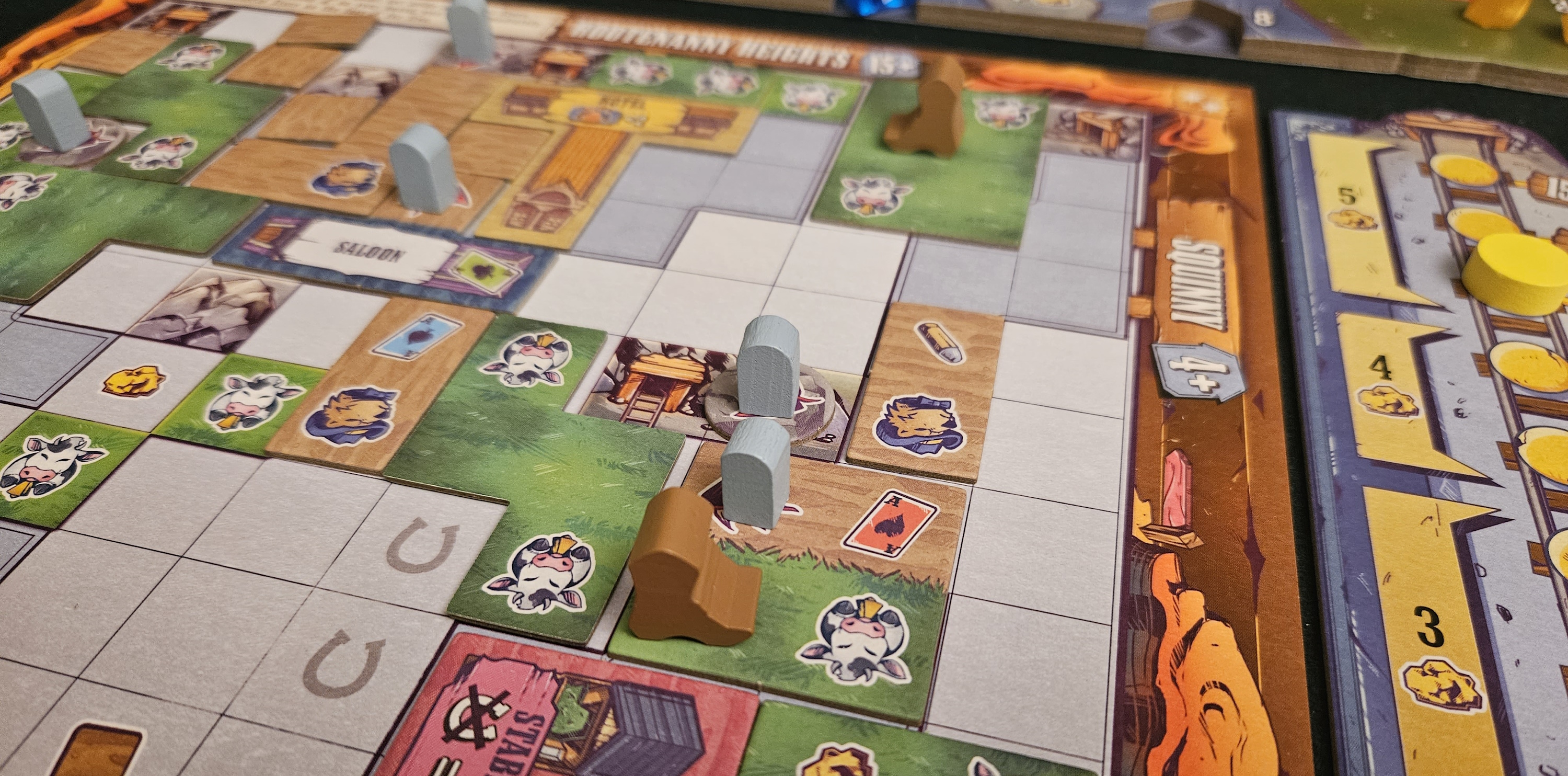
Welcome to Tombstone.
Also somewhat troubling, rules-wise. Sheriff bears can lob their bullets over icons — aces, bullets, nuggets, that sort of thing — as well as alleyways and fields and previous tombstones, but not structures, mountains, mines, other bears, and cattle. They can also only shoot in straight lines. This generates some of the game’s best placement conundrums as you strive to keep lines-of-sight open for future shootouts — it’s a very American game; you might as well be constructing an elementary school in Texas — while keeping an eye on any empty hills that might soon become populated with ne’er-do-wells. Meanwhile, certain partners, the game’s scoring cards, require bandits or tombstones in various quantities or arrangements. There’s plenty to fill your belly with, even if it sometimes proves too sinewy for easy chewing. Streamlined icons that make it clear which objects obstruct your bullets wouldn’t have gone amiss.
It also wouldn’t have gone amiss to fill the map with more than those empty alleyways. Structures are punctuation, not the game’s customary grammar. Fields of cattle are one thing. Your goal there is to wrangle the cows once they’ve reached a scoring population, placing little boots to signify that they’ve been fenced in. It’s everything else that lacks personality. I don’t mind negative space, but Wild Tiled West can’t decide between its mashed-together dense spaces and its vast unfilled stretches. Or worse, its infinite seas of planked but unpopulated alleys. There’s no sense that you’re creating an appealing place, one that people, furry or smooth-skinned or otherwise, might actually be drawn to.
While this is principally an aesthetic concern, it highlights a larger problem: Wild Tiled West consists of five or so interlocking considerations, but none of them are all that interesting to tackle, and solving them in parallel doesn’t amalgamate into a thrilling experience. This is a sedate game, full of sedate decisions and sedate scoring criteria. It isn’t bad by any stretch; if anything, it provides a relaxing enough ninety minutes, although they’re shot through with small irritations. Rather, the entire thing is wholly, defiantly okay. It provides a good time, but never a great one. And despite the veritable arsenal it provides, it’s toothless in a way that Clank! and Dune: Imperium were not.
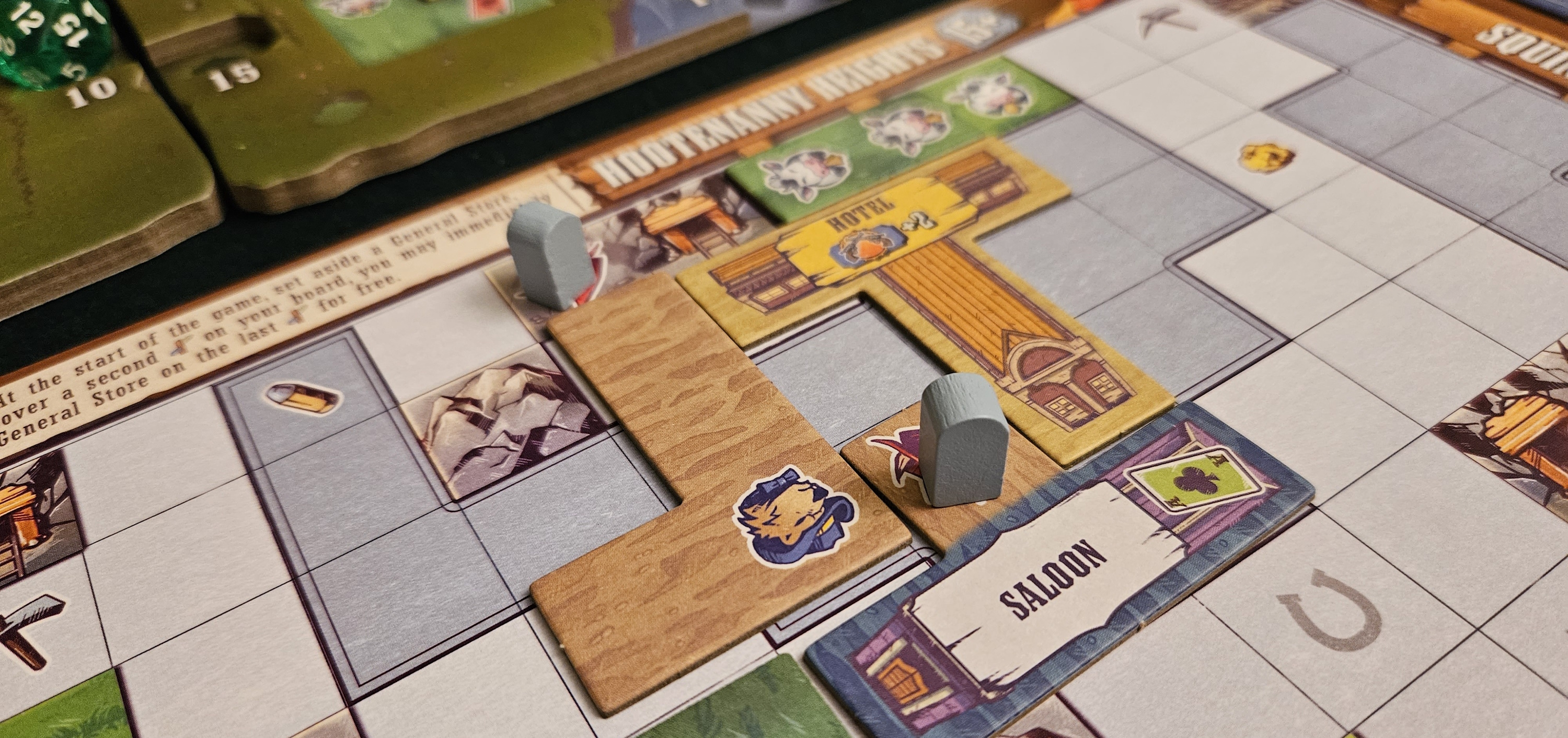
Double kill.
I’ll put it this way: what this game needed was some alcohol and vulgarity. Not the kind you’d find in a drunken party game, but a dash of flavor to give the game’s point salad arugula some much-needed zest. There’s never anything worth swearing about in Wild Tiled West. Oh, sometimes a tile won’t fit. Other times, a sheriff bear won’t line up a shot. Or you’ll need to squeeze one more cow into a field for a desirable bonus.
But these aren’t worth getting one’s hackles up. The whole thing is sleepy, the stuff of a dusty off-ramp settlement, not a bustling gold-rush town. Dennen has it in him; both Clank! and Dune: Imperium provoke feeling. Fervor, rage, a prickle at your spine when somebody or something is on the verge of catching you with a blade. This one produces some pleasant enough drafting and tile-laying. Given the game’s author, it’s hard not to consider “pleasant enough” somewhat of a letdown.
(If what I’m doing at Space-Biff! is valuable to you in some way, please consider dropping by my Patreon campaign or Ko-fi.)
A complimentary copy was provided.
Posted on July 25, 2023, in Board Game and tagged Board Games, Dire Wolf, Wild Tiled West. Bookmark the permalink. 5 Comments.

 SPACE-BIFF!
Wow, sounds like you’ve had a string of boring games! Or do you save them to write about in succession? 🙂 this one never did sound that appealing to me, which is a shame, since I also love Dennen’s games generally
Ha, just coincidence. I’ll write about a better game later this week.
I’d never heard of this game before this week, but a simple once over would have assured me that it was not for me even if I had. However, I do not read your critiques for the games, not really. I read them for the social commentary (which is what any good art critique should be aiming for, really). And did you ever deliver with this one.
Thanks for the kind words, chearns.
Pingback: Distant Rumble Train | SPACE-BIFF!