Slaying Probus

Ah, the third century. When men were men, women knew their place, and the Roman Empire was so tattered that the lifespan of its leaders was measured in months rather than years. Who wouldn’t want to be transported to those halcyon days?
If their previous design catalog is anything to go by, Wray Ferrell and Brad Johnson might volunteer. Time of Crisis and its expansion tackled the military anarchy of the third century with ease, highlighting the plagues, inflation, invasions, and civil war that were the hallmarks of the era. Their newest title, The Barracks Emperors, covers such similar ground that one might mistake it for another expansion.

I too am a mobile vulgus.
A second glance puts that assumption to bed, not least because the cards are more or less identical to those in Time of Crisis. You know, apart from being squares instead of rectangles. Same titles, and in some cases the same art. Is the map also reused? I think so, but I can’t be sure. I’ve stared at so many maps of Europe that they’re more a memetic imprint on my brain than something I consciously digest. Further, the map in The Barracks Emperors is little more than a watermark. At no point is it important that one space grazes Hispania while others are within the sphere of the breakaway Palmyrene Empire. Nor, even, that some of them are smack dab in the middle of the Mediterranean. A strict geographic representation, this is not.
Here’s the thing: none of this matters one bit. The Barracks Emperors is not only a viable successor to Time of Crisis — which would make it Diocletian, if I’m keeping my emperors straight — it’s probably the better game. I’d even go so far as to call it a work of genius.
An abstract work of genius, that is. Which perhaps puts it in proximity to Time of Crisis yet again. Time of Crisis always played loose with history. It wasn’t so much a simulation as an impression. Rather than retelling the specifics, naming failed claimants to the purple and marching players through a rigid procession of events, Ferrell and Johnson were more interested in generalities. They sketched out the broad reasons for the crisis: opportunistic generals with personal armies, neighboring kingdoms eager to carve segments out of the bloated empire, the occasional bad stroke of luck.
The Barracks Emperors runs with this abstraction. And then it keeps running. There isn’t much in the way of historical verisimilitude, not unless collecting failed pretenders like they’re wild Pokemon strikes you as an accurate depiction. Given the time period, maybe it is. Just don’t go in expecting to receive much in the way of an education.
Oh, and it’s a trick-taking game. Because of course it is. And you’re playing thirteen tricks at the same time.
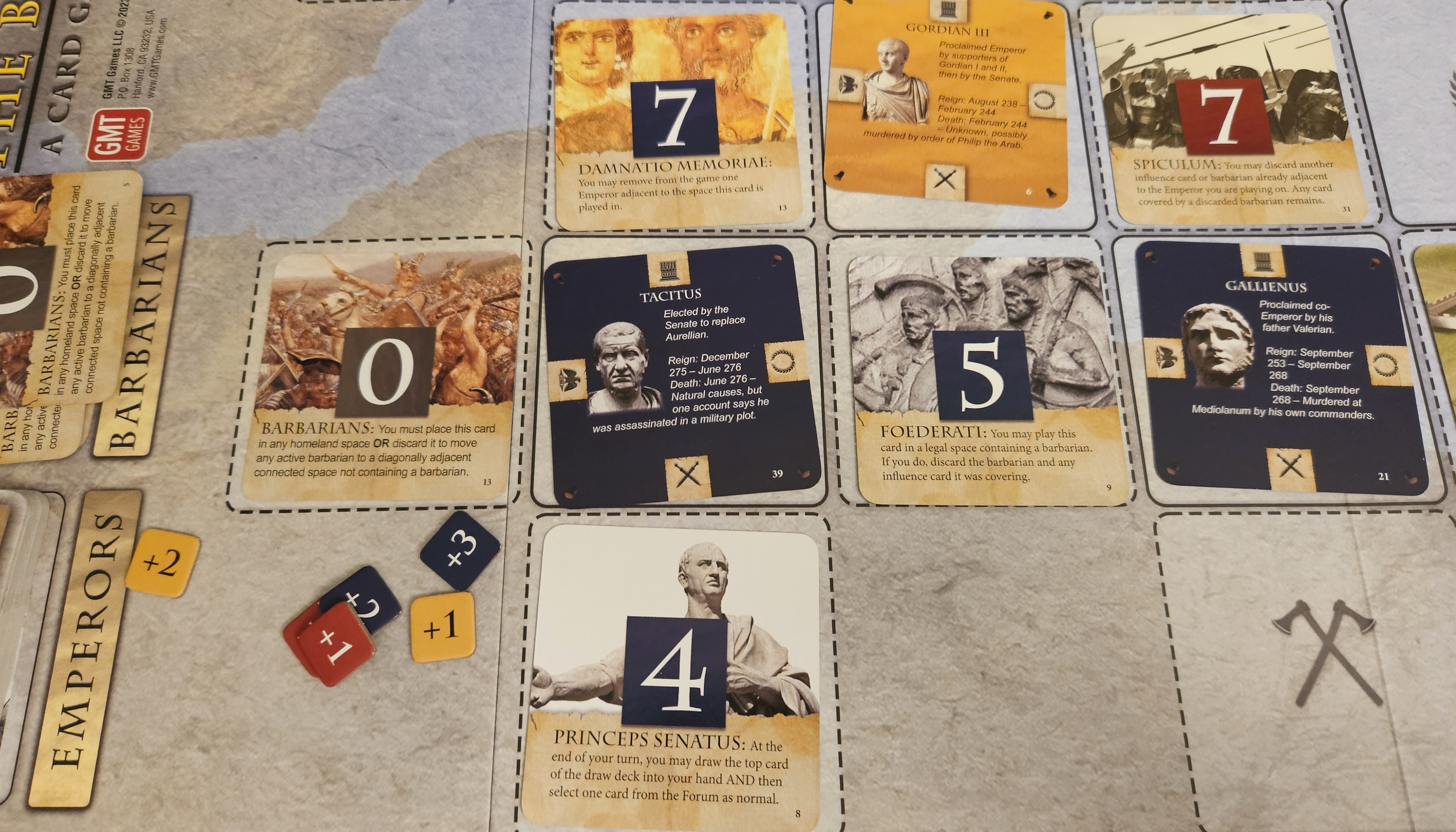
Are we killing Tacitus? Claiming Tacitus? Who cares.
What’s surprising about The Barracks Emperors’ approach to trick-taking — aside from being a trick-taker at all — is that it’s surprisingly faithful to the genre without being hamstrung by its conventions. At the start of each hand, the map is a checkerboard of thirteen hapless emperors. These are divided between three suits, nominally the same types of influence from Time of Crisis — populace, martial, and senatorial — but more readily identified as yellow, red, and blue. These establish each emperor’s trump suit; so a blue emperor will more readily be won by blue cards than yellow or red, and so forth.
Bit by bit, Ferrell and Johnson fold in further wrinkles. An emperor is only awarded after being totally surrounded on all four sides. In eye-rolling GMT tradition, the rulebook presents these resolutions as a list of nine if-then statements. If an emperor is surrounded on all sides by barbarians, then they are murdered and removed from play. If two or more cards have matching values, then they are eliminated from consideration for winning the trick. If. Then. If. Then.
But it would be a mistake to look at this clinical approach and think of The Barracks Emperors as overly tangled. Instead, the crucial detail is that every card you play is also usable by your rivals. “Your” card is determined by whichever side of an emperor it was played to. If my player icon is a pillar, then I will always resolve emperors based on the card to their north. That card, however, will likely be located to another emperor’s south, and another’s east, and another’s west. Because these compass directions resolve in favor of other players, nearly every card you play can work to someone else’s benefit — or detriment, once you realize it’s possible to dump a wimpy card onto an emperor you don’t really care to win, and thereby poison the well of another trick.
This isn’t as complicated as it sounds. It’s best understood by seeing it in motion, and by grasping that it’s a hybrid of trick-taking and area control. It draws from both mechanisms: the dominant suits and careful card-play the former, the shared spaces and overlapping control zones of the latter. In most trick-taking games, everybody slaps down a card. By default of how everybody is seated, those cards tend to be arranged in a particular way, all facing their respective players. The same is true here, with each emperor acting as the epicenter of four cards. But there’s a trick happening next to that trick as well, and another beside that, and others above and below those. Just as the tricks are shifted, so too are the cards that resolve them.

New cards are found in the forum.
The effect can be dizzying, especially midway through a hand. More than once, my eyes have shifted into middle distance as I studied the board, searching for the spot where a card might upset another player’s sway over an important emperor. Taken in the raw, every emperor is equivalent. Worth one point. Not all that special. But because you earn a tidy bonus for matching sets, the game soon becomes one of strategic denial. If Geoff has a pile of yellows and blues, they’re worth very little without a few attendant reds. I will therefore go out of my way to prevent him from claiming any martial emperors.
This contributes to the game’s deliberate pacing, its one truly significant departure from the conventions of the trick-taking genre. A full game requires three full plays on the main board, each with thirteen tricks, in order to generate that all-important metagame. Even though it takes an hour or two to play, and there are plenty of pauses throughout, I still wouldn’t characterize it as slow. If anything, its pace is steady and involved. Every play matters. At times, a single card can result in two or even three emperors being awarded, punctuating the stolid thrums of its usual tempo with little swells of triumph or disappointment.
It helps that the cards are magnificent. Each suit is built around a theme, and it isn’t long before players are counting how often a particular ability has been deployed. Military cards are the most straightforward, interfacing with the game’s area control elements directly. Cavalry cannot be canceled by cards of matching value, flanking maneuvers let you swap two adjacent cards, and a forced march can let you bypass the usual placement limitations to deploy a card somewhere you ordinarily wouldn’t be allowed to go. There are praetorian guards and javelins for removing pesky rival cards, and forts that are immune to enemy manipulations. Populace cards are less direct but no less useful. Mobs flip rival cards face-down, keeping them in place for a speedy capture but stripping them of any value, while quaestors rob emperors of their trump suit. And then there are demagogues and pretenders. These bastards block rival abilities for a full round or add new emperors to the board, filling in previously hollowed-out spaces.
The last suit, senatorial blues, interact with barbarians. These produce a fourth suit, gray and valueless, but are important for a few major reasons. First, they can be deployed to any frontier. This lets everybody slip around the game’s biggest placement limitation, that under normal circumstances you can only assign cards to an open slot facing you. This prevents you from nuking spaces that only benefit rival players, and ensures that every card you places on the table matters to you personally.
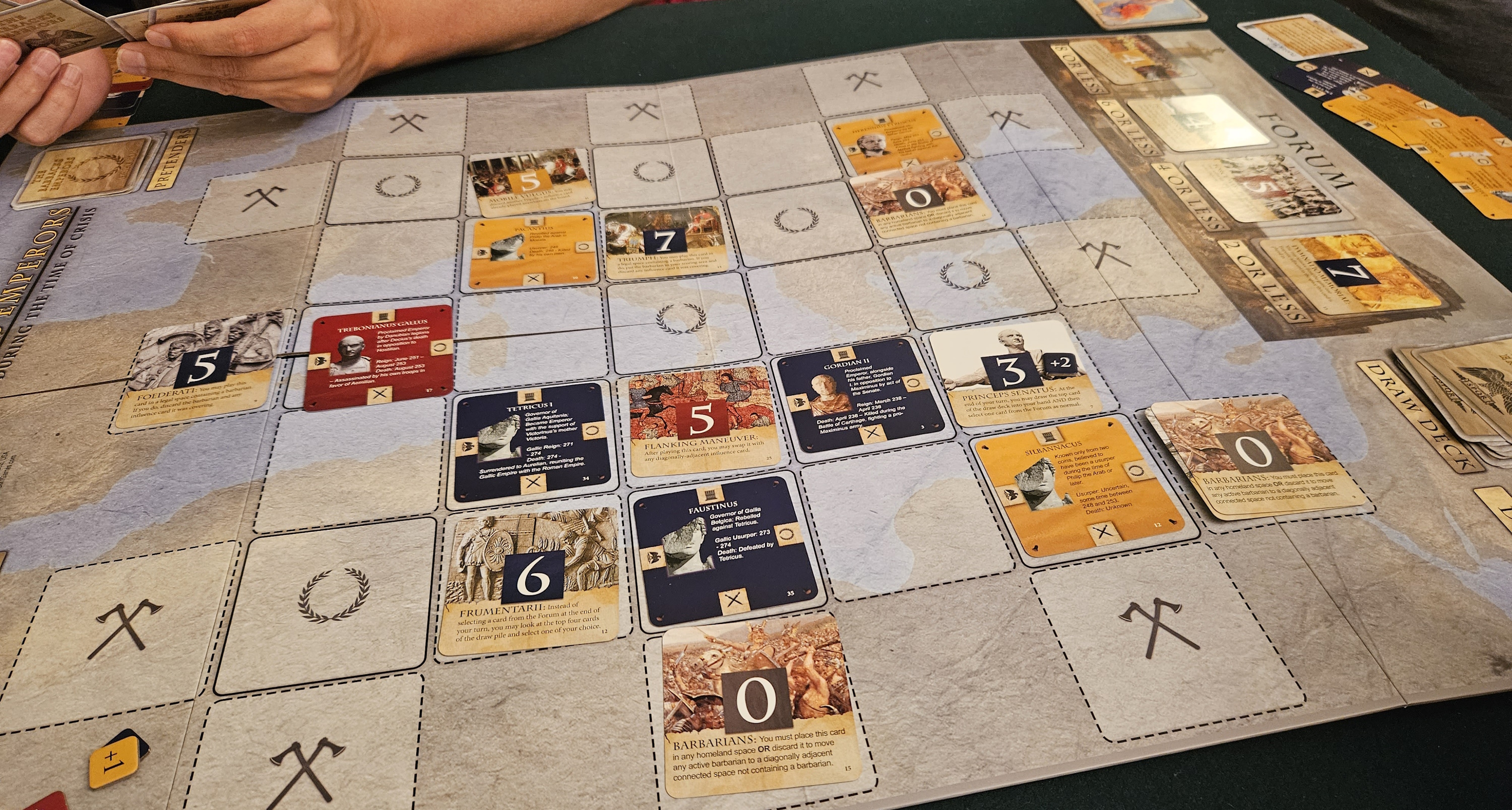
It isn’t long before the Empire is a tattered patchwork.
Not so for barbarians. These jerks appear where you least expect them, shambling over the empire’s borders and hogging up otherwise useful territory. But a wise emperor can put them to use. Playing another barbarian card lets you move one already on the table, shifting them diagonally into a new slot and covering up anything already there — a great way to eliminate a high-ranked enemy card from consideration. Or you can use those blue cards. These offer tributes for buying off invaders, foederati that cover them up, and the occasional triumph that removes a barbarian into your scoring pile. It’s a dynamic and exciting system that keeps everybody on their toes and prevents any sector of the map from feeling too secure.
Such an abundance of options might prove overwhelming, but Ferrell and Johnson have that concern covered like a barbarian who’s been bribed into ransacking an upstart princeps senatus. Rather than filling your hand with enough frumentarii and damnatio memoriae to cover all thirteen-plus tricks, you begin with only four cards apiece. New cards are gathered from the forum one at a time. It’s an ingenious method. Cards are sorted according to rank and then claimed based on the rank of the card you just played. The weaker your play, the more options you have to choose from for your replacement. This allows even flimsier offerings to shine. Doubly so when you dump them into a contest you don’t particularly care about.
Mashed together, these elements create something fascinating. The Barracks Emperors is a brain-burner, but in the best way. Every play matters, resulting in deliciously convoluted bids. Although the game doesn’t prove especially enlightening about the period in question, it still evokes a certain chaotic reality, one where the entangled pretenders of the Roman Empire are hopelessly incapable of getting ahead without also propelling their rivals to greatness. Fittingly, the emperor cards function as obituaries as well as objectives, listing each potentate’s truncated reign and cause of death. This, together with the game’s interlocked ludic space, generates a landscape of confusion rather than geography, a topography of death and turmoil. And in its own very peculiar way, it evokes treading water in segmented armor, every kick bringing you closer to the surface before another claimant to the Empire latches on and drags you down.
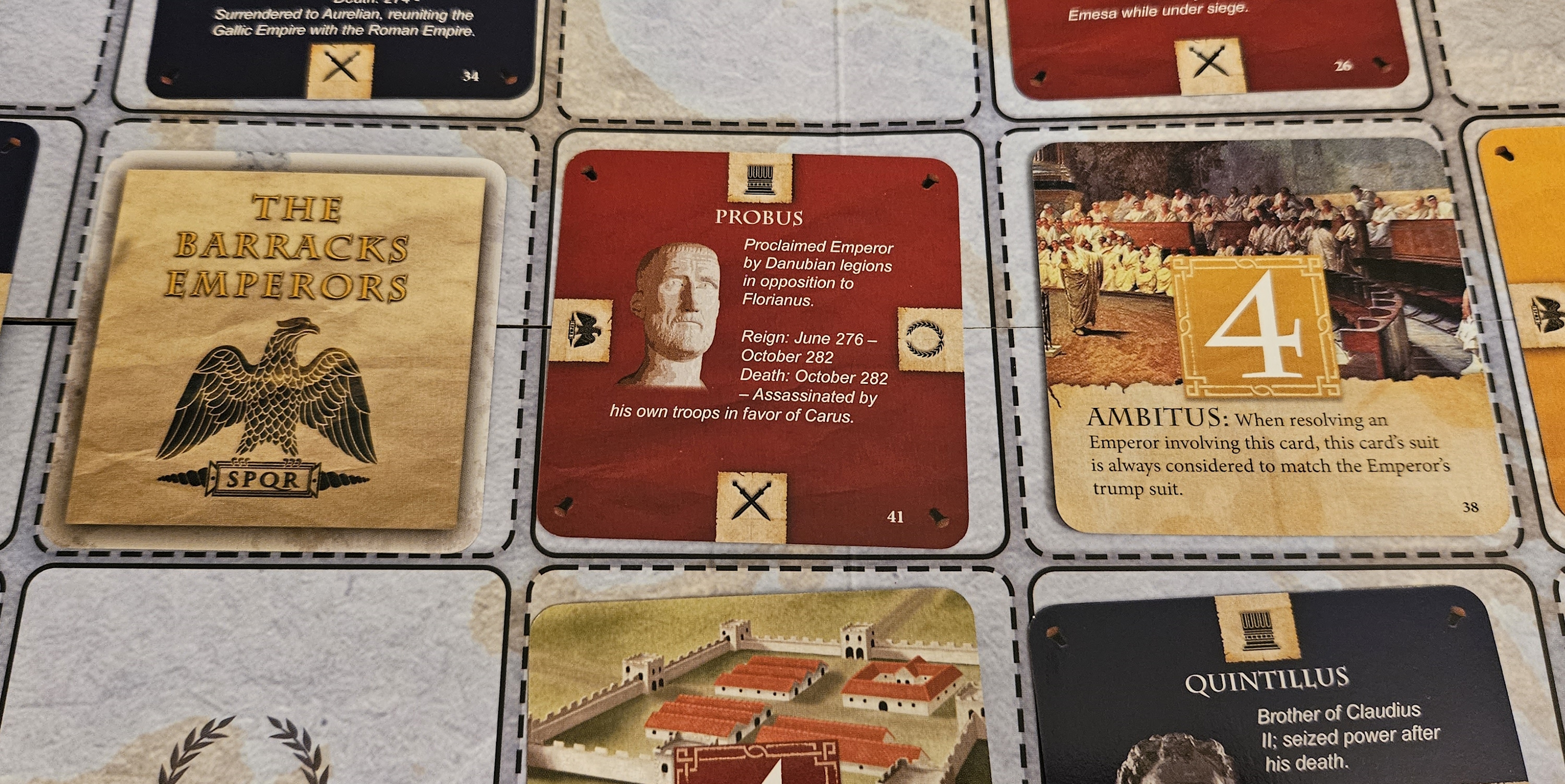
If you think that’s unfortunate, wait until you meet Pupienus.
Is this the best hybrid trick-taker? I think so. Even more than Brian Boru, even more than the early version of Arcs, more than Joraku or any other attempt I’ve played, The Barracks Emperors shows what trick-taking can accomplish when pushed to its absolute boundaries. It isn’t conventional in any sense. It’s something better. This is one of the smartest mechanisms-first games I’ve played in a while, forcing players to stretch their schemes and ability to think laterally until their brains have been transformed into a calculation engine for interlocked tricks. It’s overlong and busy and overwhelming and doesn’t pass for good history, but by damn it’s cerebral riot.
(If what I’m doing at Space-Biff! is valuable to you in some way, please consider dropping by my Patreon campaign or Ko-fi.)
A complimentary copy was provided.
Posted on July 19, 2023, in Board Game and tagged Board Games, GMT Games, The Barracks Emperors. Bookmark the permalink. 16 Comments.

 SPACE-BIFF!
So glad to see this review and that it’s so good. I just got it the other day and was hoping to play it during our Sunday game day.
Even more pumped now!
Hope it treats you well!
OK, you’ve peaked my interest. Do you think this would pay well with 2? Or is it really a 4-player game?
With two players, nothing much changes. Basically, both players control two compass directions instead of only one. I haven’t tried it that way, but it seems like it would work — although the 4p game is probably where it’s strongest.
My favorite emperor, the one I will ignore other strategic considerations in the interest of capturing, is Silbannacus, of whom nothing is known except that two coins were found bearing his name.
Oh, that’s lovely.
Can you give us a sentence or two about the solo bot play? I’m loving your cards game essays and these “trick-taking” game reviews.
Thanks, Cliff. Unfortunately, I haven’t given the bot a try yet. It looks nifty, though!
Thanks for another well-crafted review, Dan! It was sounding pretty great, but a favorable comparison with Brian Boru (which I quite like) seals the deal for me.
I’m glad that trick-taking seems to be having a moment in the broader board game space right now, because it is a great mechanical core which many people are already familiar with. My in-laws enjoy board games, so long as they are not too terribly heavy. But they grew up with trick-taking card games, so those conventions are already internalized. Brian Boru was a big hit with them, in part for being that much more easily learned.
And now game designers seem to be seeing what they can build off of that established core. I’m excited to see more!
Agreed! There are some real benefits to using trick-taking in a bigger game, and I’m thrilled to see it being put to use.
What a wonderful review, Dan. I bought a copy immediately after finishing it. This game flew totally under my radar somehow, and I doubt I would’ve ever looked at it at all without your review. Brian Boru has been a favorite of my gaming group since it came out, so I can’t wait to introduce The Barracks Emperors.
Brian Boru is great, isn’t it? Hope this one fires for you as well, Chris!
I bought after reading this r evieW. Plus space biff seems on same page with my taste in games !
I hope you enjoy it!
Pingback: This Trick-Taking Life: The Future | SPACE-BIFF!
Pingback: Best Week 2023! Tricksy! | SPACE-BIFF!