Lacuna Matata

The older I get, the more I appreciate cozy games, those with simple rules and an intent to generate sensations of warmth and ease. Lacuna, designed by Mark Gerrits, is one such game. I came very close to overlooking it.
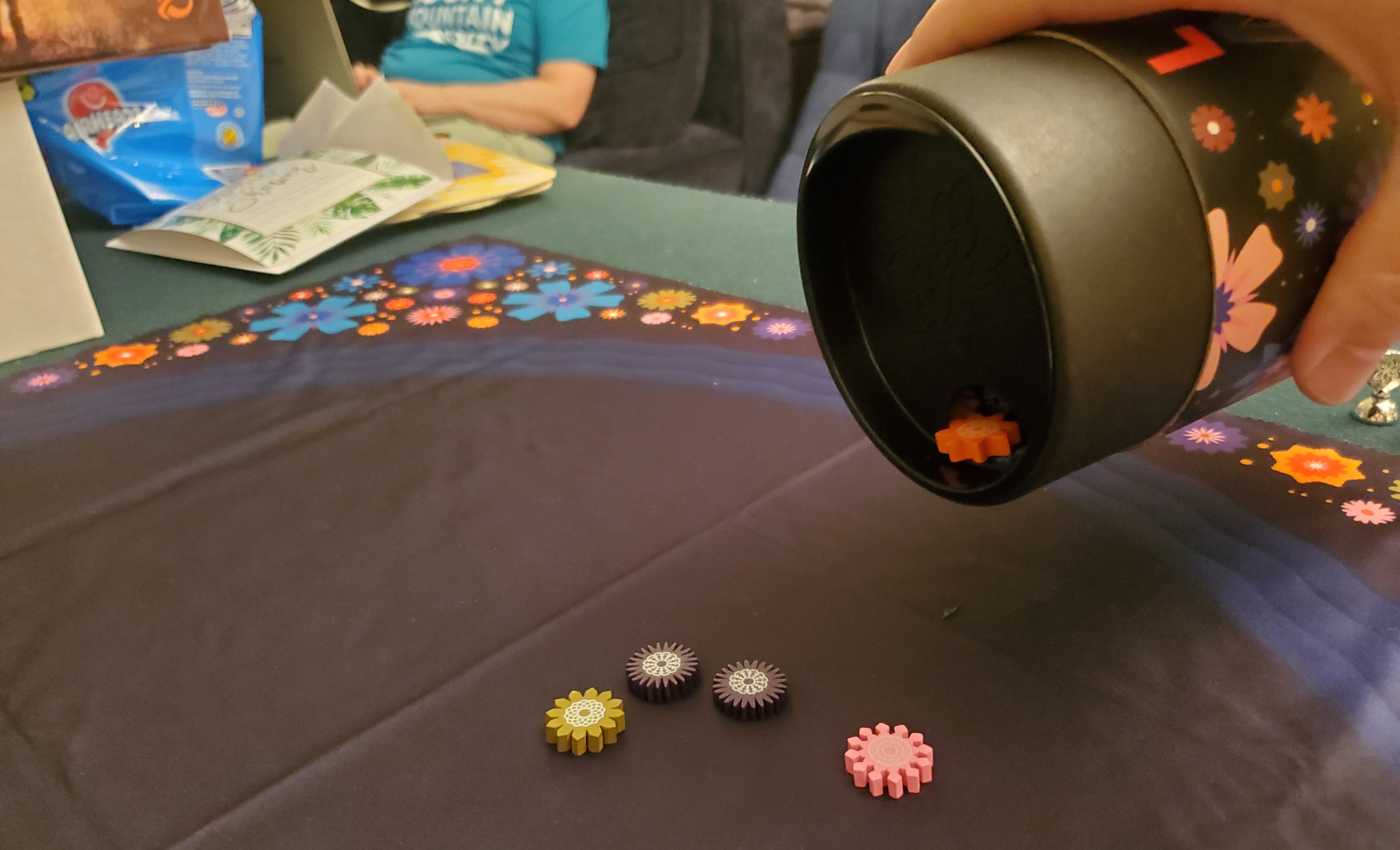
Ah. The TUBE.
It was the tube.
I don’t judge books by their cover, but I do judge them by their format. Codices are a delight. Scrolls… not so much. The same goes for board games. For pretty much the same reason scrolls made for tricky storage, tubes are awkward inclusions in any board game collection. There’s a reason the codex overcame the scroll as the premier format for amassing collections of paragraphs. Boxes are better than cylinders. It’s as simple as that.
But a friend mentioned liking Lacuna, so I figured I should unwrap this misshapen artifact that had tumbled onto my table. I’m glad I did.
For one thing, the tube serves a purpose. Lacuna is one of those “real-space” games, in which the physical placement of the components — how far apart they sit, their arrangement, the particulars of their movement or collection — is integral to the gameplay. The components here are flowers, and it begins with you pouring them from the tube, shaker-like, onto the surface of a screen-printed pond. The tube even comes with a capper that forces you to actually shake them out, sometimes giving it a little extra oomph to dislodge a flower stuck in the spout. It’s as good an opener as any, faster and more tactile than most setups, closer to preparing a meal or playing some youthful game of pebbles than shuffling decks and stacking tile offers. It feels good. Like a ritual, or an exercise. It sets the tone for what’s to come.

Placing pawns.
Lacuna is not a complicated game. Both players are trying to collect sets of flowers. Indeed, you can’t help but collect sets. The only move is to place one of your pawns directly between two matching flowers. There’s some flexibility to this process. Your pawn doesn’t need to be placed at the exact midpoint of that invisible line. The outcome, however, is always the same: you collect the flowers joined by that invisible line.
That alone involves some small measure of strategy. To get all mathy about it, there are seven varietals, each with seven flowers. That means collecting four matching flowers will award them as a point. Four points is enough to win the game. Easy.
Placing pawns, then, is a matter of watching your opponent while scouring the pond for those elusive leylines. There’s no reason to nab a pair of purple flowers if your opponent has already collected four. The same goes for you, but the other way around. It’s a counting game of sorts, if counting to seven qualifies. It’s breezy enough that my nine-year-old quickly fell in love with the process of play itself.
But that’s only the first aspect of the game. The second half arrives once every pawn has been laid.
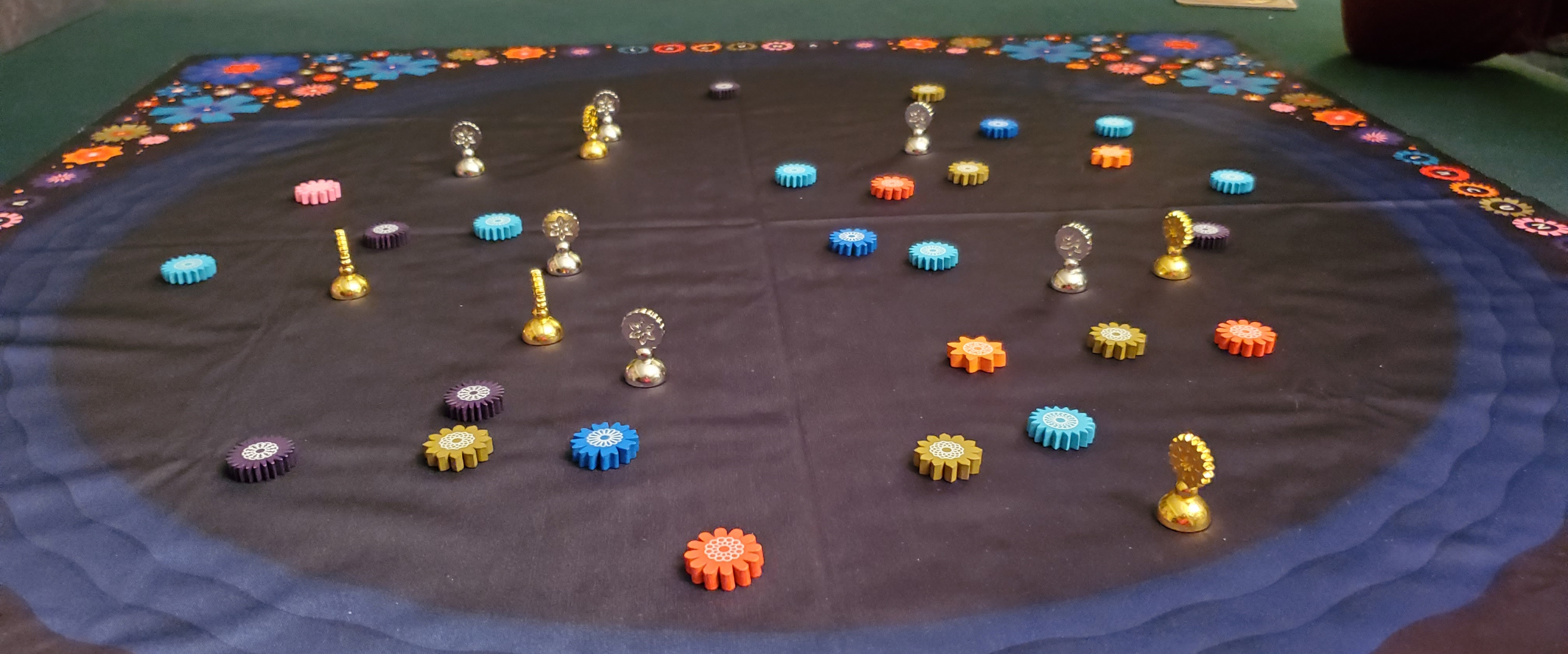
The game is not yet completed.
Lacuna now enters its second phase. One by one, the remaining flowers are awarded. This time, they’re assigned based on proximity to those already-placed pawns. It’s an extended tiebreaker if anything — players have no agency at this point in the game, no ability to alter the state of the board or negotiate their way out of a bad situation. Like the act of pouring its petals onto the mat, it’s more of a ritual than anything else.
And, of course, it’s not as though this is undertaken without thought. Knowing how the game’s second half will play out is crucial to playing the first half. Now, rather than merely finding those invisible intersections, you’re also hunting for scoring opportunities that will resolve later. The pond is transformed into a grid, or a heat-map, or a hazy approximation. Pawns are doubly strategic: placed first to claim a pair of flowers, but also to lock off segments of the pond for later collection.
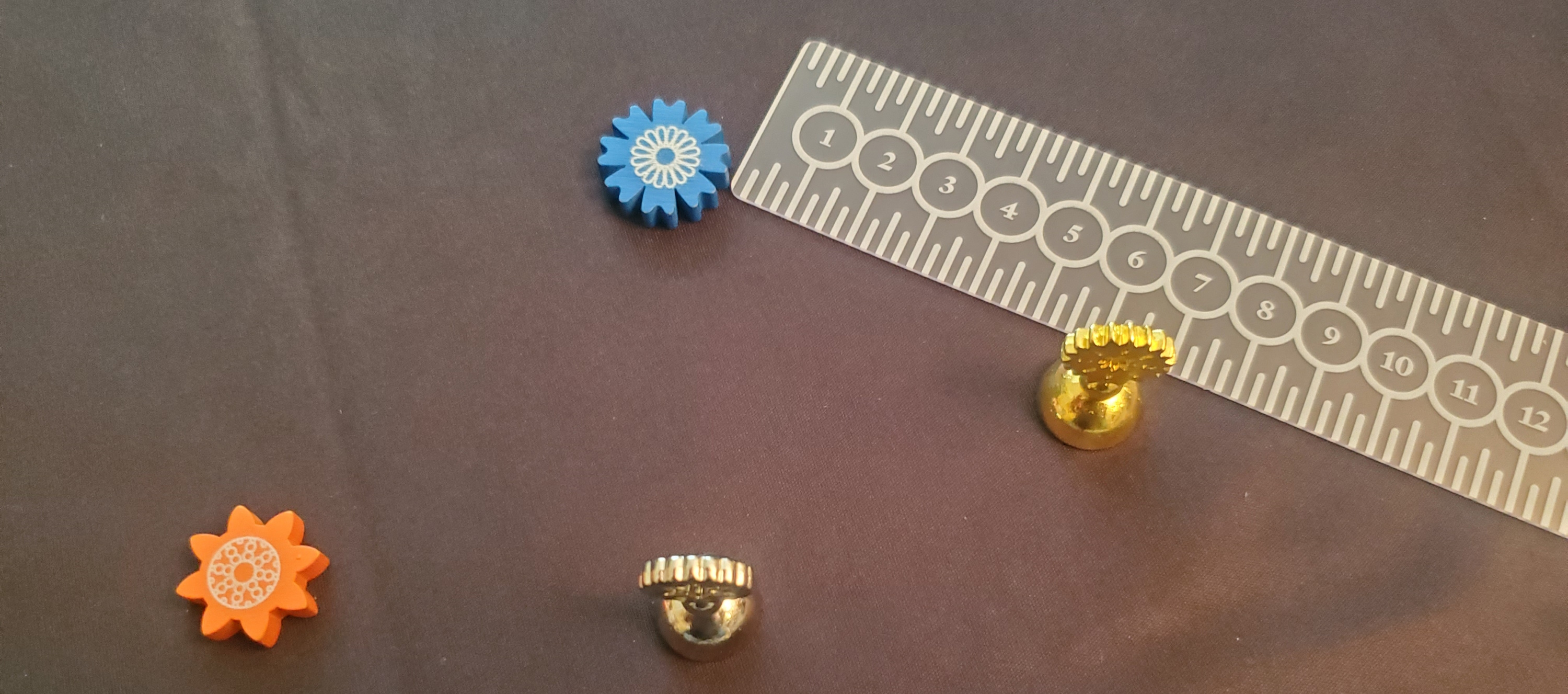
Measuring ties.
That’s one way to think about it. A natural way, for those of us who play countless board games, inundating ourselves with competition and the particulars of scoring criteria.
Yet the beauty of Lacuna is that it fosters this form of strategic thinking without ever feeling strategic. Indeed, it presents itself as anti-strategic. Calling it “strategic” feels crass. It’s closer to meditation. But if meditation, then a meditation of strategy and forward thinking. A mindfulness of counting flower petals to fours and sevens, like intentional breathing, like solace taken in the spatial arrangement of numbers and colors.
Put another way, Lacuna is what happens when a board game includes both a ruler for breaking close ties and a featureless mat so that one’s uncertain eyeballs are the only method, in the moment, for gauging distance. It embodies the processes of play and competition without ever giving itself over to them completely. Where most games are about winning, Lacuna is about the rituals we enact while we play, from setup to tiebreaker and everything in between.
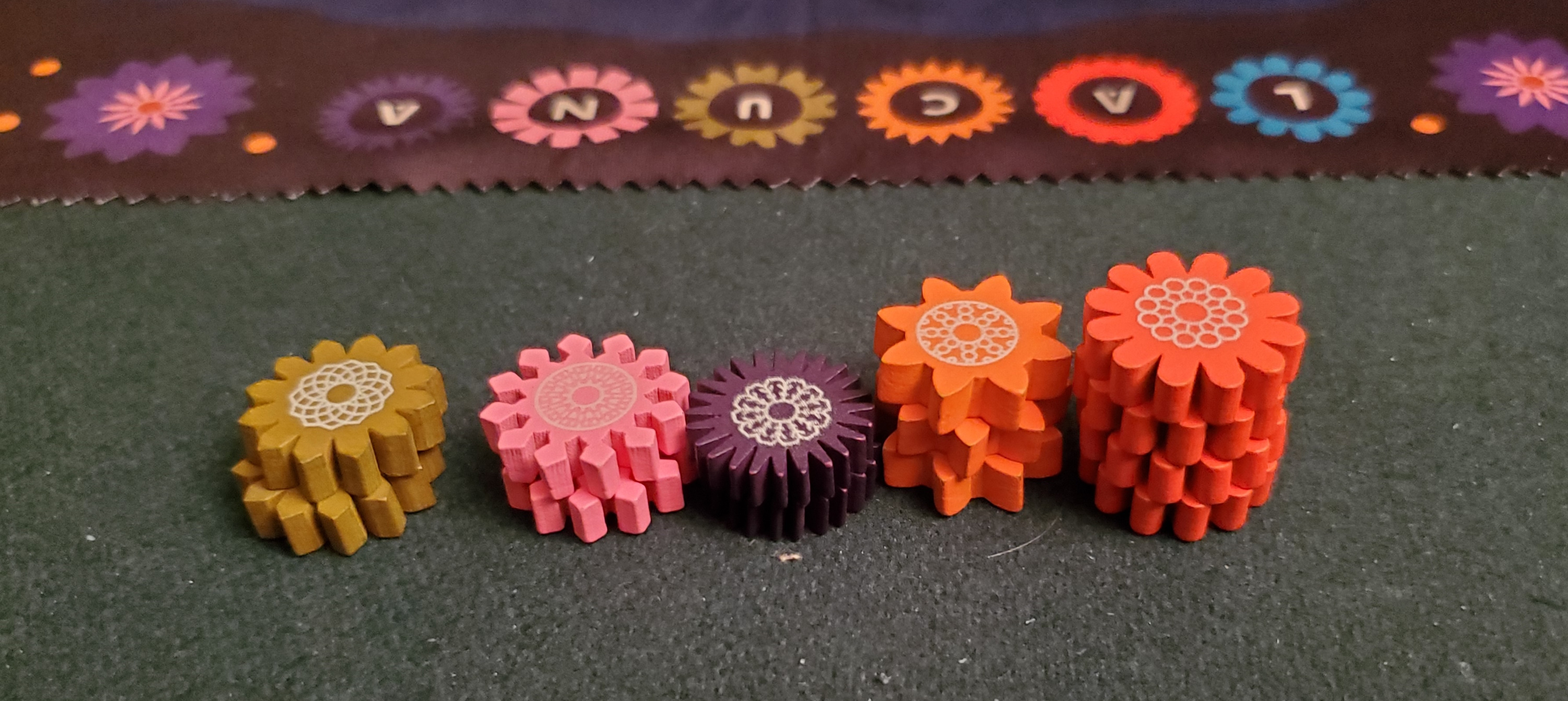
Collecting flowers.
If you can’t tell, I find Lacuna effortlessly charming. Gerrits has crafted something noteworthy, a game so undemanding that it can be explained in seconds, yet so pleasant on the fingertips and gaze that it has a soothing effect. This is something special.
Then again, it comes in a tube. Hmmm.
(If what I’m doing at Space-Biff! is valuable to you in some way, please consider dropping by my Patreon campaign or Ko-fi.)
A complimentary copy was provided.
Posted on June 6, 2023, in Board Game and tagged Board Games, CMYK, Lacuna. Bookmark the permalink. 10 Comments.

 SPACE-BIFF!
I have been looking for something new to try with my 5YO daughter, and this looks like a game she would enjoy. Thank you, Dan!
Hope you enjoy it, Peter! It’s dead simple. My 9yo loves it.
I added this to my Daybreak pledge, even though I’m sometimes hesitant about games that present themselves like this does. But CKMY has done great in my book so far, so I added it anyways.
And now I’m glad that despite you having some of the same misgivings about this game as I did, you also seem to enjoy it for the same reasons I hoped I would!
Hopefully it hits for you too, John!
I got to watch a game of it yesterday. It really is something special, and its pretty engaging just to watch. Seems like a perfect game to play when you are waiting for some games to end with another player and want a deep game that is quick.
from the dice tower review, they said that setup can be odd coz the flower can roll out and you need to spread out the flowers anyway.
zee suggested a bag drawstring setup, where you just unfurl the bag and the tokens can just spread out naturally. watchathink?
Sure, that would work. I enjoy the process of pouring out the flowers, though. Sometimes they roll around. If you aren’t careful, they can even roll off the table. I don’t mind. Even the act of scrambling to catch the flowers has its charms.
Pingback: Best Week 2023! Family Stuff! | SPACE-BIFF!
Pingback: Ars Wilmot | SPACE-BIFF!
Pingback: Magenta One: Fives | SPACE-BIFF!