Blog Archives
Island in the Sun

Spirit Island. What a game. R. Eric Reuss’s masterpiece has been around long enough that it’s become a staple of the discourse, a counterpoint to all those colonial settings that dominate game store shelves. Seven years ago I called it the anti-Catan. It’s still that and more besides. Nowadays I think of it less as a subaltern revenge fantasy (although it qualifies) or a deified avatar of conservationism (it’s that too) and more as a lament. If only there were gods, it cries. Even if they were gods that didn’t think much of us and might trample over us in their enthusiasm to preserve their creation, there would be comfort in knowing that some power, any power, cared enough about the trees and the beaches to keep them around a little longer.
Reuss’s latest iteration of the game, Horizons of Spirit Island, is a downscaled version that swaps plastic for cardboard and lowers both the player count and the complexity. It’s Spirit Island for book stores and Target, in other words. Even in a reduced format, it’s fantastic.
The Anti-Catan
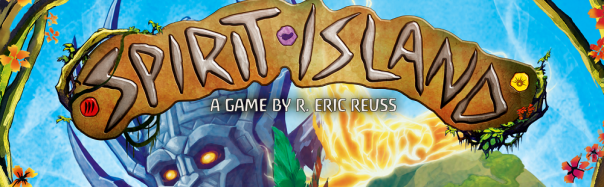
At first blush, Spirit Island looks achingly familiar. A tropical island lush with multiple colorful regions, ranging across jungles and mountains and wetlands and deserts. Why, that’s nearly as many as in The Settlers of Catan! What’s more, here are some lily-white explorers, a few towns, even the occasional city. Every so often a crude grass hut interrupts the landscape. The only things missing are some roads and sheep cards. Throw in an economic engine and some bleating about chivalry and, baby, you’ve got a Euro going.
That’s where Spirit Island turns a hard left. Turns out you aren’t the settlers at all. Rather, you’re the indigenous spirits trying to shake off their white-man burden before you can say “smallpox.” Whether that means scaring them silly or burning all those cities to the ground, whatever gets the job done.
But that’s the window dressing. Spirit Island is more than some mildly socially-aware theming. It’s also el banana grande.

 SPACE-BIFF!