Blog Archives
Fry n’ Write
Food trucks, like roll-and-write games, went from unknowns circa 2013 to oversaturated by 2021 to fresh all over again in this the year 2026. At least that’s the hope behind Chicken Fried Dice, a chuck-and-scrawler and food truck simulator from Ashwin Kamath and Rob Newton.
How does it perform? We’ll wait in line together.
Burned Notice
There’s a problem with most hidden movement games, and I say that as the mechanism’s greatest devotee. Namely, they’re slow. So slow. Maybe it would be kinder to call them “deliberate,” but even that doesn’t quite transform the ding into a compliment. Stealth, in theory, can be deliberate. Stick insects are deliberate. But it can also be harried, adrenal, instinctual. Like a panther. Like an owl. Like me ducking out of a Super Bowl party before the uncles start complaining about the halftime show.
Burned occupies the untapped middle ground between those two poles. Designed by Jon Moffat, who gave us last year’s top game about poop carts, Burned is neither Mind MGMT nor Captain Sonar. Instead, it’s the closest a board game has ever gotten to making me feel like a highly-trained secret agent picking off mooks in broad daylight. Usually right before they tackle me to the ground and stomp me to death.
Imposter Syndrome
The Imposter Kings reminds me of a game I created as a kid. That probably sounds like a slam. Kids of six and a half aren’t known for making the deepest games.
But it isn’t that. It’s the way the game loops in on itself.
In my game, there were cards numbered one to ten. On your turn, you played a card on top of your dad’s card; on your dad’s turn, he played a card on top of yours. No matter who played, the card had to be higher than the one under it. If ever you couldn’t play a card, you lost and your opponent won. Halfway into our first play, I realized that high cards were infinitely better than low cards. So I made up a new rule on the fly. You could play a one on top of a ten, looping back around to the start of the sequence.
There’s more to The Imposter Kings. Lots more. The game’s designer, Sina Yeganeh, was too sharp to think that numbered cards would be interesting enough on their own. So this is one of those games with plenty of special abilities and triggers and the occasional reaction that plays out of sequence. At core, though, it’s a game about playing the right card so that your opponent can’t follow it up with something better, about knowing when to double down with a high card and when to loop back to the beginning. Exactly like my own game. Just, you know, interesting. I’ve played it more than once, for example.
A Study in Personal Pickiness
I adore Martin Wallace’s A Study in Emerald. The first edition most of all, although even the second edition, with its overly pruned foliage, will do in a pinch. I’ve talked about these games, and their spiritual sequel, multiple times. In some ways, the original Study was one of my first glimpses into the strength of board gaming as fable, as serious historical examination made easier to stomach thanks to its drapery. Like clothes over a mannequin; like speculative fiction describing theory of mind.
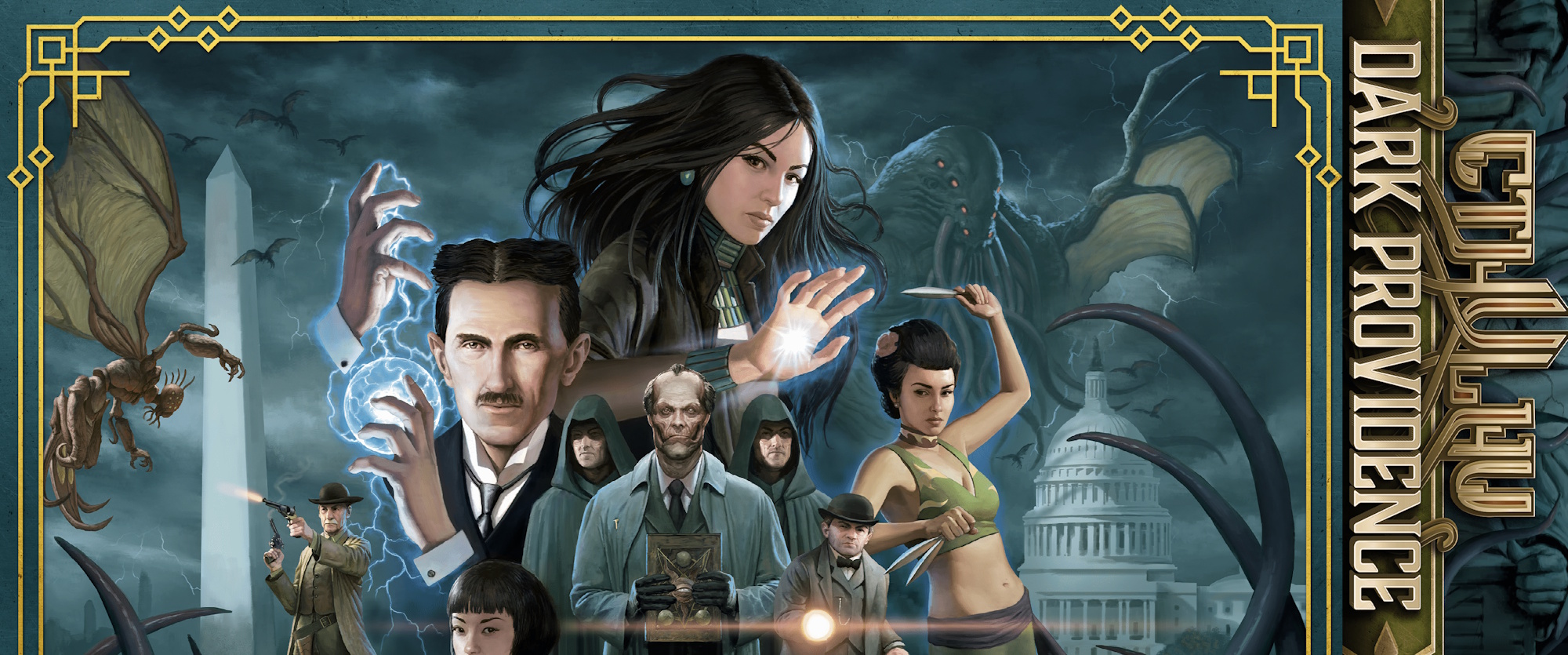
Cthulhu: Dark Providence, co-designed by Wallace and Travis R. Chance, is a remake of Study’s first edition. It’s a very good game. An excellent game. As a design artifact, it improves upon Study in fascinating and crucial ways. I’d be happy to introduce it to anyone who wants a glimpse into what board games can accomplish.
And yet, I can’t help but miss the original. There’s some rosy nostalgia at play. Of course there is. But I’m also longing for that original game’s fangs. And no, I’m not talking about how this edition swaps out the vampires for red-eyed knockoffs.
D’ough
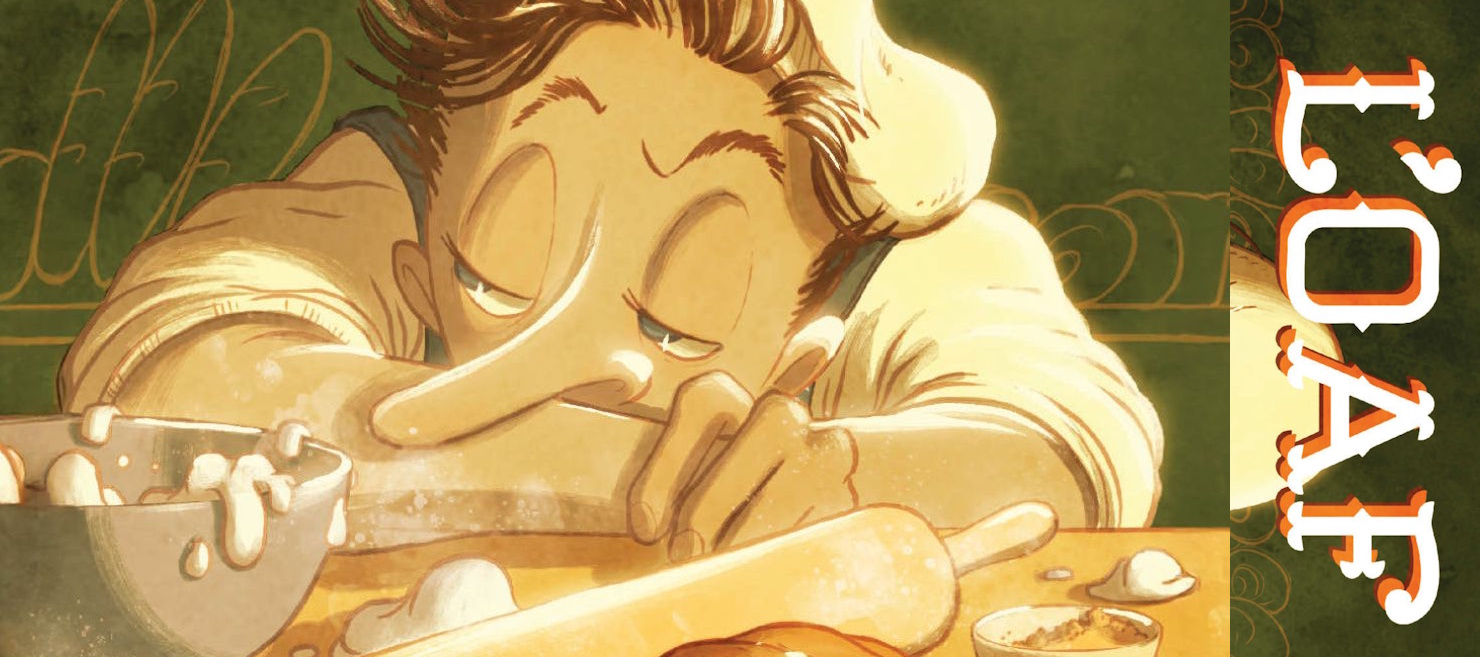
L’oaf is that rarest of gifts: a board game that makes me laugh, and not because it includes any actual jokes. Designed by Bart de Jong, it opens with perhaps the most relatable conceit ever put to cardboard, a dead-end job players are working in order to make ends meet, but one they’re not overly interested in completing beyond the bare minimum. Not quite by accident, it’s about many things — the false enthusiasm of managers, the vast gulf between owners and employees, the oppression of tedium. As if by magic, none of those headier topics break the spell.
Space-Cast! #54. Shazain!
Governance and Liberty — in translation, those are the titles of Shasn and Azadi, Zain Memon’s peculiar but timely board games about politics. Today, we’re joined by Memon himself to discuss both titles, plus the function of play as our most ancient form of education, the value of cynicism and evil in games, and what else the auteur has been working on lately.
Listen here or download here. Timestamps can be found after the jump.
“Cozy” Is a Four-Letter Word
I’m deeply suspicious of “cozy.” For much the same reason I’m suspicious of “nostalgia,” come to think of it. In the mouth of business executives, “cozy” becomes something we already own, or at least already have within our grasp, now repackaged and sold back to us as a subscription service. A monthly box of curated snacks. Ten ideas for cozymaxxing your nostalgia shelf. And that’s before we even consider the way institutions and politicians propose that coziness and nostalgia are the way things “used to be,” before someone came along to take away our picnics and crime-absent streets. What if we could go back to the Way It Was? What if all it took was getting rid of a few undesirables?
In other words, I am way too cranky to be Cozy Stickerville’s target audience. “More like Cozy Fascistville,” I probably frumped to myself. Then I learned it was designed by Corey Konieczka. Then I figured it might be a nice thing to play with my twelve- and six-year-old daughters. Then, as the undertow of commercialism swept my legs out from under me, it appeared in my shopping cart, one click away from arriving at my doorstep within three to five business days.
Then, those three to five business days later, it was winning me over.
Knizia & Kiley
Considering how hard Tigris & Euphrates rocks, it’s a shame the game always seems to be out of print. I’d even go so far as to call it Reiner Knizia’s finest creation, a statement that won’t go uncontested by the Good Doctor’s fans. To a lesser degree, the same goes for Yellow & Yangtze, Knizia’s hex-bound spinoff, although I suppose the remake, HUANG, is still floating around out there somewhere, board-obscuring standees and all.
What I’m trying to say, I suppose, is that I understand the inclination to make one’s own version of the hallowed civilization-builder, even if such an enterprise seems doomed from the start. Not that Rhine & Rhone, designed and self-published by Pax Illuminaten creator Oliver Kiley is doomed, necessarily. Its DNA is far too replicative of Tigris & Euphrates to be anything less than compelling.
But messy? At times inelegant? Awkwardly straddling the line between homage and plagiarism? All of those. More interesting to me, though, are the ways it quietly improves on Knizia’s formula.
Broccoli and Sulfur Pizza
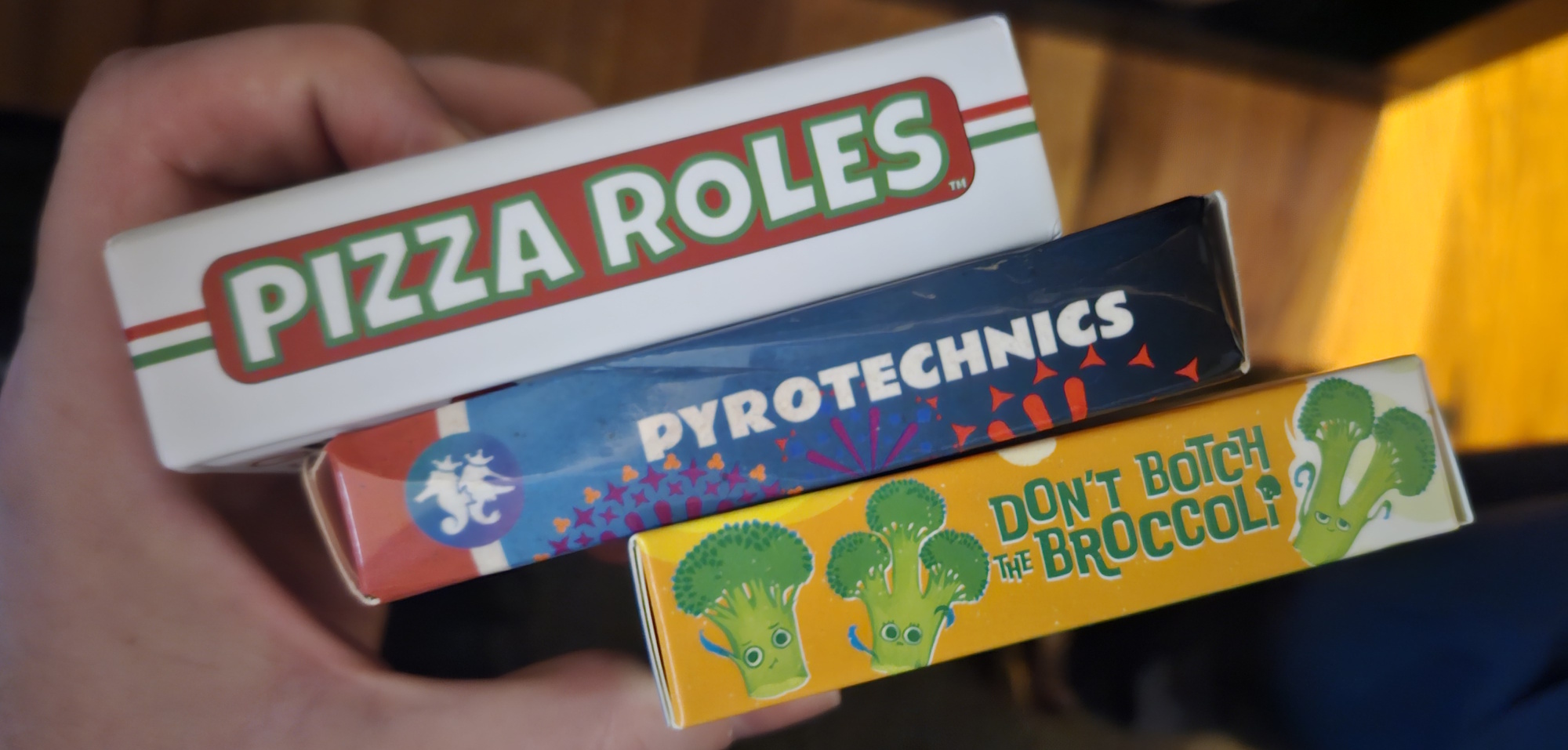
I like small games. No, smaller. Smaller. Small enough that I can fit at least three of them in my hand at once, comfortably, without even stretching. Today we’re looking at three such titles, all of which are, and I’m quoting my offspring now, “Huh! Not bad!” That’s high praise coming from a six-year-old critic.
Oh, and not a one of them is a trick-taker. Take that, tricksters.
Monopoly Ruins a Great Train Robbery

Early in the rulebook for The Glasgow Train Robbery, designers Eloi Pujadas and Ferran Renalias — whose names you might recognize from fashion dueler The Battle of Versailles — clearly spell out their stance on the 1963 train robbery that is the topic of their game. “The Glasgow Train Robbery is a board game inspired by historical events,” the disclaimer reads. “It does not intend to glorify crime or violence.”
Look, I’ll just come out and say what we’re all thinking: Unlike Pujadas and Renalias, I absolutely intend to glorify robbing a train full of cash. That’s the coolest and most morally correct action a human being can take. Yes, people were hurt. Yes, property was stolen. But the only villain here is Monopoly. That’s right, the board game. Without it, the heist would have been successful.

 SPACE-BIFF!