Unnameable

After the first day of SDHistCon, where I played three games about opium peddling, I figured the second would be easier on my stomach. I could not have been more wrong.
It has no name. Its designer doesn’t want to be credited. Of all the many board games I’ve played, it’s the one that left me the most shaken.
“You are four senior Nazi officials,” our Teacher tells us. His hands are trembling. His mouth quirks between solemnity and something like an apologetic smile. “And you are conducting the Final Solution.”
EXTREME CONTENT AND SPOILER WARNINGS ARE IN EFFECT FROM THIS POINT. PROCEED ONLY AT YOUR OWN RISK.
Trick-Taking’s Back on the Menu, Boys!
The problem with sequels, especially in board games where sequels are mechanical artifacts first and narrative artifacts a distant second if at all, is that there isn’t necessarily more to say about them. Last year, Bryan Bornmueller’s The Fellowship of the Ring: Trick-Taking Game was one of my favorites. Now, as was foretold by some lady peering into a bowl of water, The Two Towers: Trick-Taking Game is here.
It’s more of the same.
That’s precisely what I wanted it to be. But it doesn’t necessarily make for interesting breakfast reading.
Nebulae, Medusae… Crownae?
Yesterday on BlueSky, Marceline Leiman asked a great question. Using only one or two extremely vague words, how would I describe the titles on offer at this year’s Indie Games Night Market?
Now that I’ve given it some thought, I think I have an answer, although perhaps it’s more concrete than she was looking for. More even than last year, these games seem like they’re pushing boundaries. They capture the spirit of what it means to be “indie.” Not only in the sense that they don’t have publishers. Rather, that they see the hobby from a perspective apart. They know board games; they love board games; they’re in conversation with board games. But more than that, they’re board games as lenses through which one might behold the entirety of the hobby. Its past. Its present. Its future.
How’s that for a wanky answer? Oh well. What follows are three games I love for different reasons, but perhaps love even better for the same reason — because they’re outsiders paying homage to their hobby, but doing so in a way that’s so defiantly indie.
Paper Planes, Coupons, Stencils

We’re only a few days away from the Indie Games Night Market at Pax Unplugged. Funny how time gets away from us. Don’t worry, that’s less a plaintive cry about my fading youth than a statement on my incapability to properly schedule these things.
Fortunately, three of these titles fall into roughly the same category. The same two categories, even! These are tactile games that play best with family. Let’s take a look.
SDHist 2025: Day of Copium

This past weekend, I attended SDHistCon in San Diego, the most interesting board gaming convention currently running. Here are the official snapshots: the Summit Award went to War Story: Occupied France, the Bobby Nunes Memorial Award went to Amabel Holland’s video on the preservation of Kurt Vonnegut’s GHQ — thankfully beating out some doofus piece by yours truly — and I spent Saturday dealing drugs to unsuspecting victims.
In board games, mother. In board games.
Joy in the Burnout
Eric Dittmore’s Adulting is not Johnny O’Neal’s Adulthood, although it’s inevitable I’ll mix up the two titles somewhere in the text of this review. In fact, I already have! Twice! Once in the permalink and again in the tags! It happened about ten seconds apart, and after the first time I even reminded myself to never do it again.
In a way, though, that’s about as strong a metaphor for Adulthood — dammit, Adulting — as one could hope for. This is another forthcoming Indie Games Night Market title, and it might be the strongest of the year’s batch, in no small part for how well it represents the challenges of daily adult life.
Atlas Boogied

Something I’ve always appreciated about John Clowdus’s games is the way they evoke larger worlds with two sentences and a half-dozen illustrations. In the Shadow of Atlas, for instance, speaks to the way extra-solar colonization will necessarily change us, physically and socially both. Some of those changes look pretty good from where I’m sitting. I wouldn’t mind being a member of the Laverna Order and sashaying around with a fur-trimmed coat and saber. Others are more mixed, like becoming one of the clone-slugs of the Janus Order. These dudes can step into any other role. Which might seem nifty until you realize they’d be the underpaid substitute teachers of the twenty-ninth century.
Or maybe In the Shadow of Atlas is just another lane battler. Not that that’d be a bad thing. Clowdus has long established himself as one of the form’s most studied hands, and this title demonstrates that he’s still shaking up the genre.
Robots Punching Robots

space-biff: noun (informal) A sudden, sharp blow or punch or lasering, as delivered from a robot or spaceship to another robot or spaceship
I believe it goes without saying that any game about gigantic mechs will receive default coverage here on the site that is their namesake. CogDrive Neon isn’t John Clowdus’s first game about gigantic mechs slugging other gigantic mechs. But is it his… most recent? Yep. It’s definitely that.
Putting on a Row
Rowin is… not about rowing. Sorry, rowing enthusiasts. You’ve come to the wrong place. Again.
Instead, Rowin is about getting five stones in a row. I suppose that’s how rowing works, if you squint real hard and treat your brain to a few slaps. Designed by Matt Ward and debuting later this month at Pax Unplugged’s Indie Games Night Market, this one’s a standout if only for one reason: it’s not a trick-taker.
Syphilitics
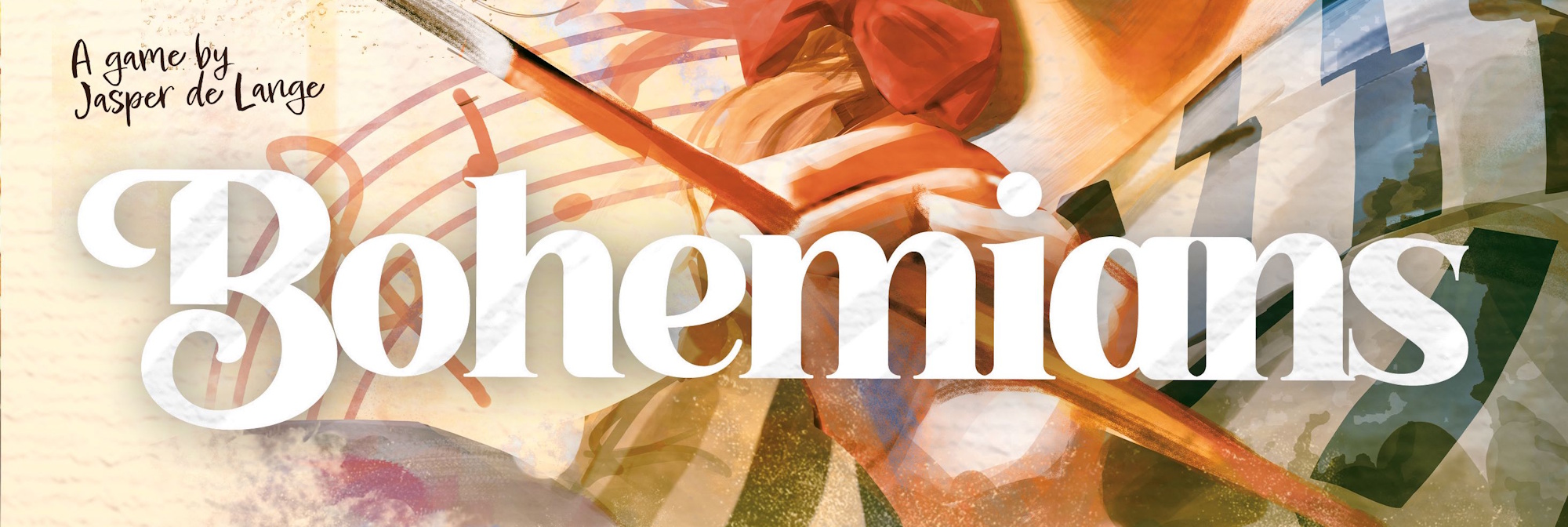
Moving to Paris to embrace my inner bum/artist has always been one of my life goals, so Jasper de Lange’s Bohemians was a safe bet. Set in the drowsy days and smoky nights of Paris-That-Was, this is a love letter to the wanderers who set out to thumb their noses at society and create timeless works of art, and sometimes even did, but spent more of their time sleeping in, strolling the streets, and spreading syphilis.
Did I mention that Bohemians is also a deeply funny game? Top comedy, this.

 SPACE-BIFF!