Distant Rumble Train

Despite all outward appearances, Lightning Train doesn’t include any magic. Which is something of a double statement. I went in expecting locomotives propelled by atmospheric violence; instead, we got a rare Paul Dennen miss. It isn’t that I wanted another Empyreal: Spells & Steam, exactly. Just something with spark. Even a little zap from the light switch after walking on the rug with my socks would have done.
PHANTO

So you’ve died. Only, rather than disappearing into the inky black, the way any sensible modern atheist would anticipate, you have been relegated to an eternity as a ghost trying to communicate nouns to lexically obsessed mediums. Dang it. Your mother was right all along.
That’s kinda-sorta the premise behind Phantom Ink, the word game by Mary Flanagan and Max Seidman. Phantom Ink has been kicking around for a few years now, one of those sturdy team games one can count on to make an appearance at gatherings once everyone is too tired for anything more taxing. It’s an unassuming plaything, redolent of any number of parlor games. That’s its greatest strength. Despite its simplicity, even despite its sleepy-eyed coziness, it’s the sort of game you can rely on.
7734

I’ve never hated a game the exact same way I hate 21X, which I suppose is a compliment of sorts. Growing up, math class was for three things. (1) Hanging raggedly onto a good grade so I could get into medical school. (2) Inventing those math jokes where you hold the calculator upside-down to see the answer. (3) Programming text adventure games into my TI-83+.
Everything but the math.
Chalice of Bananas

I promise this won’t become a food review. Although if you could see the embarrassingly touristy pictures of what I spent the past weekend eating in New Orleans, you would understand the impulse. The story of how I came to be trapped in a not-as-haunted-as-advertised hotel with sixteen game designers and wargaming wonks isn’t as exciting as it could have been. Short version: I had a flight voucher two months shy of expiration.
But the games — oh, the games.
There’s no need to cover all of them. You already know how to play Two Truths And A Lie — the key is in the title — and my brisk review of Matt Calkins’ Charioteer is that it’s too arithmetical for its own good. Instead, here are the weekend’s two standouts.
Space-Cast! #49. A Vantage on Vantage

By now you’ve likely heard of Vantage, the ambition first-person exploration game about surviving and thriving on an alien planet. For today’s Space-Cast!, we’re joined by Jamey Stegmaier to discuss the eight-year inception, development, and eventual appearance of this wonderful and strange artifact. Along the way, we discuss Vantage’s inspirations, how design constraints can engender greater freedom, and games within games.
Listen over here or download here. Timestamps can be found after the jump.
Brass: New Delhi

Is there an aphorism about how satire is often indistinguishable from reality? If not, there ought to be. Tycoon: India 1981 takes notes from Martin Wallace’s Brass, not only in terms of its interlocking economy and rich-get-richer gameplay, but also by turning choking smog into a whole aesthetic. It’s the inverse of colorful Lakshadweep, the last title we covered by Sidhant Chand, swapping the sustainable fisheries for sky-blotting smokestacks.
In spite of that shift — in spite of a few problems, really, nearly all of them inherited from the Eurogame tradition Tycoon is imitating — I can’t help but be compelled. Can you taste the carbon? That’s the flavor of money.
How Was the Gameplay, Mrs. Lincoln?

I know it’s far removed from today, but the assassination of Abraham Lincoln makes me sad in a way that most historical events do not. Thanks to my father’s interest in the topic, the Civil War was my first real foray into both history and wargames, and the Gettysburg Address was the first speech I ever memorized. Not original for an American schoolkid, I know, but still.
There is some small upside: playing Wes Crawford and Ryan Heilman’s The Pursuit of John Wilkes Booth, I had that extra motivation to nail the bastard. Some part of me approaches the subject reluctantly. It’s a game about the early history of American policing more than anything, staffed with military detectives and Pinkerton agents and Secretary of War Edwin Stanton pulling strings to put more federal cavalry under my command. Like the Civil War that had ended only five days before the traitor’s bullet found its mark, this is America’s Old Testament period, its belly fired with vengeance and fury. I know the problems. I have my hangups. And yet there is nothing I want more than to catch the assassin before he crosses some remote frontier.
Horatio Hotwindblower

There was a time when news of another entry in the Pax Series was cause for celebration. Ah, to once again be a callow youth! Nowadays I identify as a callow adult. Pax Hispanica is the eighth installment — or is it the tenth? — and as a solo Phil Eklund outing, it has that “opinionated uncle at Thanksgiving” energy going for it.
But this time, Pax Hispanica sprinkles something extra atop its what-if history, double-take footnotes, and overstuffed glossary. In a first for the series, this one is also a big old bore.
Most Select of Board Games
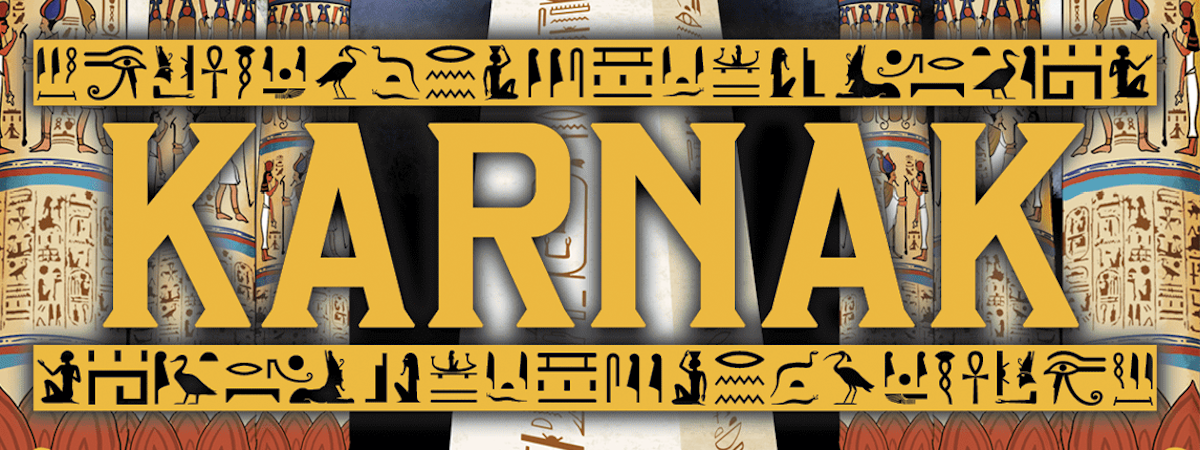
The temple complex of Ipet-isut, “the most select of places,” today known as Karnak, is unique among Egyptian sites for the sheer duration of its construction. Nearly thirty pharaohs, from the Middle Kingdom to the Greek Ptolemies, added to the complex’s collection of statues, arches, obelisks, columns, hieroglyphs… pretty much anything we associate with “very old building.”
Now Karnak has one more addition: a board game by design collective Jasper Beatrix. Yep, the same folks whose designs I’ve been admiring all year. And like Karnak itself, this one necessitates some excavation.
Space-Cast! #48. Compiling

Computers! They’re always doing pesky things like falling in love. For today’s episode, we’re joined by Michael Yang to discuss Compile, his hit lane-battler that sees two rival programs compete to expand their nascent sentience. Along the way we discuss the game’s inception during the pandemic, the joys of nailing that first pitch, and the heartbreak of having your publisher dissolved by venture capital.
Listen here or download here. Timestamps can be found after the jump.

 SPACE-BIFF!