Imposter Syndrome
The Imposter Kings reminds me of a game I created as a kid. That probably sounds like a slam. Kids of six and a half aren’t known for making the deepest games.
But it isn’t that. It’s the way the game loops in on itself.
In my game, there were cards numbered one to ten. On your turn, you played a card on top of your dad’s card; on your dad’s turn, he played a card on top of yours. No matter who played, the card had to be higher than the one under it. If ever you couldn’t play a card, you lost and your opponent won. Halfway into our first play, I realized that high cards were infinitely better than low cards. So I made up a new rule on the fly. You could play a one on top of a ten, looping back around to the start of the sequence.
There’s more to The Imposter Kings. Lots more. The game’s designer, Sina Yeganeh, was too sharp to think that numbered cards would be interesting enough on their own. So this is one of those games with plenty of special abilities and triggers and the occasional reaction that plays out of sequence. At core, though, it’s a game about playing the right card so that your opponent can’t follow it up with something better, about knowing when to double down with a high card and when to loop back to the beginning. Exactly like my own game. Just, you know, interesting. I’ve played it more than once, for example.
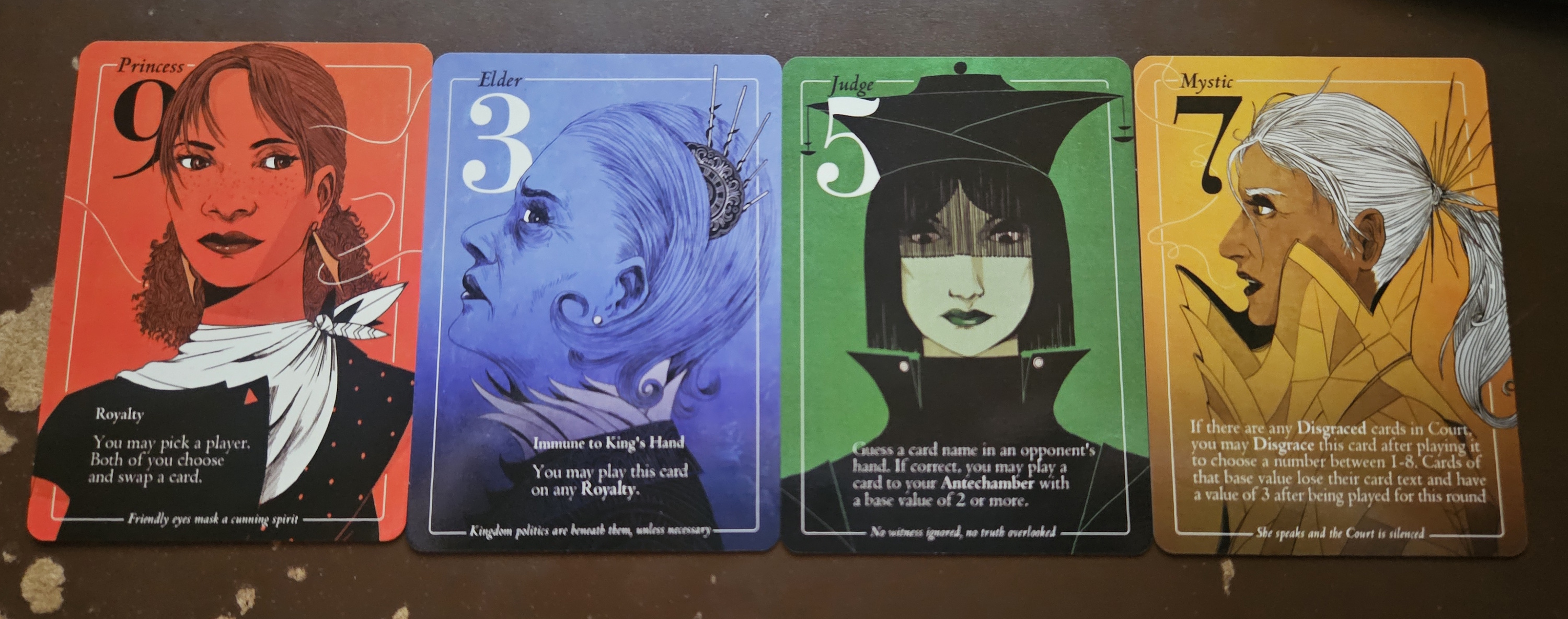
Just a few of the game’s many nasty cards.
On the whole, though, The Imposter Kings always comes back to that one central idea. Either you play a card or you lose. Very quickly, this becomes much harder than it might first seem.
Here’s the obvious conundrum. Let’s say you’re holding a nine. The highest rank. The number of royalty. If you were a six-year-old Dan, that would be the best card in the entire game.
But playing a nine is a fraught proposition. First of all, there are two nines. In The Imposter Kings, you can play any card that’s higher than the one currently seated on the throne. Higher or equal to. So a nine can beat a nine. The Princess comes along and deposes the Queen. The Queen puts that upstart brat Princess in her place. Whoops.
But even if that happens, other cards specialize in deposing royalty. The Elder, for instance, is a lowly three, but loves to swoop in and rap those royals on the knuckles. Or there’s the Oathbound, a bandaged character who can flip an enthroned royal face-down — a trick called “disgracing” — to take the seat and then follow it up with another card of any value. Spending two cards at once decreases the longevity of your hand, especially in a game about being the last person to play a card, but maybe your follow-up will hold the throne for good.
But there’s the question of everybody’s King. When the game begins, everyone is dealt a King. They then choose a card from their hand to place face-down next to the big guy. This is their successor. Once per game, you can flip your King and take your successor into your hand. Oh, and the card currently on the throne? Disgraced. Face-down. Value one. Boop de boop.
But flipping your King is dangerous, too, thanks to the Assassin. This is one of the game’s few reaction cards, and it kills a King the instant they’re flipped. So much for that once-per-game bonus.
But there are ways to out any would-be Assassins. The Judge and the Soldier both excel at revealing whether an opponent is currently holding a card, and both earn a tidy bonus if they’re right. Or there’s the King’s Hand, another reaction card, good for blocking an ability. Or you might make use of the Executioner and Inquisitor, both capable of stripping a card from somebody’s hand outright.
But you might need those abilities for something else. Or perhaps the Assassin is lurking as your rival’s successor, which would mean they could pick them up after you’ve spent the very courtier who could get rid of them.
But… well, there are answers to such a possibility as well, but I think we’ve drawn out this particular strand to its maximum elasticity. The point is that every decision in The Imposter Kings is unusually burdened, unusually dangerous. It isn’t unusual to spend a minute examining your hand. Even when — maybe especially because — there are only a half-dozen cards available at any given moment.
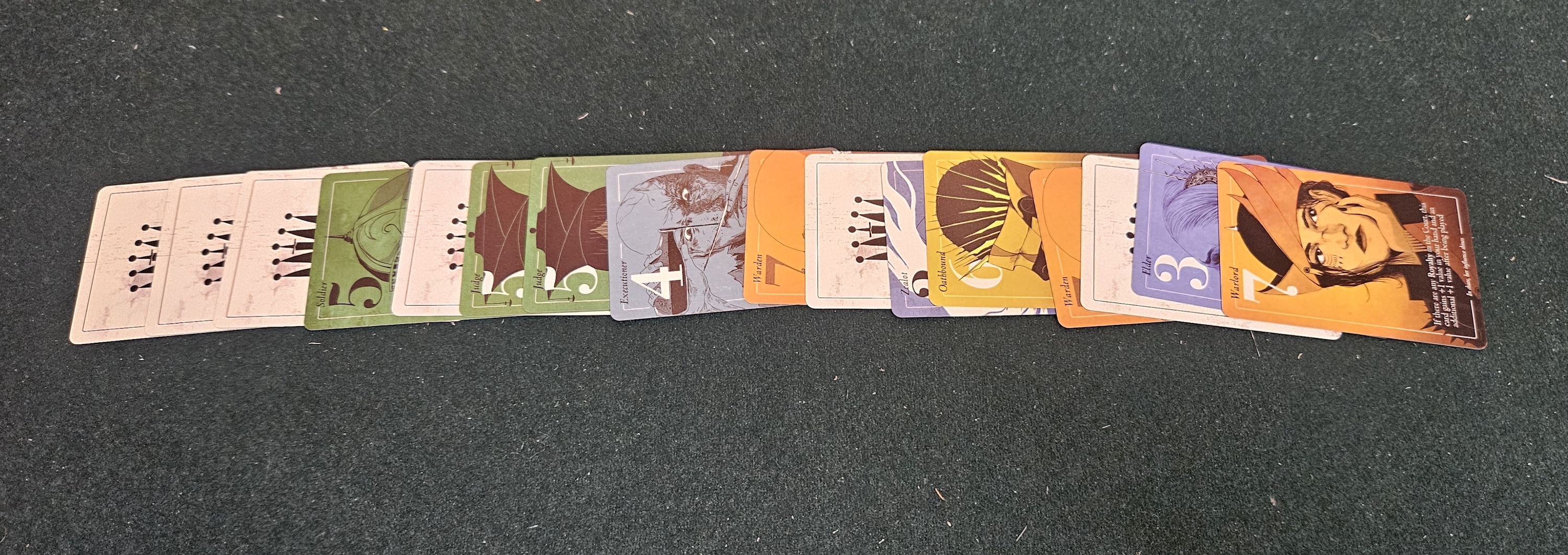
A late-game court, full of disgraced or displaced notables.
At best, these decisions feel like little masterstokes. There are elements of deduction, not to mention memory, not to mention yomi, not to mention hoping like hell your rival makes a big dumb mistake. That’s a lot of punch for such a little game. And make no mistake, The Imposter Kings is very little. With two players, you only use eighteen cards at a time. Adding a third or fourth player ups the amount, as well as injects some extra variety, but not by as much as you might expect.
At the same time, the entire process feels algorithmic. Like you’re playing through a flowchart. The Imposter Kings comes across as the sort of game a computer would excel at, its digital spreadsheet mapping the best possible option five, six, a dozen moves out, all those counters and counter-counters charted in advance. Depending on the player count, Yeganeh assuages his game’s near-perfect information sphere, sometimes by keeping a card or three hidden off to the side, sometimes by sheer dint of seating too many players to leave you certain about what anybody is holding.
But like six-year-old Dan deciding that ones can beat tens, these gestures still sometimes come across as patches. Even at the best of times, The Imposer Kings asks a lot of one’s short-term memory. What you’re holding, what you’ve seen played to the court and then disgraced, which cards you threw away when the round began. The player aids are helpful, listing every possible card at the table, but they stumble by not revealing which cards have a duplicate in the deck. Not that it takes a long time to recognize which singles are actually doubles. One benefit of only using eighteen to twenty-something cards is that there isn’t that much to hold in your head.
The bigger mitigating factor is that The Imposter Kings isn’t meant to be played once. Like card games of olde, it’s intended as a many-handed experience, players doing what they can to secure not just one win, but many wins of variable strength. Defeating a foe with cards still in their hand, or while your King is still hidden, or both, is better than eking out a victory through the barest margin. This ablates the luck of the draw, at least to some degree.
It’s also exhausting, requiring one hard-fought win after another to finally scratch out a full victory. In our experience, reaching the necessary seven points takes more time and energy than its slender exterior would indicate. Especially as players grow cannier to one another’s tricks, these sessions can sprawl outward in duration and bitterness — but also in how deviously they permit players to act.
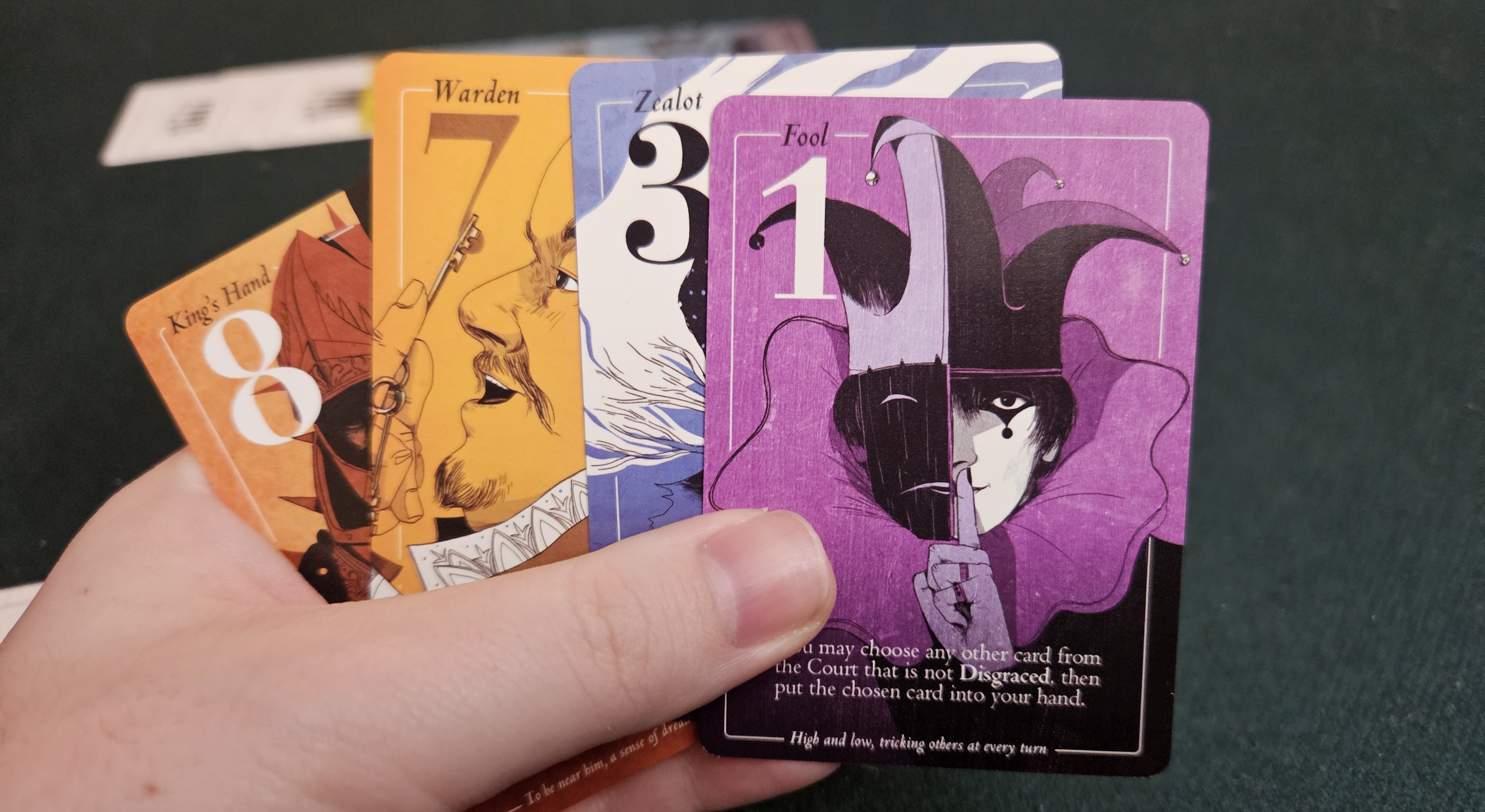
Ah, the fool. It is me. It is I.
Here’s the bottom line. Like the game’s cardplay, my feelings on The Imposter Kings are nested and complex, but ultimately they return to a few simple ideas. One, this is a handsome game that’s easy to play but devilishly hard to master. Two, in its efforts to overcome certain inbuilt limitations, it comes across as patchy and overstays its welcome. Three, even slightly different play counts produce radically distinct sensations. Where the two-player game is tight, sometimes even too constricted, and the four-player game devolves into an awkward team-building exercise, the three-player game is utterly perfect, cluttering the game’s headspace just enough to keep everybody guessing, but not robbing it of any of its devious excitement.
Until it falls apart, that is. Because, again, like the cardplay, The Imposter Kings isn’t only one thing. It’s an exercise in high cards trumping everything else, except for the low cards that beat them. Critically speaking, it’s a game where the good outweighs the bad until the bad outweighs the good. Back and forth it goes, never quite settling in one place.
And I’m afraid that’s as definitive as I can be. In the end, The Imposter Kings makes an imposter of me, too. With it on the table, I feel like a kid discovering cards for the first time. The highs. The lows. And everything in between.
A complimentary copy of The Imposter Kings was provided by the designer.
(If what I’m doing at Space-Biff! is valuable to you in some way, please consider dropping by my Patreon campaign or Ko-fi. Right now, supporters can read about which films I watched in 2025, including some brief thoughts on each. That’s 44 movies! That’s a lot, unless you see, like, 45 or more movies in a year!)
Posted on March 23, 2026, in Board Game and tagged Board Games, The Imposter Kings. Bookmark the permalink. Leave a comment.

 SPACE-BIFF!
Leave a comment
Comments 0