“Cozy” Is a Four-Letter Word
I’m deeply suspicious of “cozy.” For much the same reason I’m suspicious of “nostalgia,” come to think of it. In the mouth of business executives, “cozy” becomes something we already own, or at least already have within our grasp, now repackaged and sold back to us as a subscription service. A monthly box of curated snacks. Ten ideas for cozymaxxing your nostalgia shelf. And that’s before we even consider the way institutions and politicians propose that coziness and nostalgia are the way things “used to be,” before someone came along to take away our picnics and crime-absent streets. What if we could go back to the Way It Was? What if all it took was getting rid of a few undesirables?
In other words, I am way too cranky to be Cozy Stickerville’s target audience. “More like Cozy Fascistville,” I probably frumped to myself. Then I learned it was designed by Corey Konieczka. Then I figured it might be a nice thing to play with my twelve- and six-year-old daughters. Then, as the undertow of commercialism swept my legs out from under me, it appeared in my shopping cart, one click away from arriving at my doorstep within three to five business days.
Then, those three to five business days later, it was winning me over.
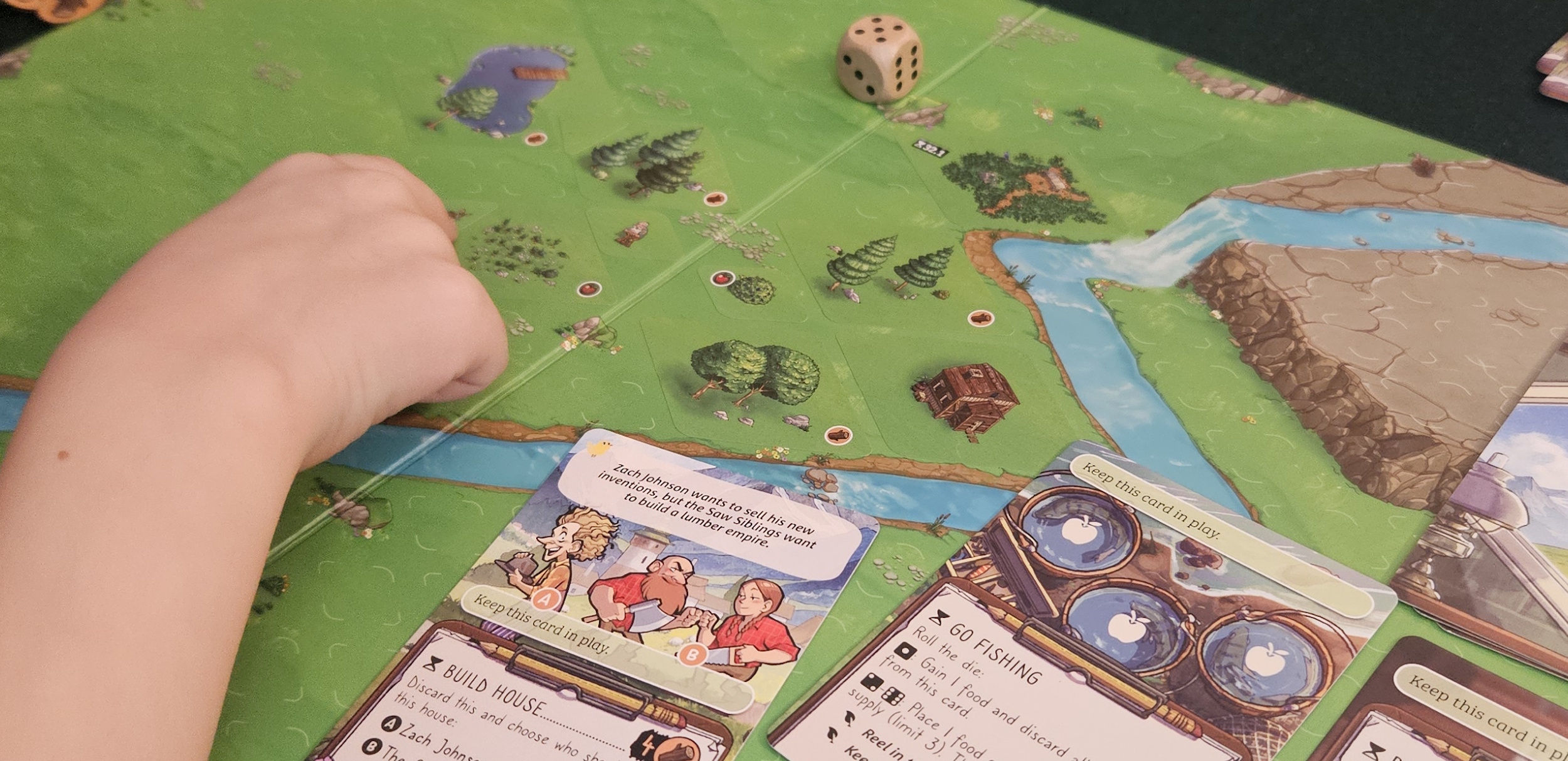
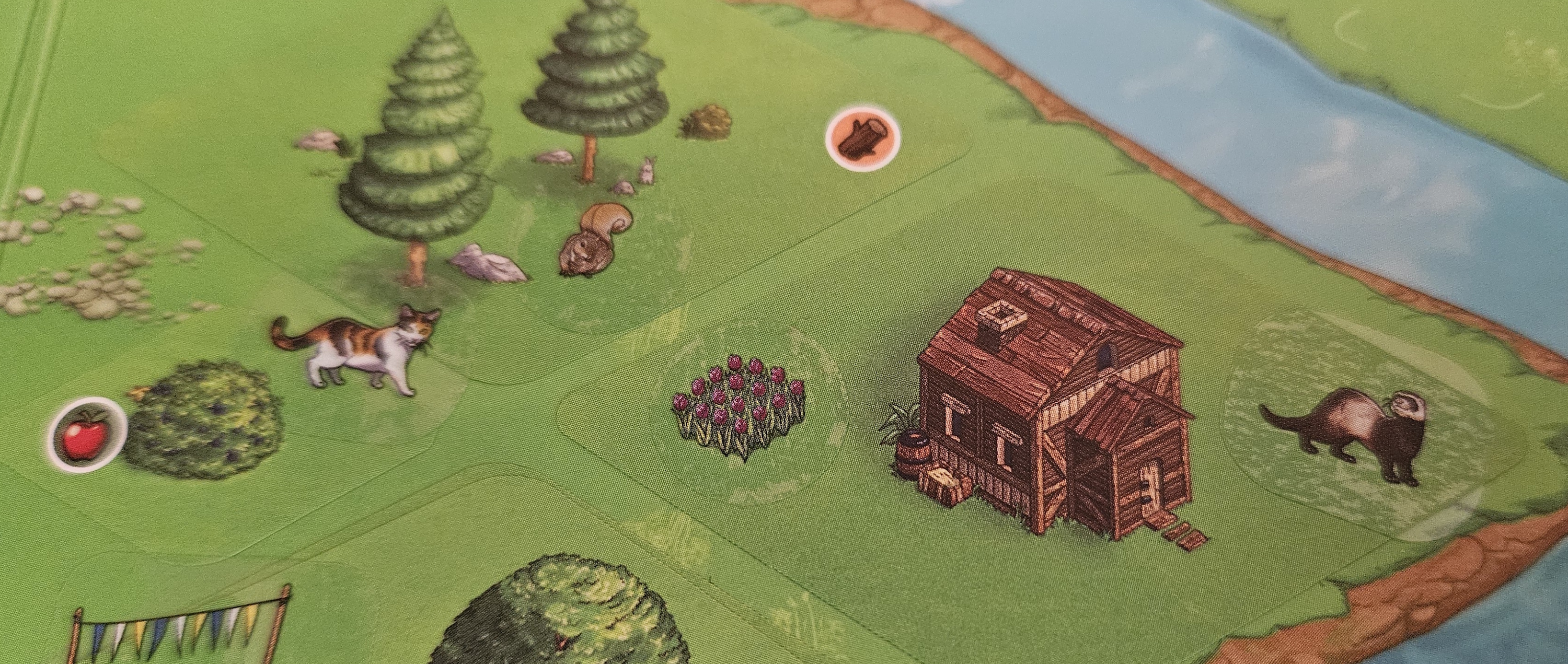
Looking for a hidden object.
Cozy Stickerville strikes me as a very Corey Konieczka design. Aesthetically, it bears so little in common with The Mandalorian, Star Wars: Rebellion, and Runewars as to make such a statement nonsensical. But I’m not talking about visuals. I’m talking about the maximalism of the thing. The maximalism contrasted with the sheer action economy.
I’ll explain.
Cozy Stickerville opens on a cozy not-yet-village. Gifted a tract of land by a distant and condescending father — hoo boy, does this game have daddy issues — you immediately take it upon yourself to transform this tract of riverland into a home. Or, in game terms, to affix eight stickers onto a grid, creating a pastoral scene right out of a Western. (Back when there was room for everybody, the cranky part of my brain intones. I tell it to shush. My kids are right there, man.)
From there, Cozy Stickerville slips into a comfortable routine. A cozy routine, one might say. Every turn consists of the metronome rhythm of resolving an event card and then resolving an action. These resolutions are steadfast in their simplicity. Events generally present a decision. Build this or build that. Answer A or answer B. Fulfill a need right now or put it off till later. The actions are more diverse primarily in their range. Some appear on the stickers as entries in a little storybook. Others appear on cards. Most of the time, they also present straightforward options. Gather wood from the ground or spend food to possibly gather some extra. Build a house for an eccentric inventor or build a house for some woodcutters. Plant flowers or pave a road.
Despite this simplicity, the actions very quickly display a wonderful range of possibilities. It isn’t only that stickers will be added, first to the board and then atop other stickers. It’s that their addition unfurls new adventures. Sometimes Cozy Stickerville turns into a hidden object search. Other times, it becomes a resource optimization game. There are branching paths to a spelunked cave, uncovered over many in-game weeks. An observatory on the hill becomes a chance to peek at celestial objects; a post office transforms into a test of how well we’ve come to know our neighbors.
That’s what I mean when I say it feels like a Konieczka design. It has that economy of action but maximalism of discovery that have always been the hallmarks of his design. It feels large inside, certainly larger than I expected of a game about putting stickers on a grid.
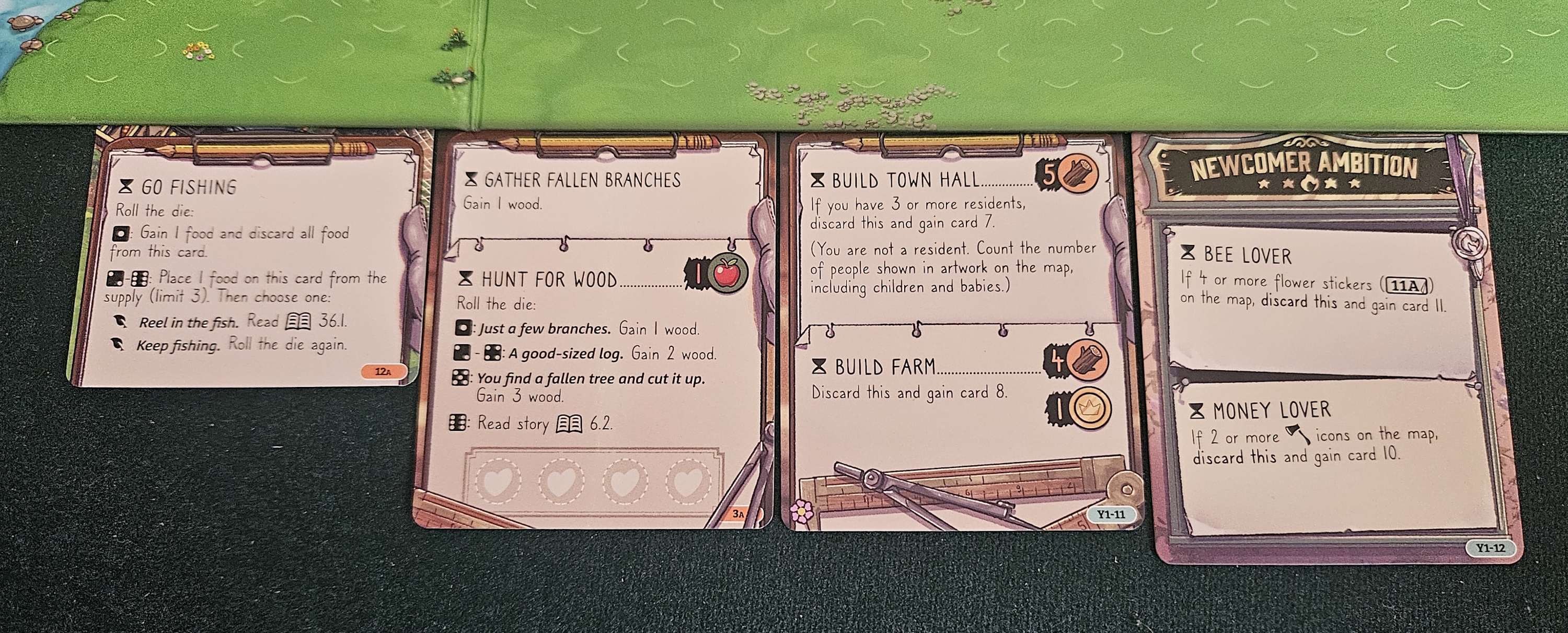
Potential actions are easily tracked.
Even the format feels generous.
Over the course of ten sessions, each no longer than half an hour, your village takes shape. Some of that shape is more or less what you would predict from a game called “Cozy Stickerville.” In our town — Happy Riverside Valley, if you care to know the name my girls came up with — we opened a bird-watching tower and animal refuge, a pet shop and a newspaper. We ran for office. We flirted with capitalism, but in a way that wasn’t too destructive. Only two copses of trees were felled, and only one lump of trash came to occupy the area. We dumped it right next to the big golden statue we had erected of ourself, a statement on how it didn’t resemble the way we imagined our unseen avatar.
But at points, Konieczka presents challenges and setbacks. Cozy challenges, to be sure, cozy setbacks. But challenges and setbacks all the same. When we borrowed money from a shady lender, the interest kept coming due at exactly the wrong moment. When we encouraged one character to date another, we were reminded, gently, cozily, that we could instead pursue the romance for ourselves. “Ew!” my girls moaned. When we failed to build a fire station… well, that was the one moment that maybe struck a little too close to my six-year-old’s heart. In real time, we invented the myth of the Farm Upstate, where all ferrets go to live after their house burns down.
These aren’t spoilers, as such. Not really. Mostly, they’re emergent properties, the result of one sticker placed atop another. Or else they’re the common-sense outcome of taking shady loans, engaging in pranks rather than doing your yard chores, or chopping down all of a valley’s trees. Cozy Stickerville sticks to obvious morals, but at least it sticks to them. Is it a spoiler to say that things turn out all right in the end? That you will be vindicated of your father’s disdain? That you will place more stickers on this sticker-grid? The storytelling rarely deposits us in expected places. It’s the trails and switchbacks it travels that are the delight.
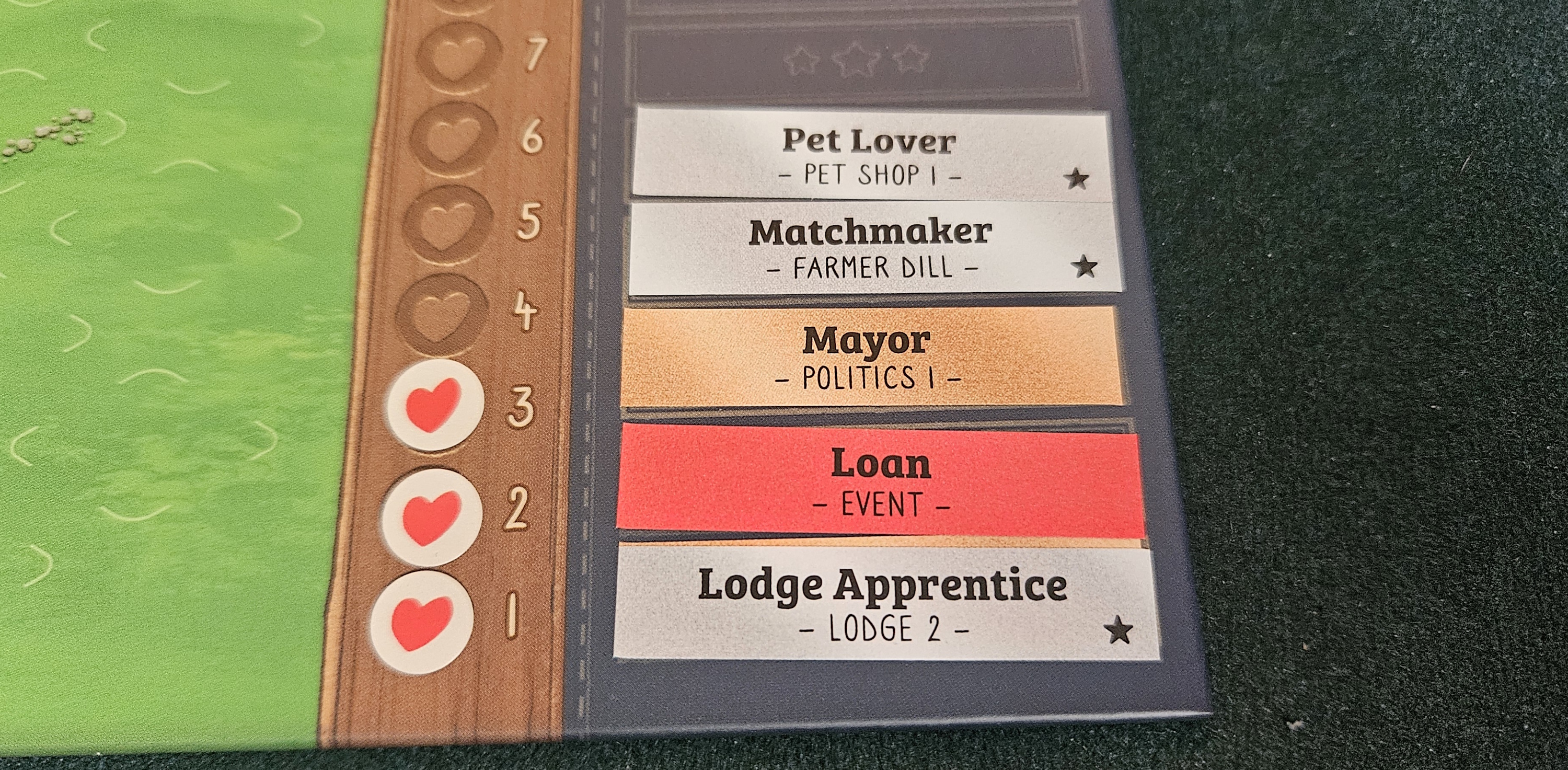
Some of the many milestones your village might unlock.
And then, when it’s done, the game permits a second outing. This one is more constrained than the first, flipping the board to its reverse side and using most of the remaining stickers. All those decision cards must be made in the other direction, building the inventor’s house rather than the cabin for the woodcutters, making dialogue choice B instead of choice A, pursuing the agenda you left by the wayside on your inaugural play.
For a legacy game, a format that is often rightly criticized for producing waste, Cozy Stickerville proves only marginally more wasteful than your average children’s stickerbook. I’m not going to pretend it has limitless miles in its soles. There’s no playing the game once it’s finished, unlike some legacies, and the hours contained within are relatively brief.
But those hours and precious ones. I rarely have any trouble getting my kiddos to play board games, but Cozy Stickerville swiftly became such a highlight of our evening routine that it eclipsed all other contenders. My children cooed over their pets, debated where to place every berry bush and flower patch, and quibbled over whether to establish a summer camp or a candy shop. They decoded secret texts with all the reverence of archaeologists and positioned inhabitants with an eye for the view from their bedroom windows. More than once, in between sessions, they discussed which story threads they would pick up next or asked me to open the box so they could study their town. Even before we had finished our first ten-year campaign, upon learning that we could only play the game twice, they asked if they could contribute some of their own money to buying a second copy. Now they insist we should frame the board, spaced halfway between their bedrooms so they can appreciate equal ownership over it.
On the one hand, this doesn’t exactly beat the accusations that Cozy Stickerville is commercialism in a box. But on the other…
Look. I know what our hobby is about for most people. We buy stuff and we sell stuff and hopefully in the middle we enjoy the memories and moments and messages these things create. There’s so much crass commercialism out there, all those boxes of miniatures with barely-developed rules, all the FOMO and churn and Cult of the New.
On the scale of worst offenders, Cozy Stickerville doesn’t even rate. It’s unapologetically cozy, but it also makes good on its word. This is coziness not as a symptom of a culture in decline, or not only that. This is coziness as a shared moment between families. This is coziness as something bespoke and human-crafted, as opposed to slopped from the mouth of the slop monster. This is the coziness of a six-year-old in my lap, eyes glittering as she debates whether to place her kitty near that berry bush or chasing the naughty goose in the lake.
Stickers over stickers! What will they think of next?
I still don’t know whether we’ll buy a second copy. I hope not. Too much of a good thing can spoil its memory. But for those two campaigns, I’m grateful to have bought and played this thing. Because Cozy Stickerville is a reminder that “cozy” is a four-letter word — but so is “love.”
(If what I’m doing at Space-Biff! is valuable to you in some way, please consider dropping by my Patreon campaign or Ko-fi. Right now, supporters can read about which films I watched in 2025, including some brief thoughts on each. That’s 44 movies! That’s a lot, unless you see, like, 45 or more movies in a year!)
Posted on March 16, 2026, in Board Game and tagged Board Games, Cozy Stickerville, Unexpected Games. Bookmark the permalink. 11 Comments.

 SPACE-BIFF!
we’re halfway through our second play, taking our more base impulses into account… roads everywhere! Such a great experience with the missus. Your thoughts really echo mine a fair bit: https://boardgamegeek.com/blog/16827/blogpost/183274/cozy-stickerville
Thanks for sharing!
Wow, your review really pulled on the heart strings. I’m so glad my game brought your family so much joy. 😊
Thanks for designing it, Corey!
It is a curious game to do as his ‘final’, where it is less of a game than it is an activity (that age old question, is it a game if there is no fail state to win or lose) but one that holds a lot of appeal regardless!
I had a university teacher who posed that same question and was a hardline believer of “no”. I think our conception of games has evolved such that having a fail state isn’t required for it to still be a game. Dark Souls has no diagetic lose condition, dying just teleports you back to your last bonfire minus your held souls. Dwarf Fortress meanwhile has no win state, you keep playing until your fortress inevitably collapses. For some board game examples, Lands of Galzyr has no win state or fail state but it’s filled with skill checks that have different outcomes, usually varying degrees of success or failure. Agemonia and Artisans of Splendid Vale are campaign games with no true fail state, your actions simply determine what route the story will take.
Great commentary on ‘coziness’ (ah the good old days, when no one had plumbing, or rights…) and on the nature of the hobby: “We buy stuff and we sell stuff and hopefully in the middle we enjoy the memories and moments and messages these things create.”
Thanks! I always chuckle at the bros who think their “retvrn” to the Roman Empire won’t consist of sharing a tersorium, wearing their teeth to nubs on grit-filled bread, and then dying young of an easily preventable stomach illness.
Love it! I was also floored by how much my wife and I enjoyed Cozy Stickerville. Well done, Corey!
No contrarian takes here!
Pingback: News Flash: Novo jogo do Looney Labs, novo jogo de codinomes anunciado – Mentede Ouro