Knizia & Kiley
Considering how hard Tigris & Euphrates rocks, it’s a shame the game always seems to be out of print. I’d even go so far as to call it Reiner Knizia’s finest creation, a statement that won’t go uncontested by the Good Doctor’s fans. To a lesser degree, the same goes for Yellow & Yangtze, Knizia’s hex-bound spinoff, although I suppose the remake, HUANG, is still floating around out there somewhere, board-obscuring standees and all.
What I’m trying to say, I suppose, is that I understand the inclination to make one’s own version of the hallowed civilization-builder, even if such an enterprise seems doomed from the start. Not that Rhine & Rhone, designed and self-published by Pax Illuminaten creator Oliver Kiley is doomed, necessarily. Its DNA is far too replicative of Tigris & Euphrates to be anything less than compelling.
But messy? At times inelegant? Awkwardly straddling the line between homage and plagiarism? All of those. More interesting to me, though, are the ways it quietly improves on Knizia’s formula.
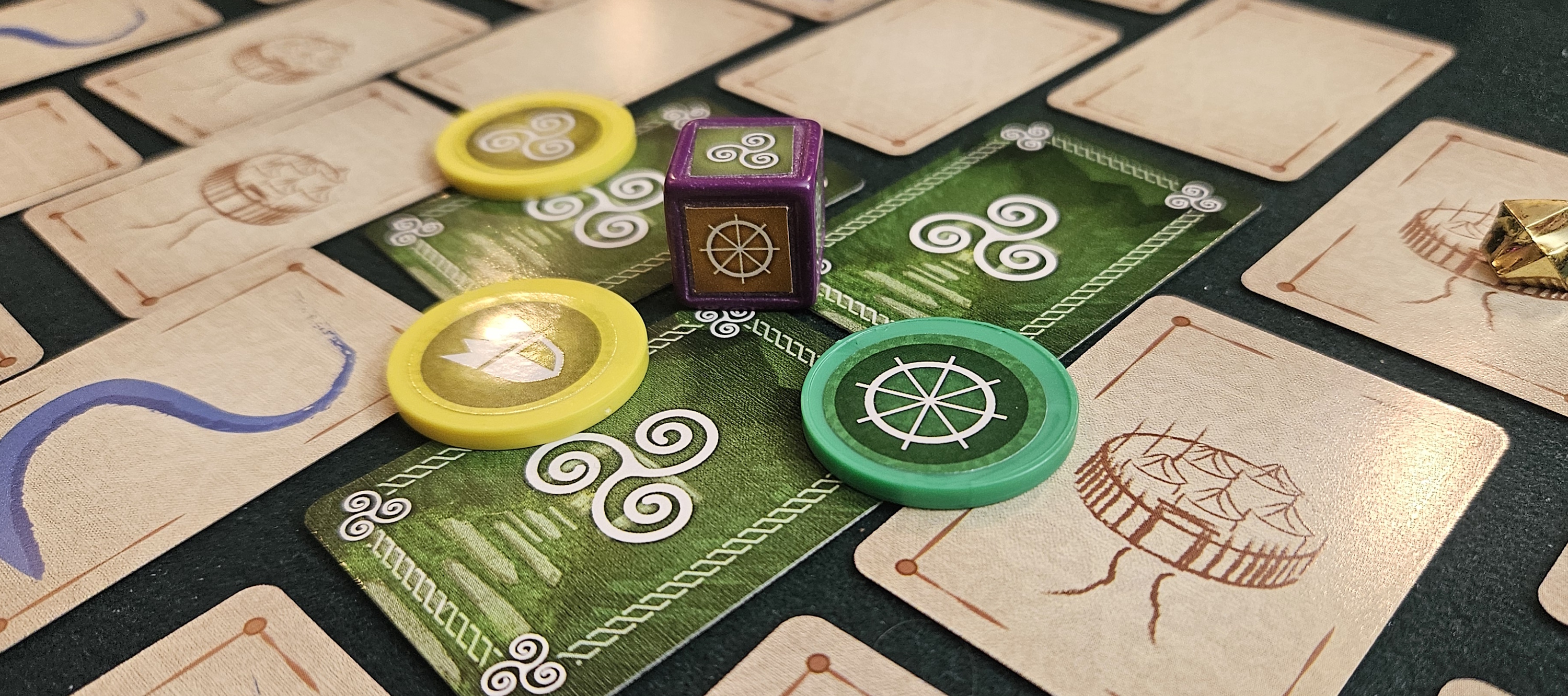
Supporters support leaders and shrines. Appropriate.
To begin, it’s useful to zoom out to the bird’s eye view. Like Tigris, like Yellow, Rhine & Rhone is a civilization game in abstract. You can probably guess which rivers are the cradle of this particular culture, but the time period is what makes Kiley’s spinoff exciting. Set during the ascent of Rome, the nearby superpower looms over the proceedings like a schoolyard bully. The other inhabitants of this playground are clans of Celtic Gauls, pitiable in size compared to their neighbor with imperial pretensions, but still scrapping for a fight and eager to make their mark. Which is to say, they’re still looking for their Vercingetorix.
As in Knizia’s masterpiece, civilization in Rhine & Rhone is portrayed as a slow accretion of various bureaucracies. Here that accumulation is represented as “supporters,” four types of cards keyed to corresponding colors of points and leaders. The process is functionally identical to that of Knizia’s games. If I play a green card, it earns a green point for whichever player has their leader of that type situated in that area, whether mine or someone else’s. This was the crux of Tigris & Euphrates, the notion that a single clan might occupy positions of authority in multiple polities, creating an entangled and codependent realm, one where my druid might merrily inhabit a kingdom ruled by your nobles and someone else’s traders and farmers. Every color of governance is important, since only sets of points will score at the game’s conclusion, but they function differently at the table, some more readily gathered or hard-fought than others.
Does this accurately peg the governance of Gallic tribes? No idea. The administrative apparatuses of Ancient Mesopotamia and China were complex enough that modern theorists consider them remarkably state-like. But the rule of thumb is that the past was always more populous and complicated than we would assume from our modern pedestal, and it isn’t uncommon for that same pedestal to disregard tribal systems as more insular and, frankly, inbred than they actually were. For the Gauls, this was a period when foreign encroachment necessitated rapid confederation. Just as the tile-laying and dynastic struggles of Tigris & Euphrates suited the successive Mesopotamian proto-states, here Kiley’s somewhat more hasty approach approximates something true about the need to unify against a neighboring juggernaut.
Anyway, the underlying thematics won’t matter to most players. But it’s still interesting how readily Knizia’s approach can be applied to various periods of political upheaval.
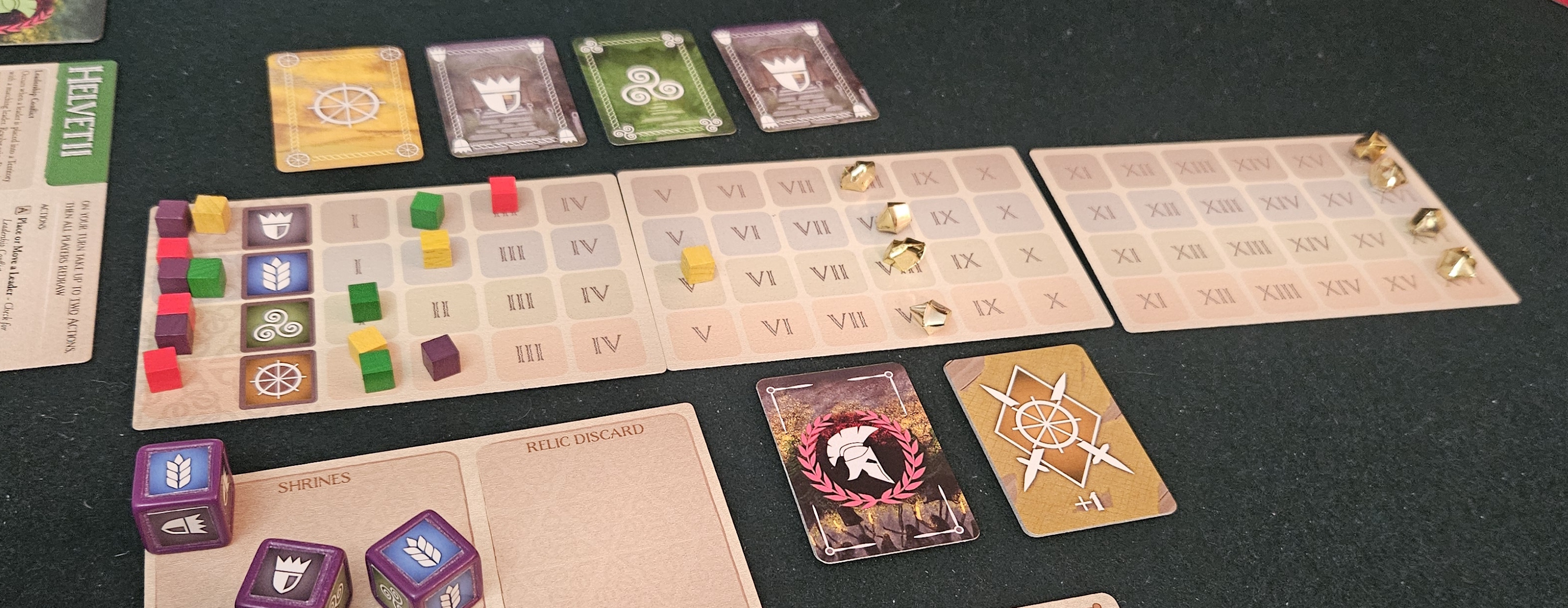
As in T&E and Y&Y, sets of points determine your final score.
As in those previous games, Kiley deploys the same touch to great effect. Each of the game’s four colors represents its own sphere of influence. As in Tigris, those colors correspond with slight variations in effect; drawing on Yellow & Yangtze, your clan leaders offer their own powers whether on or off the map. Gray is the color of nobility, producing kings that hoover up points whenever a lower-order leader isn’t present. Blue matches the riverlands, planting farms at a rapid pace. Green stands in for religious leadership, dictating who holds the right to rule. And yellow is the color of trade, offering a marketplace of cards for players to select at will rather than drawing at random from the deck.
So, too, does Kiley replicate Knizia’s conflict system, the same one that has bedeviled players since 1997. The gist is that there are two types of struggles, one mapped to internal conflicts of leadership and another for wars between two neighboring groups. These both require players to tally their support, wager some cards, and then, depending on the outcome, wipe out losing leaders and maybe a swath of one kingdom or the other for a heap of points. Yellow & Yangtze streamlined the process, some would say to the detriment of the original experience, and Kiley opts for the earlier approach from Tigris & Euphrates, with large clashes requiring multiple steps of resolution. There’s a sense of doom whenever somebody bridges the gap between two neighboring kingdoms, not only because there will be blood, but also because the card-based map is about to be thrown into disarray — both ludically and physically.
It’s a mess to handle all those overlapping cards, is what I’m saying, certainly more so than the sturdy tiles of Tigris or Yellow. And the mess doesn’t stop at the need to keep everything lined up just so. Taking a cue from his earlier Pax Illuminaten, itself a messy game, Kiley seeds the opening map of Rhine & Rhone with cards of various types. There are rivers, of course, which must be topped with farms. But there are also cards that are then drawn into your hand as new supporters, and oppida — forts — that bestow bonuses. These bonuses are all single-use, letting players deploy an extra card, move a leader, or perhaps add some oomph to a conflict.
They’re also frustrating as all hell. Simply put, the Tigris formula isn’t improved by letting some players take extra actions. Most turns consist of only two actions, so even a single bump represents a fifty percent increase in efficiency, and the problem only compounds once someone stumbles across a lucky series of oppida and performs four or five full actions at a pop. Meanwhile, somebody else might be stuck with a rinky-dink plus-one to a trade battle. It’s one more element of chance that pushes the system from its original grandstanding and uncertainty into erraticism.
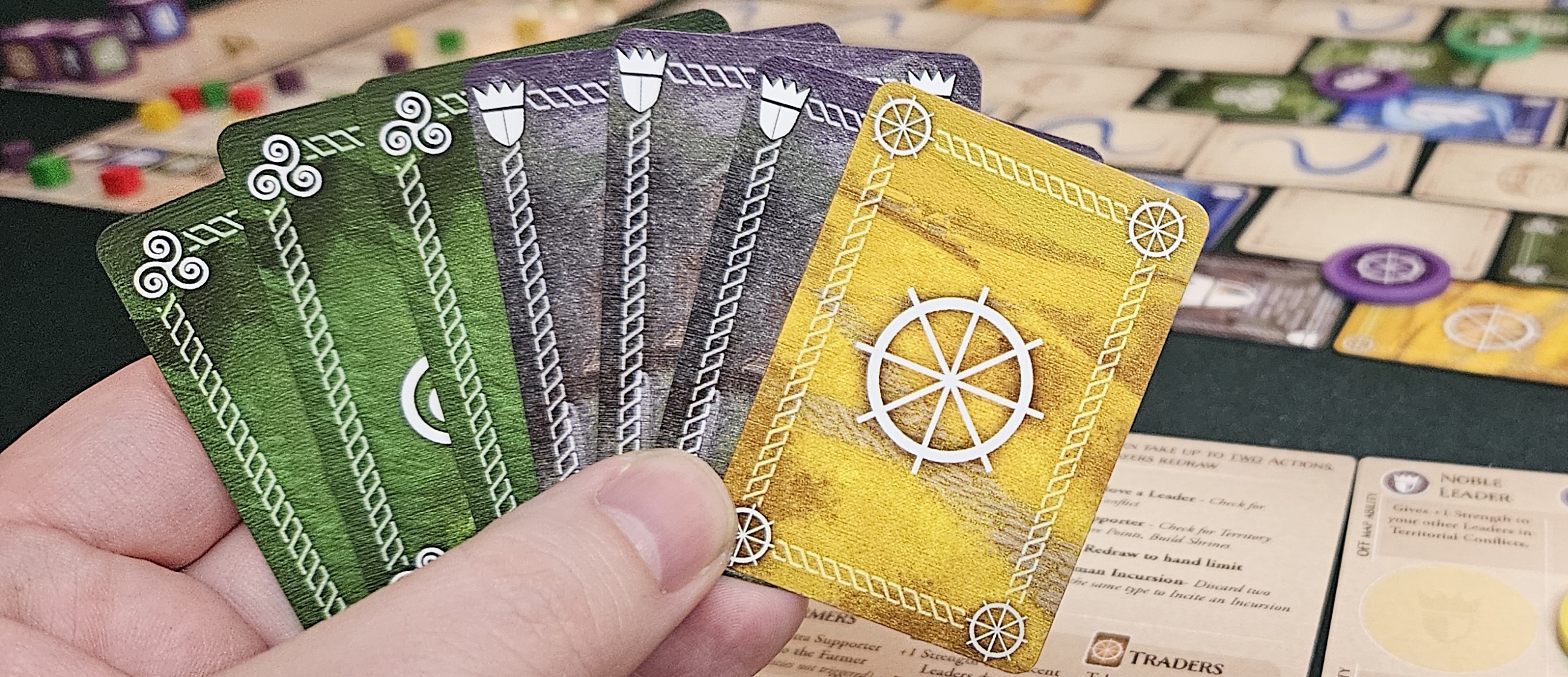
The color palette is pleasant, although I often mix up trade and farming.
At this point, it probably sounds like Rhine & Rhone is at its best when leaning into Knizia’s original design for Tigris & Euphrates and at its weakest when succumbing to Kiley’s impulses. That isn’t quite true.
For one thing, Rhine & Rhone is also weaker for utilizing some of Knizia’s developments from Yellow & Yangtze. Namely, the various abilities for your leaders. The problem isn’t the way they trigger abilities when deployed. I’ve already mentioned that nobles pick up unclaimed points, but the others get in on the fun too, with druids controlling shrines, farmers making it easier to chain card abilities, and traders gathering treasures that bolster your lower point tallies at the game’s end.
Again, this is all fine and dandy. Rather, the problem is the way those same leaders also add some bonus while sitting on your player mat. This acts as a rubber band, affording players who’ve recently lost their entire ruling class some ability to catch up. A noble ruler scheming at court makes it slightly easier to win wars; the same goes for a disgraced druid and clashes of leadership. The benefits for the other two leaders… well, I’d have to check the player mat. They’re just not very useful. Really none of them are all that useful when you get right down to it, becoming one more thing to track in a game that quickly becomes cluttered with information.
Okay, so even Reiner Knizia can over-design a game. But it’s far more interesting to look at the ways Kiley improves on Knizia’s masterpiece. There are two worth speaking about, both of them relatively minor adjustments that alter the trajectory of the system in exciting ways.
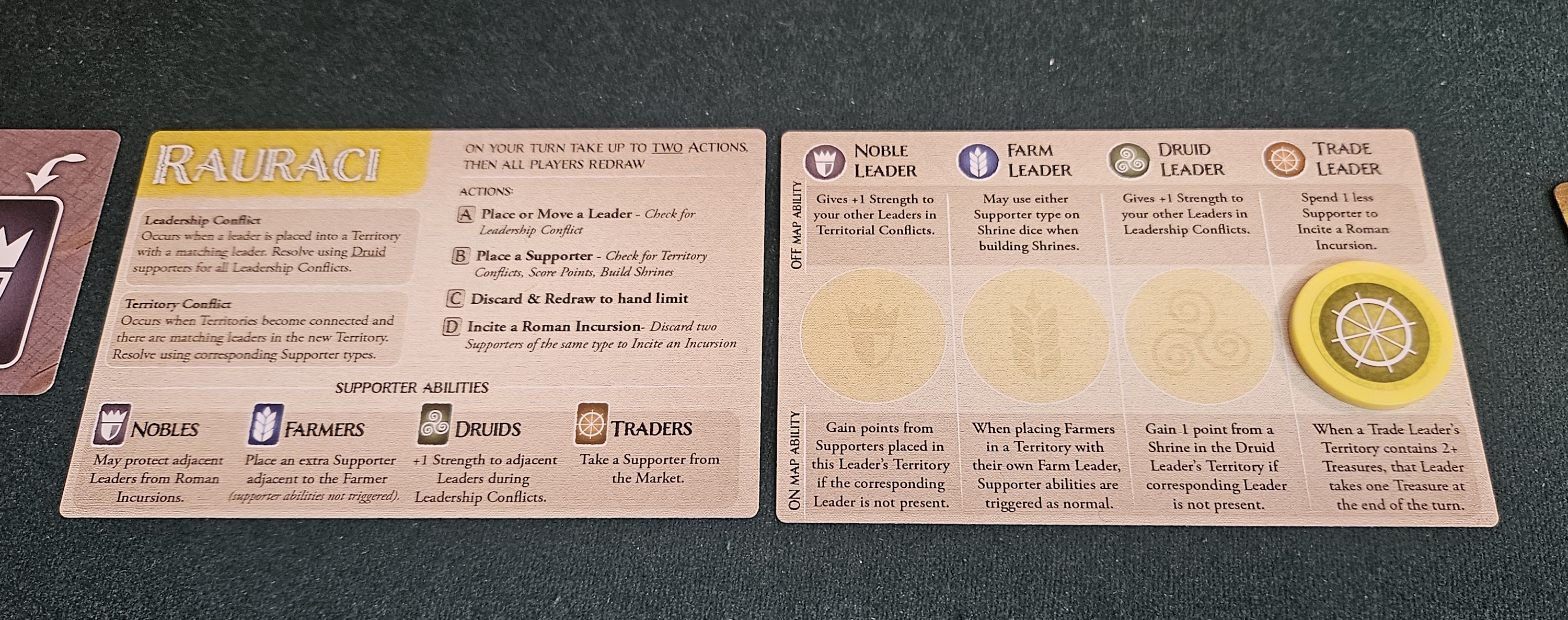
Leaders have bonuses both on-board and off-board.
First, let’s return to those leaders. In both Tigris and Yellow, leaders were tiles like any other. Placed on the board, they occupied the same dimensions as any other tile, whether the squares of Tigris or the hexes of Yellow. This required an open space for any new leaders to slide into, and tended to leave some rulers quite cozy once their support had been shored up.
In Rhine & Rhone, leaders aren’t cards. They’re tokens. And instead of sitting on the table the way a supporter card does, occupying a few miles of river or farmland or village, they’re placed at the convergence of up to three cards. Their seats of power are intersections; one commands the nearby nobility, another holds sway over a court of druids. Maybe a third has decided to lord over a conglomeration of farmers, traders, and petty nobles. For local color, maybe. For variety’s sake.
Joking aside, this changes the tone of Rhine & Rhone compared to its predecessors. Sliding into power is a relatively simple affair. Basically, you show up. This triggers a leadership challenge, potentially booting a long-entrenched ruler from their position. Of course, such a coup still requires preparation. The right cluster of druids to bribe, the right cards in your hand. Or, sure, the right bonuses from oppida. But the possibility of danger puts leadership under constant threat. Even a ruler sitting pretty on a foundation of three druids might be deposed if a challenger catches them with their breeches down.
In terms of gameplay, this alteration is groundbreaking, keeping everyone on their toes well into the game’s final moments. It suits the setting, too. Zeroth-century Gaul is a little more Wild West than ancient Mesopotamia. A little more fluid. A little more prone to a ruler packing up their treasures and retinue and claiming that nice hill-fort in the next valley. The result is a game that’s always in motion, that feels migratory. Holding power is as challenging as taking it. And as for those rulers who’ve fully dug in like a tick, well…
…that’s where the Romans come in.
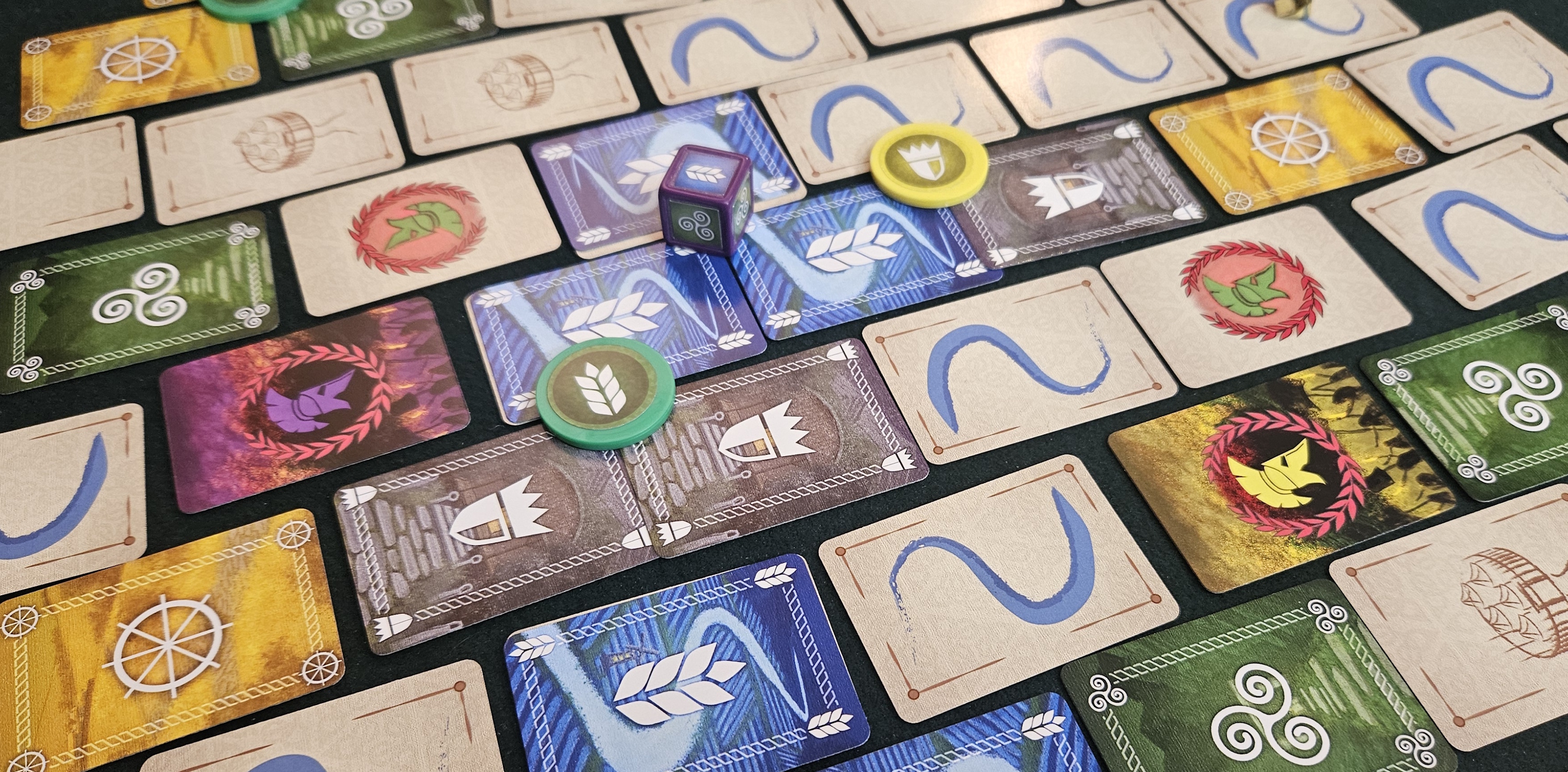
Those darn Romans, up to no good.
When I first heard about Rhine & Rhone, I treated myself to a sensible chuckle. No, not because Oliver Kiley had designed a riff on Tigris & Euphrates. It was the game’s subtitle that did it. I’ll save you the need to scroll up: the game’s full epithet is Rhine & Rhone: Resistance and Collusion in Ancient Gaul. “Who do you think you are,” I thought to myself, “a wargame?”
But as subtitles go, this one is appropriate. The Romans are indeed a clear and present danger — provided you remember to collaborate with them.
In contrast with how we tend to imagine the Gallic tribes today, the La Tène culture was wealthy and settled, if still more fluid than some ancient civilizations. The Gauls sacked Rome in the fourth century BCE, earning the Republic’s respect and fear. Eventually Rome began encroaching into their territory, culminating in Julius Caesar’s invasions in the 50s BCE. The Gallic Wars were unusually vicious even by ancient standards. And, as with many incursions throughout history, they likely would have been unsuccessful without the support of local allies, eager for revenge against dominant neighbors.
Rhine & Rhone captures that vengeful spirit. Every player begins with a few Roman invasion cards. As an action — and for a minor cost in matching supporters — these can be deployed to the map. In effect, your clan acts as scouts and local auxiliaries, producing the ancient equivalent of a carpet bombing. An entire supporter card is destroyed, along with any point-generating shrines and leaders situated atop it. Now the Romans sit there, unbeatable.
For a while, anyway. These Roman incursions simulate the brutality of Caesar’s historical invasions, but also their struggle to achieve long-term control. When the collaborator’s next turn comes around, the Romans break camp. Their card is flipped to the other side. Now that space can be settled again. This costs an extra card, but that’s not a big price to pay.
The problem is that collaboration is a drug. As soon as one clan scouts for the Romans, everybody starts doing it. This can quickly transform the landscape into a patchwork of Roman camps. Rather smartly, Kiley offers a fig leaf in the form of those gray supporters. When a neighboring leader is sent packing by Roman invasion, they can slide over onto a different portion of a noble card. In thematic terms, they’re leveraging their wealthy local connections. It’s a nice touch, making gray cards worthwhile as escape hatches the way green cards are useful for maintaining popular support.
Moreover, these incursions are dynamic in a way that overshadows Tigris’s catastrophe tiles and Yellow’s peasant rebellions. In a sense, they represent a merger of those two concepts, sticking around like a catastrophe, but only for a short duration like a rebellion. This fits the smaller map, not to mention the shorter timescale, fostering an atmosphere that’s always one collaboration away from disaster.
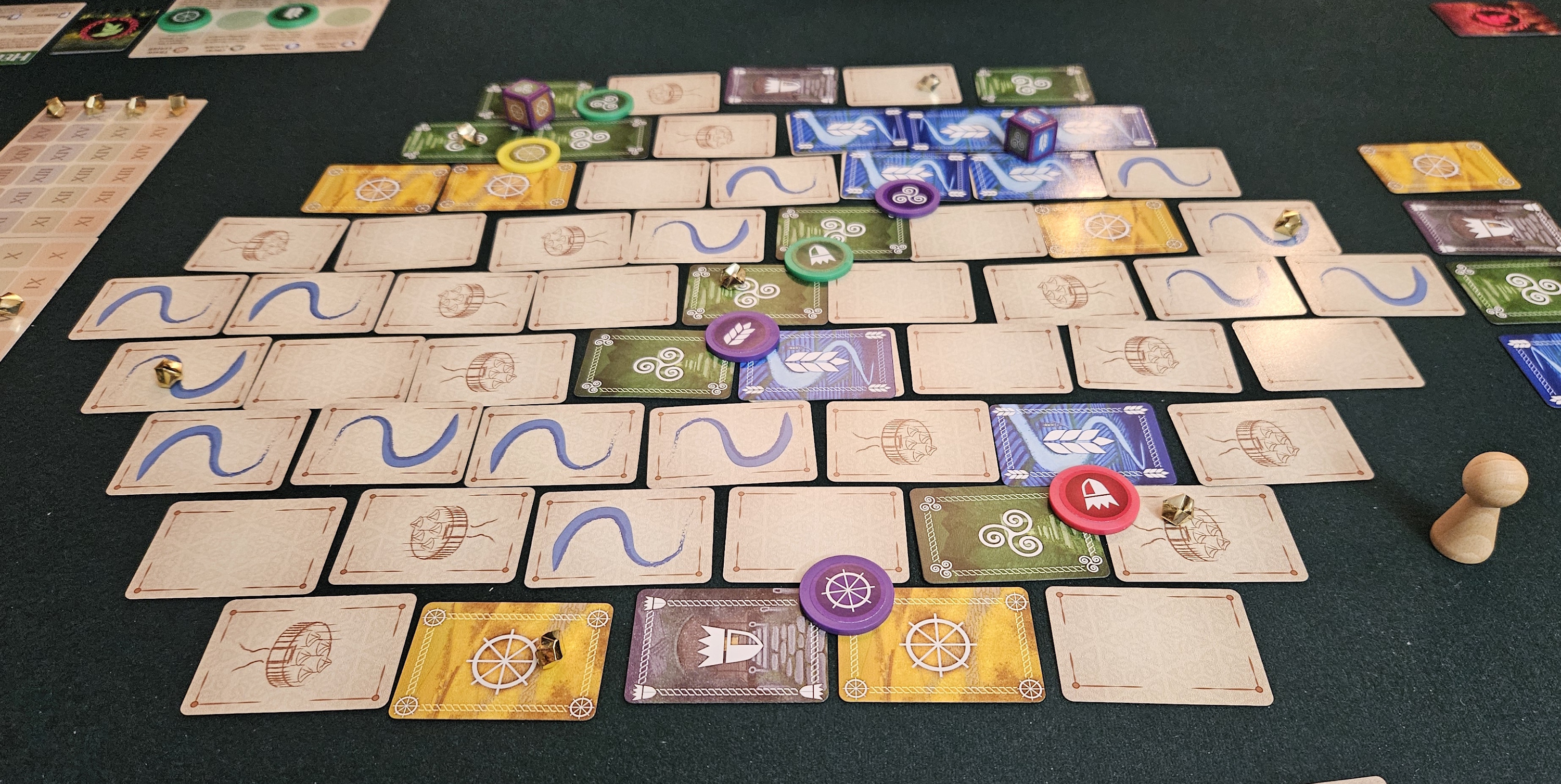
The game state isn’t always easy to read.
Put together, these elements add up to quite the chimera. Rhine & Rhone is not a perfect game. I’m not even sure it’s a good game. It inherits the tremendous authority of its predecessors. Their great expectations, too. To some degree, it comes across like the younger scion of a notable family; it has its father’s eyes and its mother’s stature, but it’s also messier, more cluttered, more idiosyncratic.
To its credit, though, Rhine & Rhone is never not interesting. It demonstrates that Knizia can not only be emulated, but in some ways improved upon. In this case, Kiley pairs those improvements with no small amount of dirty laundry, and the game would have benefited from the same professional development that its proximity to the Doctor’s most renowned titles makes a testy proposition. Still, it’s quite the sight, watching Tigris & Euphrates bear new fruit after all these years. With Rhine & Rhone, Kiley has created something truly strange, a title at once inferior, superior, and sideways to the games that inspired it.
(If what I’m doing at Space-Biff! is valuable to you in some way, please consider dropping by my Patreon campaign or Ko-fi. Right now, supporters can read about which films I watched in 2025, including some brief thoughts on each. That’s 44 movies! That’s a lot, unless you see, like, 45 or more movies in a year!)
Posted on March 12, 2026, in Board Game and tagged Board Games, Rhine & Rhone. Bookmark the permalink. 6 Comments.

 SPACE-BIFF!
Had you heard T&E will be back with a new edition from 25th Century Games ths year?
Yep. Excited to see it.
Thanks Dan for the giving Rhine & Rhine a shake! I can’t disagree (so I guess I agree?) with everything you say about the game. It’s a strange beast in many ways.
One thing that wasn’t mentioned in the review, as a point of distinction from T&E and Y&Y is the open scoring method using a score track. Many people have taken to scoring the preceding games with open scoring, which is something I leaned into here as well. The treasures on the score track are a nod to Ingenious 😉
I also think the chaos and volatility the relics cards introduce is somewhat counter-balanced by the open scoring. If you’re going to dump a pile of bonus cards on a big couple of moves, you can at least do it in a manner that lets you focus on getting ahead of the leader with more certainty, instead of just beating on the most opportunistic target even if they are in a lower place!
Thanks again for the thoughtful review!
I love it when the designers of the games Dan reviews comment on the review itself. I wish they all did! Good on ya, Oliver.
You’ve told us your favorite, now where’s the rest of the ranked Knizia list Dan?
Joking aside, I am curious if you’d recommend this to someone who’s never played T&E or any of its variants but is eager to try it out. Our group got its first taste of Knizia with Rebirth last year and we’ve been looking to delve more into his works. I just ordered a copy of Ra the other day and am eagerly awaiting the reprint of T&E.
Hm, that’s a hard question. I would probably recommend they start with T&E. But since that game isn’t imminently available, R&R isn’t all that far off. I’ve played it with a few newcomers to the format, and they were able to learn it just fine.