Carceral Draftsman
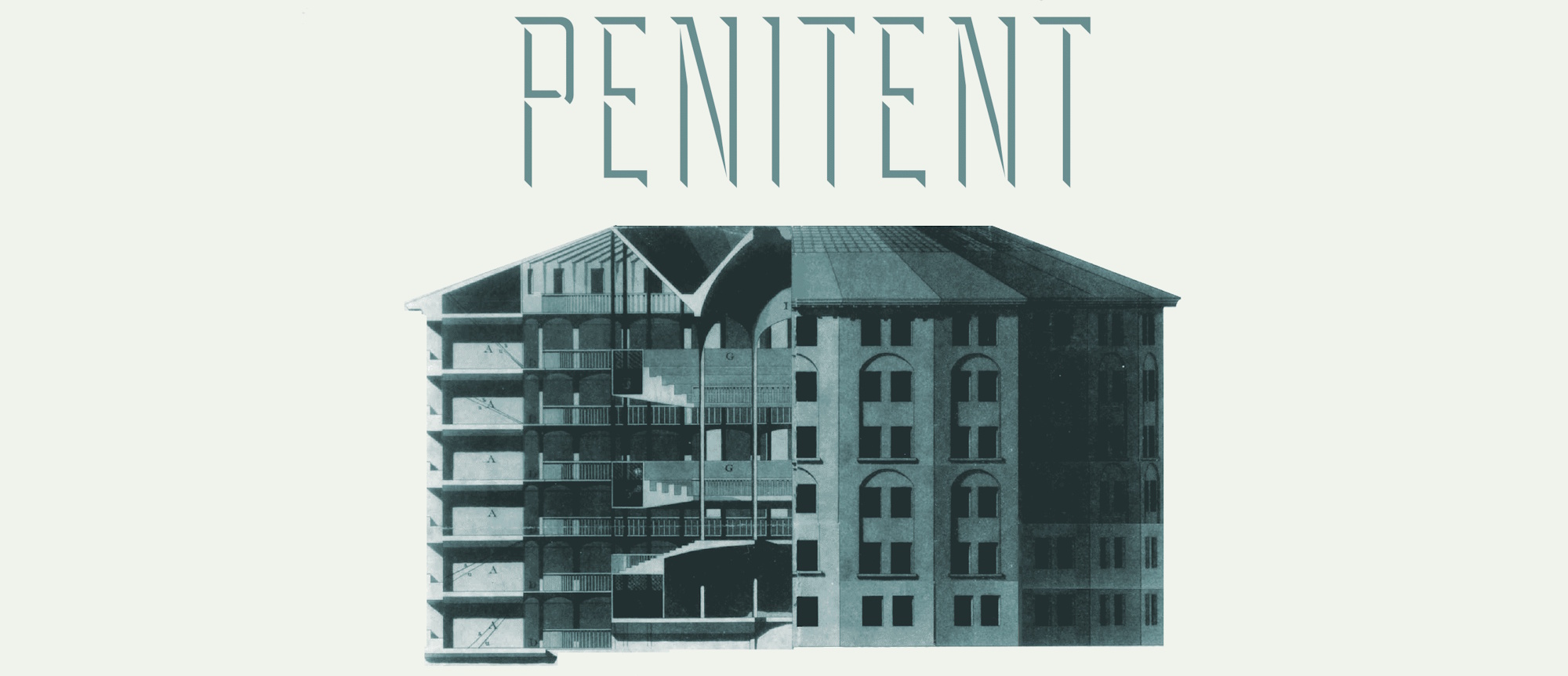
The ‘Enlightenment,’ which discovered the liberties, also invented the disciplines.
That’s the most oft-quoted line from Michel Foucault’s Discipline and Punish, probably because it’s such an apt summation from an author who, let’s face it, preferred discursive barrel-rolls to punchy thesis statements. Liberty and discipline are the topics of Dan Bullock’s latest board game, a term I’m employing loosely but not unfavorably. The game in question is called Penitent, it’s about constructing and managing a prison in the early 19th century in the United States, and it’s either the second or fifth of Bullock’s provocations on the issue of justice, depending on how liberally we stretch the concept.
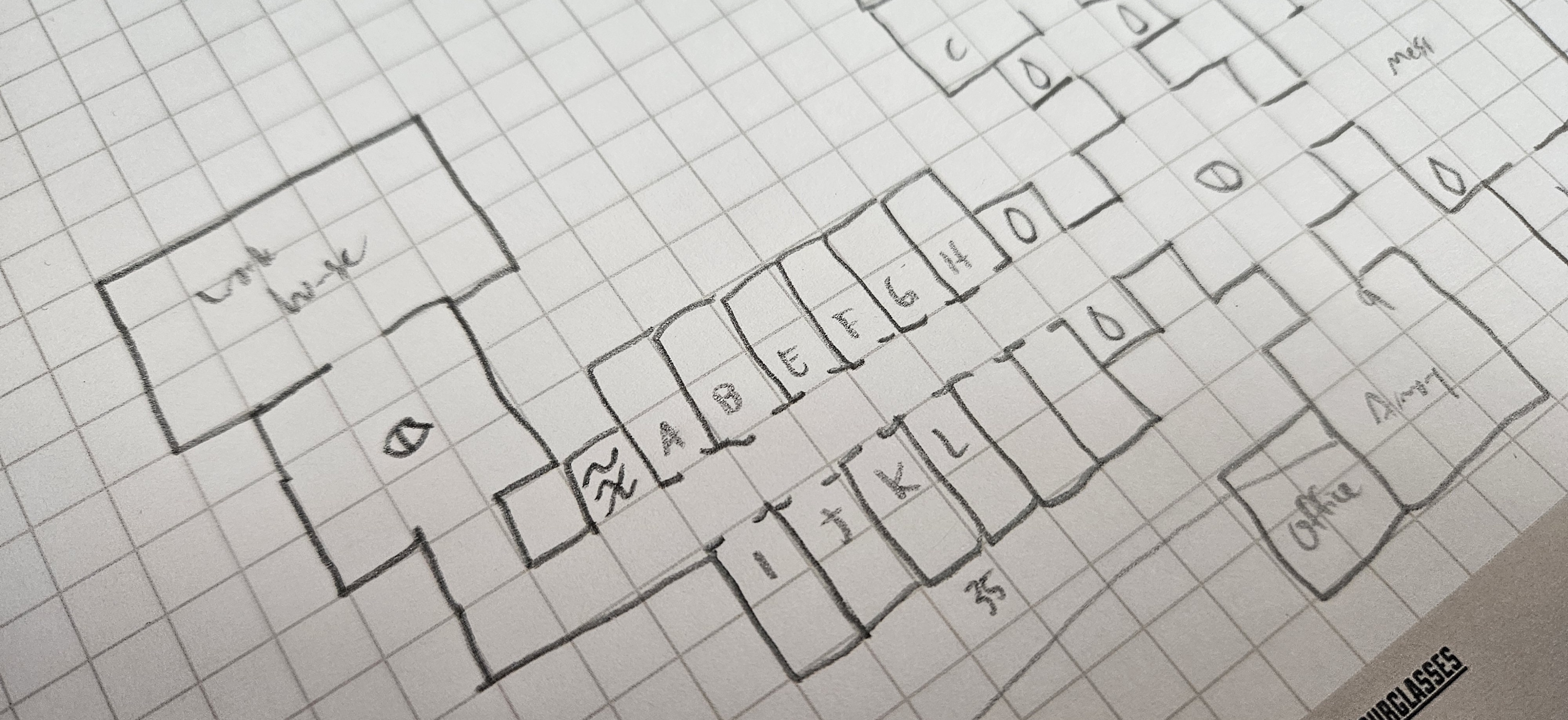
My first attempts looked more like Doom levels than actual prisons.
Back in 2021, Noralie Lubbers and Dávid Turczi revealed a collaborative board game project called Prison Architect, an adaptation of the 2015 Introversion Software video game about building and managing a private maximum-security prison. As the adaptation pursued funding on Kickstarter, the outcry from segments of the board gaming community was severe. Turczi apologized, noting that he and the rest of the game’s creators had been operating under the best of intentions, but also stating that he had come to believe that the topic was a bad fit for board games.
I never played Prison Architect, either the board or video game versions. Like many board game controversies, the announcement, pushback, and project cancellation passed at blink-and-you’ll-miss-it speed. From a distance, though, it struck me as overly gamey, too cute, to effectively communicate the nuances of such a loaded topic.
Penitent is anything but cute. It certainly isn’t gamey, at least not in the usual sense. But nuanced? It’s got nuance to the ceiling.
Your objective, as I stated earlier, is to construct and run a prison. Penitent is set in the early 19th century, a period of profound carceral transformation. Within the span of three decades, global society’s understanding of imprisonment and punishment would develop radically. Public punishment would go from the norm to unthinkable, at least in the sense that had reigned unquestioned since the Medieval period. Sanity would become a topic of public discussion, with reformers like Dorothea Dix founding no fewer than thirty-two hospitals across the U.S. and Europe for those suffering from mental ailments. Questions about racial, class, and gender justice were discussed openly in periodicals and congressional hearings. Bullock touches on every one of these issues and more, sometimes with a heavier or lighter touch, all within the span of perhaps an hour.
To regulate the game’s perspective, Bullock limits his examination to two systems of prison reform. The first is the Pennsylvania System, sometimes also called the “separate” or “silent” system for its strict solitary confinement of inmates and emphasis on moral reflection. The second is the Auburn System that evolved from it, which housed inmates separately but allowed them to work, eat, and exercise side by side, albeit often, still, in maddening silence. These reform projects existed side by side, often competing for attention and funding. Many of their fingerprints can still be found scattered throughout the penal system of the United States today.
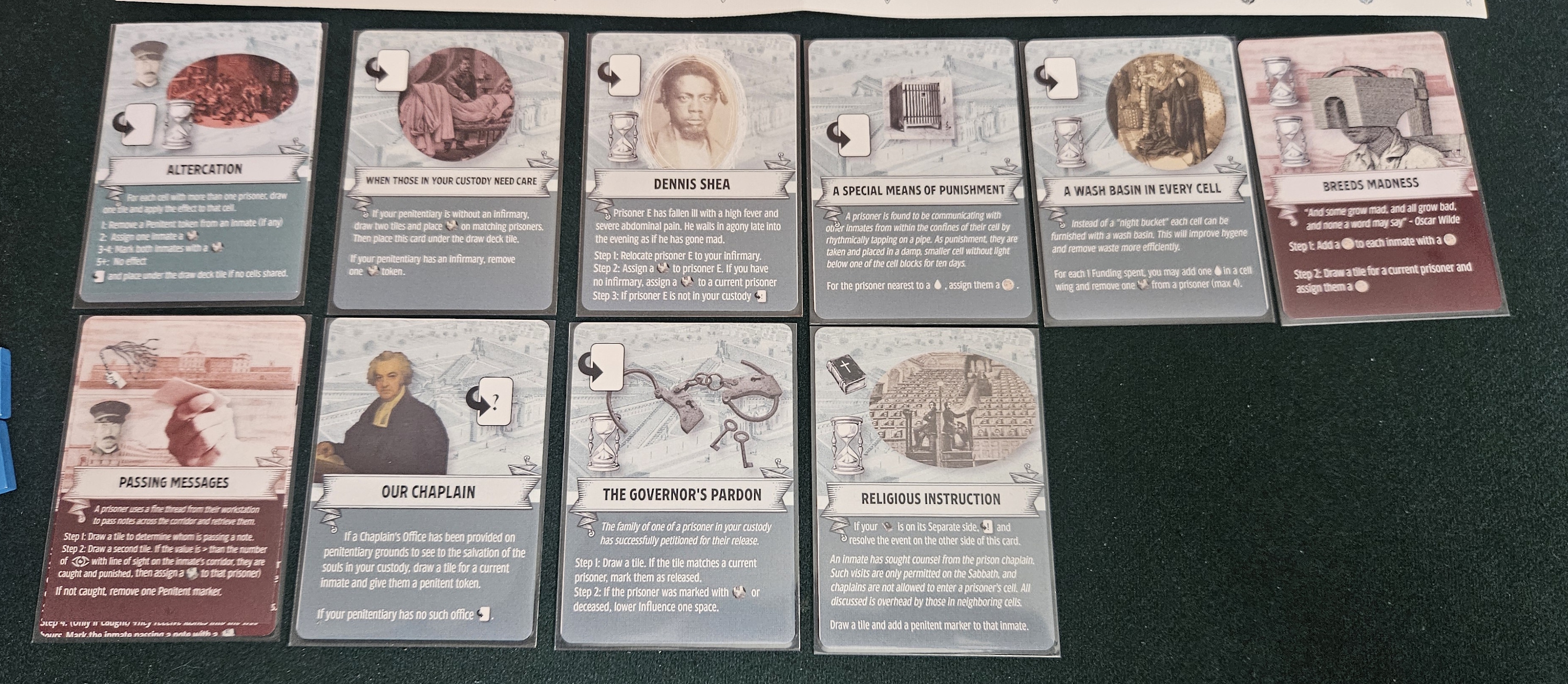
There’s a press-your-luck quality to the event phase, but I’m being rather liberal in my definitions.
As a game, Penitent is divided into two distinct halves. Right away, this bifurcation is troublesome.
In the first half, you draw a prison on a sheet of graph paper. The rules describe the necessary dimensions and chambers: cells enough for twelve prisoners, divided into at least two separate wings; exercise yards and workhouses to provide for your prisoners’ fitness and labor; kitchens, armories, laundries, and a warden’s office, their dimensions negotiable to such a degree that the rules effectively tell you to eyeball them; perhaps a chapel to see to the spiritual needs and moral rectitude of the incarcerated; cisterns and ventilation and observation posts, each of which you are told is essential, but for precisely what you do not yet know.
One of my pet peeves comes when a game’s setup instructs the player to make a game-altering decision without fully understanding its ramifications. Usually this means selecting one of two scoring cards, picking a faction you have yet to see in action, or selecting a bonus whose import remains obscure. In Penitent, it means sketching an entire prison.
Not only that. You’re also invited to select the policies that will dominate both the day-to-day operations of your penitentiary and its from-the-cornerstones construction. Will your prison operate under the unitary command of a single warden or the divided responsibilities of business operator and disciplinary keeper? Will punishments be meted out via the whip or the more “humane” method of dousing by freezing water? Will your inmates exist in unending silence, or only silence most of the time? These questions and more are posed directly, often without any guidance as to their significance.
This absence is frustrating. Systemic clarity is one of the great strengths of board games. Since a game’s rules can’t be computed, but must instead be held in the player’s head, this is a medium that excels at compressing complex ideas into their most digestible format. Penitent is the opposite case. Going in unprepared is a fraught proposition, but it’s also inevitable. Before you even set pencil to paper, you’re asked to make sweeping decisions, told that those decisions will have radical outcomes, but not told what any of those outcomes will be.
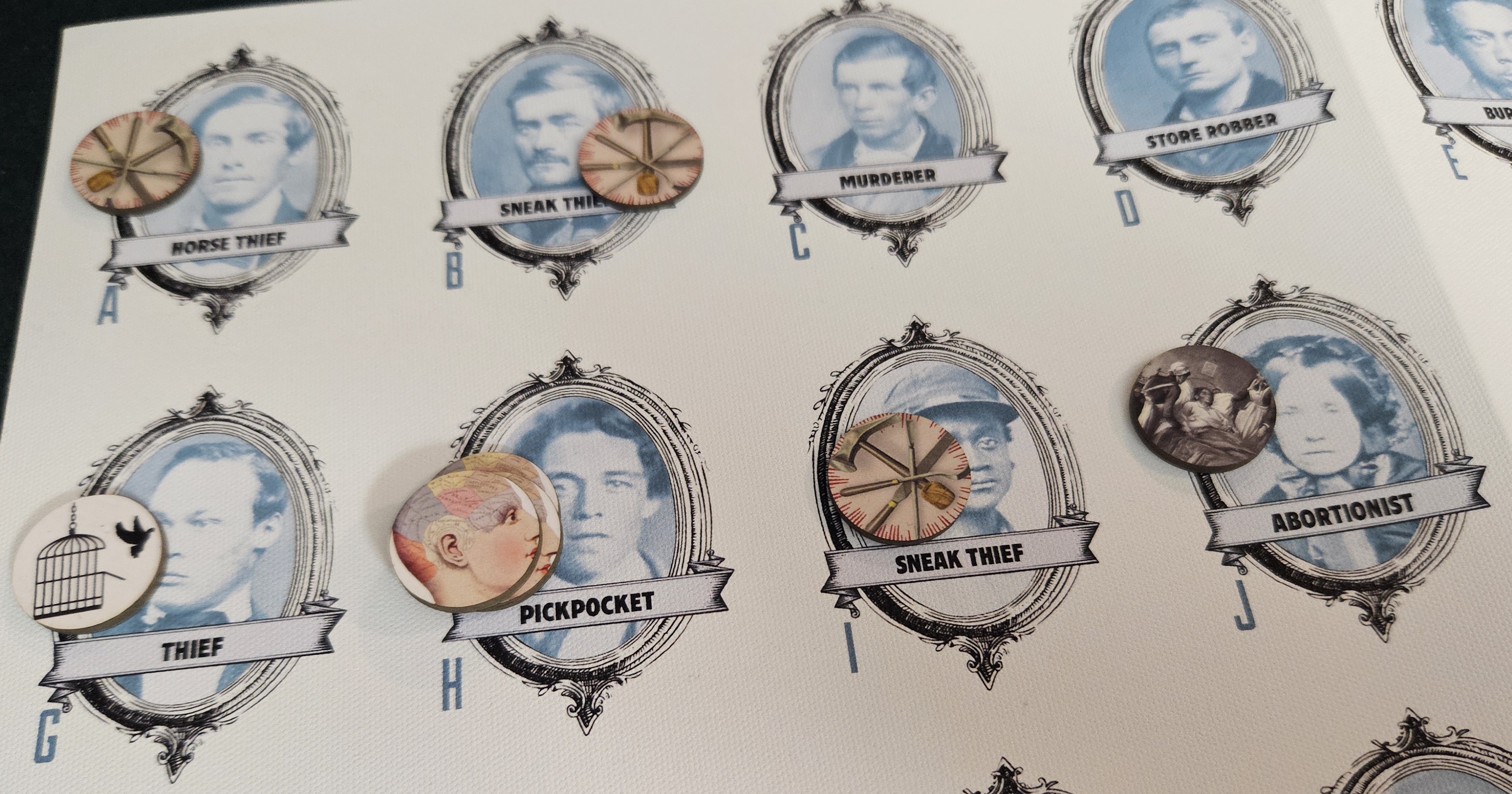
At all points, Bullock invites us to think about the human lives being managed.
And those decisions matter. Oh, how they matter. The game’s second half is effectively an extended series of consequences. One by one, you draw event cards that put your prison, and by extension the bodies and lives housed within, through the wringer. Without enough cisterns, an outbreak of tuberculosis tears through the population. Housed multiple inmates to a cell, madness and brawls break out. A state inspector comes by for a looksie and comes away horrified. The locals in the nearby town go all NIMBY, complaining about how the prison’s barrel-hooping cuts into their home-grown business enterprises.
At times, these events present flashpoints. In the case of those business complaints, you might tell the locals to shut their yaps and keep your inmates hooping barrels as long as the margins are healthy. Or you could choose to divest the output of your workhouses, importing silkworms and training your laborers in spinning. Depending on which response you select, the event might present different outcomes. Sometimes it will shuffle back into the deck, threatening to come due at some future date. Maybe it will flip to its reverse side, growing more dire thanks to your inattention. At best, perhaps it’s thrown out of the game entirely. Consequences might come due. Or they might not. You can never know.
This uncertainty is at the heart of Penitent, for better and for worse.
For one thing, there’s Bullock’s entire approach to rules. In Penitent, it isn’t uncommon for the game to ask the player to use their own judgement. Is a horse thief a violent criminal or non-violent? How about a store robber? The bonneted abortionist on the board’s second row is surely a woman who ought to be housed separate from male offenders, but what about that effeminate-faced burglar on the bottom row? And what precisely is meant by “line of sight”? At least once per in-game year, an event will raise an issue that requires the player to settle a dispute that might go either way.
Bullock’s previous self-published title, The Gods Will Have Blood, asked similar questions about the uncomfortable distinction between justice and retribution. In that game, the player was asked to render judgement on accused royalists and collaborators, feeding some to madame guillotine and setting others free. Even more than that game, Penitent requires the players to make decisions on emotive and instinctual grounds rather than adhering to strict rules. The effect is often jarring.
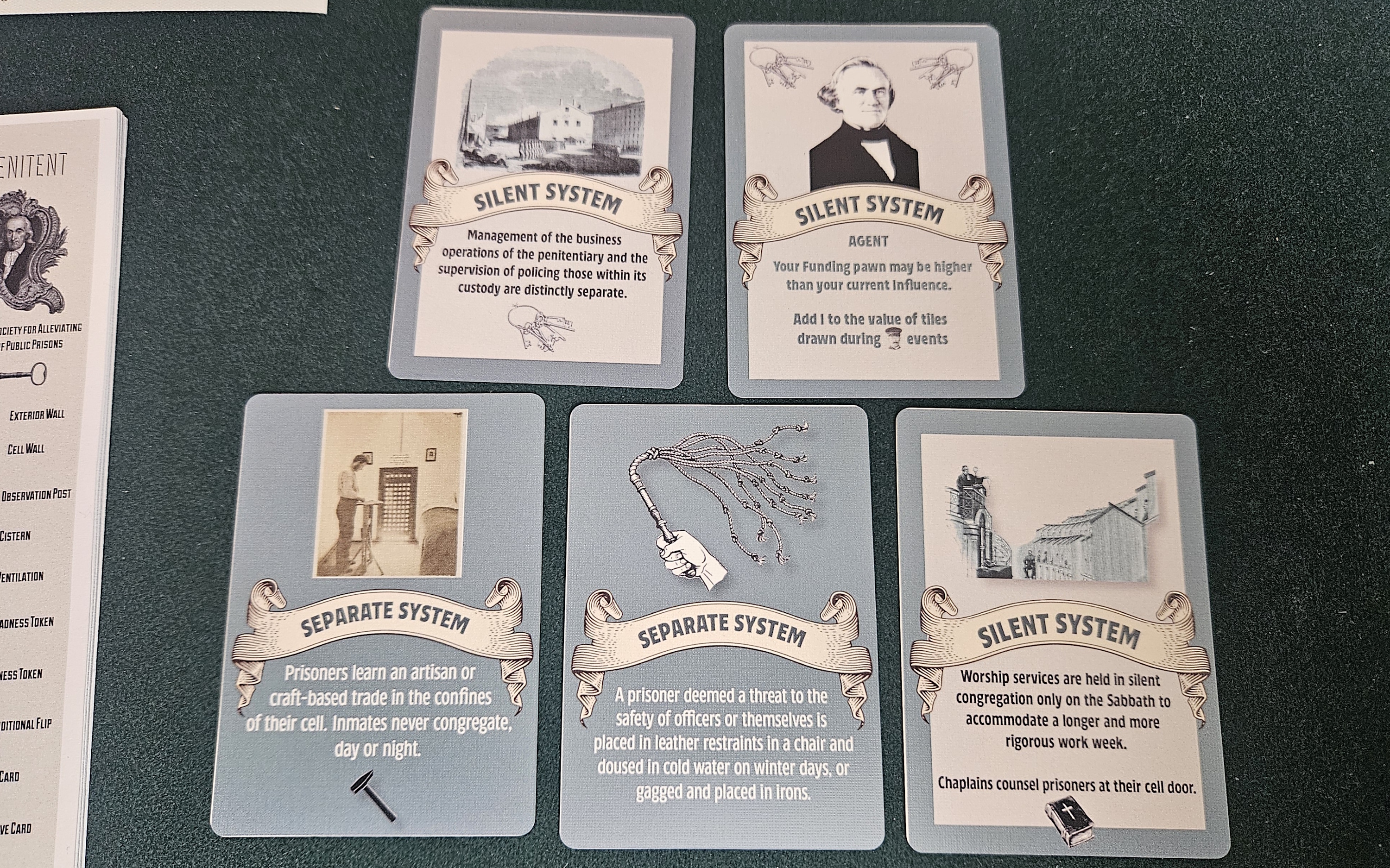
The Pennsylvania and Auburn Systems are put in tension.
But this absence of clarity is precisely what makes Penitent a worthwhile investigation. Something like Prison Architect may have proven a better game about moving cards and balancing a budget, but Penitent is the keenest possible study of the carceral experiment. Going into a session, one is provided only theory. The proper severity of punishments. Whether prison wings should contain washbasins. The nature of worship services. The physical dimensions of each cell. The placement of the institution’s watchmen. All that theory, all untested. So much theory you could choke on it.
Unlike the choice between two objective cards in some boilerplate eurogame, however, this tabula rasa is deliberate. It entrusts you with the drafting pencil of the reformers who crafted the modern prison system. You have no better idea of the outcome of one system over the other because you, like them, probably know very little about the distinctions between the Pennsylvania System and the Auburn System. Pop quiz: Which system proved more enduring? Which features are still present in modern penitentiaries? Here’s an easy one: which correctional facility is still in operation today that was built explicitly as an experiment in keeping prisoners in maximum isolation? It’s okay if you don’t know. For the most part, neither did the people who built them.
Not that this absolves those wardens and reformers of the role they played. If Penitent has anything close to protagonists, they are the prisoners themselves. Bullock has always imbued his work with a deep humanism, whether he’s asking us to consider the policies behind North Korean isolationism, revolution in Iran, or, sure, David Bowie’s artistic schizophrenia. As in some of his previous outings, Bullock puts the faces of the imprisoned on display. They quickly become cluttered with tokens: their injuries and illnesses, their fraying sanity from enforced isolation, their degree of penitence, the trades they’ve learned during their incarceration. All the while, their faces peer up from the board in daguerreotype. These are people who lived. They had dreams and aspirations. They suffered setbacks and failures. Now they are in your hands.
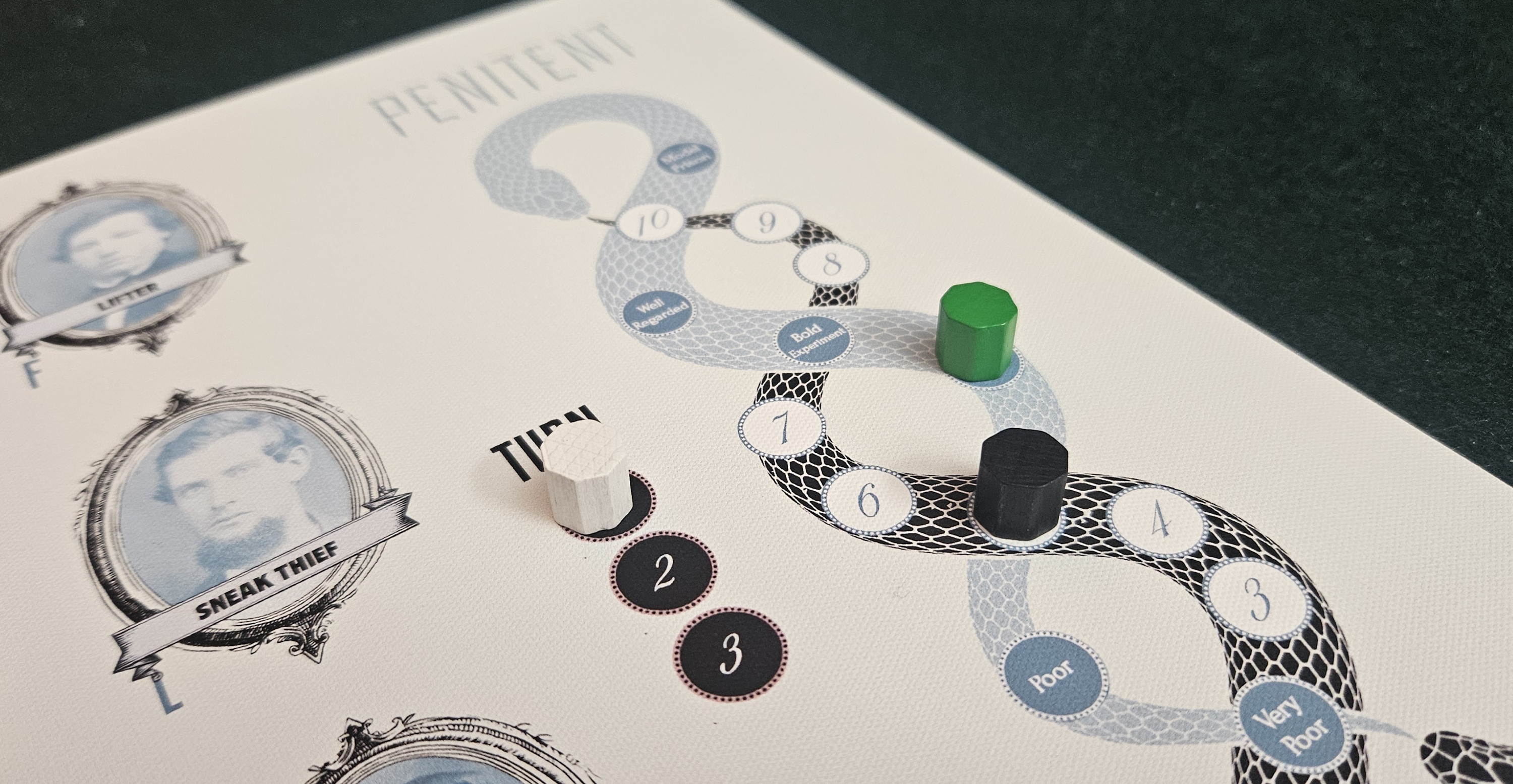
Your priorities are plainly spelled out: funding and influence — i.e. money and reputation.
Very quickly, too, their statuses become statements about the way your institution’s incentives become bent and perhaps broken entirely. Sick inmates are more easily isolated than treated. Prisoners with trades are profitable, encouraging you to keep them under lock and key. Once, when one of my prisoners died before their madness compounded, I caught myself exhaling in relief. How’s that for ludonarrative harmony?
Speaking of which, your own role as this prison’s warden is never far from mind. Victory requires you to care for your inmates to some degree, but they’re a means to an end. That end is your influence, which Penitent is careful to tie to your capacity to actually pay for this stuff. That’s another of the game’s many entangled incentives. No matter how sterling your intentions when the game opens, it soon becomes clear that there isn’t enough funding for everything. On my first attempt, I tried to fashion a more egalitarian prison. (Exactly like most of these reformers, by the way.) When my palatial twelve-by-twelve cells proved too expensive — and my lazy bones proved unwilling to sketch the whole blueprint all over again — I added a notation in the margins: “1/3 size.”
While Bullock refuses to let his wardens and reformers off the hook, he also declines to indict them too harshly. In Discipline and Punish, Foucault argued that modern discipline was pervasive, a co-opting of Enlightenment values that served to regiment and order human bodies, but that this was still gentler and more evenly applied than what came before it, so defined by public torture, disease-ridden dungeons, and irregular justice applied at the whims of sovereign rulers. For all their corrupted incentives, their horrifying theories, their abuses, their tourist-trap viewing holes (no, really), these prisons were still fashioned to be more humane than what came before. They didn’t prove as Whiggish as the, um, Whigs intended, but as a warden you’re still expected to provide some measure of care to your incarcerated bodies, to encourage their rehabilitation, to course-correct when your structure proves insufficient.
Is this an improvement? The answer isn’t a simple yes or no. Most of us would probably agree that we’d rather spend a stint in a cell, even one as cramped as those at Sing Sing, than have our ears sawed off and our cheeks branded with the initials for seditious traitor, only to be clapped in irons anyway. Then again, that latter punishment is arguably what sparked the Age of Revolution. Public punishments were awful, but they were also opportunities for public dissent. One of the functions of the Pennsylvania and Auburn Systems was the removal of any such possibility. Bodies under punishment would be placed where the public wouldn’t have to consider them; minds under punishment would be wiped through sheer silence and tedium. This, too, is torture. What good are ears when there’s nothing to hear?
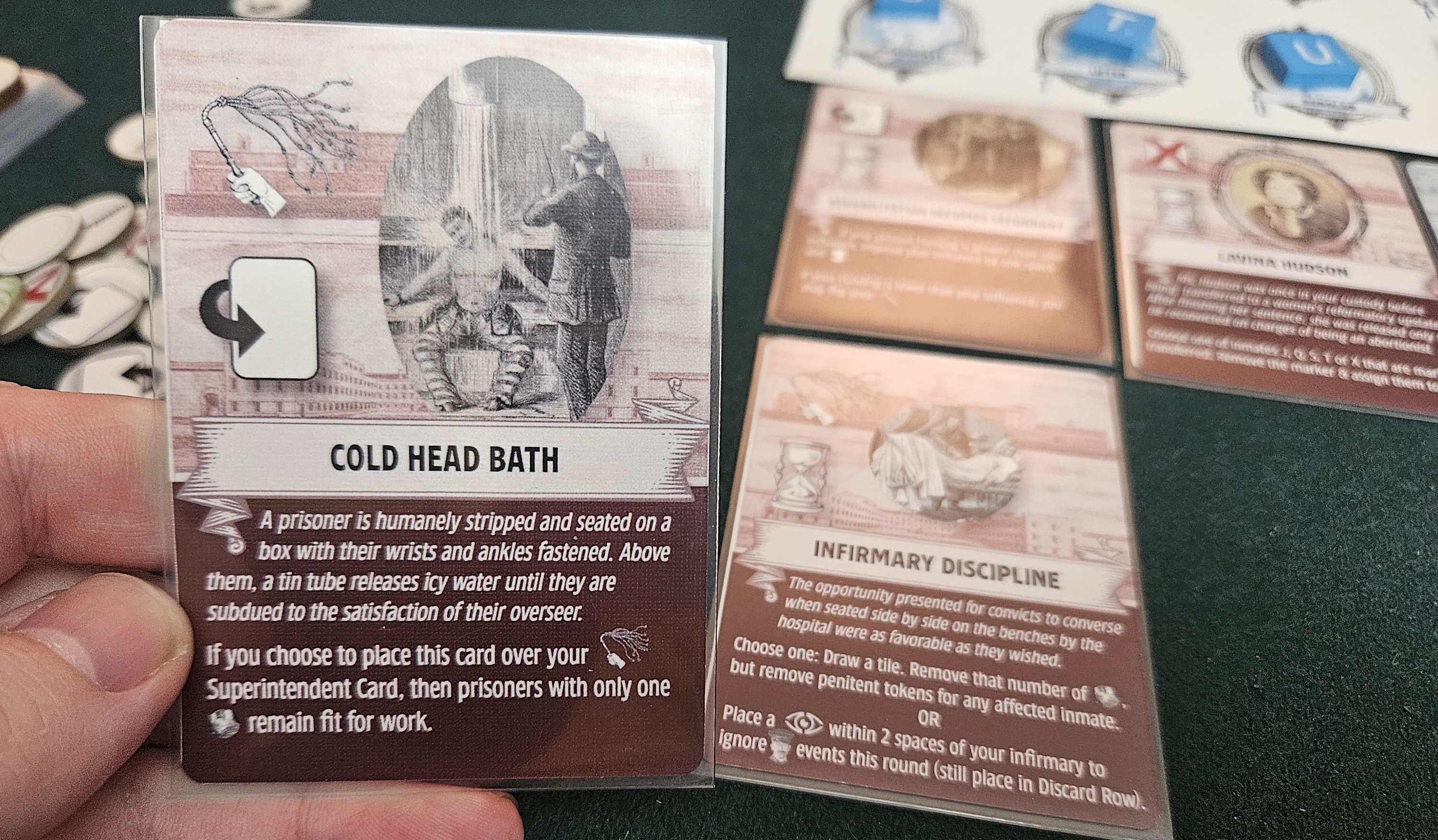
Bullock’s dark humor is a constant guide.
This, ultimately, is the real function of Penitent.
Not the examination of Foucault, although there’s always fun to be had in asking an incoming grad student what old baldy actually meant by this or that treatise. Not the examination of the Pennsylvania and Auburn Systems, with their strict quietude and felt-lined shoes and years of solitary confinement. Not the realization that you’ve grown so callous toward the faces on the table that it’s a relief when one of them dies rather than cutting into your bottom line. Not even the chilling parallels to the under-regulated detention facilities springing up across the United States, the ones that would fail even Penitent’s most basic checks.
Rather, the function is to ask us to think about the bodies under our care. To consider how a person ought to be housed when we as a society have decided we’d rather put some distance between them and us. Should they be punished? Reformed? Left to rot? Helped back to their feet? Penitent doesn’t offer trite answers.
But it does ask the right questions. I’ve spent some time in prisons. Not as an inmate, to be clear. As a volunteer, a few times. As a tourist, once, for a school thing. As a minister, usually to somebody’s irritation. And certain images are burnt into my memory. An inmate standing at the glass, hands clasped and shoulders squared, chin jutted in defiance, putting himself on display as an act of resistance. Another prisoner, crying with relief that we, that anybody, came to visit. The blank, slow gaze of someone in the halfway house, overawed at the bigness of the world outside. My own personal daguerreotypes.
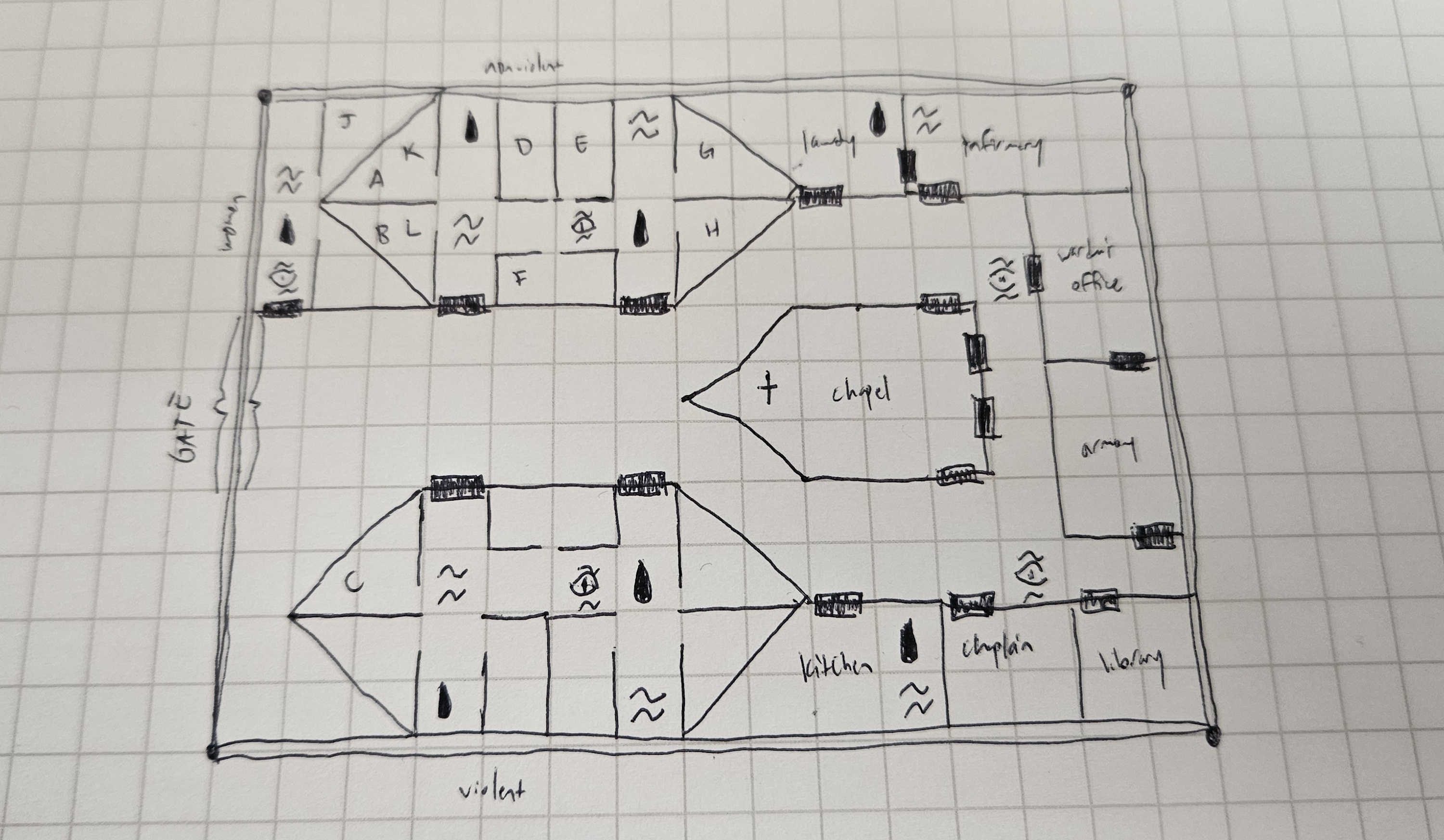
My later prisons were more prison-ish.
Penitent is quite the thing. I’m hesitant to recommend it. The last time I said that one of Bullock’s games was essential, multiple readers informed me in no unclear terms that it was garbage. So let me be clear: Penitent is not a good game in the sense we usually mean when we say those words. It is awkward and wonky and full of moments that verge on role-play. It is frustrating. It lacks player agency, whatever that’s supposed to mean in this context. It made me draw a bunch of maps on grid paper. The nerve.
But it’s also a shockingly clear examination of some truly challenging subject matter. Sure, it’s educational. More than that, it’s an act of empathy, a witness, a dissection. In all regards, it is something like a surgeon, looking directly at one of our modern world’s hidden hurts, a rupture in the abdomen that we would rather ignore. “This might be infected,” it says, prodding uncomfortably at the reddened tissue.
As for the possibility of sutures… first, we’ve got to take a long hard look at the cut.
A complimentary copy of Penitent was provided by the designer.
(If what I’m doing at Space-Biff! is valuable to you in some way, please consider dropping by my Patreon campaign or Ko-fi. Right now, supporters can read about which films I watched in 2025, including some brief thoughts on each. That’s 44 movies! That’s a lot, unless you see, like, 45 or more movies in a year!)
Posted on March 5, 2026, in Board Game and tagged Board Games, Dan Bullock, Lock Horns Games, Penitent. Bookmark the permalink. 2 Comments.

 SPACE-BIFF!
In this maddening world it is soothing to pay a visit to your site and partake in your both visceral and cerebral musings, your dissections and affections. For me it upholds the hope that at the end of day there are still some humans left trying to make sense of it all in their hearts and minds. Thank you 😉
Thanks for the kind words, Marvin.