Vibin’
Ah, solipsism. It’s always appreciated when a board game demonstrates that we exist in shocking isolation, our comprehension of the universe siloed from every other human being, loved ones and enemies alike, by an unspannable gulf. Usually it’s Dixit or Mysterium that performs the winnowing, but there are no shortage of titles for transforming everyday people into miniature versions of René Descartes.
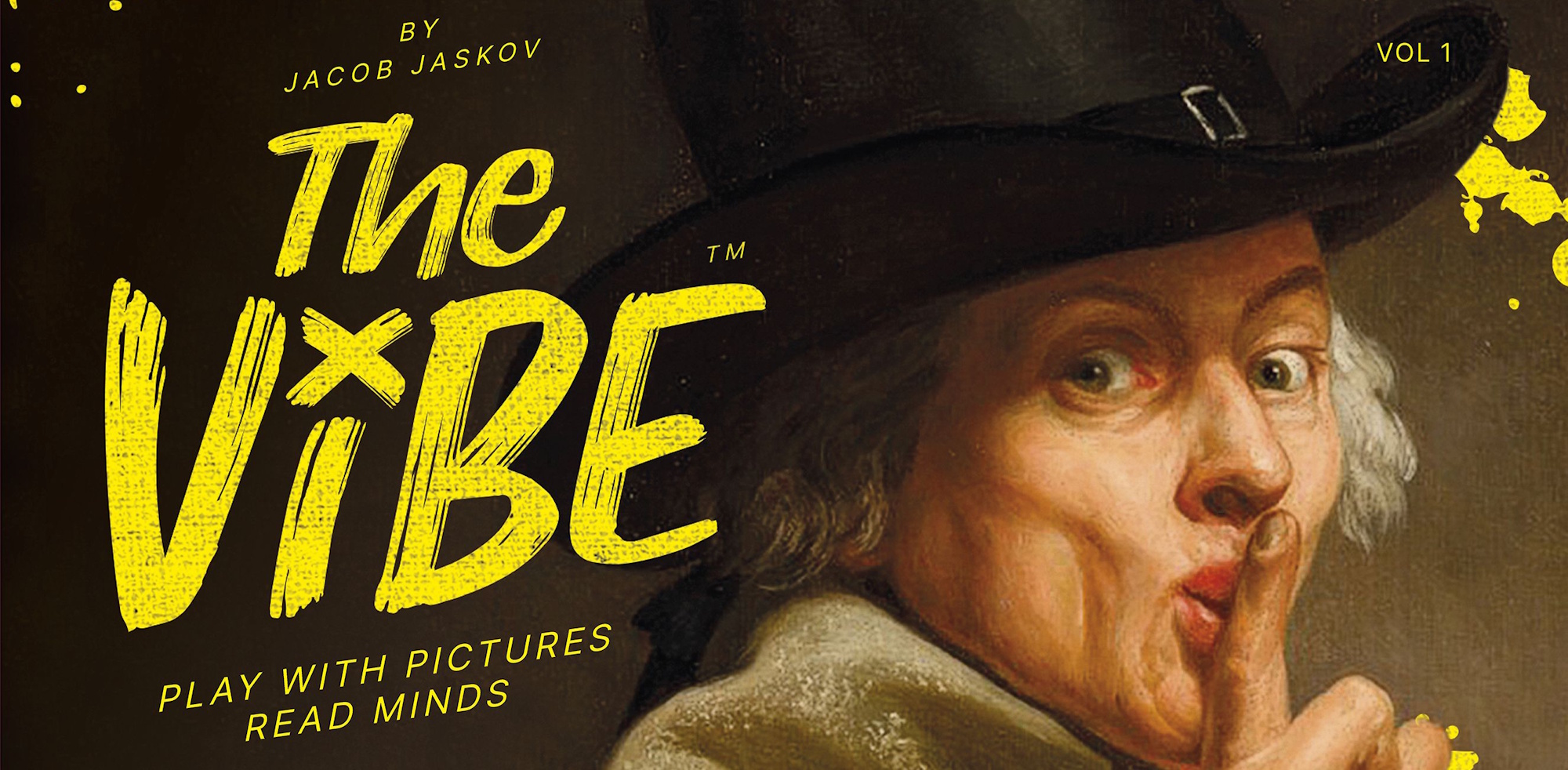
But then there’s The Vibe. Crafted by Jacob Jaskov nearly a full decade after he exploded onto the scene with Fog of Love, The Vibe is… how shall I put this… it contains some really great public-domain artwork. Joseph Ducreux, history’s finest self-portraitist, was a wonderful choice for the cover.
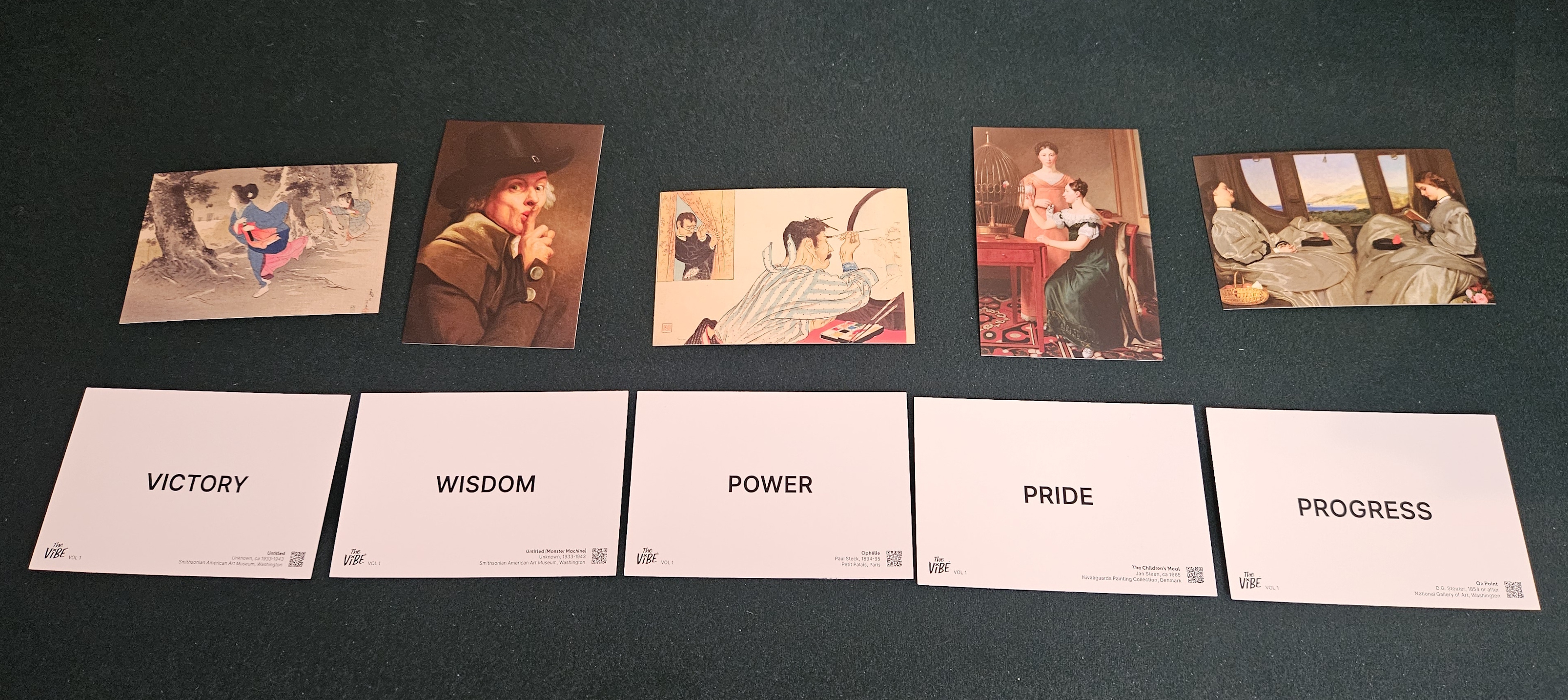
Which descriptor matches this sequence of images?
Really, I cannot applaud the art enough. The Vibe’s sixty-plus cards tour a virtual gallery, covering such works as Jacobus Doyer’s “Jan Van Speijk Debating Whether to Set Fire to the Gunpowder,” Eastman Johnson’s “The Pets,” and Unknown’s “Lover’s Eyes.” Actually, I think Unknown may be over-represented in this set. Give everyone else a chance, Unknown! Point is, opening the box presents the greatest hits from the postcard stands of a dozen art museum gift shops, drawing breathless exclamations of “Ooh, I think I remember this one!” from everyone at the table who took A.P. Art History twenty years ago.
On the back of each card, the art is titled, attributed, dated, and located in its modern museum or collection. There’s even a little barcode that promises to share more info, although at the time of writing they all lead to a generic page announcing that further details are forthcoming. Still, it’s a lovely collection. Poring over each image is a delight, and as a bonus it probably beats out any tourist shop in the world at per-postcard price. The last time I visited the Louvre, each one cost over a euro. What are the odds they’ve gotten cheaper?
But then I have to play the dang thing.
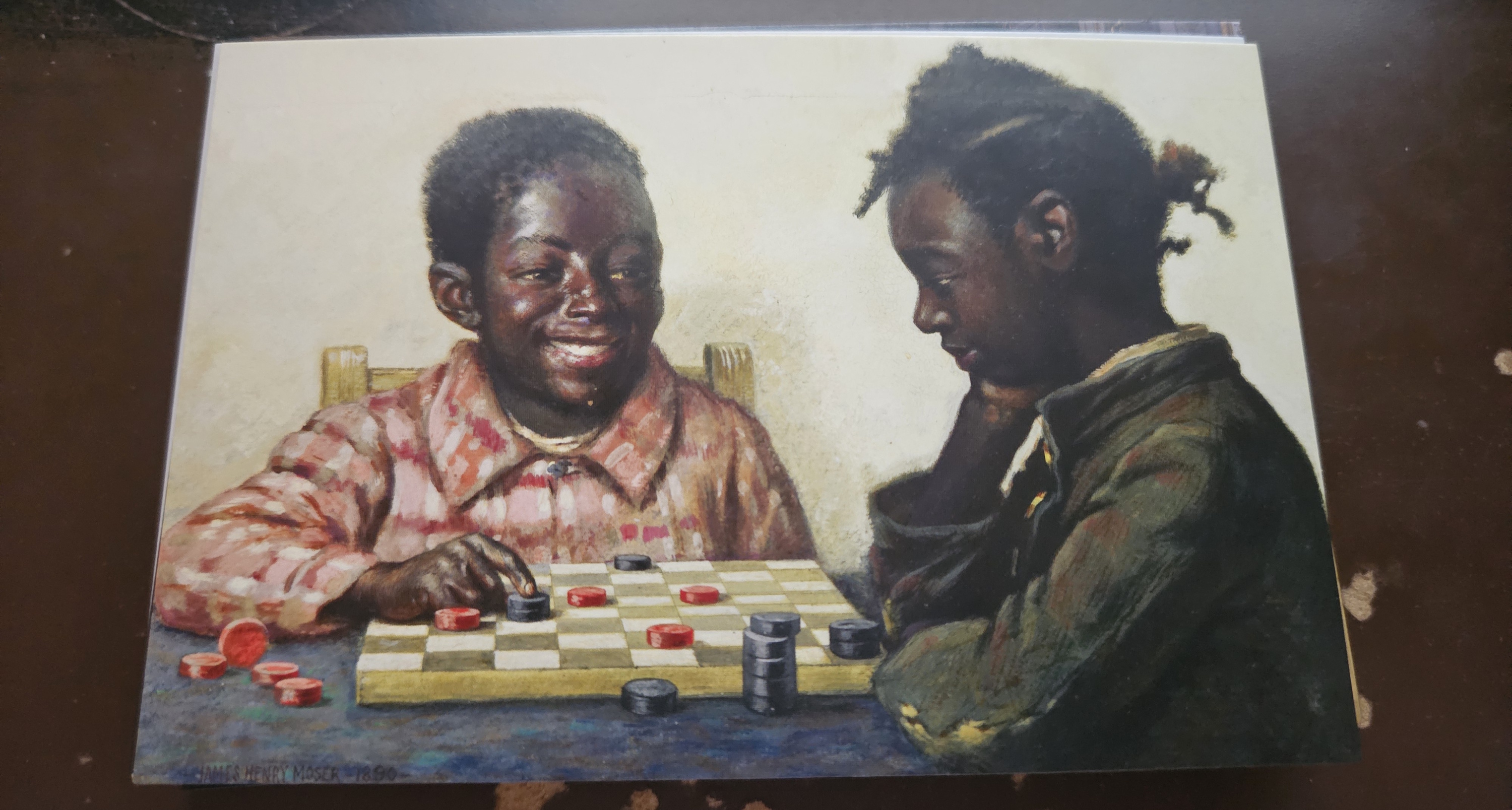
I’ve spent more time looking at the pictures than playing the game.
Picture this. In addition to the image title and author name and all that, the back of each card reveals a concept. Justice, perhaps. Loss. Passion. Surprise. On the table, you array five images, plus five more cards face-down to reveal a smattering of those concepts. Rebellion. Constipation. Transformation. Now somebody selects one of those ideas — in secret, mind you, in their brains, not aloud — and arranges the images in the order of how much they embody that idea. Left to right for all to see, from most to least. Grief. Relief. Justice. Oops, we’ve done that one. Shuffle it back into the deck. Betrayal. That’s better.
Now everybody else hems and haws and theorizes. Maybe Katsushika Hokusai’s “The Ghost of Kohada Koheiji” symbolizes anger? I mean, of course it does, but I mean right now, here, according to the five concepts on the table. But then we glance at the next image and it’s Brueghel’s “The Children of Planet Mercury.” Not very anger-y, y’know? Unless, perhaps, the arranger is struggling with their childhood faith, so any scene with a rooster-drawn chariots has certain connotations. Anger, then? Or maybe wisdom? The wisdom of the dead, the wisdom of rooster-drawn chariot-riders? Hmm. Humm.
It’s fine. Nothing incroyable, to pretend I know French. Too often it’s painfully obvious what the arranger intended to say; the rest of the time, it’s hopelessly obscure. Dixit was competitive, which ensured there were penalties for either extreme, the vague or the obvious. Mysterium was cooperative but muddied by the contrast between abstract images and concrete player actions. Here, the play is too straightforward to muster the necessary ambiguity.
Sure, there’s some of the usual apprehension that arises whenever we try to draw a box around things, to neatly cluster disparate ideas and images under shared headings. Is One Battle After Another just a social justice Star Wars? Is The Force Awakens just A New Hope for those who’ve misplaced their childlike sense of wonder? Is Star Wars just Vietnam? Are we just the Empire? Yes. I think so. Yes. I think I’m having more fun being discursive than actually talking about The Vibe. What I’m really trying to say is that the game wants to say something profound, only it doesn’t. It mostly prompts the occasional chuckle because somebody didn’t notice a detail when they examined the paintings.
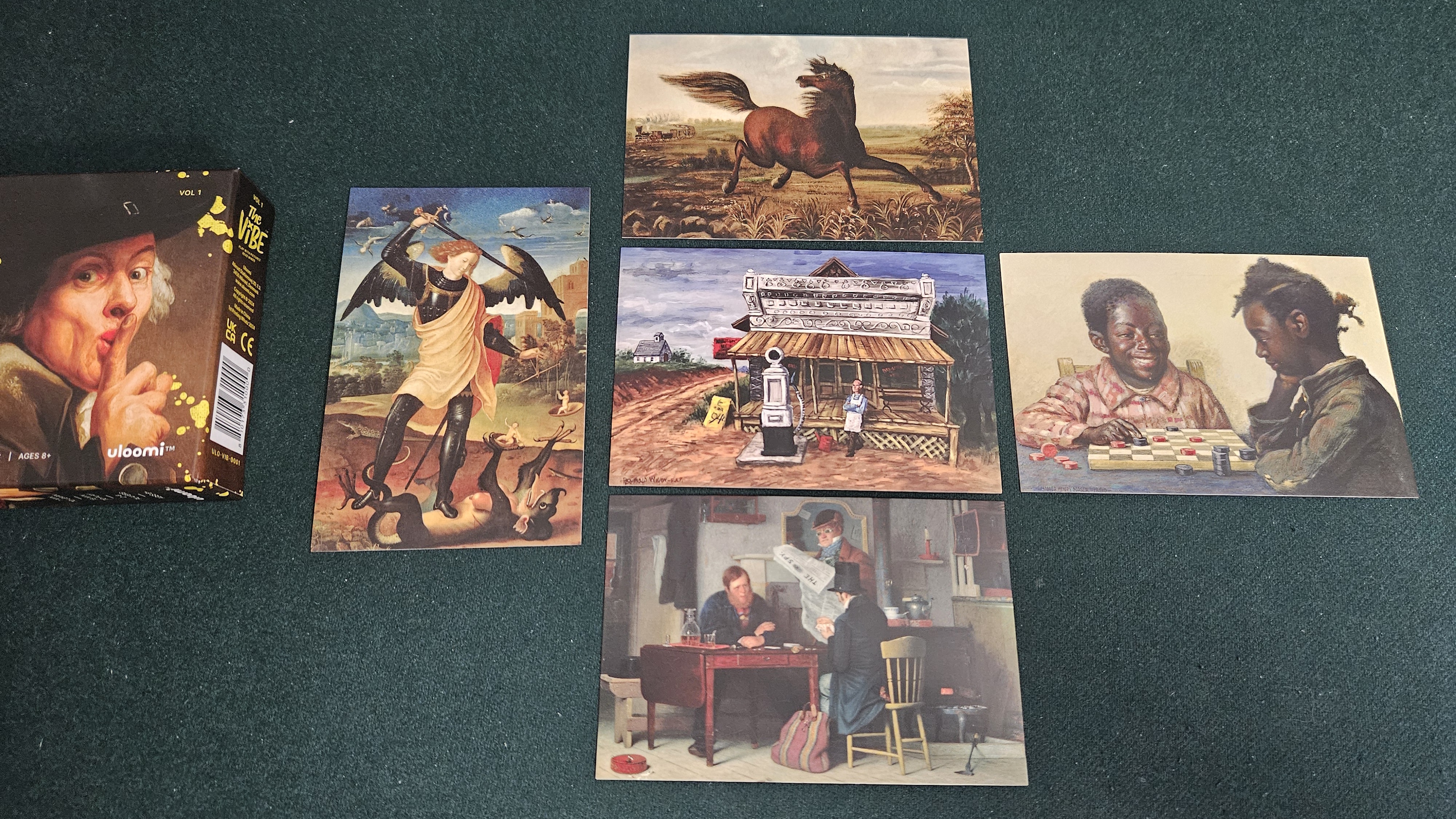
The cross-four version is significantly more interesting.
There are sparks of brilliance in this game. Especially in the advanced mode. This sees the arranger making two rankings instead of just one, this time exhibited in cruciform. Now two of those five concepts are superimposed over the images, one of them situated so that it fulfills both criteria, but only as the middle spot in both rankings. This gives the enterprise a greater density, allowing for wider interpretations and broader misunderstandings. It isn’t enough to remake the game into something smarter, more like the artists it admires than the observers who flock to see their work, but it does nudge it a little closer to becoming an engaging plaything.
Sadly, The Vibe isn’t going to redefine the party game as we know it. I wish it would. I wish it had revolution in its bones. That way, we’d be guaranteed another few boxes of sixty postcards adorned with perfect examples of human creation. Instead, The Vibes is one of the finest packs of postcards ever assembled — and a weak imitation of better titles about the wiggly nature of perception and interpretation.
A complimentary copy of The Vibe was provided by the publisher.
(If what I’m doing at Space-Biff! is valuable to you in some way, please consider dropping by my Patreon campaign or Ko-fi. Right now, supporters can read about which films I watched in 2025, including some brief thoughts on each. That’s 44 movies! That’s a lot, unless you see, like, 45 or more movies in a year!)
Posted on March 4, 2026, in Board Game and tagged Board Games, The Vibe, Uloomi. Bookmark the permalink. Leave a comment.

 SPACE-BIFF!
Leave a comment
Comments 0