The Old King’s Annulment
No need to bury the lede: as of this morning, The Old King’s Crown is now in funding for its second printing. If you haven’t read my review, the short version is that Pablo Clark’s debut design was a stunning achievement on every level.
Except, ambush!, there’s a second game afoot, and that’s the real target of my interest today. Included as an option for the crowdfunding campaign, Annulet is a card game that ostensibly exists within the broken realm of The Old King’s Crown. What is an annulet, you might ask? Short of being a legal way to divorce one’s spouse without God getting frumpy about it, an annulet is a little ring one might stick on a coat of arms or a pinkie toe. Exactly the sort of paraphernalia you might expect from the well-garbed folk of Clark’s faraway kingdom.
But is Annulet the sort of card game those selfsame weary warmongers would actually splay atop a knife-scored tavern slab? That’s the pressing question.
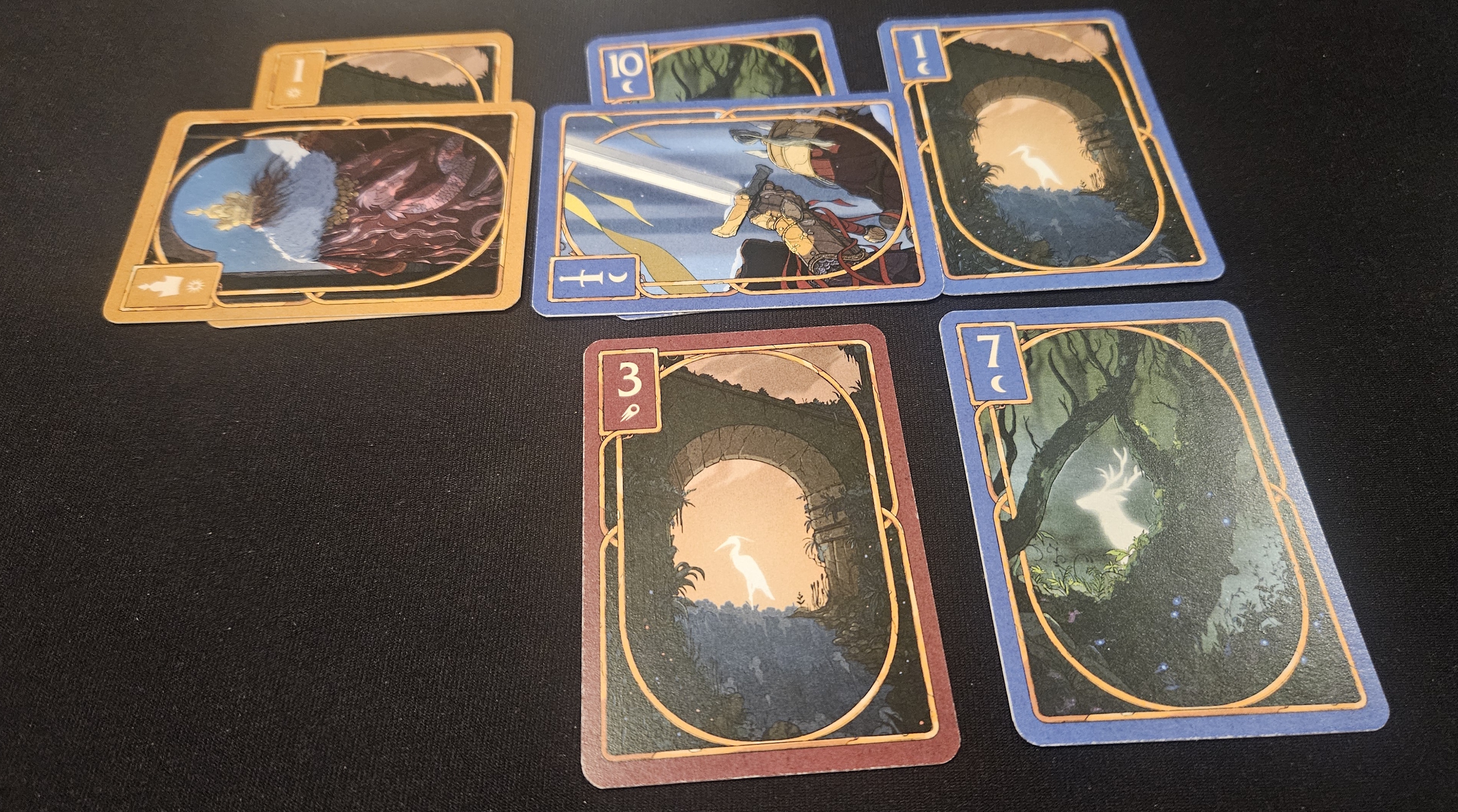
Cards are arranged on a three-by-three grid; score whenever you like!
At a glance, Annulet, like everything else in the world of The Old King’s Crown, is downright gorgeous. Also illustrated by Pablo Clark, even the prototype calls to mind a plate from a favorite childhood book of myths and tall tales, all enigmatic figures and crumbling aqueducts and mossy forests. Sure, it takes all of ten seconds to realize the game must have been designed with a regular deck of playing cards, given its four suits and face cards. So what? I can buy the notion that everything in Clark’s universe is just like ours but better illustrated.
To Clark’s credit, Annulet doesn’t play quite like anything else out there. At core it’s a market selection game. Every round begins with a few cards on offer, from which the players will draft some number into their supply.
How many cards? That’s surprisingly hard to answer thanks to the way Annulet morphs according to player count. While the rules don’t undergo any substantive changes when swapping from two players to three or four, its underlying ethos is so transformed that it becomes something fundamentally different. We’ll circle back around to this question. For now, the answer is “two cards with two players, but only one with three or four players.”
All right. So you take either one or two cards. These are added to your supply. From there, cards can be installed in your kingdom, which swiftly shapes into a three-by-three grid of lands and characters. In the short-term, cards in your kingdom are secure. Unlike those still in your supply, they cannot be stolen by upstart rivals. Thinking ahead a bit, your kingdom is also the basis of your scoring. At some future moment of your choosing, every row, column, and diagonal may form points-earning sets. The rarer the better.
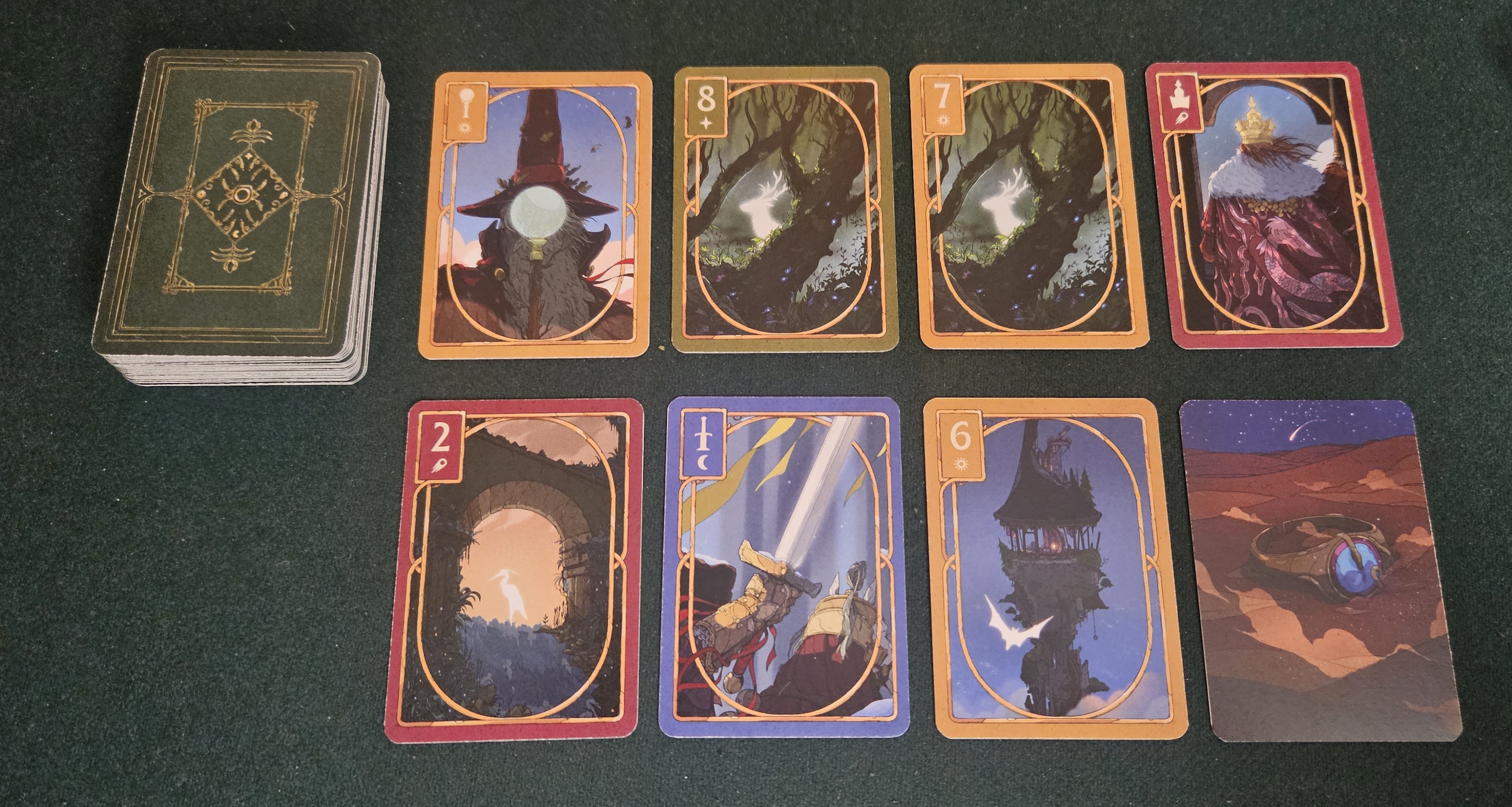
The market shows which cards are available now and later.
As befits Annulet’s heritage, it manages to feel simultaneously old and new. Old because it doesn’t stray far from any number of card-gathering and set-forming games of yore. There’s a comforting familiarity to its percentages, that instinctual understanding that a straight flush is rarer and therefore deserves more coins than three-of-a-kind. Unlike The Old King’s Crown, which was sometimes burdened by keywords and concepts and special abilities, Annulet holds its cards closer to our shared cultural vest.
But it feels new, too, thanks to more modern flourishes that make its cardplay more dynamic and open-ended than most tavern games. There’s the game’s currency, river stones that must be spent and even exchanged between players in order to install additional cards into one’s kingdom or swipe juicy offerings from a rival’s supply. There’s the way face cards are arranged atop lands to alter their values. In the case of magicians and knights, this means adjusting their host land’s suit or rank. Monarchs are even more potent, increasing the scoring value of any set they’re part of, and all the better if you can score them in multiple directions at once. At absolute best, a single monarch in the middlemost space of a kingdom can score four times. That’s rare, but it’s hardly impossible.
Crucially, these flourishes tell something of a story, or at least they gesture at the outlines of Clark’s fantasy world. Just as different trick-takers might speak to the sensibilities of those who played them historically, whether as domestic parlor games or the pastimes of naval officers padding their peacetime income, Annulet speaks to a kingdom that’s always reshaping itself. Monarchs come and go. Treasures are gathered and plundered. Violence is so matter-of-course that the apex of a kingdom is also its dissolution.
The smartest of Clark’s inclusions are the tale cards. Each session opens with players selecting a pair, whether by choice or at random. At a gameplay level, these are modifiers. Textually, they’re regional variations. One session might feature “the People’s Game,” scoring extra points for sets that sum to a small number, while the next revolves around “Border Reaving” that adds junk cards to opposing kingdoms. The effect isn’t dissimilar from the many small variations in trick-taking or shedding games, leaving the core rules intact but tweaking the game’s breadth. The result is a title that feels as large as the world Clark penned to contain it.
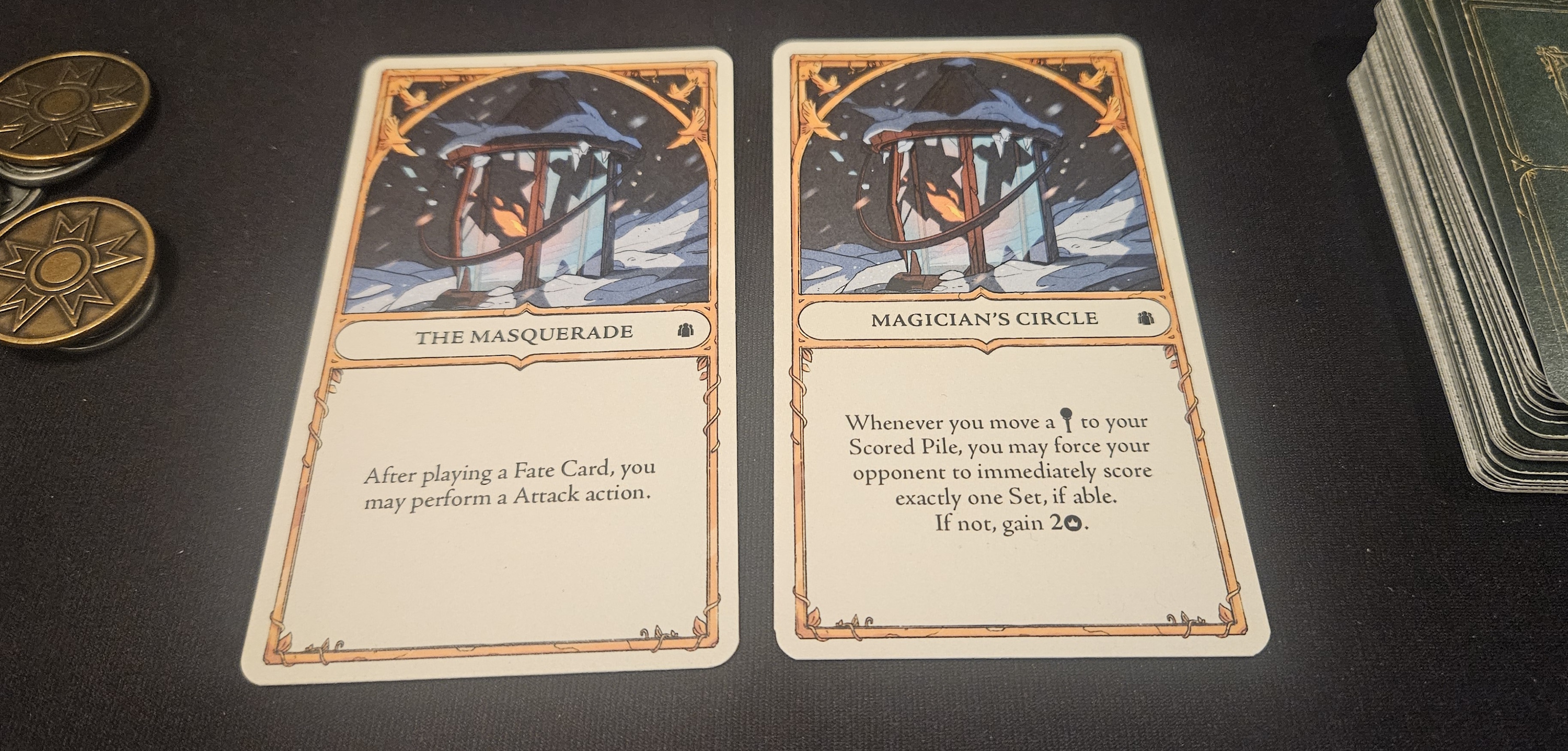
Regional variations keep each session fresh.
This isn’t to say that Annulet escapes wholly unscathed, either as a plaything or within its internal fiction, and those scathings are largely interrelated. The short version is that the game is simply too permissive — in one sense, too modern — to pass muster as something that might appear in a military camp or dimly lit roadhouse.
First of all, the scoring is tremendously intrusive, often requiring an extended pause to sum up every one of a kingdom’s angles. On its own, this isn’t such a bad thing; we share a reality with Germans who play Schafkopf, so it isn’t as though real-world tavern games haven’t ever belabored their scoring to the point of madness. But where Annulet slips is through the inclusion of special cards called fates. Everybody begins with a few of these and can purchase more for a heap of river stones. From there, fates pull multiple duty. They potentially add to one’s score at the conclusion of the game, and can be spent to place trash into a rival’s kingdom, seize the all-important initiative marker for yourself, or enter your own kingdom as a wildcard.
It’s this latter function that gives Annulet its bagginess. A fate can function as anything: any card, whether land or nobility. But in scoring, it must adopt a single posture — not always the easiest thing to visualize when there are a full eight sets that might be assessed at any given moment — and the problem only compounds in kingdoms with multiple fate cards fulfilling many roles. Too often, Annulet hinges more on how permissively one employs their fates than how sharply they draft their kingdom.
This is a small complaint, but it’s small the way a pebble is small when caught inside one’s shoe. Annulet is too broad, failing to quite capture the sensation of playing and mastering a truly great tavern game, one defined as much by chance and limitation as by the range of things a player might accomplish on their turn. It’s like playing a trick-taker with a bunch of wilds; thrilling the first time you steal a trick, obnoxious when everybody’s doing it all the time.
Perhaps more pronounced, the game is a different beast depending on player count. It will probably surprise nobody to hear that it’s strongest at two players, which affords greater numbers of drafted cards and a tighter focus all around. Higher counts clutter the decision space a bit, especially where initiative and drafting are concerned, but three-player is charming in its own way. Annulet is at its strongest when it presents that razor-wire choice of which cards to draft and how to use them. With each additional player, that sharpness is blunted.
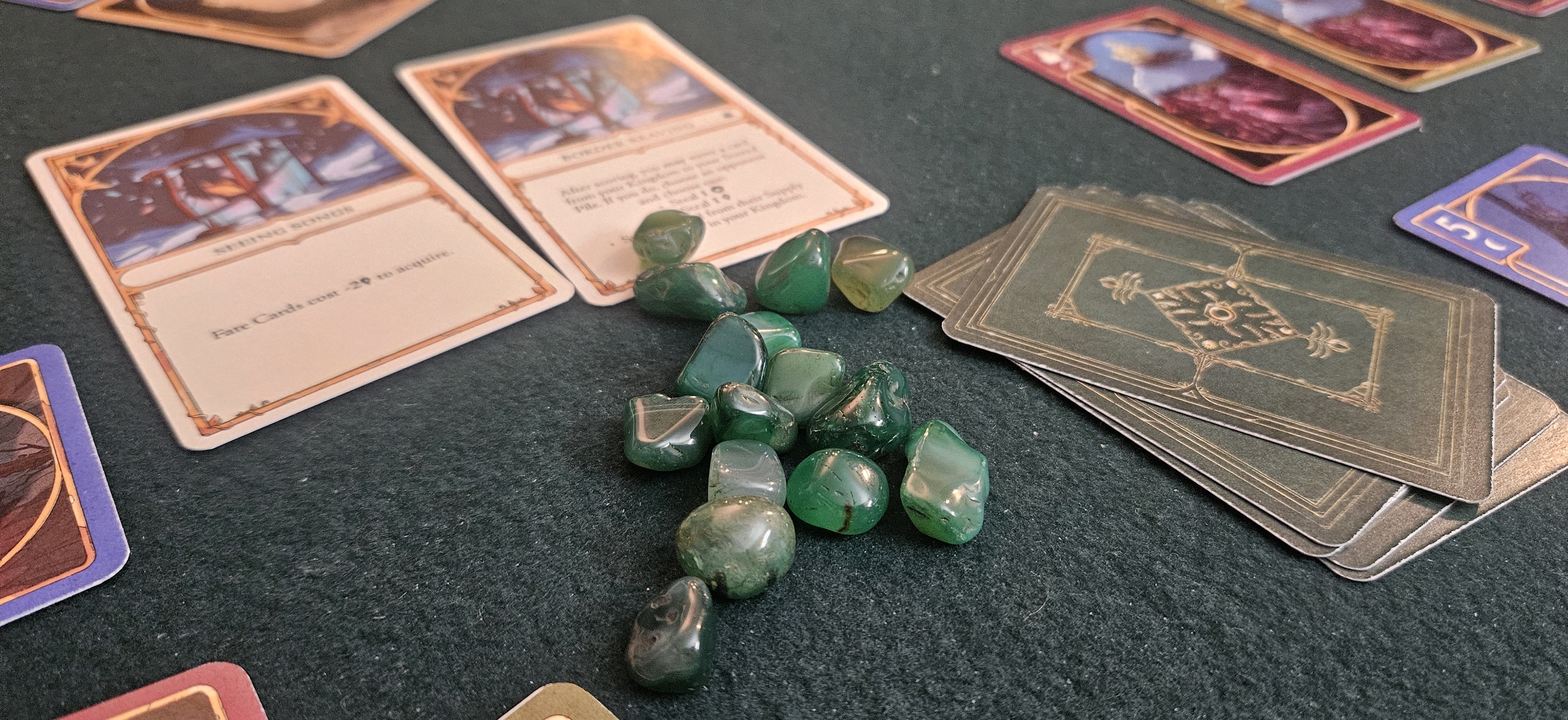
I’m a sucker for river stones. (Disclaimer: not real river stones.)
Apart from that, however, Annulet is quite the production. Even at its flimsiest, it’s lively and exciting. More importantly, as a diegetic artifact it speaks to the breadth of this place Pablo Clark has envisioned, something Baron Cuttlefish might splay atop the camp-table on the eve of crushing the Speakers of the Wood. With one finger he traces the rim of his goblet, heedless that the Vial Sect has already dusted the brass with their bitterest toxin. By the time the Ornithopter Club swoops down from the hills, his pulse will have already stilled.
Ahem. Look, it’s good stuff, even when it doesn’t hang together quite as tightly as I had hoped. For a follow-up to what was perhaps last year’s most exciting debut title, that’s no small thing. The result is an imperfect game, but a lovely and evocative experience nevertheless.
A prototype copy of Annulet was provided by the publisher.
(If what I’m doing at Space-Biff! is valuable to you in some way, please consider dropping by my Patreon campaign or Ko-fi. Right now, supporters can read about which films I watched in 2025, including some brief thoughts on each. That’s 44 movies! That’s a lot, unless you see, like, 45 or more movies in a year!)
Posted on March 3, 2026, in Board Game and tagged Annulet, Board Games, Eerie Idol Games. Bookmark the permalink. Leave a comment.

 SPACE-BIFF!
Leave a comment
Comments 0