Flip-and-Curse-That-Stupid-Dragon
Remember when every other game was a roll-and-write? That was living proof that even golden ages come with cloudy linings. Flip Pick Towers, designed by Rob Fisher and Adam Porter, benefits from its release a few years after the slew of samey writing games. It’s an unrepentant flip-and-write, is what I’m saying, more in the vein of Cartographers than the form’s more mathy alternatives. Some artistic talent won’t go amiss.
For those of us who can’t even sketch a convincing stick figure, however, it’s still charming, albeit not perhaps as compelling as some of the options out there.
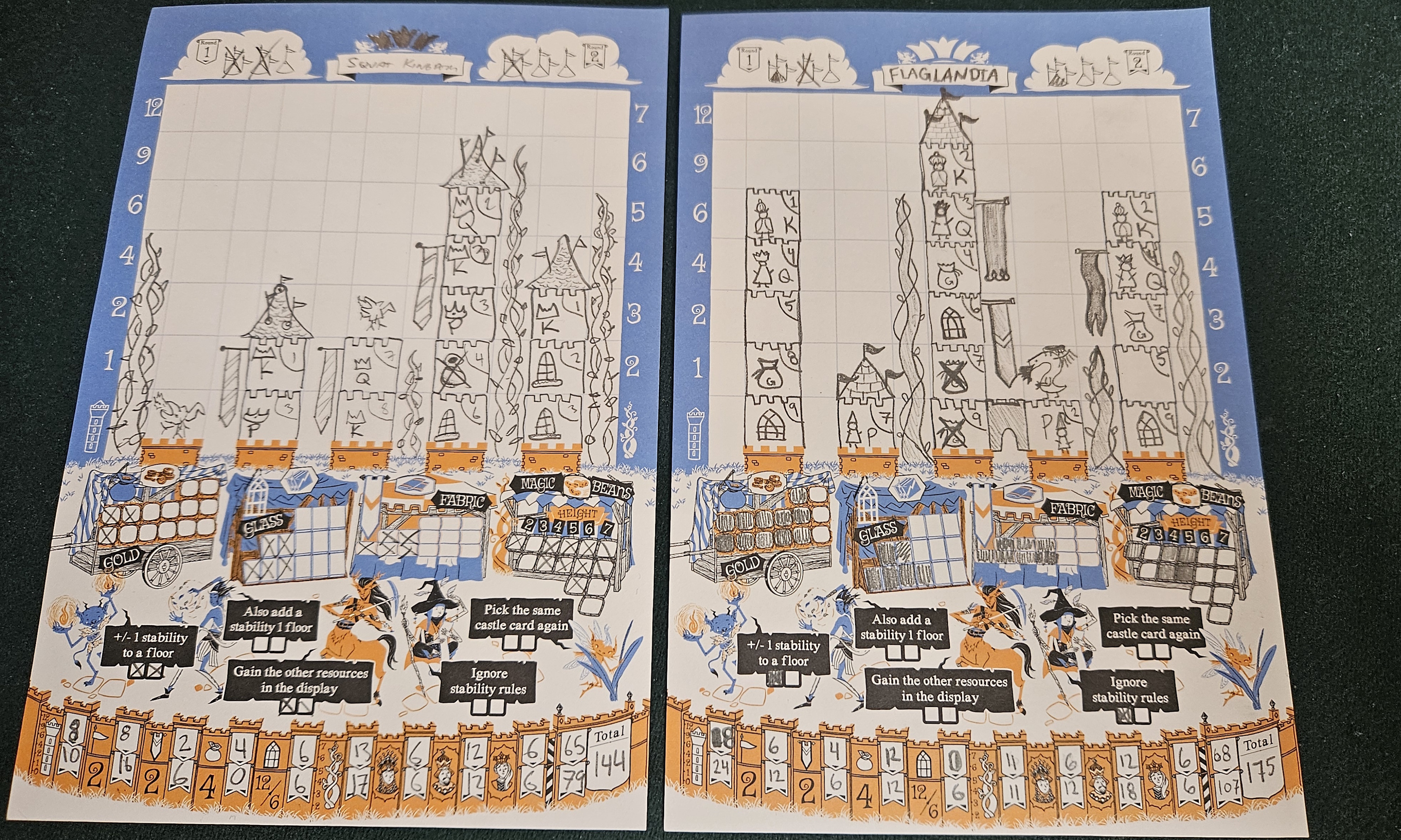
Two very nice towers. (Not mine. Obviously.)
Stop me if you’ve heard this one before. Every round, three cards are flipped. Everybody at the table picks one — different ones, the same one, it doesn’t matter — and pens it onto their personal sheet of paper. Once the deck is out, it’s time to score.
There are a few little distinctions that set Flip Pick Towers apart from its peers, and no, I’m not talking about how the game’s title is a literal description of its phases. For one thing, the game cleverly triggers its scoring phase twice. This potentially pushes you through the deck twice, which is nice for those who are still learning its composition, but also encourages players to hustle toward scoring goals early rather than waiting for them to come together at the last moment. It helps, too, that it’s entirely possible for somebody’s failed castle to end the game a few rounds early. So much for that last tower you were hoping to stretch heavenward.
The constituent parts of your castle are simple enough. Most cards represent floors. These you stack like LEGO blocks, always keeping an eye on their stability number, which must tick downward with each successive level. Eventually bridges can span the gap between floors, providing foundations for further building and bypassing the usual stability rule for a moment. Look, it’s basic architecture. If you lean two crumbling minarets against one another, you can pile another few hundred tons of hewn blocks between them. Everybody knows that.
There are also magical creatures who provide special abilities — like, say, ignoring a floor’s stability, easily the most potent ability in the game — rooftops that can earn a few points but conclude a tower’s upward trajectory, and royalty who occupy all those empty rooms to score points. More on their majesties in a moment.
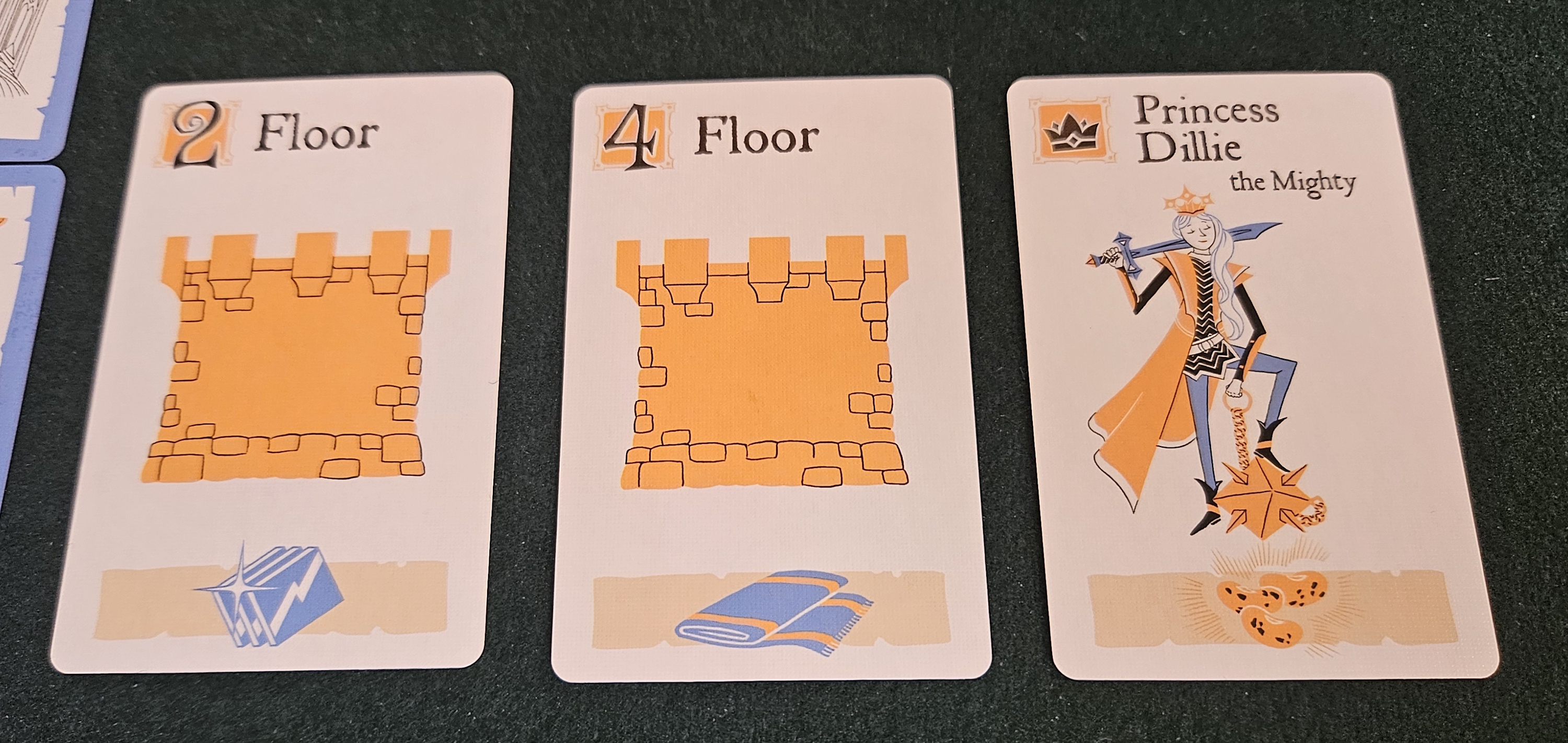
Every turn, you select from three cards.
Finally, every card also provides a material of one kind or another. The format for these is simple enough, adding new features to your castle whenever you complete a material’s column. Hence glass introduces windows to your castle, bags of gold eventually fill entire floors, and banners hang from on high while magic beanstalks creep up from below. In fine flip-and-write fashion, these soon jostle for space. There’s room for planning, but remaining inflexible is a surefire way to get nothing done at all.
The last type of card is a dragon. Argh, the dragon. There are two of these in the deck, meaning you might see four of the winged pests in a sitting, and they’re as unwelcome as it gets. Whenever one of the sky-rodents appears, you either place it atop one of your towers — blocking further construction, which can be a real nuisance if they appear in the game’s early stages — or scrawling out one of your hard-earned bags of gold to buy them off. Thankfully, they are not sexist dragons, and no sacrificial princesses are required.
Speaking of princesses, the most interesting offering by far are the royalty cards. Each session assigns an objective to your queen, king, and princess. As their chambers are added to your towers, their points tend to compound. And compound. And compound. It isn’t uncommon for a single royal member to score as much in the endgame as a player earned at the midpoint tally.
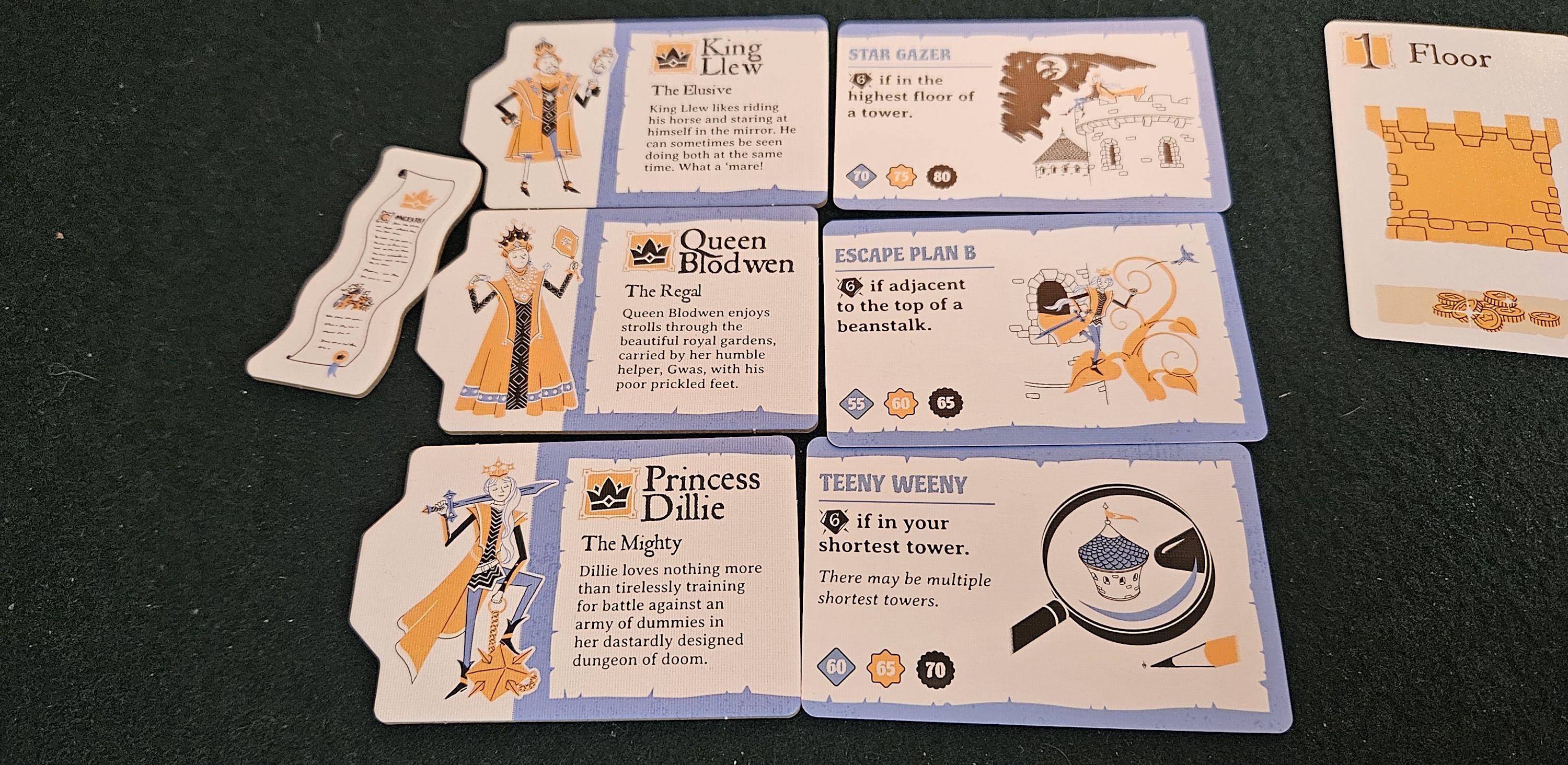
The needs of your petty royalty.
In the best of instances, these transform the game’s sometimes obnoxious placements into significant opportunities. Remember those dragons? Well, if your king prefers occupying towers with dragons perched on them, now you can keep your gold and take care of the old man at the same time. All the better if you manage to erect a single tower with a single dragon atop it, then fill the place with four or five stacked kingly quarters. The same goes for the other elements. One session might feature a queen who yearns for escape, encouraging you to place those magical beanstalks next to her chambers rather than doing the normal thing by squirreling them off. Or, heck, a princess who just really likes living near bridges. Don’t we all appreciate a nice bridge?
Not every objective is similarly worthwhile. For every goal that enlivens the game’s placements, there’s another that’s plain uninteresting. After a couple plays, our group reached the point where we would keep drawing through the deck until we found something that felt sufficiently energetic.
Even then, the overarching puzzle doesn’t change much from one session to the next. On the whole, there’s enough to keep everybody engaged, at least for a session or two. But the gameplay is simple enough that, barring the pleasure of scrawling a little castle, with little banners that look like banners and not whatever my castle’s banners look like, there probably isn’t much to keep anyone coming back time and time again.
It is, in other words, a flip-and-write. A very good flip-and-write, a charming flip-and-write, a flip-and-write with plenty of little considerations to account for. But it doesn’t stand up there with the finest of them.
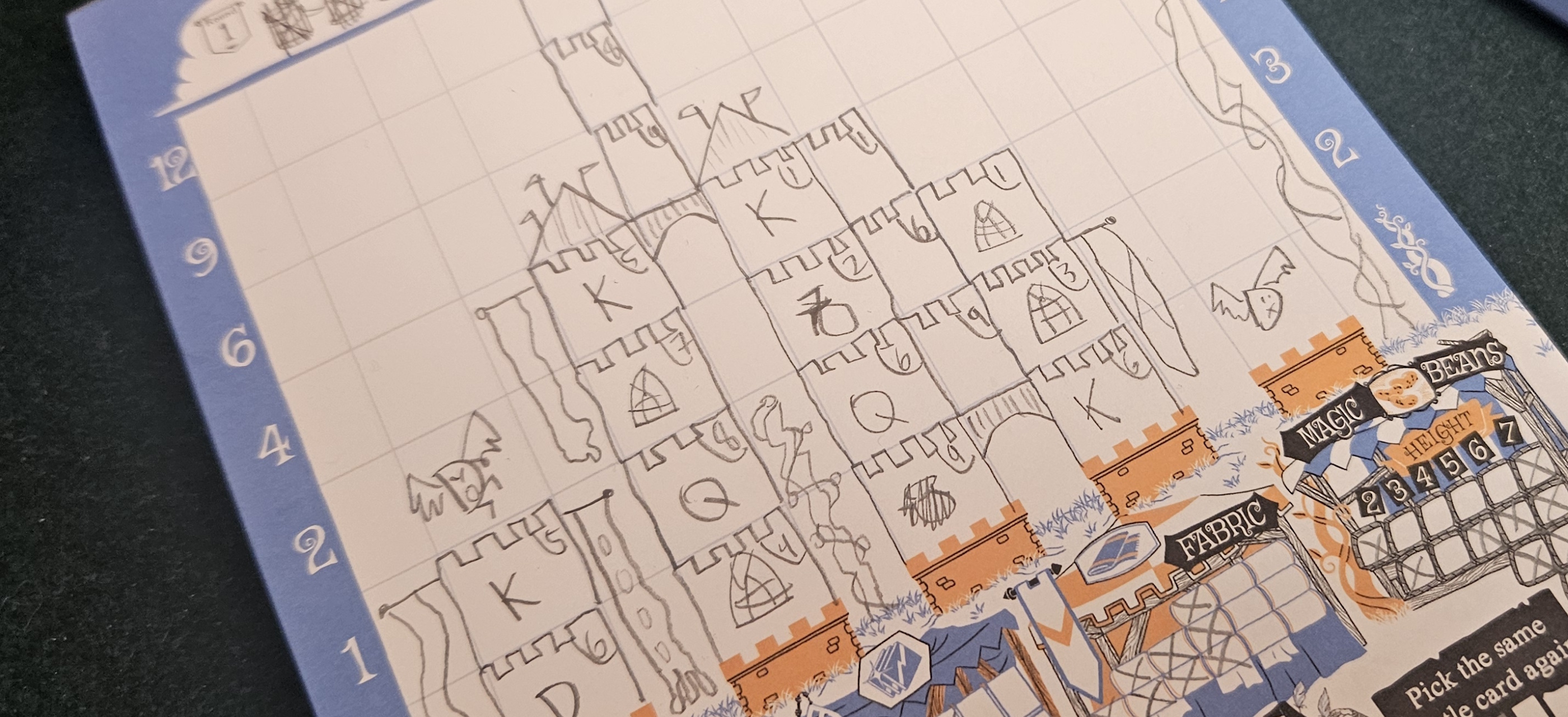
Fine. Here’s my garbage tower.
Maybe it doesn’t need to. I’ll admit I’ve enjoyed looking at my friends’ creations, and even letting them laugh at mine. To go with my perfect face for radio and outstanding voice for text, I have excellent penmanship for a keyboard. Once, I wasn’t even sure whether a room’s occupant was a Q, for the queen, or a bag of gold with a little knot cinching it closed.
Anyway. Flip Pick Towers. It’s cute stuff. I’ve had a nice time with it. I suspect I’ll strain to remember it by year’s end.
A complimentary copy of Flip Pick Towers was provided by the publisher.
(If what I’m doing at Space-Biff! is valuable to you in some way, please consider dropping by my Patreon campaign or Ko-fi. Right now, supporters can read about which films I watched in 2025, including some brief thoughts on each. That’s 44 movies! That’s a lot, unless you see, like, 45 or more movies in a year!)
Posted on February 26, 2026, in Board Game and tagged Board Games, Flip Pick Towers, Osprey Games. Bookmark the permalink. 6 Comments.

 SPACE-BIFF!
Is the royal family… Welsh? What does this mean? Do magical architecture-defying towers exist solely in Wales? Is Wales not actually a real place?
An odd choice, looks charming though.
Reminds me quite strongly of the tile placement game
Castles of Caladale.
Although admittedly that doesn’t have princes present.
Cheers.
All I ever play anymore is blank ‘n writes.
Life is a blank and write. The writing is taxes.
I’ve gotta ask: what are the finest?
My personal faves would include Fliptown, Hadrian’s Wall, and The Anarchy. I would also prefer to play Twilight Inscription to this, although it has its problems.