Yer All Sheeps
For my money — or, all right, for my attention — Blaž Gracar is one of the finest puzzle-makers of this generation. Between All Is Bomb and LOK, I’ve spent countless hours fiddling my way through some conundrum or another, thinking the madman must have left a typo on the page, only to let out an exasperated sigh as, of course, the solution was there all along. Even his lesser efforts, Abdec and Workworkwork, have proved worthwhile.
Herd is his latest project, and its adorable stacking domes bridge the gap between puzzle book and board game. In some ways it’s his most “straightforward” offering. Of course, that still means it’s twisted and full of secrets.
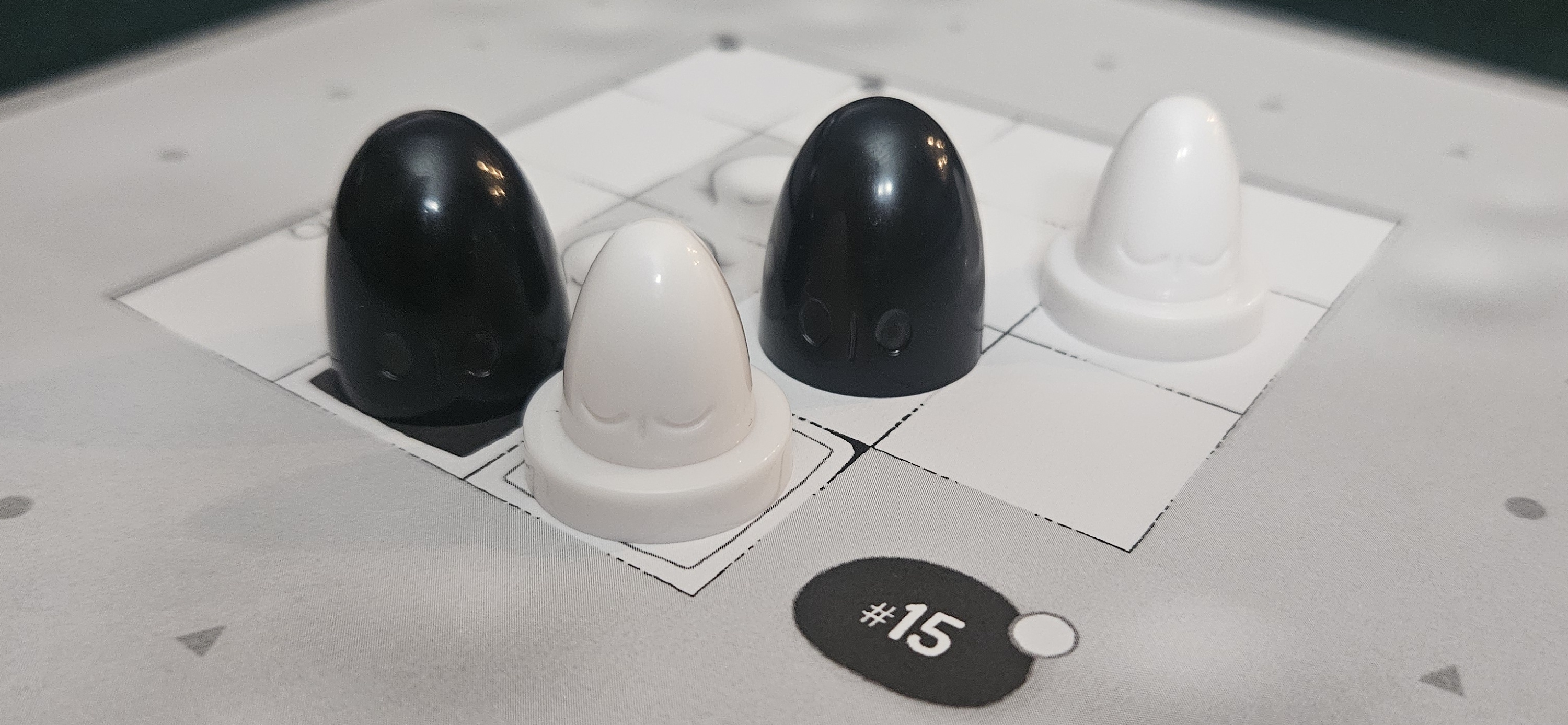
Oh, this won’t be too hard, will it?
At a glance, Herd is a sokoban game. A block-pusher, to use the more colloquial term, one of those playthings where you can see the pieces on the board, can see the receptacles those pieces need to be slotted into, only there are innumerable steps and switchbacks between source and destination.
The wrinkle here is that your pieces are no ordinary pushers and pushees, but rather herders and herdees. The two black pieces are shepherds. Their default motion is the slide, like rooks gliding across a chessboard. As soon as they reach a bump — whether another piece or a peg printed onto the page — this transforms into a simple hop, one space over the intervening obstruction. Hopping may result in a shepherd landing atop another piece. This gives them command of whatever is underneath them, in many cases a white sheep, immobile on their own. Now they glide together, shepherd and sheep, letting you shift the requisite pieces ever closer to their destination.
Herd is presented as a spiral-bound book of puzzles, and its first few pages are simple enough. A hop or two, some slides, and your sheep and shepherds will get where they need going. It’s something of a dance chart, those black and white footprints on the floor. The trick lies in discovering how they flow together.
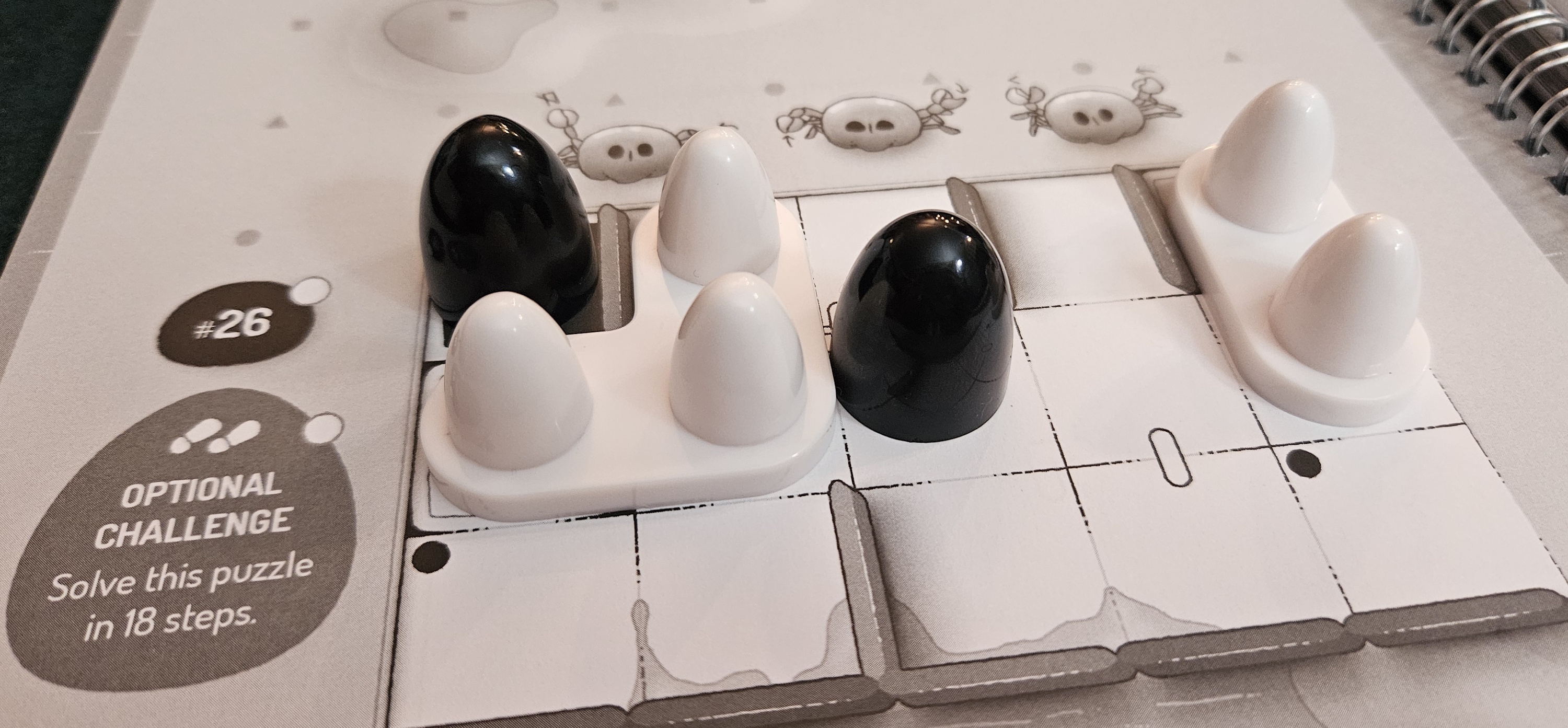
Still not too bad.
It isn’t long before Gracar starts pitching curveballs. First come the new shapes of herds: a two-space herd, another in the shape of an L. These are moved the same way as their smaller kin, only when shepherded from place to place. But they move all at once, resulting in big lumbering glides that are easily blocked by small obstructions and need to make three-point noodles to sidle around a corner.
Then holes for trapping herds, turning them into static pegs that can be hopped over but not shifted free. Then variable setups, multi-page puzzles that see you shepherding in pieces from variable angles, pages that contort as they shift across the spiral binding, hidden objects, [redacted]. The dance chart grows more complicated, less the steps to a waltz and more the cow-hide puzzle of a ballet.
Of course, it’s both brutally difficult and shockingly elegant. Like Gracar’s previous puzzles, there’s an element of the obvious to Herd. It’s the sort of game that sees you fiddling with the pieces, shifting them back and forth, caught in an agonizing loop, only to, wait, there it is, the way through, and how could you be so obtuse that you never saw it before?
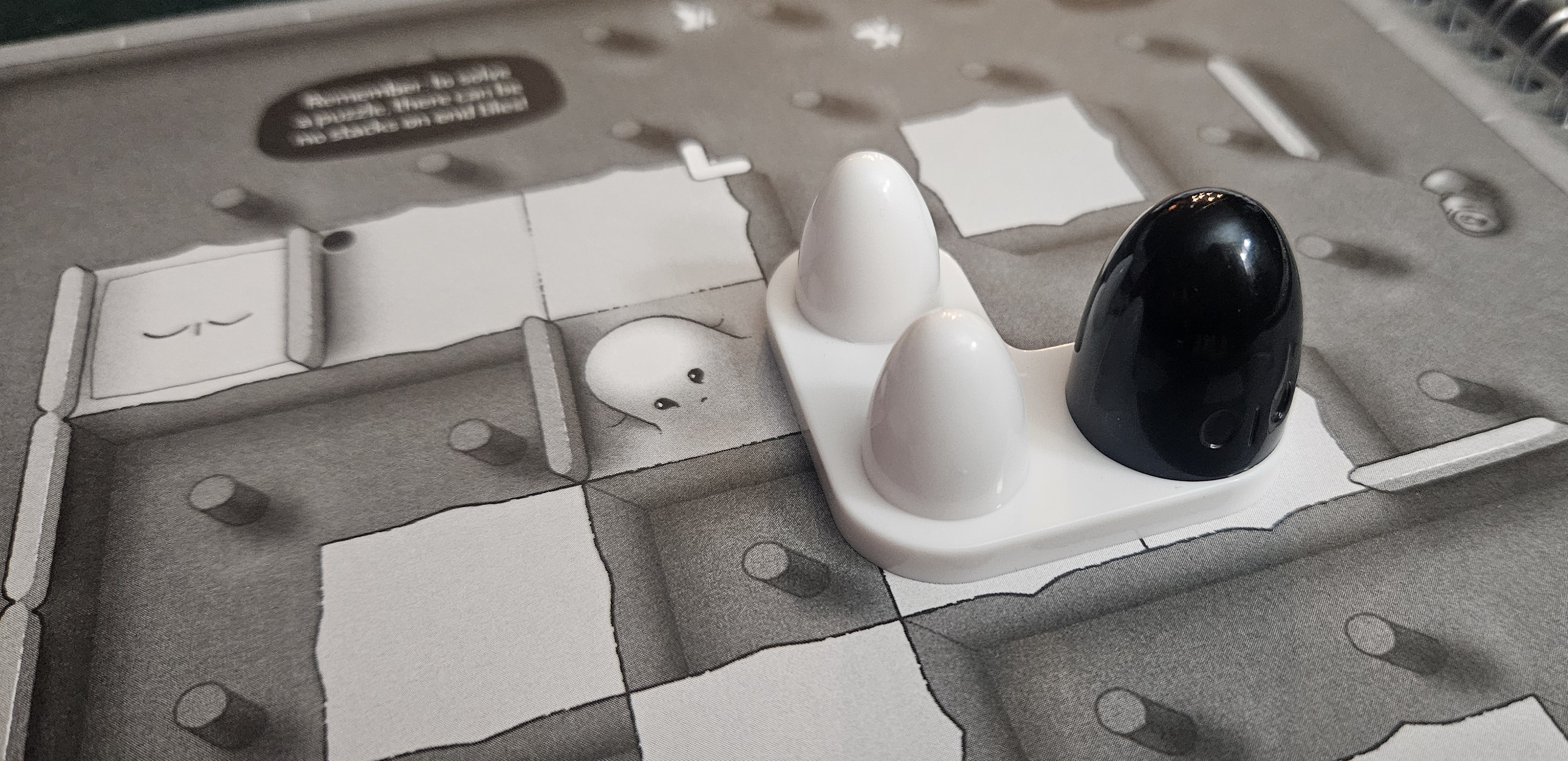
Uh oh.
Perhaps its biggest departure from LOK and especially Abdec is that you’re told the rules outright. There’s no need to guess what a particular arrangement of pieces can do. Sometimes the pages even reveal little hints, like a reminder that sliding onto a fresh page might obstruct a particular object from popping into existence. Most of the time, the tools at your disposal are clear.
I say “most of the time” because there are exceptions. Brilliant little exceptions that are a delight to uncover. But why would I tell you about those? There’s joy to be found within those pages. Even when the game isn’t as jam-packed with the wonderment that marked LOK — and made Abdec into a miniature hell — I wouldn’t dream of spoiling its best moments.
To some degree, this marks Herd as Gracar’s most conventional offering yet, although that’s like calling a coronal loop dimmer than the sun that birthed it. Even as someone who’s grown weary of sokobans, the formula here is distinct enough that I couldn’t help but leave the game set up on my game table for nearly two months, beckoning for me to tackle just one or two pages at a time. There its wide-eyed shepherds and sleepy herds called to my twelve-year-old; she learned it with me, then designed her own puzzle sliding game based on its moveset and stacking. The whole way, I was always eager to see the next ace up Gracar’s sleeve, never bored with the previous trick. That’s the game’s secret weapon. Its pacing is immaculate. As soon as one concept becomes second nature, it’s onto the next thing, and then the next, the previous lessons unfolding into the texture of each page.
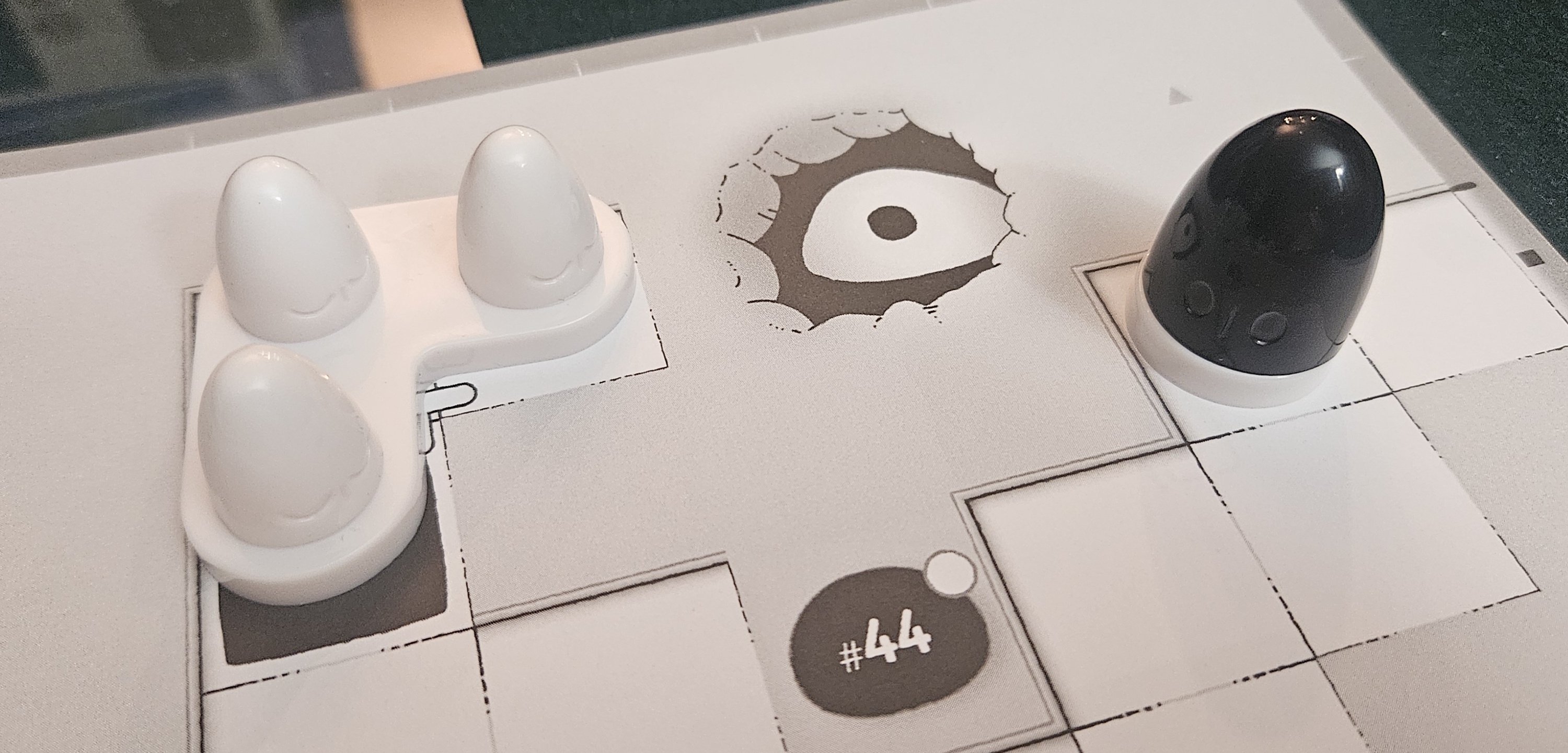
You can’t tell from here, but my head is hitting the wall repeatedly.
I will offer a warning. The game’s second act poses a tremendous cognitive leap from the first. What was once a straightforward puzzle book becomes something more. Something more Gracarian. Also something more frustrating, with new variables that at times tip over the edge from elegance into cacophony. By the time I reached the ending, after struggling through the final multi-step puzzle, my prevailing emotion was relief.
But what a journey up to that point. As ever, Gracar is one of our premier puzzle-makers not only because he can craft wonderful rulesets and excellent single-page enigmas, but because his mind seems to leap off the page. Herd is such an exemplar. Just when you think you have it pegged, it strikes off in some new direction, leaving only breadcrumbs in its wake. The result is perplexing and exciting, lovely to look at and handle, and above all, insistent on revealing the next surprise.
A complimentary copy of Herd was provided by the publisher.
(If what I’m doing at Space-Biff! is valuable to you in some way, please consider dropping by my Patreon campaign or Ko-fi. Right now, supporters can read about which films I watched in 2025, including some brief thoughts on each. That’s 44 movies! That’s a lot, unless you see, like, 45 or more movies in a year!)
Posted on February 17, 2026, in Board Game and tagged Alone Time, Board Games, Herd, Letibus. Bookmark the permalink. Leave a comment.

 SPACE-BIFF!
Leave a comment
Comments 0