Broken Clocks
The consensus on Take Time, the abstract teamwork game by Alexi Piovesan and Julien Prothière, seems to be that it’s Wolfgang Warsch’s The Mind but Even More, which means, mercifully, that it’s marginally less likely to spur tedious arguments over the difference between an activity and a game.
As an enjoyer of The Mind, at least in moderation, I figured I should take a look. Here’s my professional diagnosis: It’s The Mind but Even More. Even the hivemind’s broken clock is right twice a day.
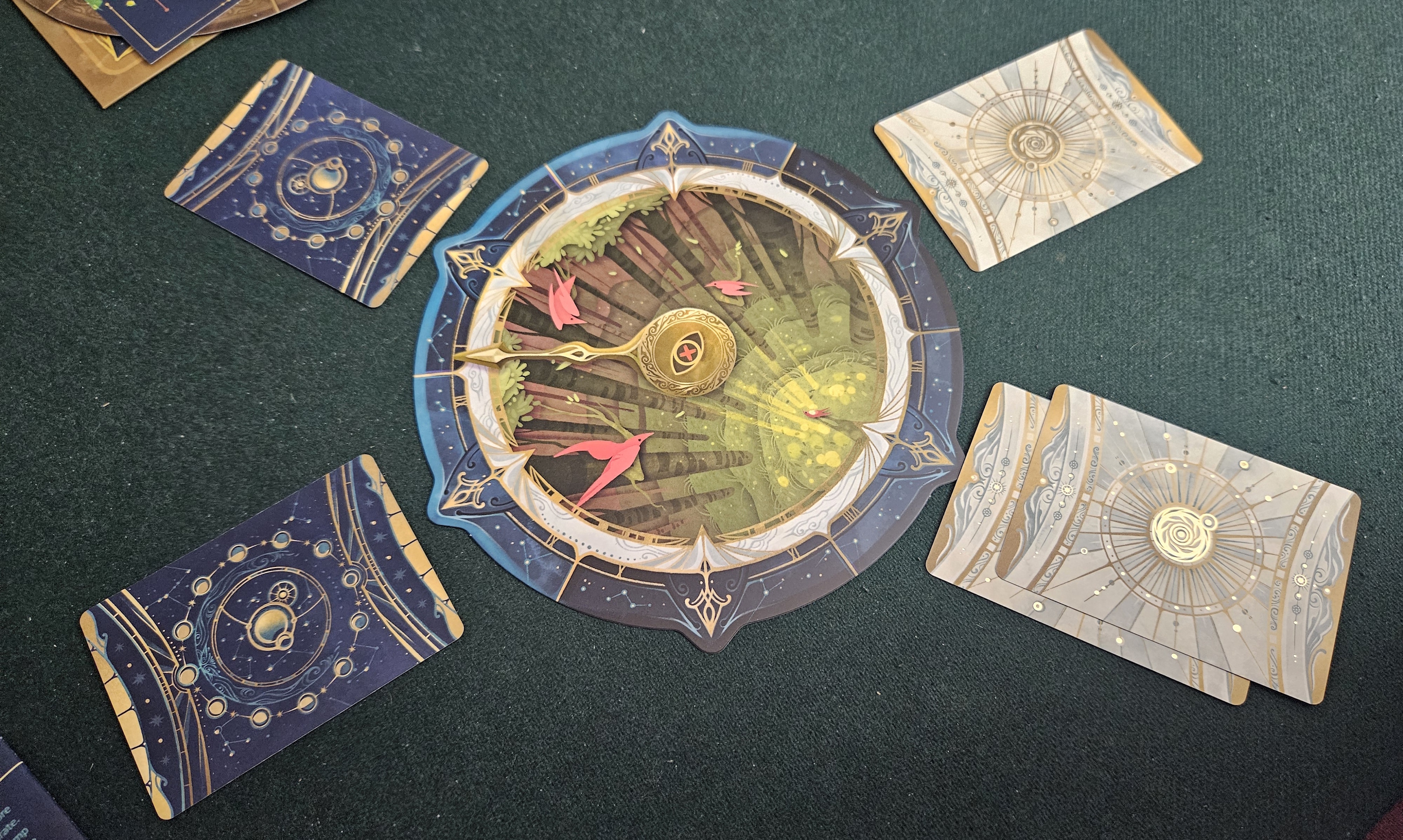
Pretty!
Speaking of broken clocks, Take Time is fashioned as the very same, an analog clock with six segments instead of twelve, and an especially illegible one at that, but one that’s perfectly suited to counting cards and staring apprehensively at one’s fellow players.
Like The Mind, Take Time is all about ordering cards into their correct sequence, although in this case the question is more cerebral and less about marching in time to a shared internal metronome. Your primary tool is a deck of cards. There are two suits, both of which show ranks from 1 to 12. Some number of these cards will be distributed to your team, and it’s your task to arrange them around the clock according to a few simple rules that naturally turn out to be anything but simple to execute.
There are three cardinal placement rules. Rule the First: Each of the clock’s six segments must have at least one card next to it. Rule the Second: The sum of each segment’s cards must match or exceed the tally that came before it. Rule the Third: None of these sums may break twenty-four.
That last rule is the really crucial one. No surprise, but it’s what keeps Take Time from feeling trivial. Sure, you could make a plan to dump everybody’s low cards onto the clock’s lowest hours and then build to the higher segments. But (1) you’re only dealt half of the deck in any given session, which means you can’t count on any given rank appearing to solve the problem, and (2) because you can’t bust twenty-four, it quickly becomes necessary to spread out your cards a little more smartly.
In addition to the game’s cardinal rules, each clock offers its own variations. Early on, these are familiar enough. Perhaps a segment will only hold white cards (rude), or require exactly a pair, or have the closest sum to 12, or be the recipient of the first two cards played to the table, or only be laid face-down.
Ah, that’s right, facing. Most cards must be played face-down. But depending on the player count — and successive failures — a certain number can be visible. Take Time is often about signaling. A face-down card to indicate you have a segment handled, a face-up one to ask for help. An exploratory digit here or there. Clearing your throat and displaying your color-coded card backs for all to see.
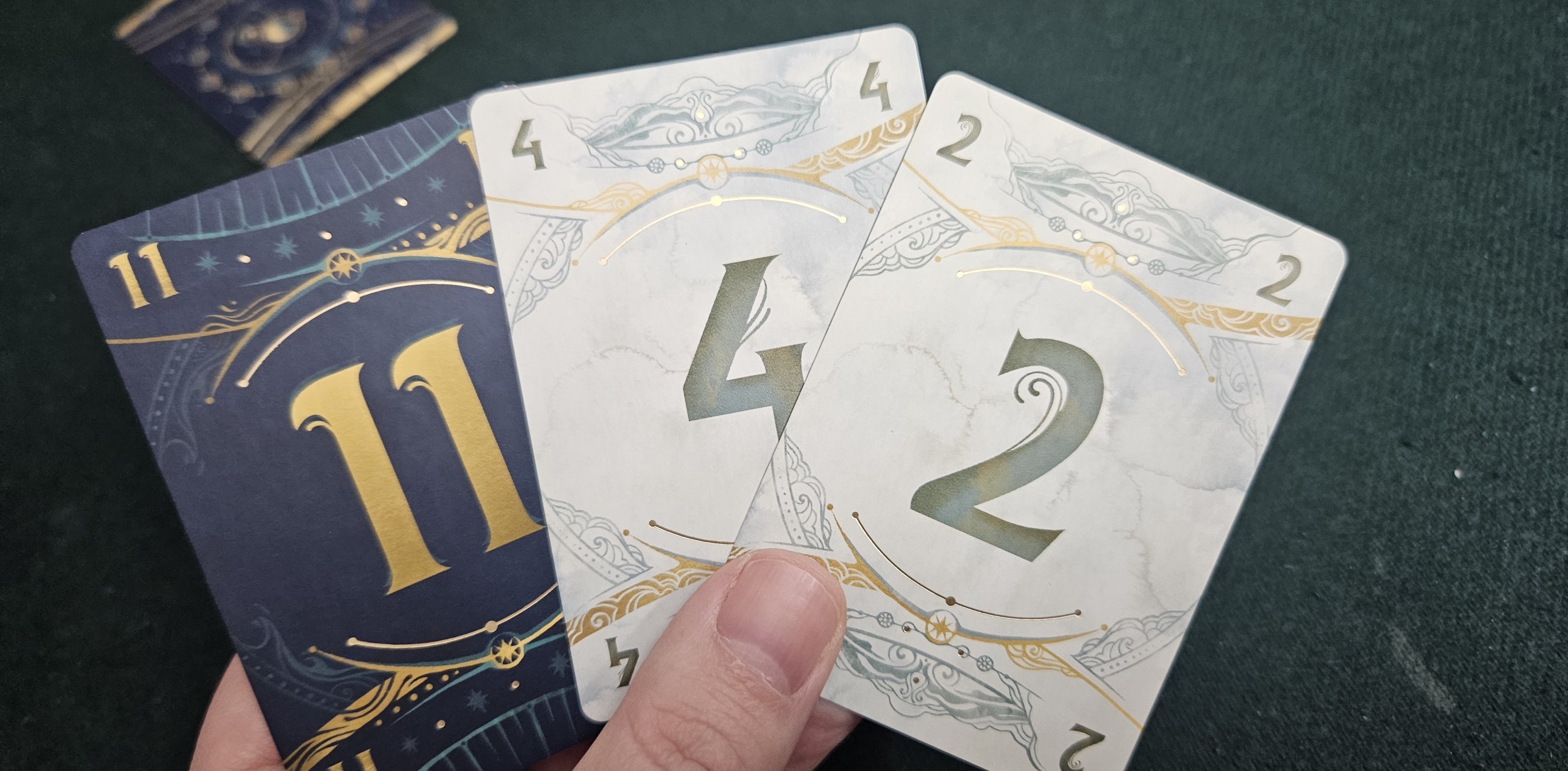
Some of the cards.
At a mechanical level, none of this is all that proximate to The Mind. Even the shared notion of playing cards in sequence is fundamentally distinct. Here, there’s nothing preventing you from playing your middle cards first, provided the eventual sum on the clock is ascending. At least until you reach the envelope where all the clocks demand you play in a certain order, anyway.
But comparisons to The Mind are apt because the sensation both games produce are largely similar. This is a low-communication game — not zero communication, although it bills itself that way — that likes to dwell somewhere in the pit of your stomach. It’s contentious in the same way as Warsch’s card game, everyone quick to lay blame at their peers’ feet, although its expanded scope and duration make it even tougher to take in stride. “What the heck were you doing with that one placement?” is a regular tally-ender.
The game’s secret weapon is its overarching format. Rather than focusing on a single play, the clocks in Take Time are divided between twelve envelopes. Each has four clocks, and — this is important — you’re meant to tackle them in sequence. This is a bit more formal than The Mind, but it’s geared toward the same end. Where The Mind was so brief and so simple that it demanded multiple plays, Take Time could easily be misconstrued as a straightforward scenario game, with shades of The Crew or those Lord of the Rings trick-takers. By asking players to progress through four clocks, including any do-overs for flubbed hands, it engenders that woo-woo telepathic sensation that was so familiar to The Mind. The group squabbles, points fingers, grouses, but gradually comes together. They learn one another’s tells and tics. They become a team.
Here’s an example. Anyone who’s played way too much of The Mind might recall the moment when the game asks you to play all the cards face-down. I remember the first time we were asked to do that. We figured we would try on a lark. We’d already been plugging away at those cards for an hour. What was one more try? And then we made it through something like six full rounds of face-down cards, our counts improbably perfect, our internal metronomes almost perfectly in sync.
Take Time pulls that same trick! On the second envelope’s final clock, after being trained to play more and more cards face-down, suddenly it insists that the entire clock will be handled blind. It’s a rug-pull moment, and it’s safe to say we were demoralized at the mere prospect. And then, of course, we nailed it on our second try. That Take Time is more puzzle and less, y’know, quietly counting, only makes these little coups all the more satisfying.
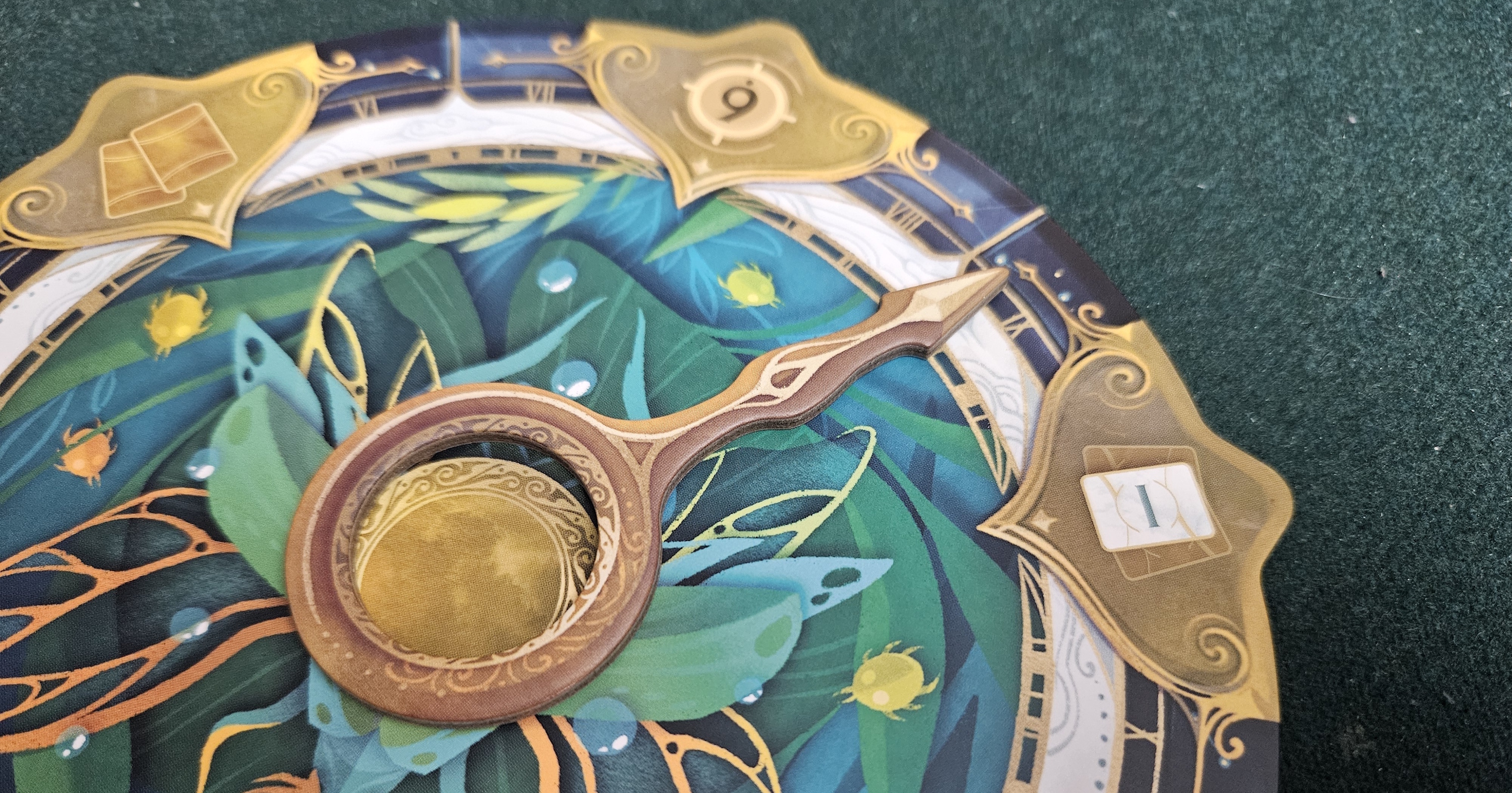
Placing the hand.
Again, though, I don’t want my enthusiasm to go misconstrued. Take Time is sometimes a bitter pill to swallow. Where The Mind presented itself as a parlor trick, there’s no mistaking the function of this particular plaything. It wants you to strain at every little detail. It wants you to make plans and then adapt them on the fly. It insists on locking you into a sequence until you get it right. Sure, it will throw you a bone every now and then. The more you fail, the more face-up cards you’re afforded. But only to a point. Eventually, your group either learns to function together or the frustration mounts.
I think I like it. But it’s also a game I can only stomach in small doses. An envelope here or there, not a spree. And it’s also one of those games that swiftly identifies the players it shouldn’t be shared with.
But hey, at least everybody seems to agree that it’s a game. And with the right people, in the right mood, during the right portion of the evening, it’s a fascinating thing to behold for many of the same reasons that The Mind was fascinating to behold. When everything finally slips into place, it feels like magic. The hard part is all the grunt work that comes before the flourish.
(If what I’m doing at Space-Biff! is valuable to you in some way, please consider dropping by my Patreon campaign or Ko-fi. Right now, supporters can read about which films I watched in 2025, including some brief thoughts on each. That’s 44 movies! That’s a lot, unless you see, like, 45 or more movies in a year!)
Posted on February 6, 2026, in Board Game and tagged Board Games, Libellud, Take Time. Bookmark the permalink. Leave a comment.

 SPACE-BIFF!
Leave a comment
Comments 0