I Don’t Wanna Do Your Dirty Work

Whenever someone gets rosy-eyed about “the good old days,” it’s a surefire sign they’ve never cracked a history book. Ahh, the good old days, back when men were men, their eyesight obscured by forty thanks to sun damage. When women were women, dead at thirty from childbearing. When children were dropping like flies from preventable diseases, when ninety percent of jobs consisted of picking stones from dusty fields, when the nights were so cold that one curled about their steaming chamber pot for warmth.
At the same time, there are certain myths about human misery that simply won’t kick the bucket. Medieval people, for example, were not shabby peasants sitting around in their own filth. Even the poor bathed regularly, wore colorful clothes, and liked to attend dances and festivals. Reality occupies a strange middle ground. In the past, most folks were sicker, fed more poorly, and struggled daily against decay, but still strove to fill their lives with good and pleasant things.
Night Soil is not about most folks. Taken on its own, one might come away thinking that everybody padded their clogs with their own BMs. That’s because it’s about the dirty task of clearing Tudor London of human waste. Gathering poop, transporting poop, shoveling poop into the river — these are the game’s occupation. It’s a greasy, brown-hued business. I adore it.
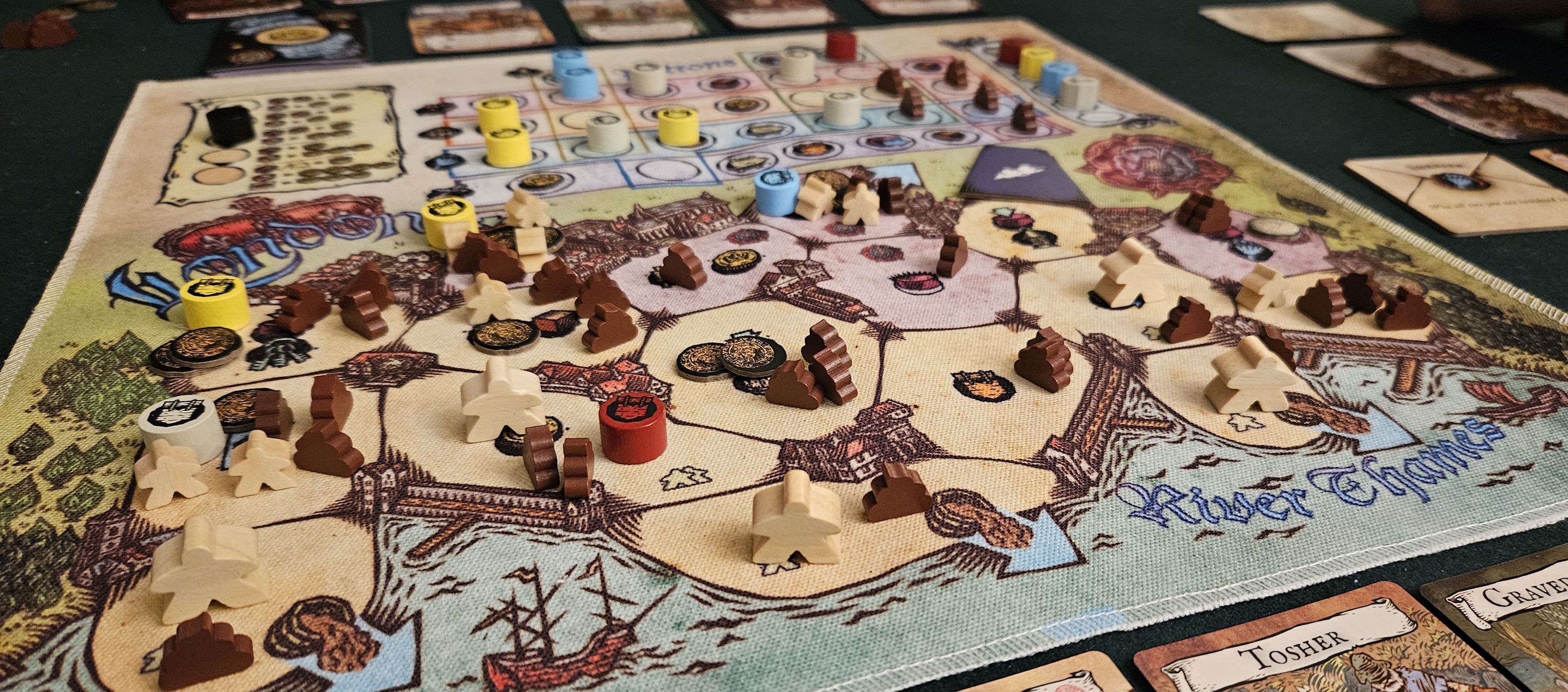
Tudor London. It’s smelly out here.
When Night Soil begins, London is buried in waste. The gutters overrunneth. The wells have stink-lines of cholera rising from them. Only with great focus can one travel to and from work without streaking one’s breeches by the poops lying about in the streets.
Enter our protagonists. Mudlarks and cart-drivers, gong farmers and toshers, these are the people who make a living removing all that waste. Mostly by dumping it in the river, where it will sicken those downstream, but also by carting it into the countryside to serve as fertilizer for a more equitable ensickening.
As a game, Night Soil is divided into two main phases, each of which operates according to its own logic.
The first portion is daytime, in which players send workers into the streets to grow their business. It’s a relatively straightforward worker placement game, with both big and little meeples — adult and child labor, one assumes — securing the favor of patrons, hiring new workers, and promising to muck out various districts in exchange for coin. The “twist,” in this case, is more of a swirl: whenever a worker gets placed, they add even more waste to a district, two cubes for a large meeple and one for a small.
It’s an evocative little system, perhaps more as an illustration of thermodynamic inevitability than historical reality. Unlike most worker placement games, where workers block spaces, here the city’s districts are blocked once they’re swamped in by too much excrement. It’s a bit like hiring a plumber to augur a line, only for them to clog your toilet. A little silly, in other words, but still useful as a reminder that labor isn’t this invisible force that’s immune to rest or relief.
Then night falls and the game enters its second phase, a logistics game that could aptly be described as pickup-and-dump. Players use their workers — cards this time, not meeples — to move all that waste out of the city. There’s an amusing sense of gamesmanship to the process. The districts you’ve promised to evacuate don’t care much for their neighbors, so it isn’t uncommon to cart the waste a few streets over and leave it at that. Neither is it uncommon to sully the reputations of your rivals by leaving loads of human waste in neighborhoods that were previously cleared. There’s a bonus for actually getting rid of the stuff, paid out like a bounty on turds, but players are reluctant to leave too many crates of dung too close to the river where somebody else can finish the job and earn the payout.
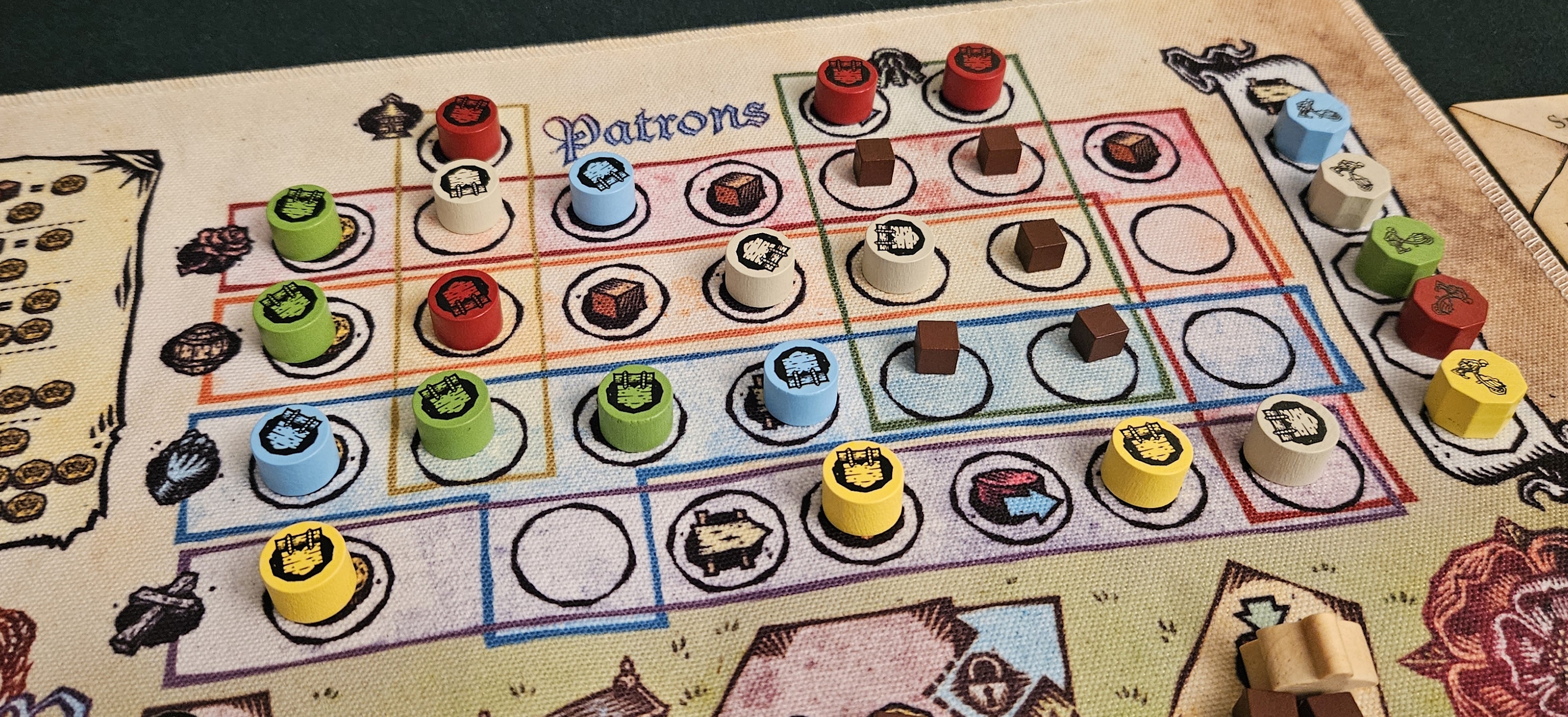
Competing for the favor of the city’s patrons.
To be clear, this isn’t especially authentic as an expression of how this work was actually performed. But it does induce a certain truthiness. People did in fact cart human dung out of the city, it was disposed of in this manner, and some employed rag-pickers and mudlarks to sift through the refuse for shiny bits and bobs. Ever heard of a tree removal service dumping wood chips somewhere they weren’t supposed to go? This stuff still happens today. Every time we rent a dumpster, the neighbors descend to throw out their junk before we can even manage our first wheelbarrow of gravel. It’s a zoo out there.
Night Soil excels at two levels. The first is the interconnectedness between its dual spheres. Emptying a district of waste confers advantages, usually meeples, who become your workers during the next daytime phase, and coins, which function both as the game’s currency and its victory points. At times, this produces comedic beats, such as a district that simply cannot get unburied from all its poop, keeping three small meeples and a growing treasure of coins trapped in place. What does this represent, exactly? It would seem to be some snowed-in orphans who will join your crew if only you dig them out. Which, again, isn’t how things happened historically. But it’s tremendous comedy, not to mention an excellent competitive flashpoint between players.
Or there are the patrons. As you muck out their premises and ingratiate yourself with their guilds, they award little benefits. The lamplighters, for example, let you advertise in a district for free before evening falls. The city watch opens the northern gate so you can cart your poop out to the countryside instead of dragging it down to the river. Holding favors with the brewers decreases the cost of various actions, while having the ear of the local church gives access to the nun, a special worker who deposits no cubes in her wake. Everybody knows nuns don’t poop.
These exemplify the second point in Night Soil’s favor. It isn’t that the game is particularly accurate. It isn’t that any eurogame is particularly accurate, especially when it comes to the tenuous connections between ludic performances and real-life procedures. Rather, it’s that it acknowledges the hidden labor that keeps society functioning. It’s about the garbage men of the day, the truck drivers and fertilizer procurers and recycling sorters. It’s about the people who dig graves and keep the clocks running, who kill rodents and dig precious metals out of the earth. Each of these careers are represented in some fashion, sometimes as Tudor analogues but also in forms we would more or less recognize today. It’s redolent of the way Obsession presents a useful historical pastiche of domestic labor. Just for poop.
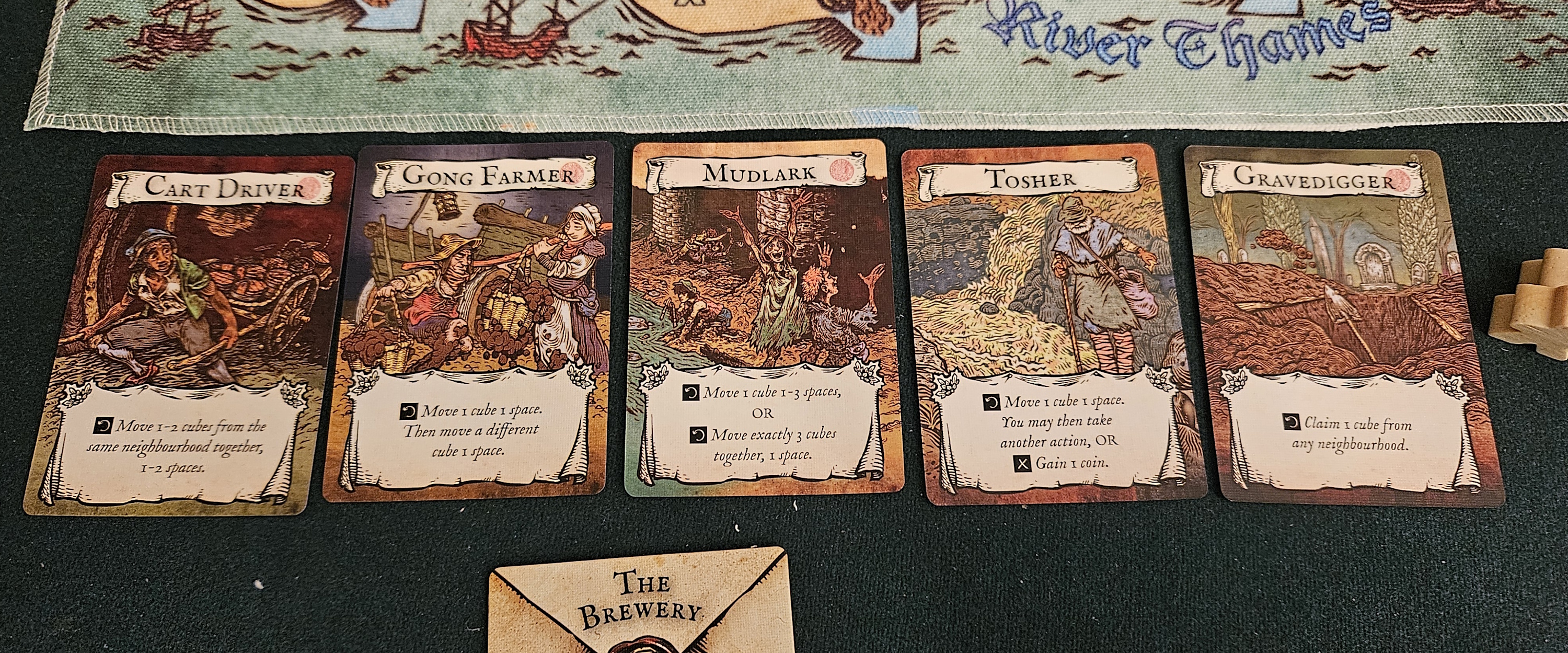
The art is certainly, ah, brown.
Along the way, Night Soil presents little conundrums that will certainly strike the modern eurogamer amiss, but which are also the source of the game’s most intriguing questions. I already mentioned how there are two classes of workers, meeples for the daytime stuff and cards for the evening. Unlike most worker placement games, the former workers don’t “belong” to you. They’re contract labor. This can result in irregularities where one player will enter a round with five or six workers, while the players next to them only have one or two. From a balance standpoint, this is a nightmare. As gameplay… well, it’s nobody’s fault but your own that you didn’t prioritize your labor more carefully. The issue some players will face isn’t that Night Soil is imbalanced. It’s that Night Soil declines to artificially remediate their oversights. Either you dig yourself out of the corner you’ve pooped yourself into, or you squat there until you can find another lifeline.
Here’s another way of putting it: the same reasons I like Night Soil are the same reasons many will dislike it. Worker placement has always been a strange genre, more about placement than workers. Precious few of the genre’s exemplars require you to feed your workers, or provide for their families, or indeed consider them beyond their utility. In Night Soil, workers produce waste, just like everybody else, and only lend their labor to those who bother to secure it.
The same goes for the cards that perform logistics in each round’s second half. Their first activation is free, shifting cubes down to the river or into rival districts. But many of them offer the tantalizing possibility of working overtime. Rather than flipping these cards face-down, you can pay a coin to keep them around a bit longer. Later in the session, certain cards might even keep them in the mix longer, such as a cutpurse who steals their wages, driving your workers to desperation as they seek another round of overtime. Or an assistant, who can alleviate one of their fellow laborer’s hardships. Or the wineman, who plies them with free drink in exchange for a few extra hours of their time.
These are no mere annoyances. They’re the game’s essential textures. Considering how far you can push your workers, whether to emphasize coin or labor, which districts to dig out, where to hire day workers, whether to inch waste closer to the river or deposit it in a rival’s backyard, these are far more interesting questions than those posed by most nu-euros. The result is a game that’s defiantly player-driven, sometimes grating, and always funny.
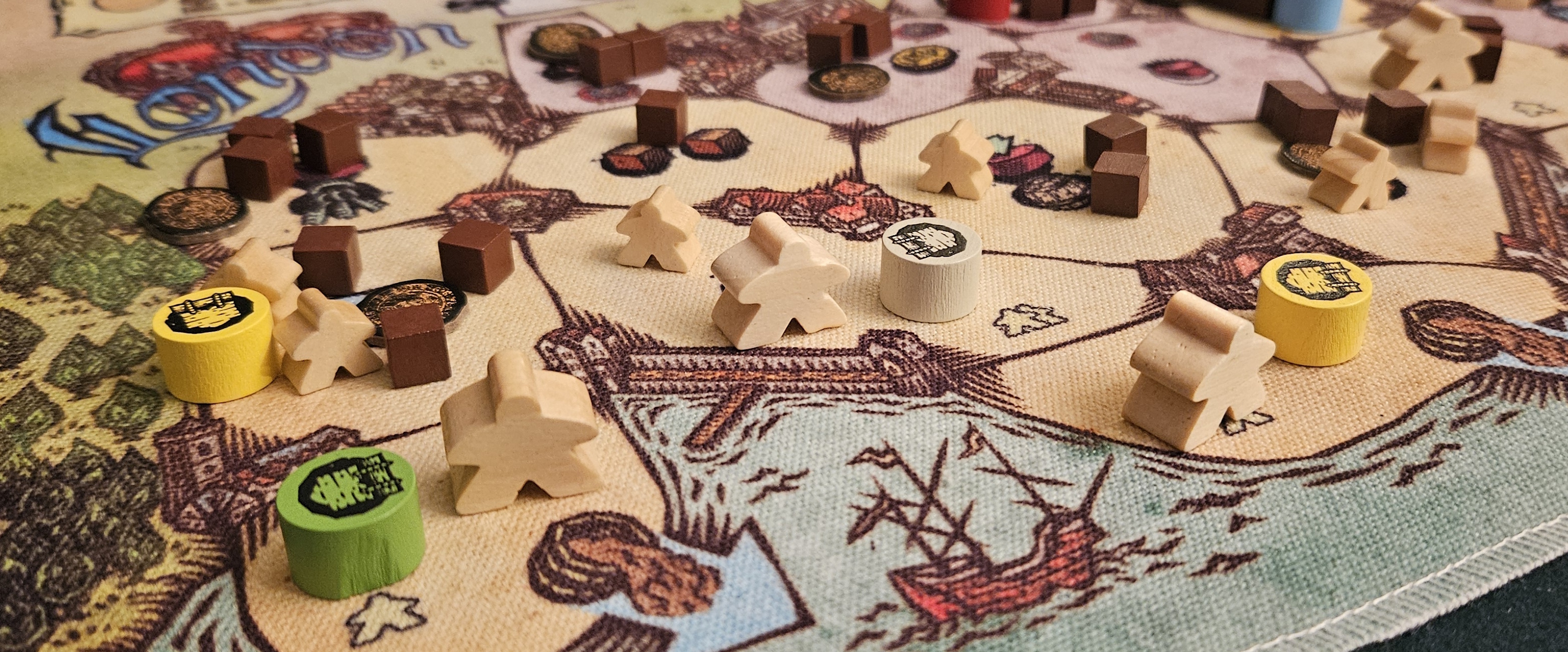
Driving these poops to the river.
Because in the end, Night Soil is about poop. Huge cartloads of the stuff. So much poop that your troupes of laborers, in their efforts to muck it all out, end up filling the city with steaming mountains of their own. The past was many things: sickly and dirty, full of light and hope and disease alike, and full of overlooked people who have only in recent decades become the topic of some scholarship. Night Soil is a fascinating plaything, a game that not only examines those lives, but elevates them into objects of play in their own right. I can dig it — out of a big brown landslide.
A complimentary copy of Night Soil was provided by the publisher.
(If what I’m doing at Space-Biff! is valuable to you in some way, please consider dropping by my Patreon campaign or Ko-fi. Right now, you can read my third-quarter update on all things Biff!)
Posted on December 17, 2025, in Board Game and tagged Board Games, Grail Games, Night Soil. Bookmark the permalink. 15 Comments.

 SPACE-BIFF!
I normally don’t share this kind of thing, but I read this on the toilet. Great write up!
Haha, I love it!
Tudor London? More like Tooter London, amirite?………I’ll see myself out
NICE.
cubes? no poop meeples, no game. Let’s be serious here.
Dan, I was reading this and had a thought. Would you consider doing a podcast where you just read these reviews out loud? I love your normal podcast, and I subscribe to your pattern since I think you’re doing wonderful and valuable work. I for one would love to be able to enjoy your reviews on the road! Perhaps as a patreon bonus?
It’s an interesting thought. I’ll consider it.
“Either you dig yourself out of the corner you’ve pooped yourself into, or you squat there until you can find another lifeline.”
Amazing lol. Thank you for the laughs. You are a scatological Shakespeare.
Yes, please consider it! I can’t speak for everyone, but I would be really interested in a podcast version of your reviews. I do think there is an unfilled niche for this – just short, polished 5-10 minute episodes, sounds delicious.
“Polished” might be the tough part. It takes me a lot of work to make the podcast eps… mostly because I’m very bad at it. I’m thinking about how to add “review reads” to my pipeline, and it won’t be a small task. I dunno. Still noodling. Maybe it’ll be possible.
See if Matthew Jude will edit your podcasts! lol I’m pretty sure he’s a fan of yours and he’s a very good podcast editor.
If you are ever looking to branch out with recording your reviews, let me know! VO actor (mostly in audiobook narration), and i would happily find a way to help you through your tome of reviews. I’ve been a fan for a long time and would be thrilled to aid you in that endeavor. I think your reviews would do exceedingly well in audio
That’s a very kind offer, I’ll keep it in mind!
Pingback: 5 on Friday 26/12/25 – No Rerolls
Pingback: Best Week 2025! Heart of Darkness! | SPACE-BIFF!
Pingback: Burned Notice | SPACE-BIFF!