Queen of Lies

I’ve said before that Salt & Pepper Games is doing some of the finest work in the industry, especially when it comes to historical titles that draw in newer and veteran players alike. Queen of Spies pairs Liz Davidson with David Thompson, who produce a handsome, if uneven, solitaire perspective on resistance and spycraft in the Great War.
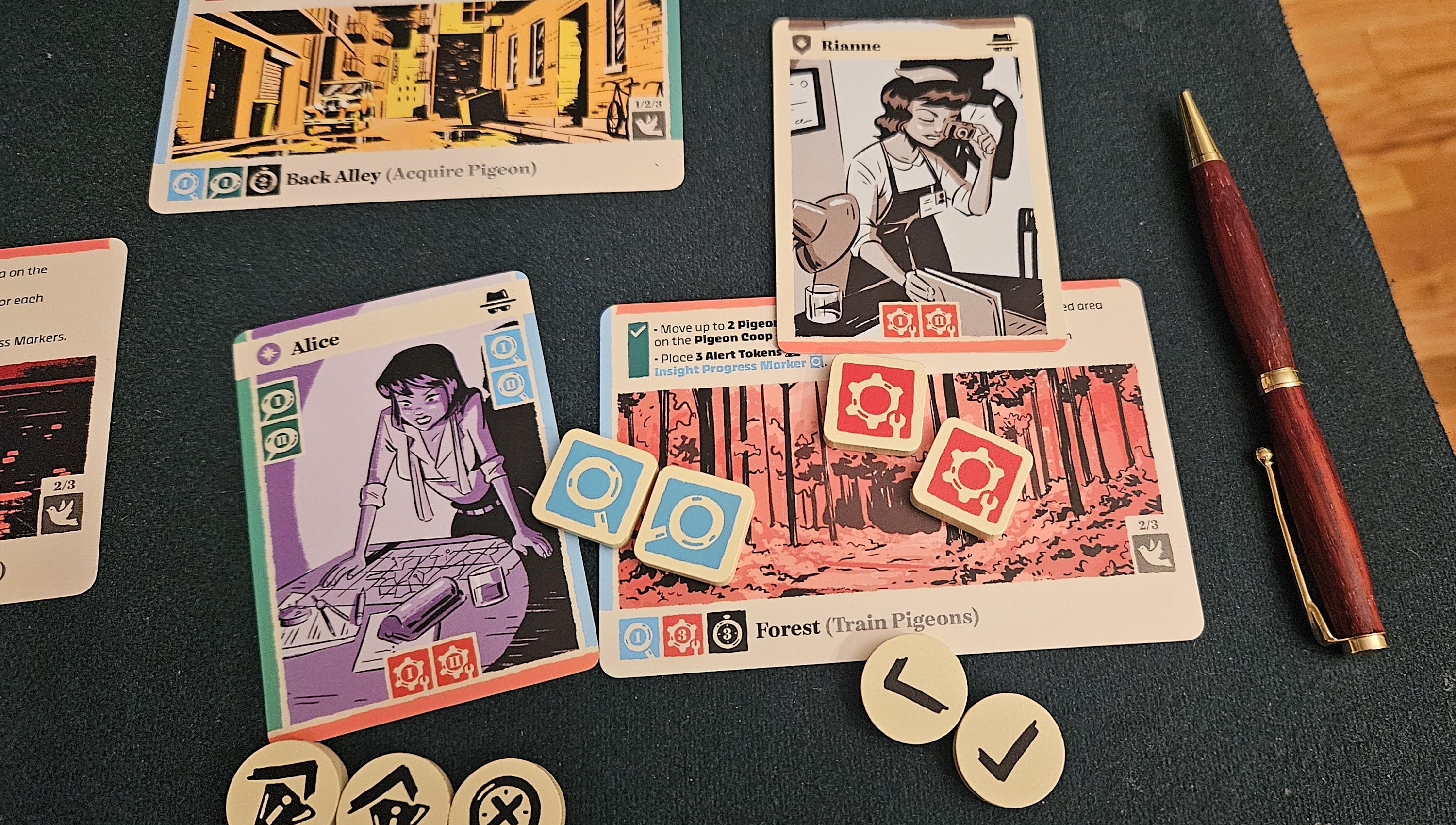
Training pigeons to rain hell on occupying helmets.
Welcome to occupied Belgium. The first time around.
Here our protagonist is Alice. Loosely based on real-life figures like Louise de Bettignies, Alice is a skilled ringmaster and resistance fighter. She’s sneaky and well appointed. She can build bombs and train pigeons. She knows how to listen in on a conversation and sift important clues from background chatter. And she can run a spy ring like no other.
For all that, what marks Alice as interesting is her ordinariness. She and the members of her resistance group are quotidian, mundane. They’re switchboard operators, maids, waiters, house staff. In many cases, at least at first, they’re under-trained and fumbling.
That’s precisely what makes them effective. There’s nary a Sidney Reilly in sight, let alone a James Bond. As the characters develop their skills, they undergo a transformation. Trained in the countryside, hopefully away from snitching eyes, their cards flip over, shedding their furtive day jobs for brasher careers as eavesdroppers and drawer-riflers. It’s not dissimilar to the trick Thompson pulled with the Spanish Maquis of Resist!, the cards split between their undercover half and the persona revealed once they take up arms or bombs or poison.
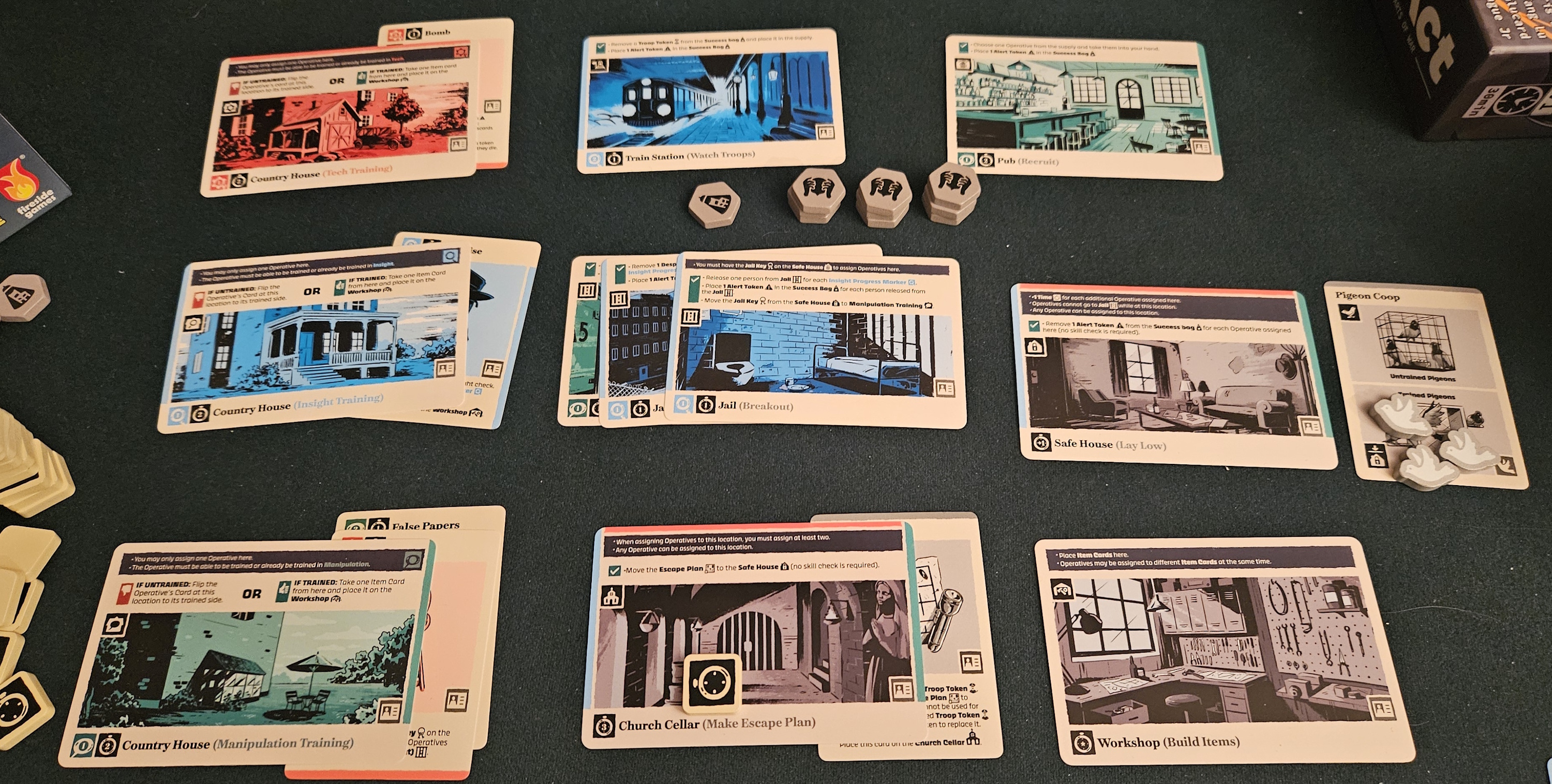
Running about town.
In this case, the mode is subtler. There’s still potential for the occasional bomb to go off, but the tools of Alice’s trade don’t tend to be flashy. Training an asset means encouraging them to flirt with an officer or work up the nerve to photograph a collaborator’s desk. Across the game’s three scenarios, players spend their time training pigeons, not shooting up barracks.
Taken broadly, this accomplishes a few things for Queen of Spies. Perhaps the foremost is a certain degree of grounding. The town, represented by a grid of locations, feels as ordinary as Alice and her compatriots. Its main locales are not garrisons; they’re country cottages, church cellars, garage workshops, pubs, maybe the local rail station if you’re feeling spicy and want to count the troops hopping off the train. This isn’t to say there isn’t danger afoot. The real de Bettignies died in a labor camp. Even if your spies aren’t about to get into a shootout, there’s always the risk of imprisonment, interrogation, and death or despair.
Rather smartly, even this is presented as a detour rather than an outright failure-state. Not all that far off from Onoda, Queen of Spies uses a token-bag as its centerpiece mechanism. As your spies move around town, they draw from that bag, pulling tokens that represent success, failure, or more often a mix of the two, such as a success that demands precious extra minutes or one that attracts attention to your activities. When arrested, spies are sent to the local jail, where they’ll be interrogated at the end of each round.
This sets the game’s second clock a-ticking. When broken, a spy will report on their companions, resulting in cascading arrests. The other possibility is that your operatives will spring into action, chatting up guards so they’re too distracted to attend to their wards, dropping off supplies to buoy your compatriot’s spirits, or perhaps masterminding a breakout. These generate admirable story beats. Will your heroes bust their friend out of prison? Or, barring that, accomplish their mission before they’re ratted out? These questions flow naturally from the game’s progression, turning missteps into second chances.
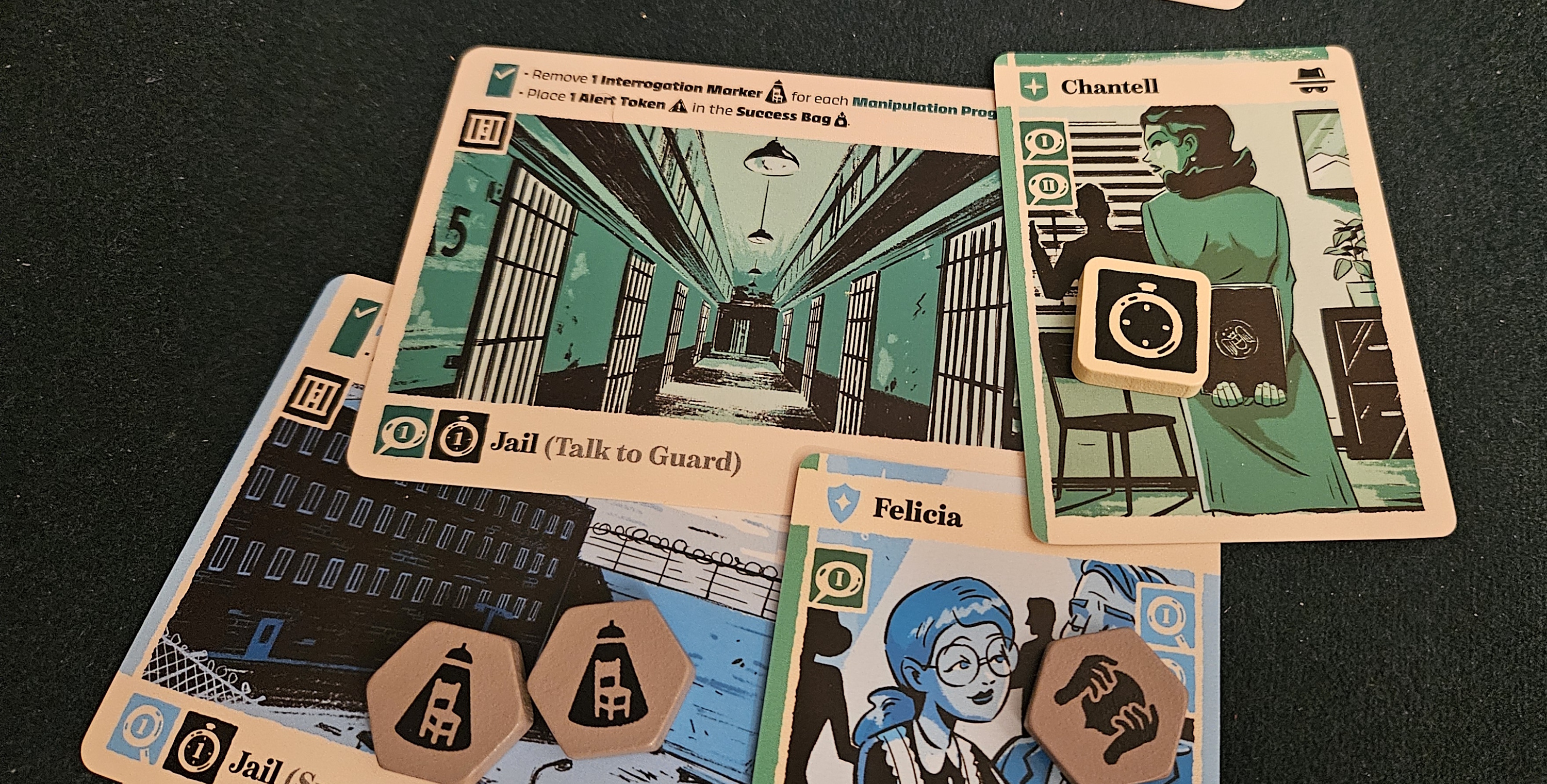
Visiting the prisoners… just like Jesus said.
The strength of these detours highlights a weakness elsewhere.
There are three scenarios in all, each of which takes around an hour to play, and apart from the occasional failure or some score-chasing, there isn’t any reason to revisit them. The first sees your spy ring training and using pigeons. The second, by far the standout of the trio, requires a jailbreak of incoming POWs. And the third, which is also the most open-ended, sees your spies gathering information on a local businessman turned collaborator.
These scenarios are interesting and colorful, and they do a good job of highlighting both the routines and flashpoints of spycraft, not to mention the courage of those involved in resisting occupation, but they also resemble flowcharts. Early on, you’ll train your operatives and craft disguises, false papers, and escape plans. Later, your mission will require tougher skill checks, including those that require participation from multiple agents at once. There are side activities, of a sort, although apart from the imprisonment of your companions they mostly amount to a few minutes cooling your heels in the safe house or rail station.
Which is to say, the entire game soon feels like a series of if/then statements. If you have a companion in jail, then alleviate their situation. If you have an untrained operative, then send them to the country house for training. If there are enemy soldiers in the bag, then prepare an escape plan at the church. If your mission requires a camera, then craft it at the workshop. If all previous statements have been fulfilled, then commit your team to the mission. All the while, the whims of the draw bag establish the parameters for the next statement.
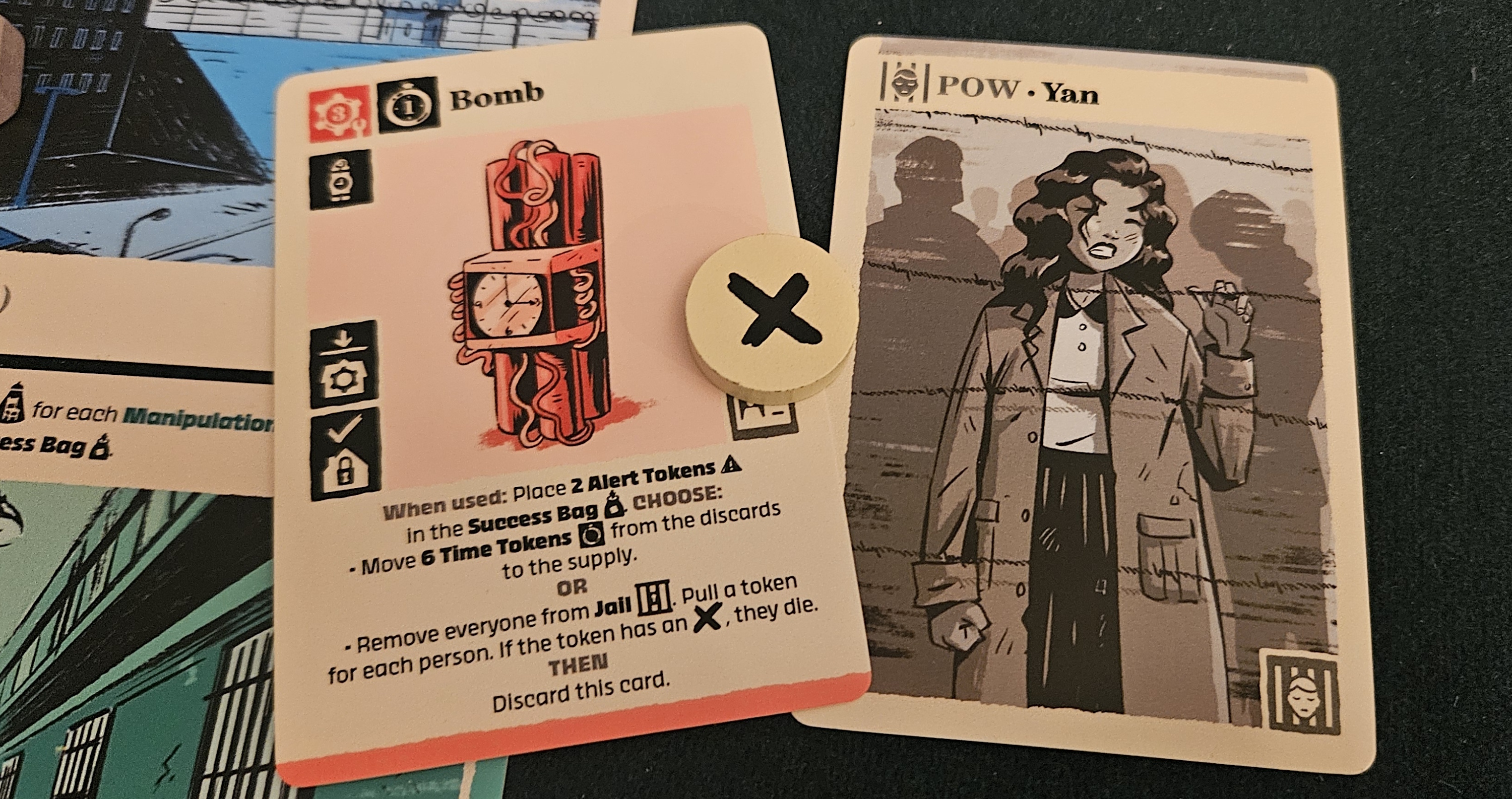
Oops.
This isn’t to say there isn’t room for excitement or intrigue. Perhaps my favorite moment in the entire game — one that felt like an actual decision rather than a binary toggle — arrived when we ran short on time to save a final POW. We could orchestrate a second breakout, complete with newly forged keys and disguises, but every step would have to go off with utter precision in a town that was now crawling with searchers. Or we could set off a bomb. A bomb that might, and did so happen, to kill the object of our escape attempt. Now that’s moral calculus!
If only that calculus needed calculating more often. Like every entry in Salt & Pepper’s historical catalog, Queen of Spies is a handsome and worthwhile title, one that shines a light on an undersung corner of history. In its brightest moments, it evokes real courage and derring-do against the backdrop of a ticking timebomb. At the same time, it doesn’t evoke those moments as often as it might have, resulting in a lighter experience, both narratively and ludically.
A prototype copy of Queen of Spies was temporarily provided by the publisher.
(If what I’m doing at Space-Biff! is valuable to you in some way, please consider dropping by my Patreon campaign or Ko-fi. Right now, you can read my third-quarter update on all things Biff!)
Posted on December 15, 2025, in Board Game and tagged Alone Time, Board Games, Queen of Spies, Salt & Pepper Games. Bookmark the permalink. 1 Comment.

 SPACE-BIFF!
Looking forward to this one.