Unnameable

After the first day of SDHistCon, where I played three games about opium peddling, I figured the second would be easier on my stomach. I could not have been more wrong.
It has no name. Its designer doesn’t want to be credited. Of all the many board games I’ve played, it’s the one that left me the most shaken.
“You are four senior Nazi officials,” our Teacher tells us. His hands are trembling. His mouth quirks between solemnity and something like an apologetic smile. “And you are conducting the Final Solution.”
EXTREME CONTENT AND SPOILER WARNINGS ARE IN EFFECT FROM THIS POINT. PROCEED ONLY AT YOUR OWN RISK.

Words fail. I wish I could paint a better scene. A quiet room. People with serious faces. Light glittering off motes of dust.
But that isn’t how it looks. This is a board game convention. The hall is deafening, as it always is. The players are a mismatched bunch, as they always are. Every few minutes, a new group of onlookers stops to see what we’re playing. When they inquire about the game — curiosity piqued, I think, by our unexpected seriousness — they wince, as if at a bad joke, or their faces widen in surprise, or they turn and walk away, perhaps afraid of being associated with the plaything before us.
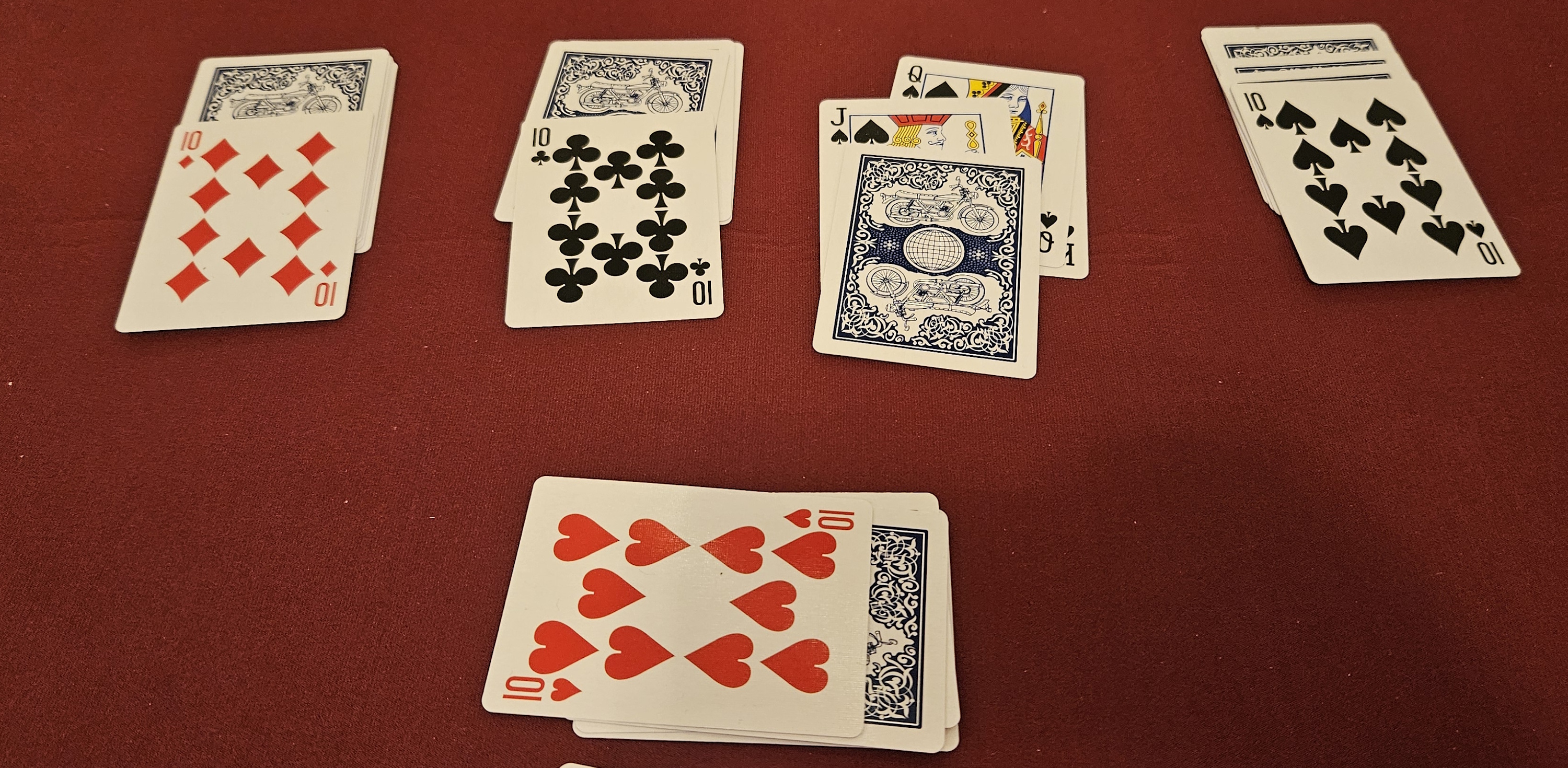
I’ll confess I also flee. While my body sits there, watching the setup: a regular deck of playing cards, arranged into a line of decks representing the West, the Deutsches Reich, and the East, with a fourth below the others for the occupation of Hungary; beneath those locations, seeded face-down, are Jews of various values. While my mind bobs, listening to the rules: how each of us will reveal, transport, and exterminate those Jews to earn points. While my soul aches: is this a trick? Am I meant to stand and announce, like some participant in Brenda Romero’s horrid rug-pull Train, with its Holocaust reduced to a punchline and its participants to rubes, that I will not play along?
As though in response, our Teacher clarifies. “You are senior officials. You are eager participants in this process. You know what’s happening.”
Well. So much for this being a trick.
A trick-taker, though? Yes. While half of the deck constitutes regions and Jews, the rest are used to play. The process takes shape. Each round is a hand of four tricks. Each suit is connected to a different organization and offers a different step in the process. The winner takes their suit and conducts its operation: one for hunting, another for transportation, a third for cleansing. The final suit is wild. The not-so-clean Wehrmacht, filling in the gaps.
But this wouldn’t be enough to accomplish much on its own. So, despite being desperate to climb the party ladder, the winner must always select one other official to partner with. Now with two cards added together, they can build a combo. Jew-hunting and Jew-killing in the East, the bodies stacked many miles short of the camps. Boxcars and the ovens, those old partners in crime. These collaborating officials then share credit for the undesirables they have sanitized together.
For a moment, I go again. Then our Teacher reveals the nine of clubs. “Nines represent bureaucratic obstruction. When they’re played into a trick, they decrease the value of the corresponding suit.” He pauses. Are his eyes twinkling with mirth or because they’ve grown watery?
“Get it?”
I’m slow. We all are. It’s one of my fellow players who catches the pun. “Nine,” he says. “Nein.”
“That’s right,” our Teacher says.
Slowly, like birdsong from behind razorwire, it twitters out of us. Not quite laughter. Something between a chuckle and a wheeze. It’s necessary, that release valve. Just the slightest bit of pressure vented from the boiler.
I can do this. I can do this.
This is how it happens.
Four officials hope to prove themselves competent and effective. The more prominent the Jews they find and exterminate, the greater their prestige. So they delve into the hidden parts of the Reich’s occupation. They uncover and transport and shoot and incinerate. They select their partners carefully, always elevating those who won’t threaten them in turn. In the East, they don’t bother with the trains. As soon as an undesirable is found, it is easier to kill them where they stand. In the West, far from the camps, they must first be removed and processed. When one of these officials rises above the rest, the others find ways to obstruct them. Paperwork. Troops on call elsewhere. Polite but stern refusals to collaborate.
This is how it happens.
The targets of our solution are not human. They are things. Cattle: unthinking, guilty of imagined sin, unclean from wallowing in their own filth. Cards: black and red suits for the lowborn, face cards for those with connections or wealth. Numbers: identities lost in a string of numerals, more indecipherable than gematria.
This is how it happens.
Two officials must cooperate in order to root out these things that are not human. They will share the points from those that they exterminate. But when I look around the table, I cannot see how this will be accomplished. There is no pencil and paper. There are no counters.
I am the first to succeed at our appointed task. All I play anymore are trick-taking games. That’s a joke I write sometimes when reviewing trick-takers. I didn’t grow up playing these games, but I’ve become good at them. A skilled hand.
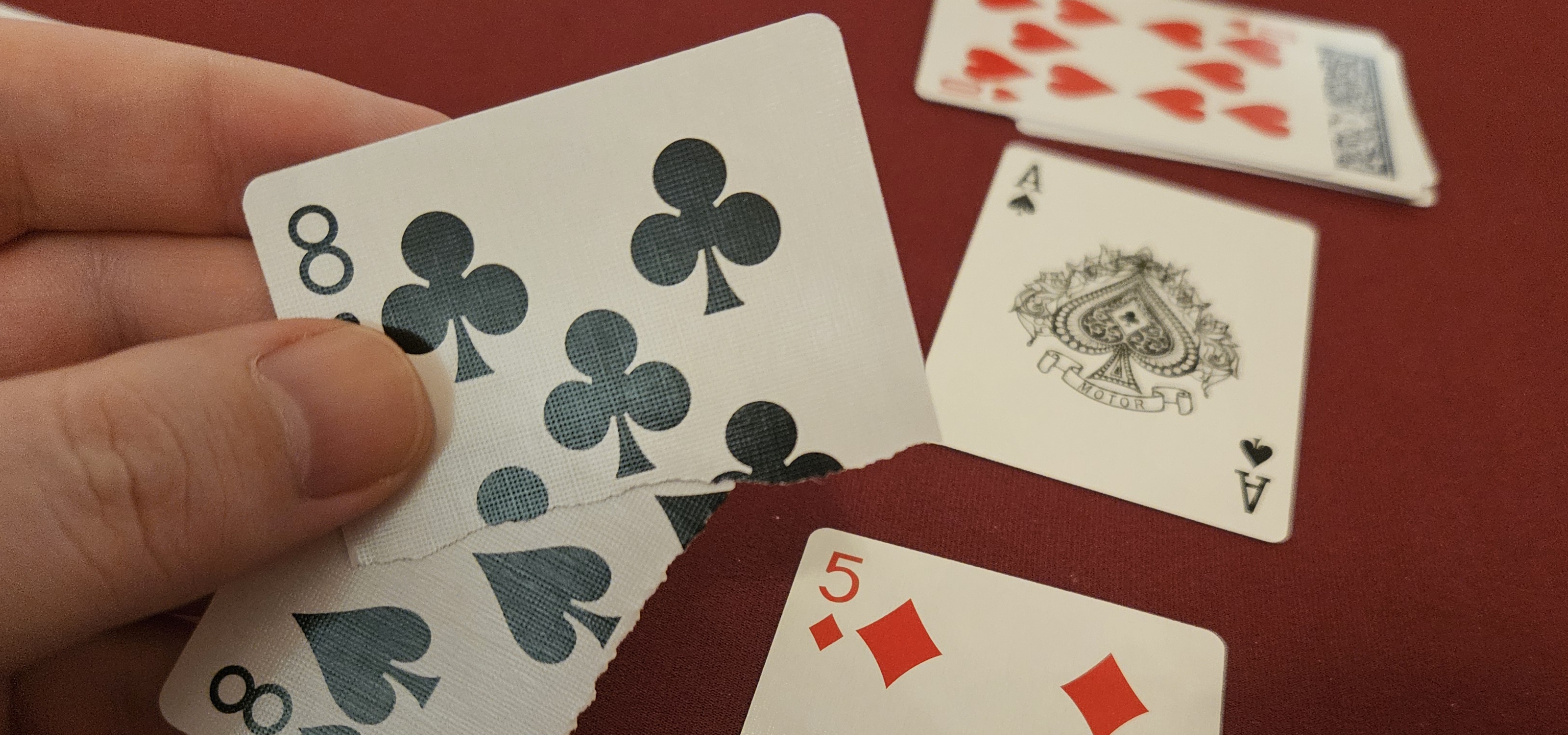
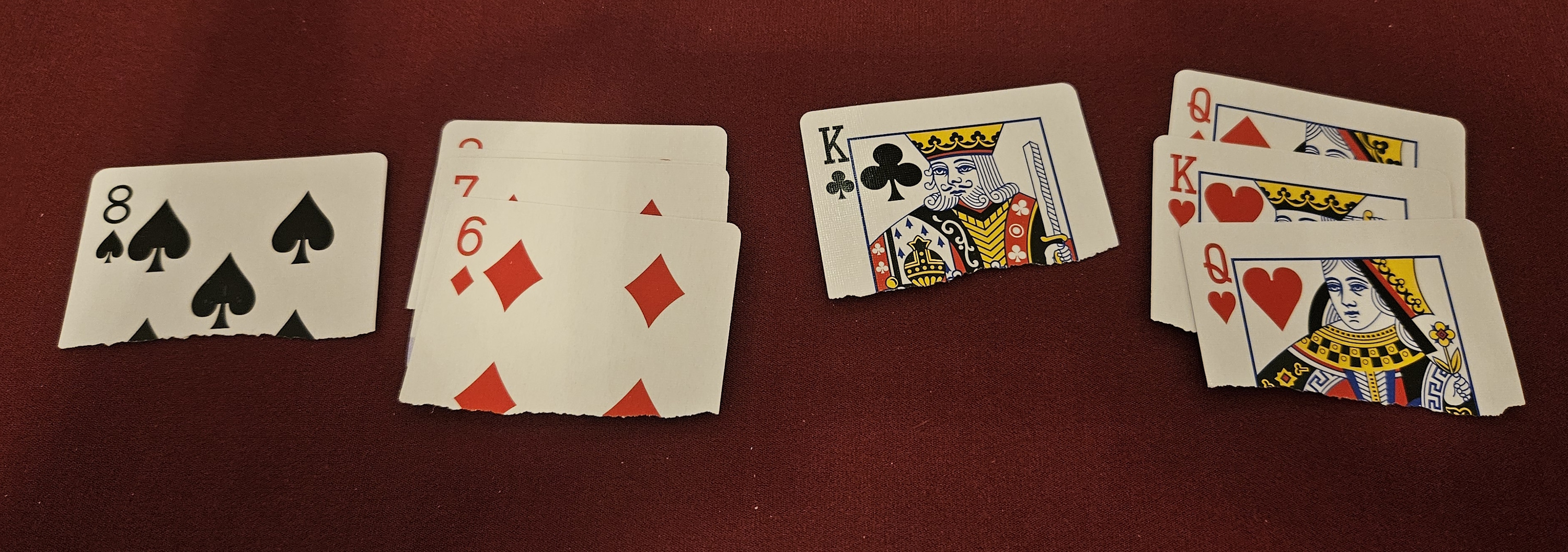
Our Teacher hands me the card. And then, like fingers snapped in front of my face, he says, “Tear it in two. Give half to your partner. Keep the other for yourself.”
I do as he says. It is a violation. The deck is ruined. A life is ruined. The card is an eight of spades.
This was only the first trick. Eleven to go. I have been sitting here for ten minutes. It feels like an hour.
This is how it happens.
Playing this game, total focus becomes impossible. My mind ranges afield to topics that are difficult in their own right. I find myself thinking about how when my faith began its slow crumble there was no one I could speak to.
Not my wife. We had promised in the holy temple that we would keep forever faithful, and my doubts, concealed long before we knew one another, felt to me like a violation of that covenant. Not my friends. They were under-equipped and fell back on clichés that had the timbre of folksy wisdom but were meant to smother my questions in their crib. Not my father. Always, when he told me that he was proud of me, he said it was because I was good and faithful. To confess that I had never quite believed all the way, that now I maybe didn’t believe at all, would be to murder the one thing he prized about his only son.
So I went wandering. I went first to the appointed places. My bishop. My stake president. Neither had anything to say. So I went to the forbidden places. The bishop of a congregation in the same faith tradition. The pastor of a church down the road. Both were kind and had open ears, but could not tell me what I needed to hear. So I went further. I found a Rabbi.
When the Rabbi asked if I had read the Book of Job, there was no way to tell her that I had, countless times, in four languages, so often that I had big opinions about which translators and which word choices were the best and worst. Instead, all I could say was yes. I have.
And she said, “I think it’s marvelous that Job, our great hero of suffering, was a Gentile. That he was not one of us.”
In English, there are three translations of Job that speak to me.
Robert Alter’s Job is precise. After his long complaint against the evils that have been wrongly inflicted on him, after the Lord has appeared to him in the whirlwind, his statement has the tone of a legal concession. “By the ear’s rumor I heard of You, and now my eye has seen You. Therefore do I recant, and I repent in dust and ashes.”
Stephen Mitchell’s Job is awed at the majesty of the Unnameable. His smallness, the ease with which his body bends and breaks, become a reassurance. “I had heard of you with my ears; but now my eyes have seen you. Therefore I will be quiet, comforted that I am dust.”
Edward Greenstein’s Job is defiant. Pain without purpose is not to be accepted, but confronted. “As a hearing by the ear I have heard you, and now my eye has seen you. That is why I am fed up; I take pity on dust and ashes!”
As I sit there, playing this unnamed game, I feel all three Jobs within me, refusing to resolve into a single entity. I am precise. The rules are my tool, the format my language, the victory conditions my sole aim. I am breakable. The magic circle is failing on all sides, the shame of murder bleeding into my fingertips, the safety of play no more secure than a blanket before the bullet. I am defiant. Suffering must be stopped. I must spit this bloody mouthful back into the face of whomever inflicts it, or I am nothing. I think these things while I play an untitled card game, and tear its cards to shreds, and wonder what I will take with me when it is done.
When the game has ended, we go out to lunch, all the players of the game and our Teacher, because even after that hour in one another’s company, to break apart now would be a violation of what has just transpired.
Our Teacher doesn’t know what to do with his game. There is maybe one publisher in the entire world he would trust with it, and maybe not even then. Personally, I tell him, if I had my way, the game would never be published. It should not be a game. It should be exactly what it was for me. It should be played by as many people as possible, but as something closer to performance art than a game. It needs to be played. But it needs more than the cards, more than the rules. It needs the Teacher. Maybe not him specifically. But someone whose words will quaver and hands will shake, who will interject that pun when the players consider backing out, who will instruct them to tear the cards in half. Who, afterward, will sit and eat dumplings and discuss the game’s intentions and imperfections. Who will speak. Who will listen.
Why did this game have such an impact on me? I’m still trying to decide. The immediacy of play, perhaps, or the magic circle showing its cracks. But I’ve visited the camps. Read the books and watched the movies. And this was the closest the blade has come to touching bone.
The rest of the day is a blur. I have a panel after lunch. I speak sluggishly and imprecisely. I play other games. I play them badly and distantly. I go out to dinner with new friends. I am off-balance, unable to express myself, hurting. I walk back to the hotel in the dark. On the way, I am accosted by someone in rags, carrying a beach chair in his hands and smelling of brine. Because I turn to look at him, he shouts that I am a faggot and a fat fuck, and shuffles after me and clutches my shirt and strikes me on the shoulder, and when I shove him off and hurry away, I wonder if I have done the wrong thing. Should I have helped? Should I have pushed him more gently? Should I have never looked at him in the first place?
Over the coming weeks, I carry the cards in my pocket. When I pull them out, I think about the game. I think about chimneys staining the clouds black. I think about a grandfather’s surname, changed to conceal his heritage. I think about the camp I visited in Israel, machineguns pointed inward. I think about play and death at the same time, and do not stop thinking for a long time.
Never again, I think. Never again for the six million murdered Jews. Never again for the millions of murdered Slavs and Poles. Never again for the hundreds of thousands of murdered disabled peoples and Romani and Serbs and prisoners of war and dissidents and intellectuals and homosexuals and all the rest.
Never again for anyone.
Posted on November 24, 2025, in Board Game and tagged Board Games, SDHistCon, Unnameable. Bookmark the permalink. 47 Comments.

 SPACE-BIFF!
This article gives no understanding of how is this experience is actually conducted. It’s just a bunch of artistic emotions. I have no way of understanding of what is happening other than that you have just bunch of feelings. Sorry. I rarely comment, but this was a frustrating read.
You rarely comment, but still too often it seems.
Immense article, Dan.
At the very least, it was not a question about if it was any fun… I’ve never commented before, but this was a chilling, tremendous read. Thank you.
Jesus Christ.
I don’t even know how to feel. What a monumental piece of writing.
Please ignore the giant fucking dweeb who wants the rules.
My God. I can feel your apprehensions bleeding through every word. Is it right that a game like this eixists? Maybe not. But it’s not right that its subject matter happened.
Damn Dan, What a write up. It’s hard to find the words to comment about this experience and somehow you have found them. I had a hard time reading it and skipped some passages fearing what I would read but very quickly grasped the importance of this history which should not be forgotten or repeated. Once again your skillful writing proves itself.
-Bryan
This is perhaps some of your absolute best work Dan. I feel immensely moved solely from reading this article. There are tears in my eyes and a sinking feeling in my stomach at my desire to experience this myself and I a questioning of what it is about myself that could possibly hope for that.
Wow. Thank you, Dan, for experiencing that first-hand, so I don’t have to. Second-hand is bad enough.
Thanks for this Dan.
Trick taking and the Banality of Evil.
If you haven’t seen The Conspiracy about the Wannsee Conference where this was all planned out.
https://en.wikipedia.org/wiki/Conspiracy_(2001_film)
Or the earlier German language film (more disturbing since I didn’t recognize the actors):
https://en.wikipedia.org/wiki/The_Wannsee_Conference_(film)
And, of course, Shoah (which I haven’t been able to completely watch):
https://en.wikipedia.org/wiki/Shoah_(film)
You may also be interested in Brenda Romero’s The Train:
https://en.wikipedia.org/wiki/Train_(board_game)
(Sorry if this is a double submission, login problems!)
Safe to assume he already knows about Train, considering he mentions it on this very same article
How effective can a game be at portraying the banality of evil if it presupposes that you are aware of and are an enthusiastic proponent of an atrocity? If a game intends to engage with the Holocaust, it ought to have some argument or observation about the event that it intends to illuminate. It is unclear to me what the argument/observation in this game is from the write-up I just read.
It’s not obvious to me why the knowledge of the characters embodied by the players is a problem. The perpetrators of the Holocaust were overwhelmingly aware of what they were doing. If you were to make a game where the players carry out these terrible acts but do so (within the fiction of the game) unknowingly, you would be flirting with some dangerous historical revisionism. I am certainly not saying that you are calling for that; but I don’t understand your complaint in that regard.
I also wouldn’t want to assume that the game is specifically aimed at exploring the “banality of evil”; Dan does not claim that. I think that Arendt’s phrase has become so well-known that people sometimes reach for it even when it is not always the most illuminating way of discussing the issue at hand. Perhaps the game is a way of catalysing player experiences, of forcing them to put themselves in the shoes of people it is extremely difficult to empathise with, not as an “argument or observation”. Whether that is an experience that is valuable or not is something I would only be able to judge having played the game.
Thank you, Dan. For your writing and your engagement with this game. And for not looking away.
I don’t know how I should think about this one.
On the one hand, this is a really good description of an experience that was clearly meaningful, developed by someone who had clearly thought a lot about what it should be. I think you’re right that this is a lot closer to performance art then a game; much like Train, a lot of the power is by the teacher. You are, I’m sure, familiar with the issue of the Holocaust and gamifying World War 2. A faithful simulation of the Nazis in WW2 has to include the Shoah because the Germans made strategic choices to kill Jews, and diverted strategic resources to kill Jews. But obviously it would be in bad taste to make a board game where you get minus two movement points – or whatever, the details don’t matter – because rail lines are diverted to deporting the Jews of Hungary. War games specifically are stuck between the Scylla of ignoring the Shoah or the Charybdis of making it “a game.”
But.
I hate – I despite – the idea of a universalized message from the Shoah. There’s no lesson there; we already knew it was bad to kill people. Nor is it universally applicable. The Shoah was not the same as the Rwandan genocide or the Holodomor or the Khmer Rouge or anything; it was unique. The place of the Jews in twentieth century Europe doesn’t actually have a parallel. We can’t learn anything from it.
And I’d like to gently push back on your last paragraph, Dan. You know what that last line reminds me of? “All Lives Matter.” When people saying “Black Lives Matter,” we’re not saying “black people uniquely matter,” we’re saying “the persecution of Black people has a unique place in America and we need to pay attention to it.” Similarly, when survivors at Buchenwald and fighters in Warsaw adapted a 1926 poem about Masada into a slogan, they were referring to a Jewish experience. Saying “Never Again” is a reference to Jewish persecution. It’s not a universalist message; the death of six million Jews was not a lesson to teach the world that murder is bad.
Unfortunately, I think you are right. The past two years have shown a lot of older Jews (and nearly all Israeli Jews) really took the message to be that protection of Jews is more important than anything – international law, common sense, morality. It’s really been enlightening on how good and evil are just mutable constructs in the human mind, and why objective, judicial rulings are critical to guiding our behavior.
Perhaps you should take a minute to think about why your response to “the Holocaust is a unique event and can’t be universalized” is “we need to universalize the Holocaust.” Maybe you’re in fact exemplifying exactly the sort of issue I was referring to?
“All lives matter” originated as a deliberate attempt by the right wing to undermine the Black Lives Matter movement. It was a rejection of Black people’s lived experiences, especially violence and discrimination by the police, through a mendacious appeal to colour-blindness.
You evidently feel that “never again” should be the exclusive preserve of references to the Holocaust, and admit no parallels to other victims of other genocides. Many Jews and non-Jews disagree with your interpretation, and have done since the phrase was popularised.
The comparison between a disingenuous political slogan and an attempt to draw commonalities between victims of different genocides is wildly inappropriate, as is your condescension to the commenter who replied to you.
I’m really sorry that your would-be faith was the only thing your father was proud of you for. Also heartbreaking.
I once thought experiments like this are important, and that forcing players into a role of a Nazi might give some special insight and make players reflect on how it is to be complicit in an unforgivable crime.
I no longer believe that. We absolutely do not need
to explore perspectives of fascists because we know them because they’re already here. In the White House, in the Kremlin, ruling Italy, India, Hungary, possibly soon the UK. If you live in the US, Germany or Israel, your tax money has been going to bombing and deliberately starving Palestinian children. If you live in Russia, your tax money goes to bombing civilians in Ukraine every night. If you live in any border state of the EU, your tax money goes to border pushbacks making people drown in the Mediterranean or die from cold in a forest in Belarus. We already know how to be complicit because we all fucking are.
We need to tell the stories of the people who are being bombed and starved, who are risking their lives crossing borders, and those who are medics in warzones, activists helping immigrants, and those who are resisting fascists however they can. Roleplaying Nazis is a waste of time and energy and our empathic impulses.
Focusing all our energies on the Nazi’s reminds me of the Hate Minute in 1984 (workers would communally scream at pictures of the nation’s approved enemies daily for one minute). It keeps our emotions safely away from the real enemies, including the modern day Nazi’s in Israel.
I don’t even know if a game about the Gaza genocide would be approved for BGG, because it’d be deemed offensive. There are just some groups that we must feel sympathy for, and others that we must disregard.
Slightly amused that you didn’t get the 1948 reference. The hate is against a specific guy with a Jewish name.
You are literally an enthusiastic participant of the current Two Minutes Hate against the current Emmanuel Goldstein – Israel.
A historical rhyme, no doubt.
Funny, the person telling me how to understand “Never Again.” Growing up Jewish, I was always taught that it applied to everyone. Lately it seems a specific cross section of my people have decided it’s only for us. Shame.
Although I admire the writing and I’m all for games as an art experience, these days I find it a glaring omission to elevate this particular suffering without a reflection on how it’s used to inflict the same suffering on other people.
Yeah, I’m with Klara on this one.
I’ve doubted whether the contemporary board game hobby will ever seriously approach the modeling of political violence against civilians and this article really helped confirm those doubts.
Thanks!
I feel like this game would be better adapted to a theme like private equity, the US’s failed nation-building projects in Afghanistan and Iraq etc.
My point is that this game brings little new to the holocaust discourse. It might be a neat encapsulation of the administrative state that enabled the evil, but these are not new insights for those willing to engage.
More troublesome, is that any new work about the holocaust will be viewed with deserved skepticism in its intent unless it explicitly engages with the Palestinian genocide. Prior to Oct 7th. this wouldnt have been the case. Today it’s simply table stakes and to pretend otherwise will doom it to failure.
And to that point, the true insight that this game seems to be dancing around is that administrative systems of evil are not wholly unique to an era, people, or conflict. They function in remarkably similar ways, and to be able to recognize the mechanism in the face of state mouthpieces telling you otherwise is the most valuable insight we might walk away with.
I completely agree; we have a local high school that serves a large Jewish community, and though they teach about the Holocaust frequently, they have not mentioned a word about the Gaza Holocaust. I spoke with one of the non-Jewish students there, and she didn’t even know what I was talking about.
There’s a video on Youtube about how Israeli Jews are brainwashed into becoming zealots (“Palestine Talks: How Israel’s education system brainwashes children”) , and it’s a similar concept; they teach the students about the Holocaust, but it’s entirely from the perspective of Jewish suffering, not human suffering.
I guess it’d be seen as destabilizing to talk about the government systems, the education systems, and just the plain shame and guilt (even this article is unable to name the Gaza genocide, and who can blame him, it’s honestly taboo in America to talk about it).
No can say the simple truth – the Israeli’s are the new Nazi’s.
At first blush, that’s what I took away from the article. But I’ve come back to it a couple times over the past evening and it strikes me that that’s more or less what Dan is saying. He draws a pretty linear parallel between his faith crisis and the modern crisis of Jewishness that many of us have felt since October 7. The only characters, besides Dan, are ‘rabbis’. He takes care to universalize the Holocaust. I don’t know if I could reach this conclusion without having read Dan’s work for many years, but I’m 99% sure that he’s drawing a line from the Holocaust to Gaza. It’s just that for whatever reason he doesn’t want to state it outright.
I understand this is an emotional and complex topic, but comparing the Holocaust to the situation in Gaza isn’t accurate. The Holocaust was the systematic extermination of a people solely because of who they were — not because of territory, war, or political conflict. Jews in 1938 weren’t launching rockets into Germany, nor was there an equivalent to an October 7 attack where over 1,200 civilians were murdered. The contexts are fundamentally different.
The Israeli–Palestinian conflict is tragic, and civilians on all sides suffer, but it’s still a territorial and political conflict — not an attempted racial extermination like the Nazi genocide.
Another important point: multiple times over the past decades there were proposals for a two-state solution, and Palestinian and broader Arab leadership rejected them. That doesn’t mean Palestinians don’t deserve rights or safety — they absolutely do — but it shows the situation is far more complicated than a simple victim/oppressor narrative.
We can criticize governments, policies, or military actions, but equating Israelis with Nazis erases history and shuts down meaningful conversation. It’s possible to defend Palestinian civilians and condemn suffering without resorting to comparisons that aren’t historically or morally accurate.
Dear Dan,
Thank you for this article. I’ve always read your reviews whenever I want to know if a game is any good or not, and I’ve always admired how your words illuminate each game you experience. Today though, the words you’ve put here is something else. I didn’t even realize I was crying. I wish we didn’t live in a world still as badly fucked up as it was before.
Thank you, Dan, for sharing your experience with this unnamed “thing” and the thoughts this has provoked.
How disappointing that some commenters here have chosen to criticize the author for not referencing his revulsion with every other injustice in the world when commenting about an absolutely awful sounding game regarding the Holocaust. How interesting that those same commenters focus on the sins of Israel and incorrectly (on so many levels) equate it with Nazi Germany, while ignoring the multiple gross injustices being perpetrated by non-Jews against the people of Sudan, Nigeria, etc., and even the Palestinian themselves who are being summarily executed by Hamas in Gaza as we argue about whether this essay is “woke” enough.
Anyway, bravo to Dan for artfully expressing what should not be a controversial notion, i.e., that the murder of Jews, Roma, homosexuals, Catholic Priests, etc., is not a proper subject matter for a game amongst people with any sort of common decency. Keep up the good work.
This is a great exposition. I admire how nothing in the gameplay and mechanics as I can deduce from the article appears out of the ordinary compared to other games. Even tearing up cards has been normalised with the destroy-your-game legacy fad a couple of years ago.
If this wasn’t frontloaded with a serious taboo context, we’d all happily participate in the game and feel happy for winning or at least enjoy the time spent playing. I think the lesson is in there.
At the end of the day we would have played this game just like the author did. And if we ourselves had not been through an educational system teaching us about the dark history that the game runs through its symbols, signs and acts, we might come away from it commenting on the thrill of the novelty of its mechanics, or how another player was just ahead of you the entire game, until you managed to pull off the win near the end. We have no problem doing so with games about the Crusades or the conquest of Gaul.
I agree this is unfit for publishing. I do however wonder if the Teacher was right frontloading the context at the beginning, or whether it would have been much more effective for the lesson to hit if he let the context seep in during play, creation friction between the dawning realisation of what you were ‘doing’ by playing into the earlier emotional investment of players wanting to ‘win the game’.
The category of this experience appears more closely related to the social experiment known as The Third Wave than ‘board game hobby’: https://en.wikipedia.org/wiki/The_Third_Wave_(experiment).
Stripped of the taboo this is a trick taker and we’d become invested in play as it progressed. Even if the context were brought in later, the ‘dehumanisation’ had already occurred; we had been putting cards, numbers and symbols into play, extracting what they’d offer us without any further thought.
A comment above mine puts forward Arendts ‘banality’ and while the commenter argues the game detracts from the banality-argument, I think this ludic object all the more exemplifies how the acts of many were seeping with banality.
Because that is at the heart of all these historical events; people are driven not by the bloodthirsty killing alone. People care about social standing in their community or team, taking the lead in scoring, gaining resources, career successes, having the highest numbers in hand, hitting targets, winning the spades, getting the girl, showing off how your strategic play won the most tricks, perhaps we even bought a house… and if any of that is hidden behind the paywall of enacting exclusion or (physical or political) violence upon others – especially if we can order others to act it out for us- not many shy away from it (even though many of us delude ourselves we’d be the hero of the story).
If the violence had been the golden ticket to all these things, or if it was the only game in town to be played, most would happily deliver the idea of the Final Solution on the desk of their manager and boast about their following promotion up the ranks to their significant other and friends at home.
Next to these existential questions about good/evil running through the heart of every human, this is also a great exposition about meaning-making through narrative in board games. Because of the frontloaded context, regular cards got meaning imbued into them. Suited cards turned into victims of one of the horrific crimes that played out in the last century. A meaning so heart-wrenching and taboo-breaking, the players felt physical, emotional and psychological reactions to it.
If the context was never handed to us, this could have been a fun but most likely forgettable trick-taker because it uses regular cards and nothing stood out much against the myriad of games that come out in this industry. This part of the story alone is fascinating by itself.
The medium of play is the closest psycho-technology we have to a holo-deck. While I agree this is unfit for publication to a general audience and ensuing commodification, I consider it very fit as a medium to explore this specific historical event, especially because it forces us to *participate* in it were other media only allows passive consumption instead (and thus allowing room for us to ‘other’ the perpetrators beyond ourselves).
Dan, THANK YOU for writing this astounding review and for sharing the experience. I teach a course called “Dangerous Books” at a small university. The class reads six books that have been banned in one state or another, and I always include Primo Levi’s Survival in Auschwitz as one of the six. Since I often use games in the classroom to enhance the experience or understanding of a book, I frequently have students ask if I have ever tried to create or find a game related to Survival that might make the reading of the book a more immediate and visceral experience. I’ve wrestled with the idea for the very reasons you bring up in the article and have always decided to err on the side of caution, encouraging instead a deep-dive into the idea of bearing witness. If I were ever to employ an exercise in class to provide another experience of the book, I would hope for the level of engagement and introspection and discomfort you articulated. At present, I’m not at all confident that I would get such a response from the majority of students and worry that the effort would instead dilute the content and diminish the impact of the book. If you have further thoughts, I’d love to correspond. Anyway, thanks again. The article was wonderful work. -Karl
I appreciate this thoughtful write-up on what sounds like a profound experience you had. I have one (I think important) quibble.
Clarification on Brenda Romero’s ‘Train’: although in 99% of writing about the game it’s presented as a ‘rug-pull’ or gotcha where players are tricked into participating in the Holocaust, that isn’t actually how the game/art piece is presented. If you look at images of the game (stuffing human-shaped pawns into trains) or read its rules (e.g. they call the pawns prisoners), it’s extremely clear what is happening, there are mechanics directly built into the game to resist its goals, and its players absolutely do that even in its first presentation. That is the point of the piece, to argue that Germans (and thus all of us) in fact weren’t unwitting rubes, and it’s only through self-imposed disassociation and a sort of double consciousness participation in a rules-based system that horrors can happen.
(Source: Game Studies Study Buddies episode on Katherine Isbister’s How Games Move Us)
That’s very interesting, thanks for the clarification and reference.
“never again”? The Israelis are doing a genocide right now to Palestine. Erasing their existence. They are executing civilians, harvesting organs from civilians, raping civilians and sniping children.
We’re all just gliding past the fact that the author experienced shocking dissociation AND got PHYSICALLY ASSAULTED in the same day?! I hope you take care of yourself, man. I would be an emotional wreck.
I could not agree more. Reading this piece was horrifying and I cannot even imagine how I would feel after an experience like that. Take care Dan, and thank you for having the strength to dive back and write this.
Another raw, brave piece. Thank you.
I just got back from PAX Unplugged and visited the Indie Games Night Market on your recommendation. It did not disappoint. Such nervous, grateful excitement from the creators and enthusiasm from the people lining up.
It was also a chance to spend the weekend with friends from each corner of the country, together for one time this year around the table laughing and playing pocket sized cards games, unexpected First Look titles, and old favorites from the library. All in an environment that did its best to celebrate diversity in so many forms.
I hope you continue to have plenty of warm, nourishing experiences like mine to keep you strong for the work you do to bring us the stories of the challenging experiences like these.
That was quite a read. I am reminded of Cohle Werle’s John Company 2nd edition, which puts players in the role of the English turning the whole country of India into a business venture. The turmoil in that country is expressed as market dynamics to consider when planning your investment, the monetization of a whole country’s trauma rendered as a game of diplomacy and risk hedging. A part of me is fascinated by how quickly and easily I can find myself role playing within those dynamics. Another part of me is never quite comfortable that the game… exists.
I don’t know. I think it’s a great game (John company), and I think it makes for great conversation and reflection. More than anything, I think it makes for a great lesson in objectivization.
I get the feeling the the game you describe in your post performs a similar trick. My biggest confusion is that I’m glad Cohle published his game, but I also hope the game you played never gets published. Maybe that’s because there are no lessons to learn in that card game that can’t be learned by reading your post?
either way, thanks.
Games are a medium. We can have a movie on the topic, we can have a book, we can have a comic book too. And so we can have a game. It’s not the first either.
We have a problem with the hobby and with this industry, and it’s not games like this.
The problem is this one: https://youtu.be/dWR42Q0PrYs
If teached by that teacher and played by historically educated and self-reflecting intellectuals like Dan, this game can advance insight. Neonazis will simply have a blast.
Thank you for sharing this important experience and the beautiful wrestling you had with it intellectually, Dan. I’m very sorry for the violent experience you had with the man in San Diego, and as ever, my heart breaks for you when I read about your background with faith and faith communities. I am ever struck by your talent for analysis and writing, and also filled with love and compassion for your soul. – Dylan
I respect your attempt to grapple with one of the immensities that is out there Dan. I think anything on this topic is born to fail, because of what the topic is. But to still try is the only way to resist. To elide it is to repeat something of it, to grapple with it knowing it isn’t to be overcome in some sense, and yet to still resist seems to be the way to continue to resist. But I dont know. Some things are so overwhelming that it cant be for sure.
Your experience seems like punch to the gut, using the elements of play to force a thoughtful philosophical consideration of real world politics and values. I appreciate your talent in relaying your emotions to give us a glimpse of what you felt. I’d call this something more like art than board gaming. Wow!
I don’t see the point.
Pingback: Brettspiel Medienschau November 2025 | Ministerium für Brettspielspaß