Trick-Taking’s Back on the Menu, Boys!
The problem with sequels, especially in board games where sequels are mechanical artifacts first and narrative artifacts a distant second if at all, is that there isn’t necessarily more to say about them. Last year, Bryan Bornmueller’s The Fellowship of the Ring: Trick-Taking Game was one of my favorites. Now, as was foretold by some lady peering into a bowl of water, The Two Towers: Trick-Taking Game is here.
It’s more of the same.
That’s precisely what I wanted it to be. But it doesn’t necessarily make for interesting breakfast reading.
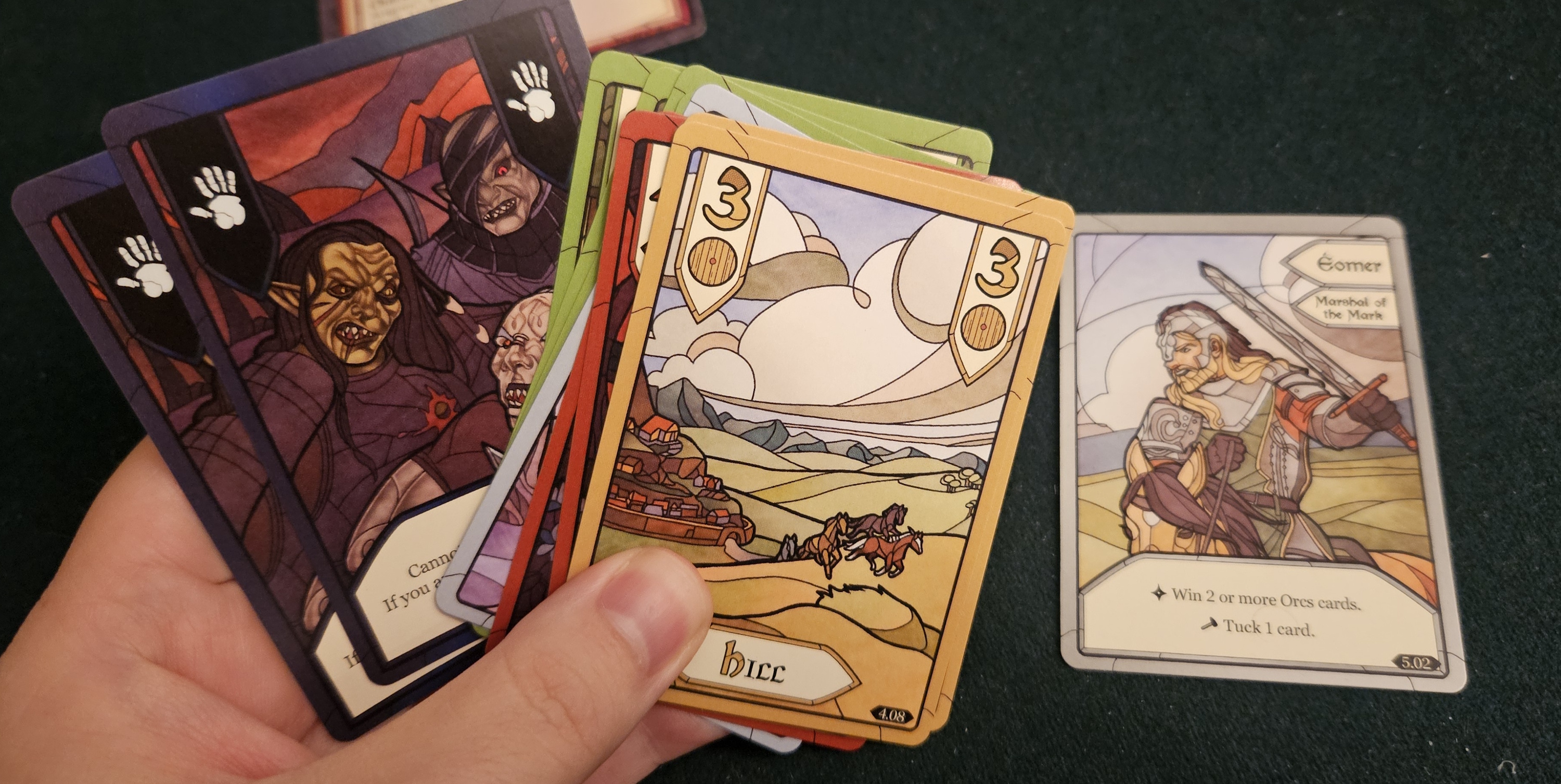
As in the original, your deck is a treacherous thing.
If you’ve been living under a rock — or not reading Space-Biff!, which is much the same thing — then I’ll catch you up in six sentences of Elvish.
Or, fine, for those among us who refuse the allure of the golden tongue:
The Two Towers: Trick-Taking Game, like The Fellowship of the Ring: Trick-Taking Game before it, is a trick-taker that walks us through J.R.R. Tolkien’s masterpiece one chapter at a time. In the tradition of Thomas Sing’s The Crew, this is a cooperative affair, and much of the game revolves around selecting the proper context for the trick-taking. Picking your character is the big one. After dealing out the cards, everybody picks who they will be, which amounts to selecting one’s objective for the hand. What sets it apart from The Crew, though, is the way it furnishes the tale. It’s akin to a new translation of a familiar work, with illustrations and marginalia and a few turns of phrase that illuminate the original in unexpected ways.
Trick-taking is a peculiar genre, being both mired in tradition and perpetually reinventing itself. As one curmudgeon noted just yesterday, the phrase “trick-taking with a twist” is a redundancy. Trick-taking is twists. Small twists, layered atop the familiar.
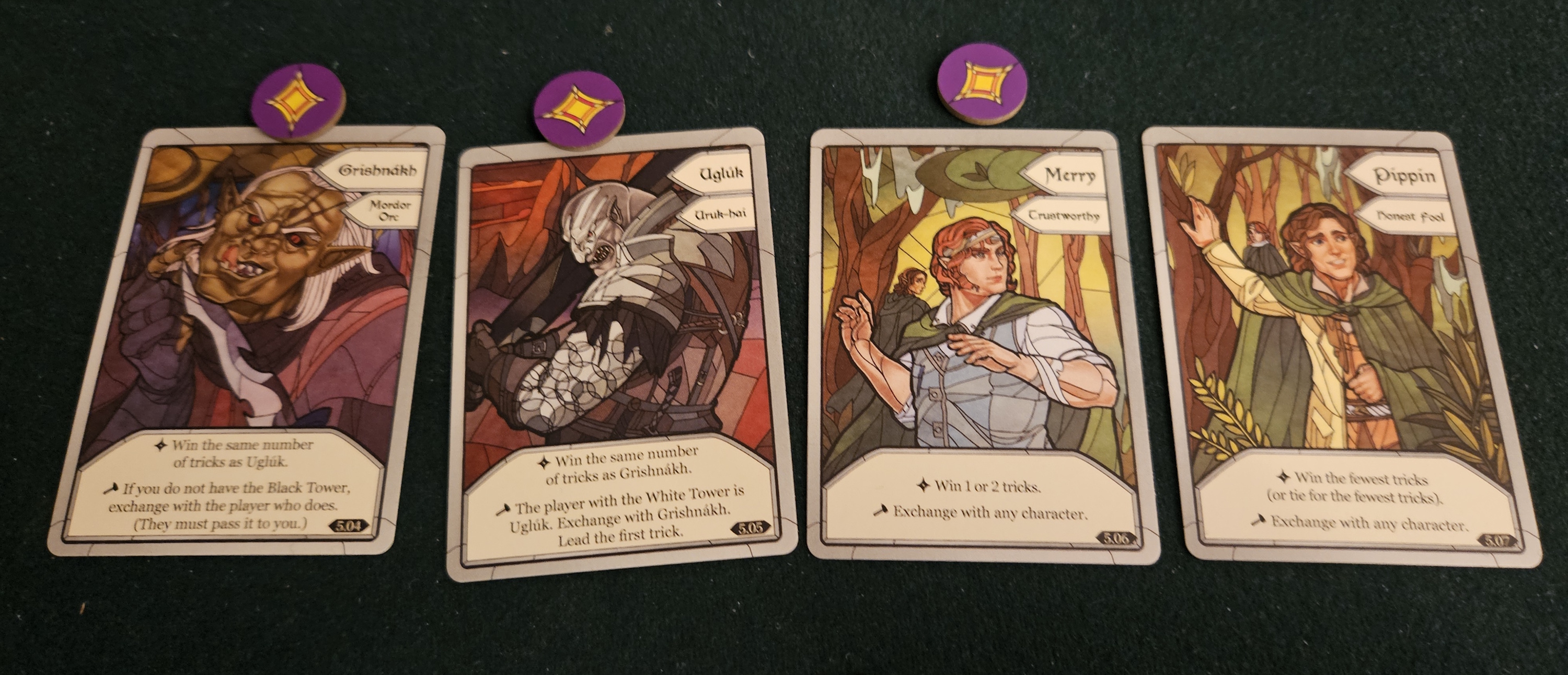
In TTT:TTG, those twists come fast and hard. The deck composition, for one, with its auto-win pair of towers that cancel one another if played into the same trick. Every new chapter piles on additional tweaks. Early on, Bornmueller adds in a pair of orcs as playable characters; the players must hold them in tension by winning an equal number of tricks so that Merry and Pippin can escape the orcish camp. Behold: ludic narrative! Only a few chapters later, Treebeard enters the scene. His whole deal is that he speaks so slowly that his cards enter the following trick, making him the trick-taking equivalent of molasses on a cold day. Even later, the battle of Helm’s Deep becomes a multi-hand death march, additional orcs piling into the deck as the table strives to succeed with enough characters to carry the day. Of course, Gandalf can only be played in the final hand. “Look to my coming at first light on the fifth day. At dawn, look to the East.”
Chills. Right up the front of my thighs. I’m not even kidding.
Remember that menu? From our favorite café? The one with all the meats?
The sheer creativity on display is frankly staggering. Remember when Gandalf the White showed up and for a hot second everybody thought he might be that dork Saruman? Yep, Bornmueller has that in there, a minor hidden-character segment where two strangers in white might be either Tolkien Jesus or Tolkien Judas. Remember when Gollum was doing his multiple personalities routine? Meet Gollum and Smeagol, dueling characters whose roles might reverse mid-trick.
One of the toughest problems for Bornmueller to tackle is also mechanical, although not in the game design sense. Tolkien divvied the books into broad segments rather than interleaving the narrative, resulting in one big chunk with Aragorn, Gimli, Legolas, and the war for Rohan, and then another big chunk with Frodo, Sam, and Smeagol. Bornmueller follows the book rather than Jackson’s adaptation. This necessitates a slightly awkward reset mid-game, with a few cards getting set aside so that the One Ring can return to the deck, not to mention a crescendo at Helm’s Deep when a full half of the scenarios remain to be played. This, I think, was the right decision. Players are invited to get to know their deck and cast of characters, ever-expanding though it may be, rather than swapping back and forth. At the very least, preserving the trilogy’s format keeps the overhead in check.

Uh oh. Wormtongue. That guy has a nasty tongue.
But this isn’t a game for “at the very least.” It’s a maximal sort of game, offering such a bounty that it threatens to overwhelm one’s appetite. I don’t think this second volume will persuade those who didn’t get along with the first. But for those of us who appreciated what Bornmueller was going for, The Two Towers offers more, more, more. More characters, more scenery, more upsetting objectives that seem impossible until suddenly they aren’t.
I’ll offer one better, and annoy the skeptics out there for good measure. These trick-takers are a singular argument for the value of ludic translations, smaller in scope than film adaptations or radio plays or stage productions, but no less critical for how they approach one of the modern world’s greatest works of literature through the scope of play rather than narrative. To experience The Two Towers: Trick-Taking Game is to revisit Middle-earth and recall what made these stories worthwhile in the first place.
A prototype copy of The Two Towers: Trick-Taking Game was provided by the publisher.
(If what I’m doing at Space-Biff! is valuable to you in some way, please consider dropping by my Patreon campaign or Ko-fi. Right now, you can read my third-quarter update on all things Biff!)
Posted on November 20, 2025, in Board Game and tagged Board Games, Office Dog, The Two Towers: Trick-Taking Game. Bookmark the permalink. 9 Comments.

 SPACE-BIFF!
I finally got round to playing a bit of TFR TTG recently and it was an absolute blast! Both when we breezed through the first 4 chapters without a glitch and when we smashed our heads in grinding through the next two chapters in 7 goes each… I’m pumped to hear TTT continues in the same vein. This series feels like a masterpiece of adaptation – you can feel the story, the characters, and the situation in each chapter, and yet the ruleset is simple and sleek, the objectives always clear.
Agreed. I didn’t talk too much about in this review, since I focused on the characters a bit more last time and didn’t want to repeat myself too often, but the ways it evokes the “feel” of the characters with just a few rules is wonderful.
Table: What are we playing?Me: What about a Tolkien Trick-Taker?We’ve already played it.We’ve played one Tolkien Trick-Taker, what about the second Tolkien Trick-Taker?That awkward moment where I have to create a category for a game series on BG Stats to appease my eccentricity, because I am essentially playing the same game and refuse to log them separately.
We’ve already spent more hours in the Fellowship than the extended Jackson movies combined, and we’ve only just been able to leave Rivendell. Playing with two young kids (8 & 6) isn’t speeding things up of course, but it’s the journey, not the destination, that counts!
Your end paragraph sums it up perfectly for us.
Really excited to explore Two Towers with the family. From the details I’ve seen already, the puzzles are really thematic and creative. Too bad it isn’t available over the Christmas period. Let’s see if we can get through Moria before it goes to retail!
I wish it had been ready for Christmas, too! I was a teenager when the Jackson adaptations came out one per year, and that regular trickle of LotR made so many memories. Maybe I should introduce my eleven-year-old to this one…
You should! While the puzzles sometimes are a bit too much for our kids (especially the young one is focussed more on winning the specific trick than keeping eye on the actual goals in play) they enjoy the gameplay a lot and they really enjoy playing ‘difficult’ games with their parents.
This has been a smash hit in our household because the entry bar is low (you can play along if you know colours and numbers) while the gameplay beyond is quite complex. They love to grapple with that. I have found few games like that.
I’m nearly finished with a solo playthrough of the TFR and it’s left me wanting to continue the campaign into the sequels, but somewhat stale on the solo gameplay itself. I’m hoping there are not as many instances in TTT of scenarios, items, etc that deal with hidden information and are thus unusable in solo gameplay. Four-handed solo only starting with 4 cards per hand makes the beginning choices and exchanges less consequential and the game overall feels more reactive to the cards being dealt after each trick. The last few chapters where characters’ objectives overlap more has made gameplay feel a lot more monotonous. I’m eager, however, for a large finale in the Breaking of the Fellowship to tease me into quickly buying the second.
Pingback: Legend Became Tabletop | SPACE-BIFF!
Pingback: Space-Cast! #52. Fellowship of the Trick | SPACE-BIFF!