Atlas Boogied

Something I’ve always appreciated about John Clowdus’s games is the way they evoke larger worlds with two sentences and a half-dozen illustrations. In the Shadow of Atlas, for instance, speaks to the way extra-solar colonization will necessarily change us, physically and socially both. Some of those changes look pretty good from where I’m sitting. I wouldn’t mind being a member of the Laverna Order and sashaying around with a fur-trimmed coat and saber. Others are more mixed, like becoming one of the clone-slugs of the Janus Order. These dudes can step into any other role. Which might seem nifty until you realize they’d be the underpaid substitute teachers of the twenty-ninth century.
Or maybe In the Shadow of Atlas is just another lane battler. Not that that’d be a bad thing. Clowdus has long established himself as one of the form’s most studied hands, and this title demonstrates that he’s still shaking up the genre.

We will dominate these moons… or get discarded trying.
Okay, so welcome to the Atlas System. These particular star-lanes are dominated by five planets, each in need of a ruler, and naturally you’re the best fit for the job opening. Too bad about the other guy. The one seated across the table from you. It would seem your résumés are deadlocked. Time for a nudge in your favor.
But rather than solve this problem the old-fashioned way — the Omen: A Reign of War way, with sacked cities and soldiers impaled on their shields — things in the Atlas System must follow every rule to the letter. This is a more political affair, about parlaying the favor of your culture’s six predominant orders to establish a foothold on those planets, command orbital outposts, and hopefully manage your treasury along the way.
For example: rather than piling troops into each lane, here your expansion is more measured. There are only six flavors of card in the deck, one per order, each with its own ability. Ho hum. We’ve heard this before. But in In the Shadow of Atlas, each order can only be deployed to any given planet once. If representatives from the Felicitas Order currently occupy every planet, well, you won’t be sending another felicitation to any of them anytime soon.
That’s not all. Successive cards cost more credits, and money is tight. Most actions are deployments. You spend some credits, deploy a card to a planet, and trigger its effect. While the first card only costs one credit, the second costs two, and the third card costs three.
Now, you might be thinking, “And the fourth card costs four!” Nuh uh. Three is as high as it goes. The instant somebody plays three cards to a planet, they become that planet’s arbiter. They gain some bonuses and flip the card to its developed side.
Only this isn’t a decision easily undertaken. Becoming a planet’s arbiter sends all three of your cards to the discard pile. From now on, you’re that planet’s ruler and can no longer play cards there. But your rival’s cards stay in place. They can still pile up. And — and this is the big one — they can strip you of your arbitership by getting three of their own cards installed there.
In other words, claiming a lane is how you scoot closer to winning the game, but it also opens you up to big swings from the opposition.

Managing your faction’s resources.
Simultaneously, there are resources to manage. Cards are the foremost measure of your health, and that goes double because most cards become more effective when you’re holding a duplicate. Playing a member of the Neptune Order, for instance, lets you draw a card. But if you then discard another Neptuner, you draw two more cards. There’s an element of chance to the whole affair, of plumbing the deck for the right cards. But the real draw is the way this encourages a certain degree of restraint. Success requires a knowledge of when to play and when to hold out for a sterner combo.
Two other resources complement your hand. There are credits, which seem limited until you learn how to bounce your accounts back to full every other move. And there are orbital outposts, effectively one of the avenues to scoring and victory, which are peeled off the deck and use the orders’ reverse side, gradually winnowing the deck and thus the cards available for play. Be warned: there’s a lot of shuffling in this game, especially in its later stages as players approach the threshold for owning enough outposts to conclude the session.
The appeal of these resources lies in the way they apply such an uneven topography to In the Shadow of Atlas’s action economy. Outposts are points, but they also generate credits; credits pay for cards, but they must be carefully managed lest you find your accounts overdrawn; cards are your biscuits and space-frozen vegetable emulsion, but can also prove a burden if not churned smartly. It’s not quite a circle of life. More like a figure-eight, or a bow tie, or maybe a vicious conveyor belt. But there’s no escaping it.
In one sense, the game plays as a riff on what Clowdus was doing all those years ago with Omen. Success requires one deft combo after another, sometimes resulting in mind-boggling turns or painful reversals. Indeed, it’s necessary to keep an eye on the relative standing between players at all times, lest your rival gain arbitership over their last two planets in the same turn and bring the game to a premature conclusion. Like Omen, this is a game that rewards repeat plays.
Very much unlike Omen, however, it feels entirely self-contained. Which is to say, if Clowdus produces an expansion for this one, I shall eat my vacuum helmet one rivet at a time. Clowdus’s games are often elegant, according to some definitions of the word. They’re graceful, if still a bit untamed, emphasize a certain instinctive skillset over counting sums, and, above all, are restrained.
In the Shadow of Atlas is all of those things. Stringing together the right combo feels not unlike a dance. It looks effortless, but only from the outside. In the moment, it’s all taut control and daring leaps, little pirouettes where one card enables another, which enables another, which sets up the next handspring.
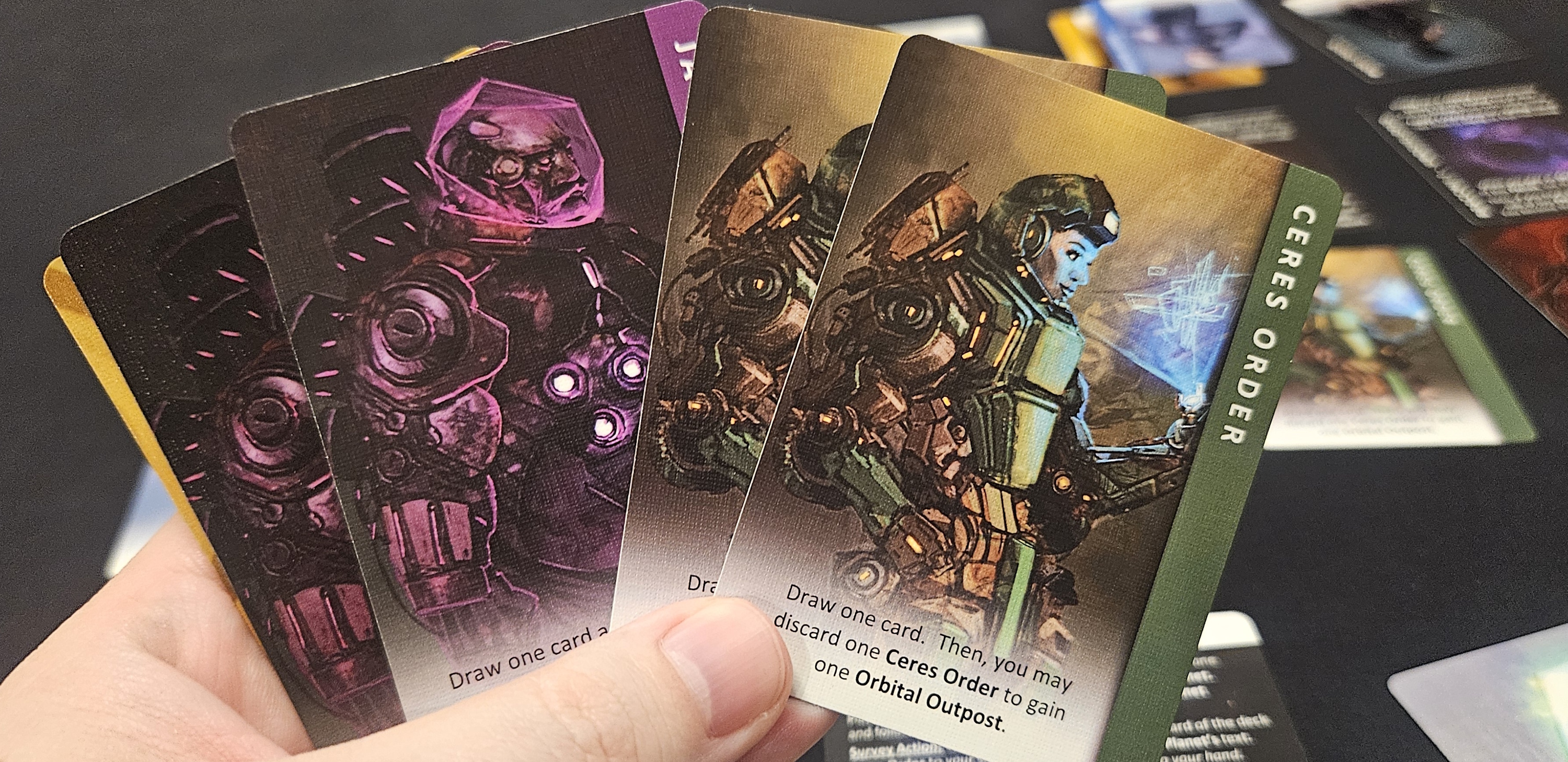
Aaron Nakahara’s illustrations are evocative… and color-coded!
Do I have complaints? Sure. Clowdus offloads a few too many rules onto the reference cards and even the planets, muddying their legibility and making certain subtleties easy to overlook. To continue the dance metaphor, the set is too busy and the dialogue requires cross-referencing in the playbill.
Still, In the Shadow of Atlas is perhaps Clowdus’s strongest game in years, probably since Pariahs or Bronze Age. Maybe further back, circa Neolithic? It’s hard to say. His catalog is such a deep well that it’s hard to settle on any one toehold. Regardless, this is the good stuff. Exploring this game takes me back to the first time I played Omen — the thrill of discovering a powerful combo, the infuriation on my rival’s face — only this time, the game is slimmer, more approachable, less phasey. The underlying message of In the Shadow of Atlas, insofar as such a diminutive game has a message, is that time and space will change us. In the case of Clowdus’s lane battlers, it seems those changes have been for the better.
A complimentary copy of In the Shadow of Atlas was provided by the designer.
(If what I’m doing at Space-Biff! is valuable to you in some way, please consider dropping by my Patreon campaign or Ko-fi. Right now, you can read my third-quarter update on all things Biff!)
Posted on November 5, 2025, in Board Game and tagged Board Games, In the Shadow of Atlas, John Clowdus, Small Box Games. Bookmark the permalink. 12 Comments.

 SPACE-BIFF!
Every time I read your reviews of a Clowdus offering, it reminds me to bring a few to the next game night. Great little explorations,and I appreciate how the sharp edges are never filed off to “optimize the new player experience.”
Agreed! These games have corners. And that’s what makes them so good.
Hey Aaron, thanks for playing them!
Thank you for writing about another one of my games, Dan!
“A complimentary copy of CogDrive Neon was provided by the designer.“While I’m sure that’s true, I think it’s on the wrong post.
Gah! Thanks!
This looks great. I am glad you reviewed this, as I have had my eye on this one for a while.
I am going to try to buy some of John’s Print & Play files. I am getting a laminator off Amazon (Christmas), laminating pouches (3mm), printing from a UK print shop (200gsm), an accurate cutter and a corner rounder. I have see the videos, so fingers crossed I can do a decent job.
Best of luck!
Hiya Dan, just wanted to leave a data point for you (and John Clowdus). Thanks to your reviews I checked out Small Box Games and have printed and played the new Omen version. Really enjoying the first so I bought the rest and are assembling them now.
Hey Ernest! Thanks for giving my games a shot. I’m so happy to hear you’re enjoying Omen!
Thanks for the data point!
Loving the economic flow here—I’m a sucker for decisions about immediate impact (like “coins” here) or VP. I guess I’ll be putting this on the shelf next to Omen. Great review as always!
Thanks for reading!