The New Dog-Ears
Storyfold: Wildwoods isn’t the game I was expecting. It isn’t the story I was expecting. If we want to be a little more crass, it isn’t the product I was expecting, either.
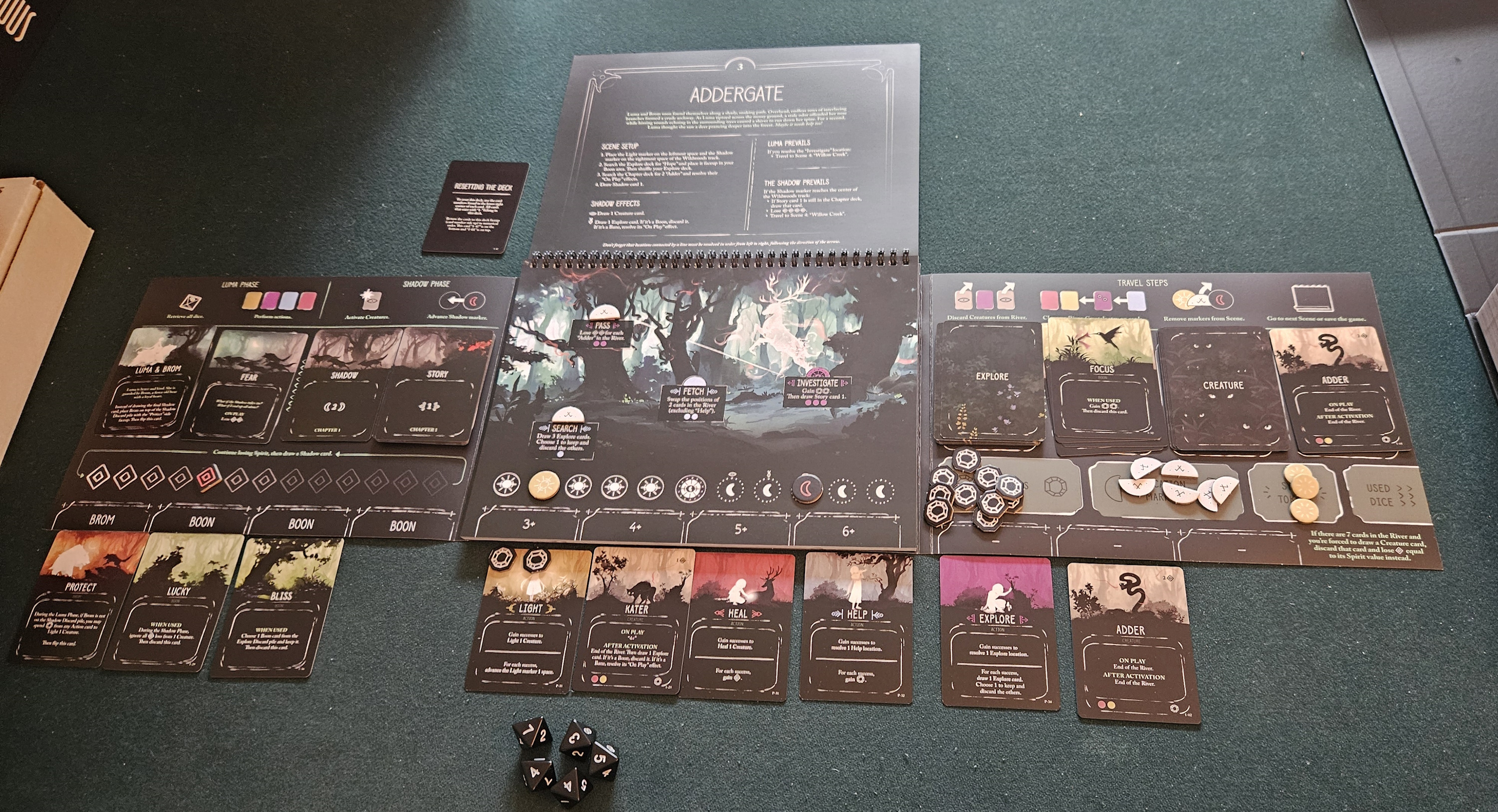
The whole thing, story and folds and all.
Brought to life by Sjoerd van der Linde, for whom this is his inaugural title, and Open Owl Studios, the publisher that previously gave us Mythwind, an imperfect but intriguing attempt to produce the tabletop equivalent of Stardew Valley, Storyfold: Wildwoods is named, curiously, after the arrangement of its storybook. Laid out on the table, it unfolds like some class-defying marriage between a gold-enameled triptych and one of those complimentary spiral-bound calendars passed out by your local auto shop. The spiral-bound portion is the storybook, passing vertically from one scene to the next. The wings of the triptych, meanwhile, are what govern the gameplay, holding the decks and counters and all that. Oh, and this is how you save your place. When it’s time to pack the game away, the triptych folds across the current page like the world’s fanciest bookmark.
Which is another way of saying that Open Owl has reinvented French flaps. Time is a flat circle after all.
Speaking of this thing as a production gives me the hiccups, but there’s no denying the entire package is handsome. The storybook is lovely, of course, but there’s also an insert for holding the current arrangement of your cards, preserving not only their order, but also the tokens currently stacked atop them. This isn’t anything new to Open Owl. Mythwind, with its durable session lengths, could be seen as one big exercise in state maintenance, with its myriad solutions for ensuring your next play picks up precisely where the last one left off. Storyfold is simpler, in no small part because it’s a solitaire game, but the ease it permits is still worth mentioning.
The same goes for the game itself. I’ve developed a wariness for board games that promise to teach the rules as they go. In most cases, what this means is that the drudgery of the rulebook gets spread across multiple hours, rather than being consigned to the few minutes it would take to just read the dang thing. But here, Storyfold really is a snap to learn, the prologue nudging you into a gentle roll without belaboring the process. It’s conversational rather than stilted, and while it helps that the game’s rules are simple to begin with, I do appreciate that they’ve cracked the code.
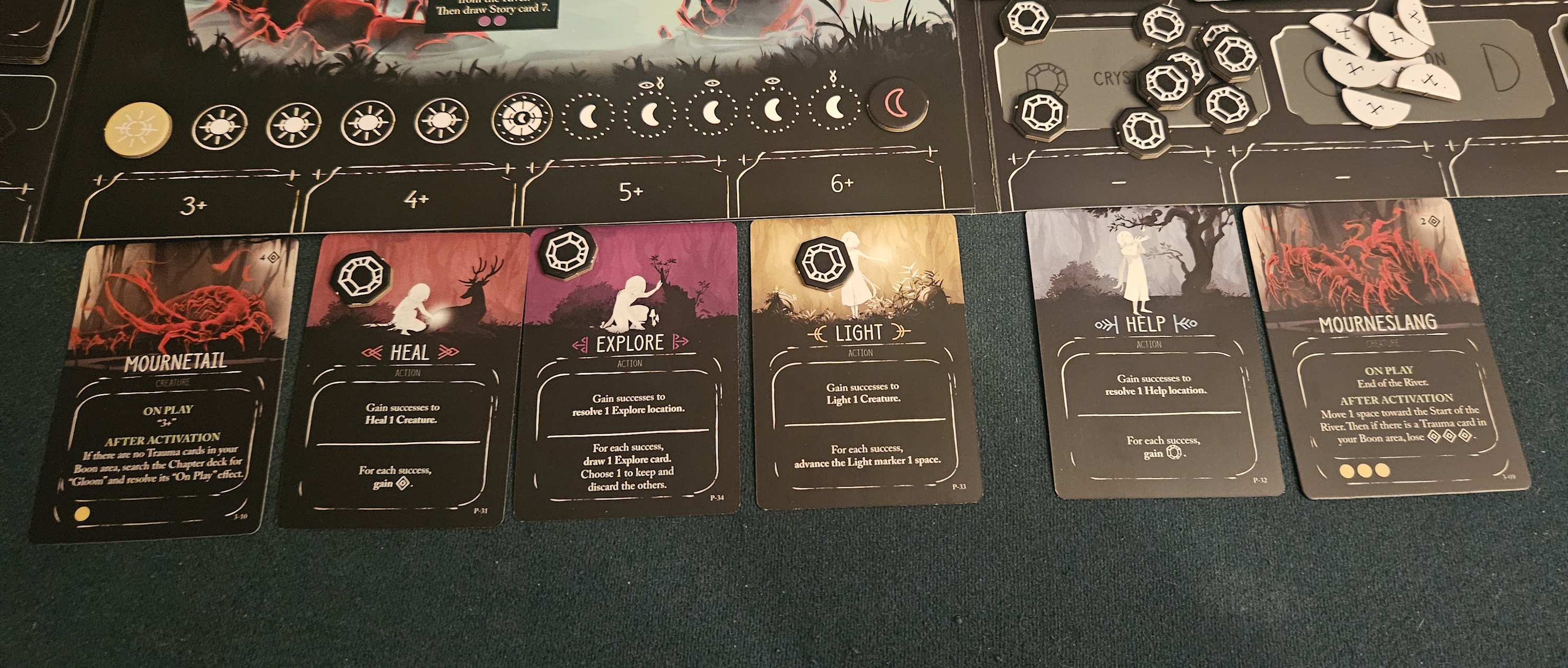
The card row, where the magic happens.
Okay, enough of this box-opening crap. What is Storyfold? What is the Wildwoods? And are they the same thing?
Mechanically, Storyfold: Wildwoods is a game of two halves, a card-management game and a dice-chucker, although these halves are welded so tightly that it’s hard to separate them.
The same goes for the narrative, which stands astride the more mechanical portions at all times. Your character, Luma, has undertaken a journey through the forest with her bear companion Brom. Luma is a precocious girl who is, thanks to the game’s rather, ah, impressionistic style, something of a cipher. The forest, meanwhile, is a darkling thicket populated with nightmares that threaten to dampen Luma’s spirits. Within all of five seconds, one begins to suspect that these woods are a metaphor. But let’s not get ahead of ourselves.
Of the game’s two halves, the more intuitive portion is the dice. Over the course of her misadventures, Luma will be presented with a number of challenges. To overcome these, she’s allowed five eight-sided dice, plus a couple of higher-digit options that may unlock over the course of the tale. Running out of dice allows the forest to respond, pinging Luma with damage or adding dangerous creatures to the mix. She’s thus encouraged to spread her dice as thinly as possible, taking two or three or (dice help her) four actions in a turn, but risking the consequences of a flubbed roll. It’s familiar fare, but that isn’t to say it isn’t well applied. Every action is dangerous, and never more so than when Luma stretches to accomplish more than she maybe ought.
What really makes this system shine, though, is the other half of Storyfold’s formula. Luma’s actions are bound to four cards. By extension, the odds of their success are tied to their relative position. This takes the push-your-luck element of the game and connects it to a hand management puzzle. You might, for example, want to heal a monster’s traumas so that it leaves you alone. But your heal action happens to be situated a little farther along your card track, with rolls that only succeed if you hit 6 or higher. Not great.
But when you use a card, it shifts to the rightmost position of the track, letting everything else tumble into lower-risk slots. This opens up the game to a marvelous degree. You can plan ahead, ordering your actions so that they trigger in the best possible order. Or, in a pinch, you can resolve an action with a single die. In many cases this will “fail” the action, but still shift a blocking card out of position. With some finagling, your essential actions will always be in slots that are likely to succeed.

Progressing through the story.
The beauty of this system, though, lies in how prone to manipulation it is. As the game progresses, nasty creatures enter your card row. These pose the foremost danger to Luma’s well-being, gradually decreasing her health and triggering other effects. For instance, ensuring good rolls becomes a lot harder when there’s a shadowed wolf squatting in your card row’s leftmost position. It becomes necessary to juggle all of your actions, sometimes stunning creatures with bursts of light or healing them altogether. More than once, I’ve been saved because I held onto a timely boon that let me swap the position of two cards or shove a pack of monsters to the tail end of my card row.
For such a simple game, there’s a lot to think about. Sure, there’s always the possibility of a bad roll, but that’s where Luma’s tricks come into play. Cards can be stacked with tokens that guarantee additional successes. Boons spill from the exploration deck, permitting rerolls or flipping dice to their opposite value. And there’s always Brom, your trusty companion, ready to step between Luma and a fatal blow.
Then again, such an act of heroism might have consequences. Because Storyfold: Wildwoods isn’t solely mechanical. There are choices to make, forks in the storybook’s narrative that, although they don’t majorly change the outcome of the story, can lead you along contrasting paths in your journey.
Sometimes even minor alterations can result in long-term changes. I was pleasantly surprised when a wound was added to my exploration deck because Brom had stepped between Luma and an attack. I say “pleasantly,” but that’s me speaking critically. Watching my companion endure lingering injury was more bittersweet. The same goes for other adjustments. Saving an innocent creature might add them to your deck as a permanent boon, while failing to confront a particular threat might see them lingering as a nagging threat. This reactivity isn’t always evenly applied, but for a format that often bifurcates its narrative and mechanical sides — here’s the game and there’s the story — it’s lovely to see them interleaved with such care.

The exploration deck tracks many of your choices.
I wish I could say the same for the story. Earlier I called Wildwoods “impressionistic.” But even as that captures something about the way this tale is told, that’s doing it a favor.
To be clear, there’s nothing strictly amiss with the narrative. It’s colorfully told, it takes us to interesting places, it plucks the right heartstrings. But it also struggles to establish much in the way of setting, character, or stakes. Luma is a young girl, but we know so little about her that it’s hard to regard her as more than a stand-in. Without exception, the story moves along the same beats. Luma enters another stretch of damp forest, sometimes a marsh or a thicket or a towering tree, but always wreathed in shadow. She sees something worth saving: a bright light, a cheerful otter, a squirrel. But then she’s approached by a creature out of nightmare, whether a pack of wolves or a clacking crustacean or a dim reflection of her shadow self. Over and over, this same formula is repeated. The details surrounding each encounter are evocative enough, the writing is florid in that way some people like, the dream-logic is suitably disorienting. But it’s like fancy clothes draped around a mannequin.
Or perhaps more accurately, it recalls a nightmare sequence of a larger story, except this tale is all nightmare and no waking. It’s like hearing somebody recount a dream. A very long and repetitive dream. To be sure, a dream in which they arrived at an emotional breakthrough! Which is great and all, but doesn’t necessarily make the dream all that much more interesting to hear about.
The obvious touchstone would be Eila and Something Shiny, another title riddled with dream logic and cipher characters. I can say without reservation that Storyfold: Wildwoods is the better game. Mechanically, narratively, and certainly morally. Like Eila’s tale, Luma’s journey is emotional rather than concrete. Unlike that tale, fortunately, Wildwoods never stoops to hideous moralizing about what Luma deserves. The ending, for all its remoteness, is touching, because it speaks to a universal human experience, and does so humanely. We have all found ourselves coated in shadow. Hopefully, we have all found a way to break through the shroud. Sometimes, anyway.

The real protagonists here.
In the end, Storyfold: Wildwoods is many things, nearly all of them worthwhile. Its underlying system is enthralling, and I sincerely hope to revisit both its card row and French-flapped storybooks in the future. The production is fantastic (urp), and while the narrative is the weakest link in this particular chain, it still taps into something good and fine about our capacity to confront the ills that have befallen us. With any luck, this won’t be the last tale we hear from van der Linde.
A complimentary copy of Storyfold: Wildwoods was provided by the publisher.
(If what I’m doing at Space-Biff! is valuable to you in some way, please consider dropping by my Patreon campaign or Ko-fi. Right now, supporters can read my next essay, on the competing strands of history and criticism that are present in my work. That’s right, it’s the Death of the Author, bay-bee!)
Posted on October 24, 2025, in Board Game and tagged Alone Time, Board Games, Open Owl Studios, Storyfold: Wildwoods. Bookmark the permalink. Leave a comment.

 SPACE-BIFF!
Leave a comment
Comments 0