Belligeniture
It isn’t often that a title will cause me to spend more time thinking about its system of political succession than its gameplay, but that’s exactly what happens every time I try to break out Leaders. According to designer Hugo Frénoy, these borderline abstract contests serve to keep the kingdom peaceful. Every spring, would-be rulers engage in a bout to capture their foe. Recruiting warriors from the sidelines and calling it quits the instant one potentate has been surrounded, these matches are bloodless, honorable, and prevent infighting.
Sure they do. Because a loser has never decided to stab the winner in the face. Because the court eunuchs have never manipulated the odds to favor whichever weak-willed sycophant will let them do their thing. Because the mercantile class has never said, you know what, annual belligeniture isn’t suitable to long-term economic policy, let’s poison the game-masters.
Am I fretting too much over throwaway details? Undoubtedly. But that speaks to some flimsiness on Leaders’ part. This is a game that ticks so many of the right boxes. All the more pity it doesn’t quite work.
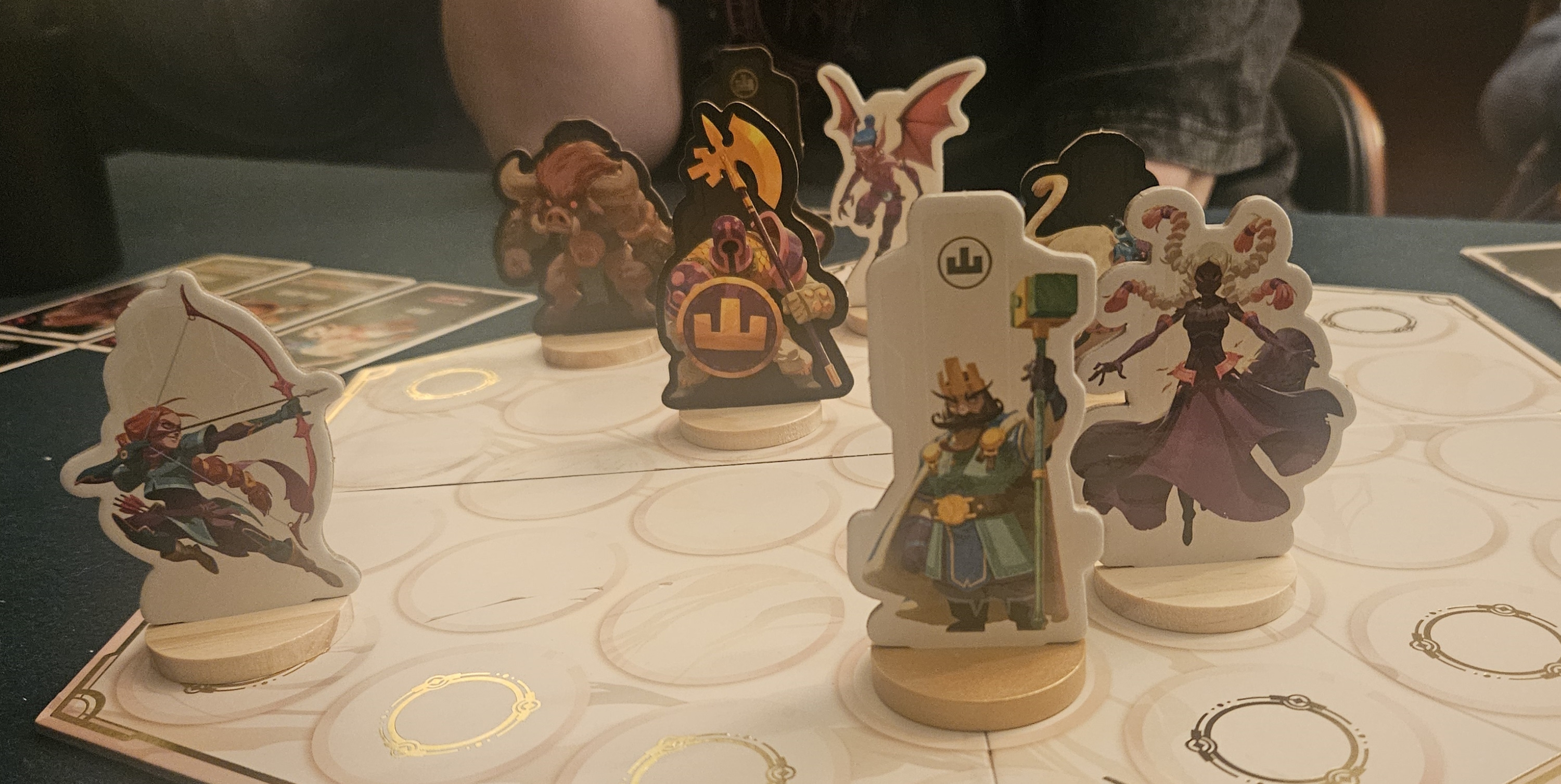
One potentate squares off against another.
Picture this. The arena, a great hexagon thronged by eager crowds. The aspirants, both regal in capes and crowns, unblooded weapons hoisted menacingly. Three gormless helpers on the sidelines, waiting to be drafted into this goofball contest.
The objective of Leaders is to surround your rival, whether by nudging two of your fighters up against them or hemming them in with any number of troops no matter whose side they’re on. So much for castling, eh chess fans? To accomplish such a maneuver, your leader will recruit warriors from an ever-refreshing pool. What begins as an open arena populated only by those two would-be rulers soon becomes crowded with archers and mages and wily frogs.
Early commenters drew some parallels to chess. It’s easy to see why. Leaders is like chess if players began with only kings, and then drafted rooks and knights and bishops to their side. Not during some pre-game preparation phase, but during the action itself, each new addition altering the landscape with their unique method for projecting force.

My ragtag team.
Of course, the comparison is imperfect. The differences are even starker than the parallels. Most pieces can only move a single space, for one thing. There are no slides here, or at least they aren’t the norm. Some pieces stand out for their mobility, but these remain more limited than any invocation of chess might let you think. The Rider, for example, can move two spaces in a straight line. The Claw Launcher — a gremlin with a spring-loaded grappling hook — can move in a straight line all the way to a visible character, which is potent but also prone to enemy manipulation. The Vizier doesn’t gain any mobility advantage for himself, but he does let your Leader move an extra space, a powerful consideration for anybody dodging mid-game capture. The Brewmaster is similar, letting an adjacent ally move a space. If that sounds dumpy, it is. Nobody picks the Brewmaster.
Other heroes are more worthwhile. There’s the Bruiser, who can push an enemy out of their position, the Manipulator, who forgoes regular movement to shift a foe from afar, the Wanderer, who can teleport to any space on the board as long as it isn’t adjacent to an enemy piece. Some picks are outright better than others. This isn’t so much a problem of balance as one of selection. Even weaker selections can be made to work with the right teammates. You know, apart from the Brewmaster. Nobody picks the Brewmaster.
Perhaps you’ve already sussed out that Leaders is at its best when it’s leveraging these personalities against each other. There are sixteen draftable heroes in all, although only a handful will appear in any given session. Both sides only draft one per turn, apart from the second player’s first turn which sees them drafting two, but these drafts end once both sides have picked four times. That’s plenty. The arena is compact, after all, and it won’t be long before somebody’s Leader wedges themself into the wrong corner.
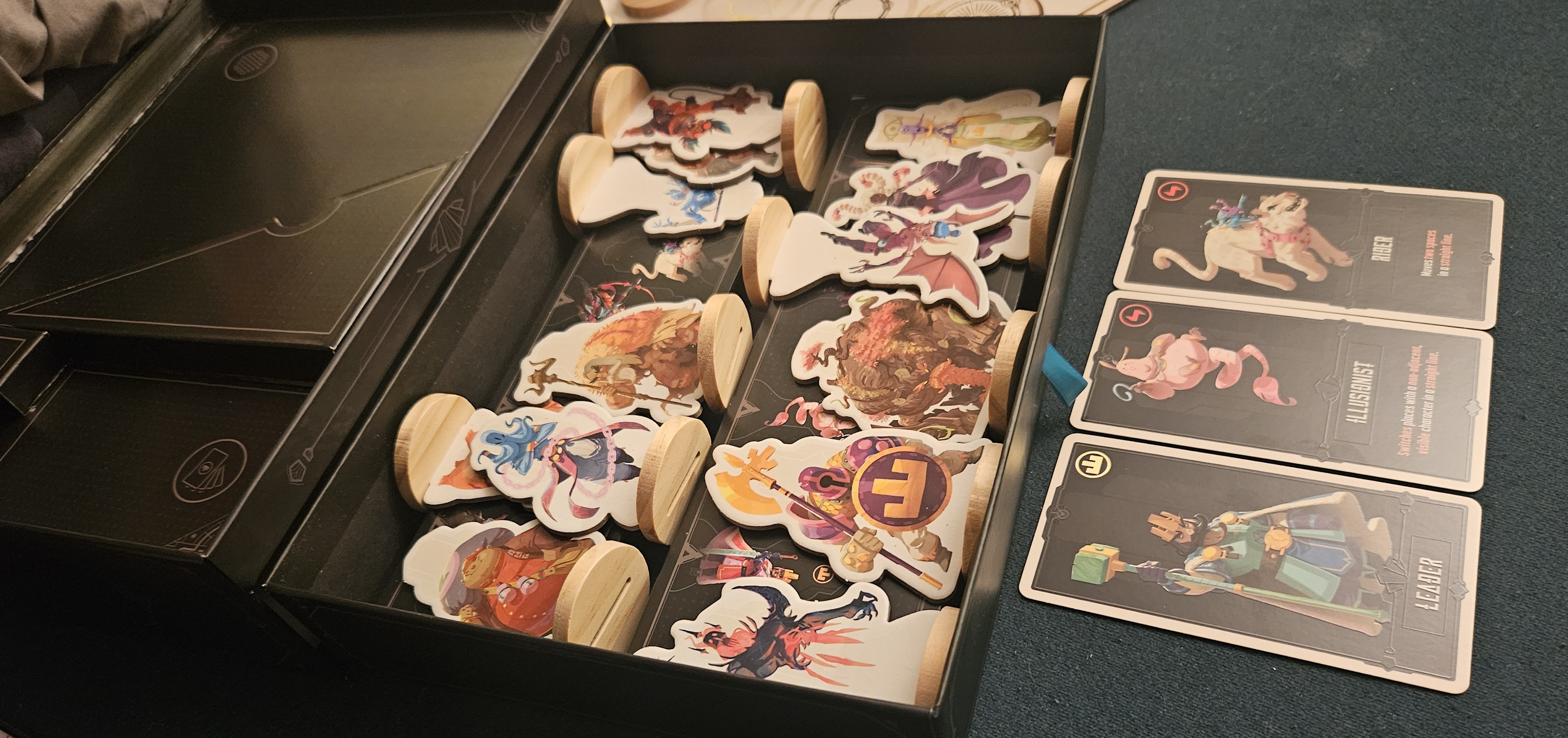
The box drawer is a 10/10 storage solution.
If anything, that’s the game’s biggest weakness. For a contest to secure the future of the entire kingdom, these events sure lack drama. The arena is compact, like I said. You could reach the other side at a crawl without needing more than a minute. When all you need to do is get two units next to your rival, it usually doesn’t take much more than that. Leaders lists its playtime as fifteen minutes, and for once a board game isn’t lying through its dentures. The problem, though, is that this isn’t enough time to generate the necessary heat.
Adding to this problem, turns see you moving every unit you have on the table, another departure from abstracts like chess. The board state is readable enough, largely thanks to the way units amble so slowly from place to place, but there’s very little consistency to anything. If a king is wedged up against three of his own pieces, well, that’s not a big deal, the entire flank can waddle away as quickly as you can waddle toward them. The board’s boundaries are your best friend here, putting a hard limit on how far those legs can carry your quarry.
The result, unfortunately, is matches that nearly always resolve long before they actually conclude. I mean, not long before, but a minute or two, which in a game that lasts only fifteen of the things is an eternity. More often than not, Leaders concludes for whichever player nabs the most mobile pieces. Barring that, whomever first marches across the board. Given the way the default draft rotates, there isn’t a way to block selections. If a useful piece fills in the gap, you take it. Otherwise, you take whatever’s best and do your darnedest to ignore the Brewmaster. Nobody picks the Brewmaster.
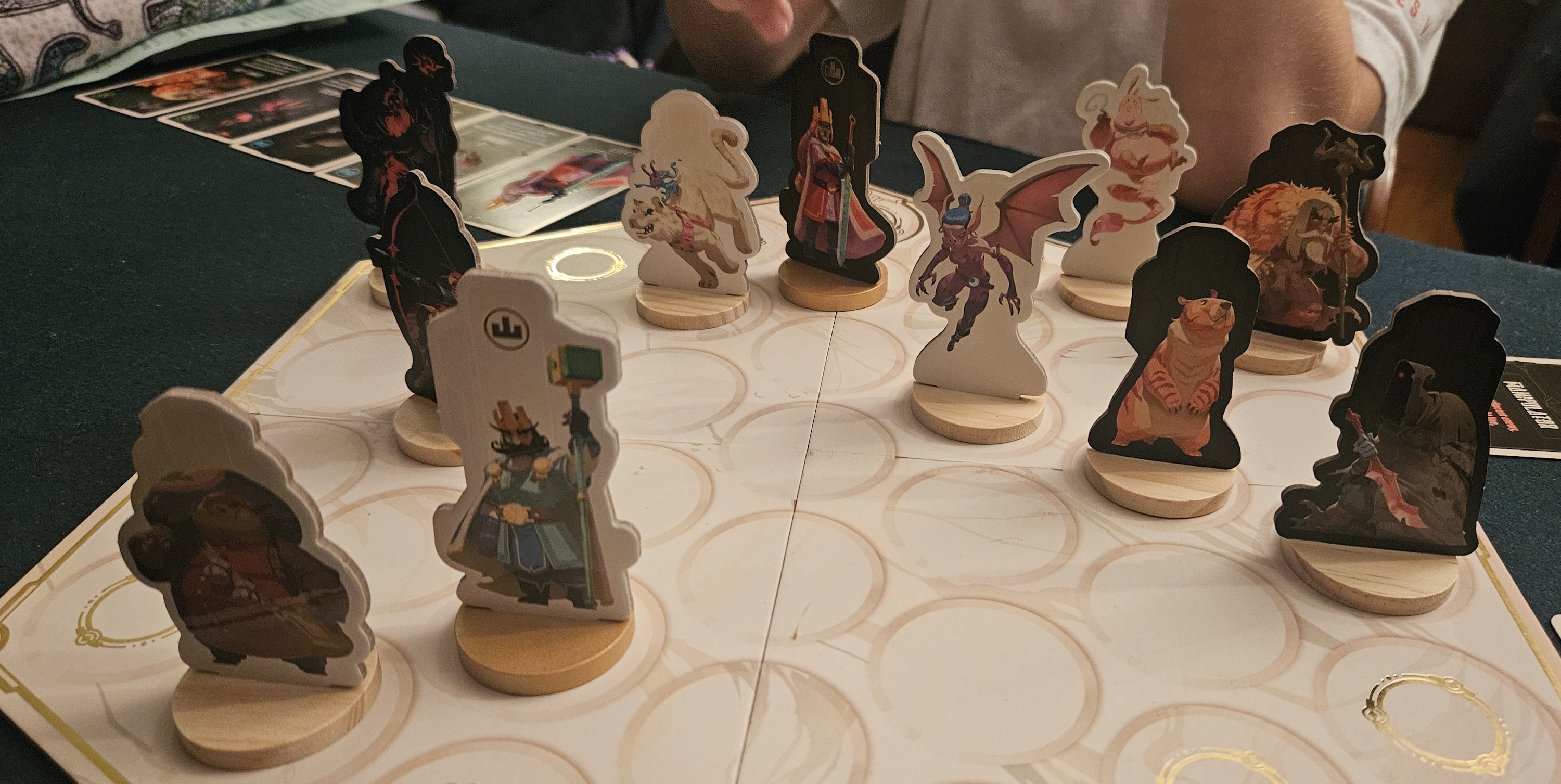
On the verge of being crowned the king. Until the next year, anyway.
It’s all a shame, because a combinatorial abstract about selecting your pieces mid-action is a great concept. There are powers aplenty here, the space feels about the right size, and the box comes with this awesome little shelf for holding the pieces. Leaders feels like it ought to work.
But it doesn’t. Like its method for picking a successor, this thing has too many underlying problems. Without the necessary drama, the possibility of big reversals, the gradualness that marks a game like chess as worthwhile, the entire contest feels as throwaway as its lore. In the end, what this kingdom needs is a new form of governance. I nominate the Brewmaster.
A complimentary copy of Leaders was provided by the publisher.
(If what I’m doing at Space-Biff! is valuable to you in some way, please consider dropping by my Patreon campaign or Ko-fi. Right now, supporters can read my next essay, on the competing strands of history and criticism that are present in my work. That’s right, it’s the Death of the Author, bay-bee!)
Posted on October 14, 2025, in Board Game and tagged Board Games, Leaders, Studio H. Bookmark the permalink. 2 Comments.

 SPACE-BIFF!
I had the opportunity to play Leaders last week-end and had a blast, it’s right up my alley. Funnily enough, my opponent mentioned War chest while setting up the game (and yes, that drawer is so satisfying!)
I need to play it more, but I really liked the shift in paradigm brought by the fact that all units move in a turn. It makes for big, powerful combos and entices you to think a lot about the draft.
Did you get the opportunity to try the “strategist mode” mentioned at the back of the rulebook ? It looks like it could solve some of your issues.
Glad to hear you enjoyed Leaders, Chips! I did try the strategist mode, and while I liked it better than the regular draft, it didn’t wholly fix the game for me.