Hex-and-Counter Meets Its Little Boney
Hex-and-counter has always been that inscrutable corner of the wargaming hobby for me. Whenever I venture over, it’s like getting a faceful of cobwebs. And don’t even get me started on clipping counters. I barely even clip my toenails.
But there are exceptions. This year, Paolo Mori — yes, that Paolo Mori, the one with some of modern boardgaming’s best regarded titles in his portfolio — founded Ingenioso Hidalgo, a label specifically for publishing projects that might not fit anywhere else. Thanks to a collaboration with Alessandro Zucchini — yes, that Alessandro Zucchini, the inventor of the oblong green vegetable we know as the cucumber (and more seriously, Mori’s co-creator on Toy Battle) — we now have the imprint’s first release. It’s a hex-and-counter wargame called Battlefields of the Napoleonic Wars.
True to the company’s name, it’s downright ingenious.

Drawing the Austrians into French lines at Rivoli.
In more ways than one, Battlefields of the Napoleonic Wars recalls the wargaming hobby of yesterdecade. It comes in a box that’s very nearly a replica of the old Victory Point pizza boxes. Inside are four folder-bound scenarios that wouldn’t feel out of place in a comics-sized ziplock. The dice, which are absolutely lovely, chunky wooden things with rounded corners, require their stickers to be applied in advance. The only thing missing is the laser-cut woodsmoke aroma.
But where the production has that homebrew feel of something assembled in the design team’s basement, it’s lovely from top to bottom, nowhere more so than in the gameplay itself.
The game’s foremost innovation revolves around the arrangement of the counters themselves. Where far too many hex-and-counter games present inscrutable stacks of chits, moved across the board with delicate tweezers lest the slightest tremor scatter this instantiation of Gettysburg into disarray, Mori and Zucchini have something else in mind. Now, these are not the first designers to limit their units to a legible one per space. But they are, I suspect, the first to imbue them with such a legible flair.
Here, each unit in Battlefields is presented by two pieces. At a functional level, these function as an indicator of the unit’s strength. When they absorb a hit, you flip one of its pieces to the other side. Upon taking a second hit, the other piece gets flipped as well. This means each unit can absorb four hits, as opposed to a single counter’s regular and depleted side. At a glance, the relative composition of the entire battlefield is plain to see.

Austerlitz brings out all the toys at once.
More than that, the arrangement of these units speaks to their current battlefield utility.
Take your average unit of infantry. Depending on their current status, you physically arrange their tiles differently within the hex. If the unit is in a column, the pieces are placed one above the other. Now you know the unit is ready to march at speed and potentially assault enemy positions. However, placing the pieces side-by-side now indicates a firing line. These troops move more slowly, but can unleash volleys on nearby enemies. When cavalry charge your position, one possible reaction is to shift your infantry into a square. These form little boxes, much like columns but with both units facing outward. Now your formation is an immovable rock that refuses to displace. Later, as your troops are scattered by ill fortunes or flanking attacks, the tiles are placed at odd angles within the hex. This represents disruption. Only a well-timed rally will knit them back into fighting shape.
This does wonders for Battlefields’, erm, battlefields. Not every unit has the same flexibility as infantry. Cavalry are always in columns, artillery are always in lines. But even those units might become disrupted. Or worse, be reduced to a single weakened chit that can be easily overrun. Each of these possible states communicates a range of important information to the players. How far a unit can move. Whether it can fire at range or must close in for a direct assault. Its relative strength. How likely it is to absorb further hits from various attacks.
Even, thanks to a color-coding system, the range of abilities possessed by that unit. This is one of the few areas where Battlefields risks going too far, offering a bevy of special rules depending on a unit’s veterancy. For my powder, the advantages outweigh the extra weight. By tinting certain units in silver or gold, you’re presented with additional textures that may well swing a fight in your favor. Veteran infantry, for example, ignore the rule that sees regular troops rolling only one die rather than the usual two when charging up hill or firing into cover. Heavy cavalry can make a second charge, provided their first attempt succeeds. High-value units are more potent, but award an extra victory point when eliminated. That sort of thing.
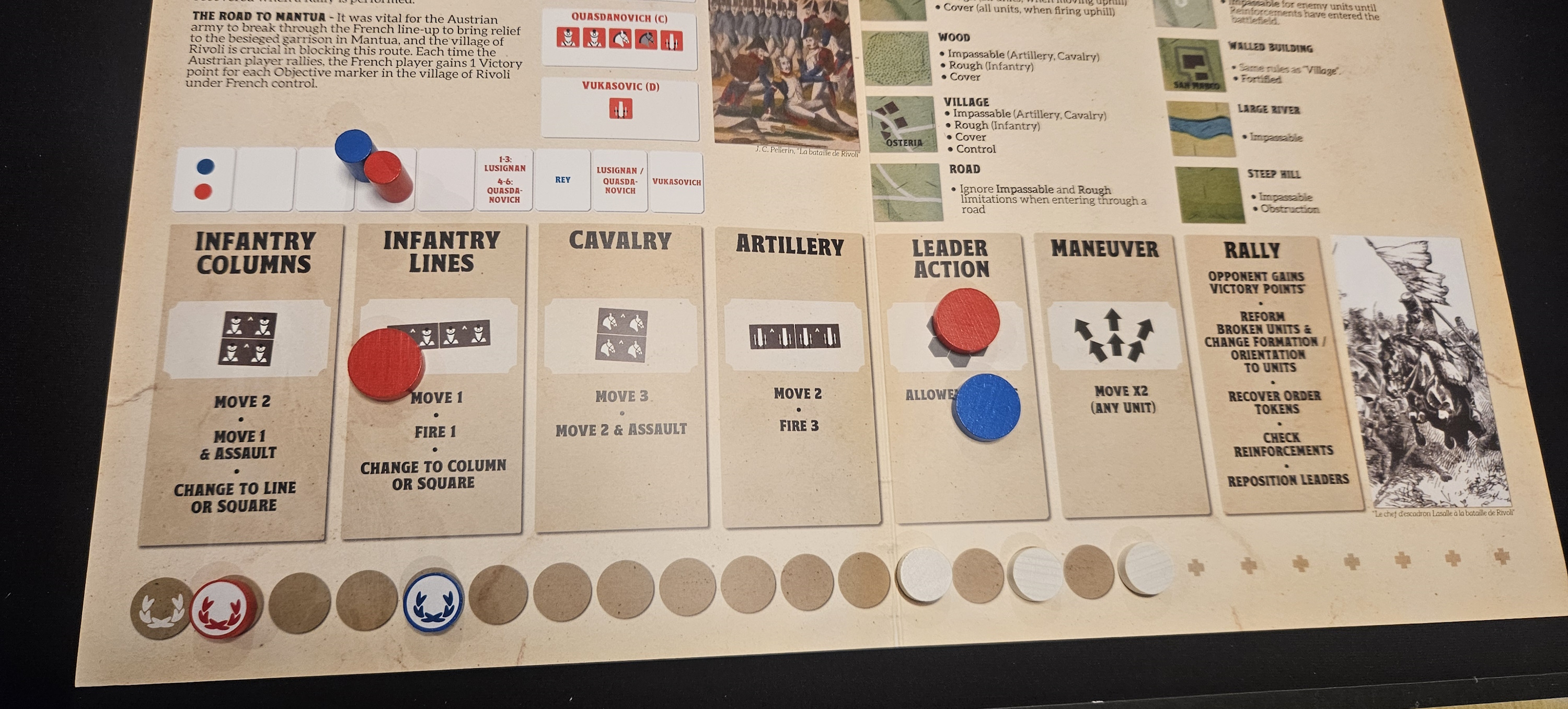
The inside of each folder dictates activation, reinforcements, and special rules.
This presentation of the game’s soldiery, taken together with its terrain, the protective forests and towns, the roads that overcome movement limitations, the hills — those damned hills! — Battlefields presents a topography quite unlike any other hex-and-counter game I’ve played. There are no doom-stacks here, only a constant, even oppressive clarity. When you mire a unit in a stream, taking fire from the cannons atop the nearby hill, you have nobody to blame but yourself.
Of course, this shouldn’t be taken as gospel. As noted, this is a subgenre I’ve always shied away from.
But that’s the point. Presented in this fashion, with this degree of clarity, taking hints from lighter fare like Commands & Colors or even some of Mori’s more wargame-adjacent titles like Pocket Battles and Battalion: War of the Ancients, does wonders for this thing as boundary marker. It sits on the line between light and heavy, airy and serious business.
That clarity even extends to the action system. When unfolded, those folios present the parameters of each conflict, functioning as a handy reference chart of the scenario’s terrain features and any unique rules, plus some tantalizing notes on the scale of each hex and unit for the grognards to quibble over. But there are also trackers. One for victory points, a fraught proposition where any given fight might conclude earlier or later depending on the fickle mood of your army. Another for reinforcements, again testy, many of these battles hinging on whether those few extra columns of cavalry arrive one hour sooner or later.
The final track is for unit activation, and it’s here that Battlefields is at its gamiest. Although in this case that’s a compliment, a doff of the cap to Mori’s long experience as a game designer who understands that all games are gamey and ought to be leveraged as such. The idea is that both sides have a limited number of action discs. On your turn, you choose whether to place one of those discs on a unit type that hasn’t activated yet, or else rally to return all of your discs to your pool but also yield a victory point to your opposition.
This presents a strong tension between repeatedly pushing the same units over and over again, often for maximal effect, or spreading around the battle-stress more equally. It also allows your generals to shine. Normal activations only trigger one type of unit — infantry columns versus infantry lines, for example, or cavalry or artillery. Activating a general, on the other hand, allows some number of units in that general’s vicinity to activate. This is your shot at utilizing combined arms: softening a unit with cannon shot, bringing a line or two into range under cover, charging with cavalry. It reflects the dynamism of Napoleonic commanders, juxtaposed with the strict orders of battle that dominate elsewhere. A few scenarios even let you activate Little Boney himself, dishing out orders all across the battlefield as he pings like a blue Sonic pinball between flanks.

The dice system allows for a nice range of outcomes.
There are four scenarios in total, and each does a magnificent job of highlighting not only the innovations of Mori and Zucchini’s system, but its flexibility as well. Let me tell you, this thing is limber. Rivoli, itself a component of the larger Siege of Mantua, presents the French forces in a fighting retreat, doing everything in their power to delay until their reinforcements can arrive in the wings. Austerlitz zooms out so far that your cannons have their range reduced to two measly hexes, but highlights the sheer scale of these clashes, not to mention the way Napoleon relied on deception and division to carry the day.
Because this game reflects history and not fiction, the scenarios don’t proceed in an orderly fashion. Where Austerlitz is grand and bombastic, bringing together the game’s many toys for what would normally be a grand finale, the final pair of scenarios are relatively compact by comparison. La Coruña sees the British waging a delaying action until they can escape by sea, while Hagelberg is profoundly asymmetrical, its Prussian Landwehr outmatched by French veterans, but enthusiastic and fresh and buoyed by the advantage of surprise.
In each case, Mori and Zucchini add a certain distinctiveness to their grocery list of successes. I’m hard-pressed to pick a favorite scenario because each offers such a sharp presentation of its particular fight. The same goes for the way Battlefields presents little story beats. I remember when three full companies of my Landwehr were repulsed as they each attempted to assault a single near-broken battery of cannons, its powder damp, but that sole damnable die still beating them back in turn. I remember the cavalry clashes in the wings of Austerlitz — the center taken, as Napoleon intended and succeeded historically, but the left flank bending and flexing as those horses charged and counter-charged until one final shudder saw the Allied line collapsing in a moment. I remember the French bogged down on the outskirts of a port city, cursing their general for not taking greater advantage of the roads to either side. I remember floundering with my various lines and columns of infantry, coming to terms with such a widespread command.
There is, as I mentioned earlier, a certain gaminess to these proceedings. Victory points come from a variety of sources. Rallies, defeated units, seized objectives. At times, this wealth of opportunity can make the battles seem artificial, a little too rubber-banded in service of generating late-game drama.
Then again, I have yet to see a battle grow too despondent for either side. The result may teeter over the line at times, producing a verisimilitude of feeling rather than good history. In those moments, I remind myself of all the students who started down the road of learning history because of the tragically inaccurate opening battle of Gladiator, myself among them. We all start somewhere. And one could do a whole lot worse than to start here, with such a clear and concise system that still finds a way to add detail to every corner that might otherwise go untouched.

This is… not looking so hot.
Or, even, to linger here despite having fought some of these battles over and over again. Simply put, Battlefields of the Napoleonic Wars is that good. It’s so good that I’m already aching for other clashes and other conflicts. I would love to see how Mori and Zucchini tackle the American Civil War, or what their Battle of the Bulge would look like, or whether chariots and horse archers are as good a fit for their system as cannons and muskets. Heaven help me, I want to see them stretch until they meet their Waterloo.
For now, this opening salvo will do. As a starting point, there is so much to consider in this not-especially-firm box, with its not-smoky-enough counters, with its stickered dice, with its head full of brilliant ideas. Ingenioso indeed.
A complimentary copy of Battlefields of the Napoleonic Wars was provided by the publisher.
(If what I’m doing at Space-Biff! is valuable to you in some way, please consider dropping by my Patreon campaign or Ko-fi. Right now, supporters can read my second-quarter update!)
Posted on September 25, 2025, in Board Game and tagged Battlefields of the Napoleonic Wars, Board Games, Ingenioso Hidalgo. Bookmark the permalink. 17 Comments.

 SPACE-BIFF!
Man I would kill for a fantasy setting!
I haven’t played Burning Banners, but I understand it falls into that category. Maybe give that one a look?
There really is nothing like BotNW in terms of size and portability unfortunately. Burning Banners looks really awesome and too big for my life. BotNW is just the right size. And if it had a fantasy setting it would be absolutely perfect!
Great review! I was immediately enamored with this and ordered it the day it became available, and I’m thrilled to see it get the Space-Biff treatment. It’s rivaling Commands & Colors: Napoleonics as my go-to light-ish wargame.
Nice! I’m so glad to hear that. I have yet to hear about somebody hating it. Some mixed feelings, sure, but everybody at least seems to respect what it’s doing.
Great review, thank you.
Thanks for reading.
Must have. The idea with the two counters alone is pure genius. Your scrupulous noting of game flow endangering historicity is duly noted, but this looks exactly the threading of the needle I have been waiting for. Your prose is a pleasure as ever.
There are so many little innovations on display, and they’re folded so expertly together, that it runs the risk of overshadowing itself. But, yes, the biggest one of all is two counters per hex, and how their positioning communicates so much about their function. I didn’t mention in the review, but one counter alone means that a unit is broken. At that point, you need to rally to bring it back up, turning the game into a little race to whip your broken troops back into fighting shape before your opponent overruns them. So smart!
yeah, so I was never going to have a chance. Mori and Napoleonics. Seems to scratch a similar itch as the timeless classic Manoeuvre.
How big are the pieces? I mean actual, handling-with fingers dimensions.
I’ve played miniatures battles with only two bases per battalion (instead of the usual one or more per company), sometimes further breakable down to a single smaller one for a square that’s not vastly oversized. In translation to hex grid, though, that’s always entailed more than one hexagon.
Oh gosh, I dunno. The hexes are pretty big, so the pieces are fairly big as well. They’re definitely not as small as some of the H&C chits I’ve handled.
This is indeed an excellent game and the choice to use two counters to represent the status of the units (instead of fiddly chits) is great.
The choice of having a folder with its own action selection and special rules makes setup a breeze.
The flow of the game reminded me of another good game by Mori, Battalion, where the timing of activation and rallying is similar, although the game is overall more abstact and less interesting than this one.
The only negative about this is that I wish the terrains were a bit more visible, sometimes you can barely see the hill contours and the distinction between uphill / impassable can be a bit tricky.
Oh, yes, good point there! I probably should have thought about that. The terrain, especially hills, is somewhat tough to decipher.
A Napoleonic Wars game where you get to physically move the pieces into formation? Sounds exactly like what I’ve been looking for!
Pingback: Space-Cast! #51. Mori, Zucchini, Napoleon | SPACE-BIFF!
Pingback: Best Week 2025! Picture Perfect! | SPACE-BIFF!