Real Moytura, Guys
I’ll confess it was a little surprising to unfurl Moytura’s board and see such a literal depiction of Ireland. After the suffocating hoplite melee of Iliad, the checkerboard Mount Olympus of Ichor, and the abstract leylines of Azure, here the membrane between the real and the mythological seems especially thin. Designed by one of the busiest partnerships in the industry, David Thompson and Trevor Benjamin, and fiercely illustrated by A. Giroux and Harry Conway, Moytura loosely retells the Maighe Tuireadh’s ancient clash between men and monsters to decide the fate of pre-Christian Ireland. As an installment in this particular series, it’s something of an odd duck. I’d even go as far as to play loose with some definitions and label it a light wargame.
A light wargame with heaps of monsters, that is. Right from the get-go, Moytura portrays its conflict as a desperate struggle for survival. And let me tell you, the main attraction is all those baddies.
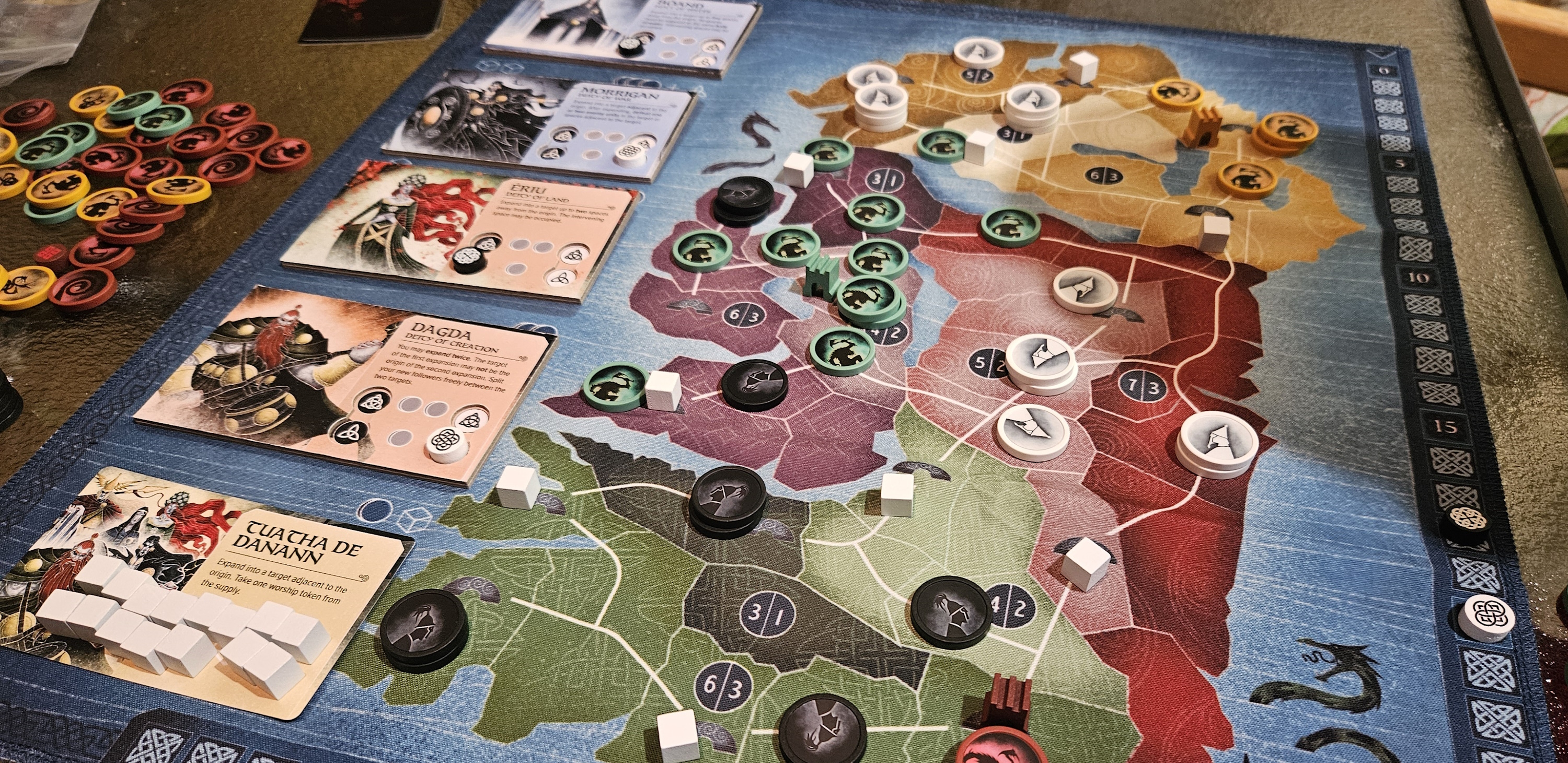
Hemmed in by monsters.
When Moytura opens, that sense of desperation gives a little roar. As is the case with the rest of the Mythos Collection, Moytura is a two-player game, although here that boundary is strained by the inclusion of a third faction, driven by a deck of cards that govern a trio of monstrous tribes that begin with a significant hold over the island. One player commands the white pieces, complete with two encampments. The other is black, also with two meager camps. The monsters, meanwhile, hold three regions firmly in their grasp. Not only do they hold their starting camps, but significant real estate on all sides as well.
The ensuing fight is anything but certain thanks to the way those monsters handle themselves. After both players take a turn — which, yes, I’ll describe in more detail in a moment — the monsters reveal a card from a prepared deck. This sends some number of them on the warpath, sticking to roads in their default form as Fomorians but potentially flying or swimming or teleporting in their more advanced incarnations. These invasions are brutal, often threatening three, five, seven provinces at a time, well above what your puny clans can manage. The trick is that each tribe only has four cards at most shuffled into the deck, putting a hard cap on their expansion. This adds a touch of press-your-luck to the whole thing. Will you be able to capture that crossroads before the nearby tribe of monsters goes again? Might the beasts in the south rise up and break your opponent’s chokehold there?
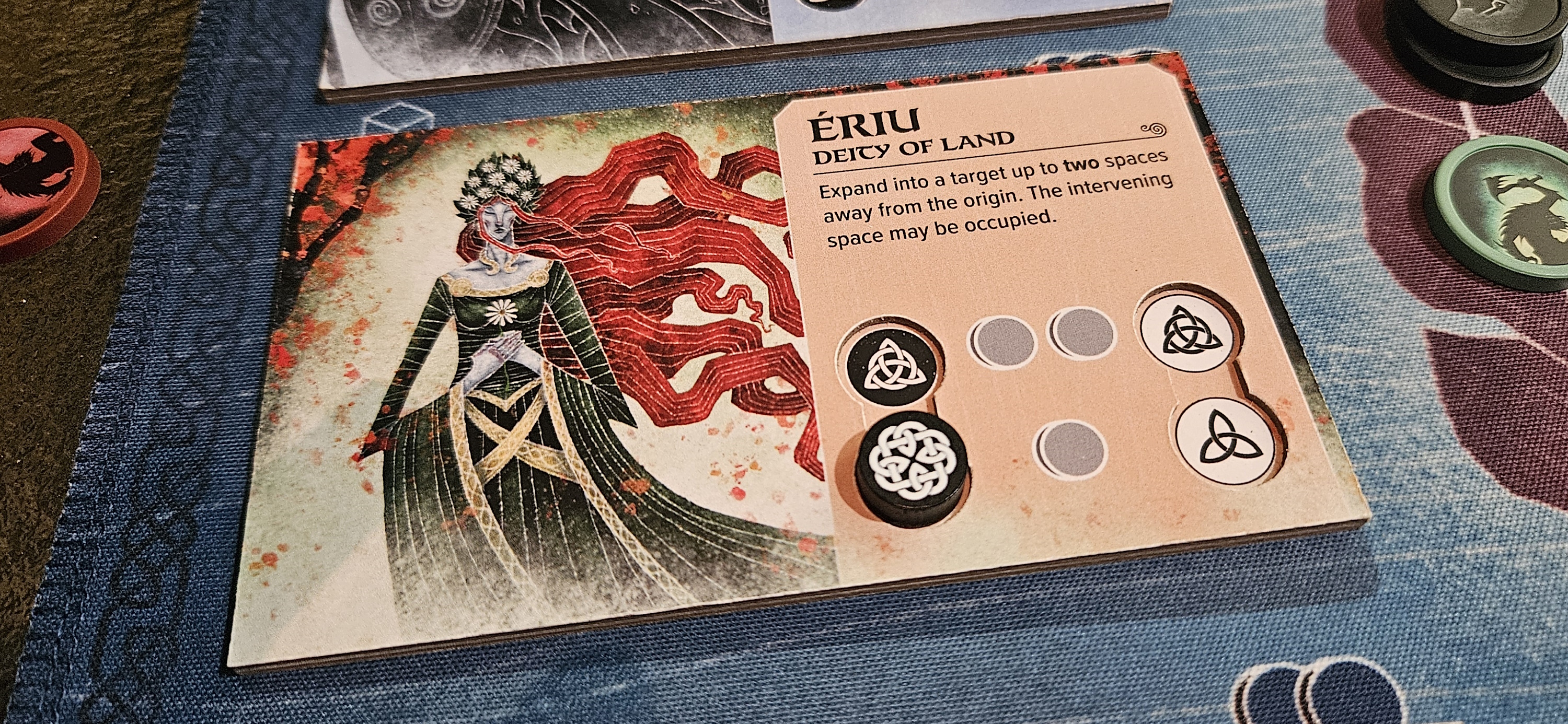
The gods help you spread across the land.
For your part, Moytura presents two core problems. First, you need to overcome the monsters. Second, you also need to outscore your rival.
These twin problems dictate everything going forward. Every action matters, and doubly so because most will only let you expand into a single space. Actions are selected by currying favor with the local deities. These are all similar enough in practice, letting you raise a few armies and send them off across the countryside to slay your foes and claim territory, but they differ in the details. Ériu, the matron goddess herself, lets you skip an intervening space, potentially bisecting a tribe’s territory or skipping past a massed army. Boand lets you travel even farther, but only if you stick to coasts and lakes. Morrigan pitches in by killing some adjacent monsters, making your expansion all the easier. Every god is worthwhile, but they become even more desirable as you invest tokens to upgrade their favor. Early on, you’ll be lucky to wring three armies out of an action. By the game’s crescendo, tactical investments may have doubled that amount.
You’ll need the manpower. As I noted earlier, the monsters are capable of rapid expansion. Your only hope is to out-think them. This is where your knowledge of the deck comes in. The system designed by Thompson and Benjamin is clever in that you can never be fully sure that a tribe has spent their power, but it’s also limited enough to afford some educated guesses. For one thing, your goal isn’t to eradicate every monster on the island. Instead, Moytura is all about commanding the most pieces in any given region. This lets you play the numbers game, cutting off enemy reinforcements by seizing roads or sneaking an army into some overlooked corner to steal a province’s majority. This is a time of great heroes, sure, but it’s also a time of great sneaks and opportunists. When everything out there wants you dead, it pays to play smarter. Let the suckers live and die by the axe.
That goes for your human rival as well. Moytura prevents direct conflict between its players, but there are plenty of ways to gain an edge over your kinsmen. This portion of the game is more or less a straight area control contest, but a few wrinkles keep the proceedings snappy. Such as, say, declining to remove monsters that threaten your rival’s flanks and then sowing yourself into the furrow left by their passage. Or racing to claim the mounds where extra worship tokens are located. Or just being a nuisance with your army placements. Even a toehold can turn an area’s scoring potential in your favor when that toehold is filled with six army counters.

Moytura comes alive once you mix in the advanced monsters.
Even at its most hotly contested, Moytura never lets its monsters stray far from mind. Even when you think you’ve got a tribe on the ropes, they generally require a few troops nearby just to keep them bottled up. More than once, I’ve watched as the monsters ruled the day despite being beaten back from the main paths, thanks to either a resurgence in their numbers or because they held second place in so many territories that they nickel and dimed us to death. More than most games about our mythological past, Moytura feels dangerous and testy thanks to its baddies.
And they only get cooler once you ditch the default Fomorians and start using the advanced tribes. This bumps up the difficulty somewhat, but it’s well worth the added uncertainty. Rather than facing armies purely on roadways, you might instead be confronted by Ellén Trechends that sometimes spread into the hills and forests, or Oilliphéists that raid the coastline, or Banshees that show up wherever the hell they want, giving your frontlines all the defensive value of a sponge. For once, this also makes the expansion considerable, adding three additional monster factions that are all brutal in their own ways. My personal favorite are the Bánánach, jerks who add spectres that can’t be attacked but still add their value when scoring a region. There’s nothing more galling than slaying a region’s monsters only to still find yourself infested with their lingering spirits.
Whatever form the monsters take, though, Moytura feels great. The indirectness of its human conflict is underscored by the monster-slaying stuff, allowing huge clashes and big blowouts without actually requiring players to inflict casualties on one another. There are shades of Martin Wallace’s The Arrival here, players cooperating in some spots but viciously grappling for territory in others. If I had any one complaint, it’s that I wish Moytura had gone even bigger. I would absolutely love to play a version of this game that allowed three or four human clans to strive for survival, perhaps even clashing more directly in some instances.
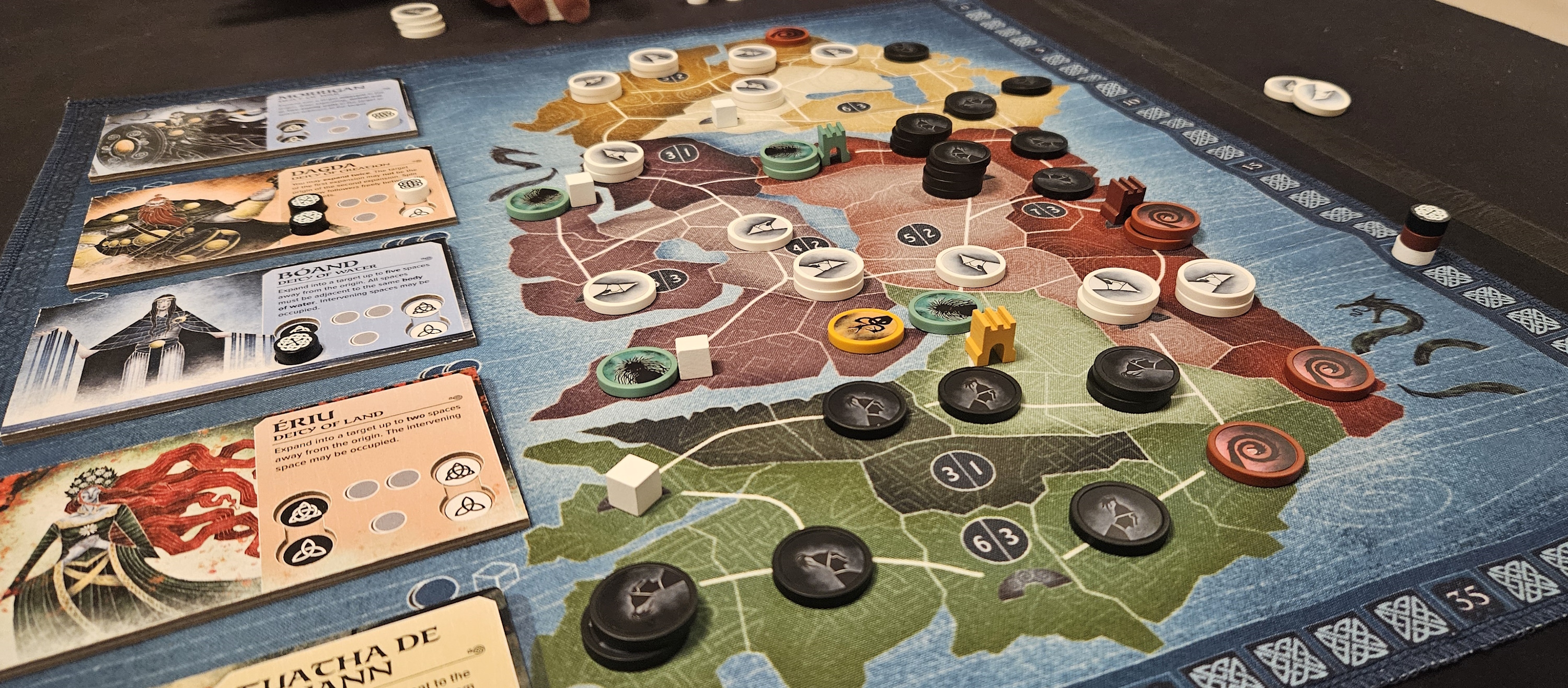
Quantity or quality?
Ah well. It’s poor form to wish for something other than the game we have before us. And it speaks well of Moytura that it makes my stomach yowl for an extra helping. As it stands, this is a compact but fibrous serving. Moytura’s monsters are deadly and evocative, its clashes are slight but impactful, and every corner brims with danger and potential. It may well be the strongest contender in the entire Mythos Collection — and after Iliad in particular, that’s saying something. Well, I’ll say it. This game rocks.
A prototype copy of Moytura was temporarily provided by the publisher.
(If what I’m doing at Space-Biff! is valuable to you in some way, please consider dropping by my Patreon campaign or Ko-fi. Right now, supporters can read my second-quarter update!)
Posted on September 24, 2025, in Board Game and tagged Bitewing Games, Board Games, Moytura. Bookmark the permalink. 7 Comments.

 SPACE-BIFF!
Aaargh! Just as good as I thought it would be.
Sadly, yes.
it sounds like this could become multiplayer solitaire. Can you give more examples of player interaction?
Beautiful reviews, both of them. I’m always skeptical when I see your reviews of Bitewing Games because you sometimes feel to be the #1 marketer of their games but here:
They felt like the opposite of reviews written by AI, actually.
So, I was hesitant about between backing both, as I usually do, or none at all, and after reading your reviews I happily settled to back Moytura alone. Not influenced at all!!!
I seize the opportunity to ask a quick question: the review that most impressed (and I would dare say the best review I have ever read for a board game, and that’s including some by Laszlo Molnar) was the one you wrote for Eila.
Sure, it would get nowhere near as personal, but that made me think, would you consider writing a review for Storyfold: Wildwoods? I’m a bit tired of reading about how “charming” or “cozy” it feels. I’d like a review that gets a bit deeper into the goo.
Yep, I plan to write about Storyfold. I’ve played the prologue and first chapter so far.
Pingback: Cutting the Cottage Pie | SPACE-BIFF!
Pingback: Moytura – Keltische Mythen als 2-Spieler Area Control - Mehr als Spielen