I’m Not Azure About This One

Hot on the heels of Reiner Knizia’s Iliad and Ichor, Bitewing is crowdfunding another pair of titles for their Mythos Collection. As seems to be the pattern with these things, one of them stands head and shoulders above the other — although whether that’s the things’ fault or because we’re doomed to hold everything in comparison to every other thing is harder to tell.
Azure is the one I’m shakier on. Designed by Trevor Benjamin and Brett J. Gilbert, this is an abstract game about controlling four intersecting leylines and the auspicious beasts who inhabit them.
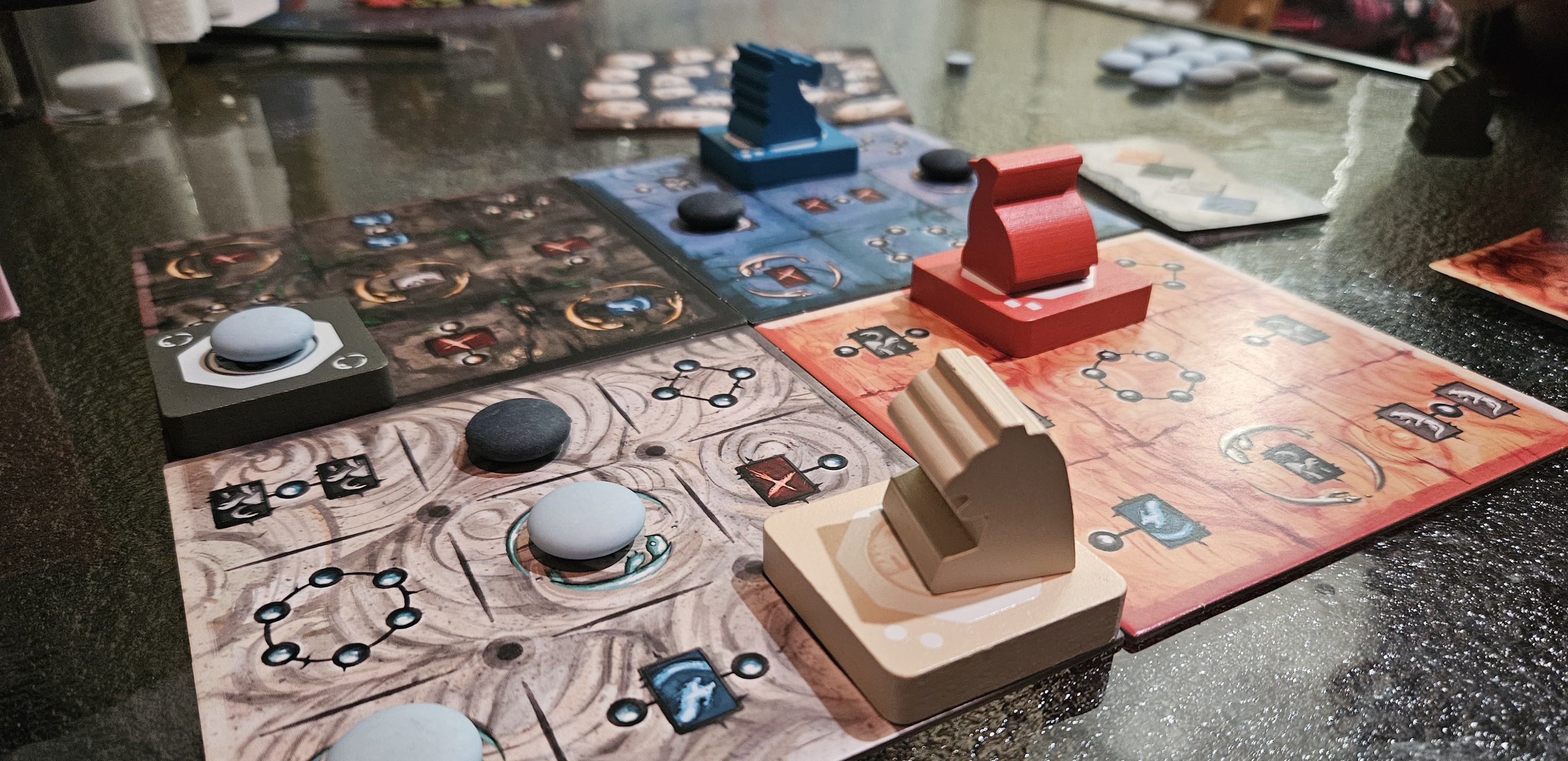
I want to eat the stones.
From its very first moments, Azure invites a handful of questions. What are these Four Auspicious Beasts and how we do curry their favor? With boards that rotate and flip, how many possible setups are there? Do these stones taste like the after-dinner mints they so resemble?
These questions are answered before long. In order: they’re the guardians of the cardinal directions in the Chinese zodiac, and their favor is much more freely given than one might expect; over 24,000, according to the rulebook; and no, not even a little bit.
The rules for Azure are dead simple. On your turn, you spend cards to place a stone on one of the grid’s many spaces. The cost for such a placement is equal to your intended space’s number of symbols. There are only two icons in contention: wisdom, the game’s word for a victory point, and qi, which allow you to draw the corresponding color of card. So, if a space shows a card and two points, it costs three cards of its color in order to play there.
Except, of course, there are discounts. For every stone you’ve already deposited in that row or column, the cost goes down by one. Align your stones properly, then, and some spaces will be discounted to the low, low price of zero. Even the more expensive spots, those that boast six or more points at a pop, can gradually be whittled down to a manageable sum.
Which is a good thing, given the sparsity of cards. When Azure opens, the starting player has but two in hand. The second player has three. As the game progresses, it isn’t uncommon for your hand size to wax and wane according to your placements. These are uncommonly barbed. Every affixed stone is permanent, for one thing. And for another, if ever you deplete your hand to such a degree that you can’t make a legal placement on your turn, you lose the game outright. Which, yes, means it’s possible to conduct some light card-counting and deprive your opponent of affordable placements.
More often, Azure comes down to points. Your goal here is to be the first to accumulate twenty-five wisdom. I would say this is easier said than done, but honestly it isn’t all that hard. Given enough time, and provided you don’t run out of cards or stones, it’s pretty likely somebody will hit the target. It’s a race, then, and one where the obvious move is rarely the best move.
After all, here be dragons.
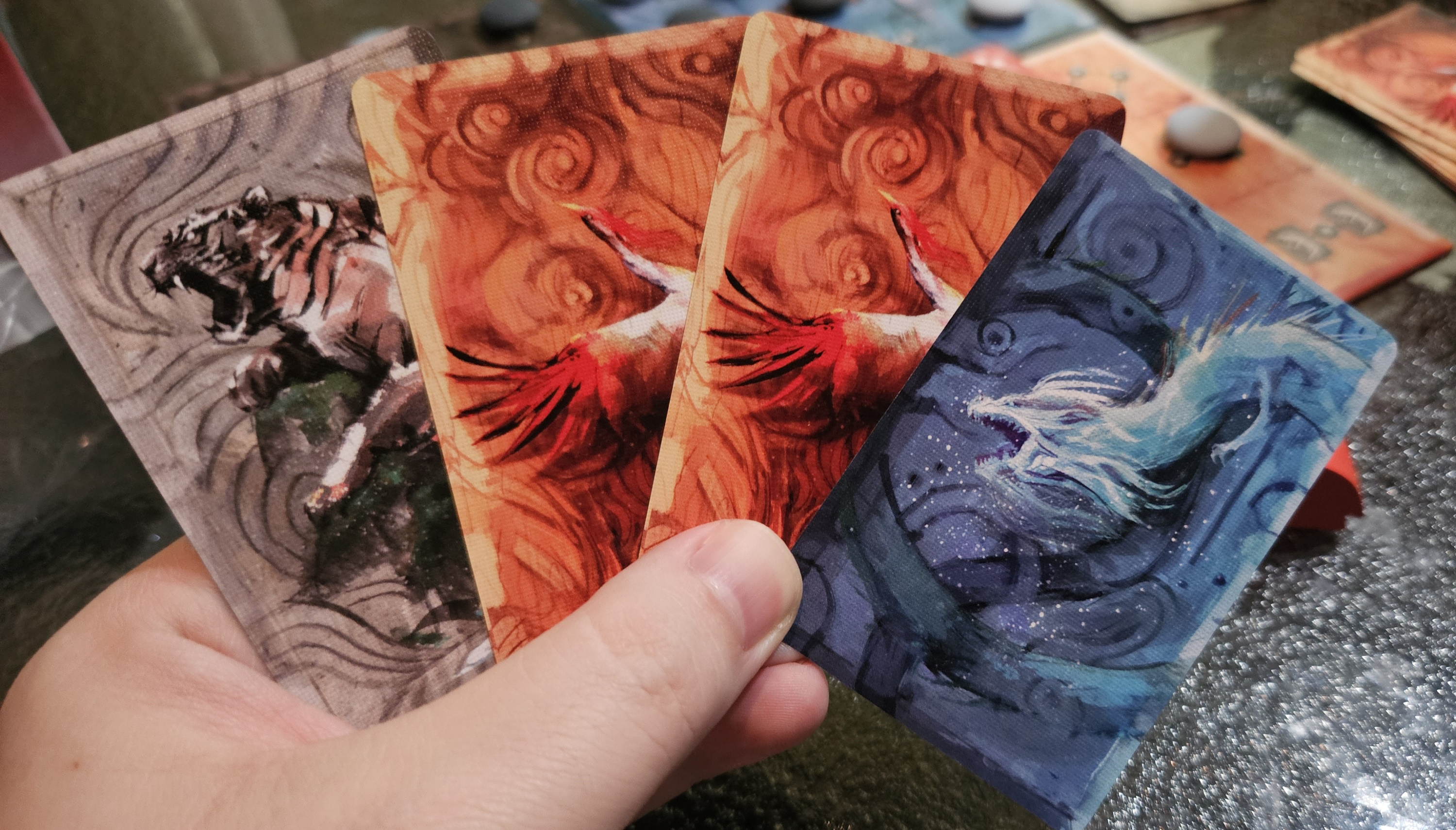
It’s almost redundant to say that Kwanchai Moriya’s art is gorgeous.
Okay, there’s one dragon. The Four Auspicious Beasts loom large over the field, each seated on their mountain and waiting to be claimed. Initially, this is done by affixing two stones within their preferred realm. Later, a beast’s favor can be stolen from your rival by one-upping their current count.
These are important because each creature has their own means of appeasement and provides their own reward. The simplest of the two, the Azure Dragon and the White Tiger, are awarded to whomever places two stones in their row/column, and provide either three or two wisdom respectively. The Black Tortoise is a little trickier, favoring the player who places their stones on the board’s scattered ring-looking spaces; when claimed, the Tortoise allows its owner to place a stone on its mountain, providing a nice discount without the usual blocking entailed by mountains. Finally, the Vermilion Bird is a homebody who favors those who place stones in its home realm. This lets you draw an extra pair of cards. Which, in case you missed it earlier, can be a surprisingly potent boon.
Here’s the rub. The field is tight enough that any given placement might matter for two or even three Auspicious Beasts at the same time. This depends on the setup, of course, but there’s a real possibility that one stone will swing the Tortoise into your favor, which in turn will populate his mountain and parlay another beast to your side. These early coups are potent, maybe even game-deciding. Seizing a beast from your opponent is a matter of placing more stones in the relevant domains. But in a game with such a constricted action economy, not to mention such suffocating physical boundaries, these swings are no small thing to engineer.
Hence, in the long tradition of many abstracts, it isn’t enough to place stones that forward some objective. Stones ought to instead further two or three objectives at the same time. You’re playing offense and defense at the same time, and hopefully claiming the right Auspicious Beasts, and keeping a mental tally on your rival’s card count, and assessing discounts along those leylines, and also, sometimes, if you’re playing with the optional boards that are included in the deluxe edition, attempting to pull off an alternate win condition.

The alternate stuff is interesting, if inessential.
This sounds like a lot, but perhaps the best thing about Azure is that it’s so streamlined that it never quite expands beyond a reasonable confines. A full session lasts, oh, fifteen minutes, plus or minus some flubs or extra thinking time.
If anything, that lightness is one of the reasons I’m somewhat ambivalent about it. At its best, Azure is a drum-tight experience. During one sitting, Summer and I played it three times in sequence. Each match was more bitterly contested than the last, one smart placement following another, little traps opening their jaws and little victories spooling into match-ending triumphs. We were fully zoned-in, counting cards and checking every single space on the grid.
But when we finished that spree, we both agreed the game was interesting, we’d had a great time… and that we had more or less seen what it had to offer. And that was Azure at its best! With other partners, it came across as more airy, absent that hard-bitten contest and multivalent approach to success. In many cases, my play partners weren’t interested in reaching the necessary degree of mastery to produce such close matches.
It’s a quandary. Azure is, as I’ve noted, an interesting little thing. But it’s also hard to pin down. Perhaps it’s another victim of the way our hobby has come to disregard most abstract games. Or perhaps there’s a reason my eleven-year-old regularly plays chess with her friends but rebounded from Azure like an arrow of chalk paffing against dragonscale. Of the four titles in the Mythos Collection, this is the only one that hasn’t commanded some degree of her attention.
Or mine, frankly. Even contrasted with the other Benjamin/Gilbert abstracts, Mandala and Patterns and Tic Tac Trek, Azure is the one I’m least likely to return to. It’s pretty, it’s smart, it leaves me chilly.

Auspicious!
I have my suspicions. That it’s too light, but not light enough to compete with something like Tic Tac Trek. That its beasts are too flippantly gained and too hard to sway. That most sessions feel like the second player is stuck in catch-up mode. That the stones are not, in fact, flavored like minty chocolate.
Whatever the reason, Azure doesn’t do it for me. Tomorrow, we’ll look at the one that does.
A prototype copy of Azure was temporarily provided by the publisher.
(If what I’m doing at Space-Biff! is valuable to you in some way, please consider dropping by my Patreon campaign or Ko-fi. Right now, supporters can read my second-quarter update!)
Posted on September 23, 2025, in Board Game and tagged Azure, Bitewing Games, Board Games. Bookmark the permalink. 5 Comments.

 SPACE-BIFF!
I follow Bitewing’s new offers quite regularly, and Azure just left me cold from the outset with the whole concept. It seems to bear out in the game experience as well. Thanks for the review! Looking forward to reading about Moytura, which has tempted me a lot, though I think I’ll miss out because worshipping pagan gods just isn’t a theme I want to immerse myself in, and it looks to be too integral to the gameplay to mentally box out when playing.
PS: I finally managed to get EGO to the game table the other week and thoroughly enjoyed that one though!
Nice! EGO is super cool.
Thanks for the review.
It’s a pity, but, yes, an abstract game like this needs to be very good to have me bothered trying it.
Pingback: Real Moytura, Guys | SPACE-BIFF!