When the Bell Breaks
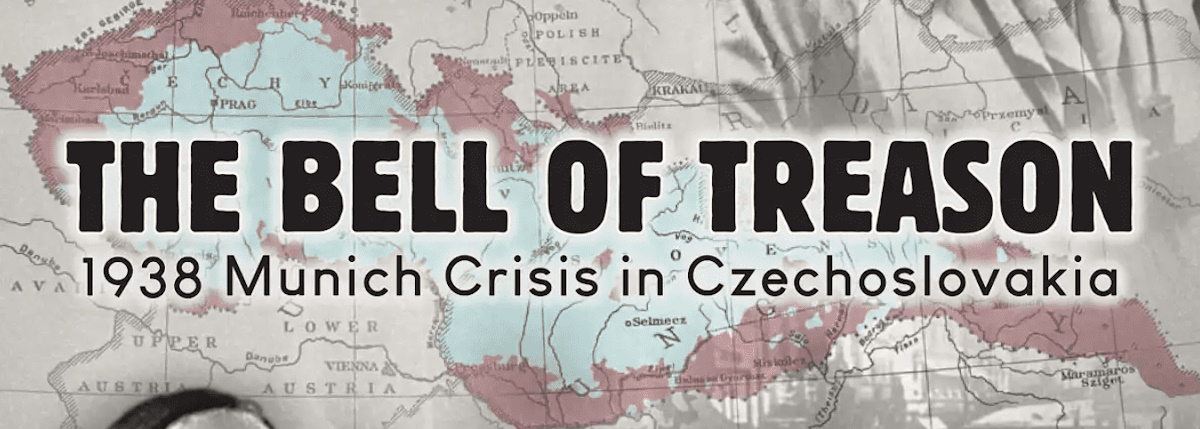
It wouldn’t be fair to call the Munich Crisis “small.” Certainly it wasn’t small to the almost fifteen million inhabitants of Czechoslovakia. But time and history, especially the history of World War II, have a way of making the betrayal of an entire nation seem tiny. In 1938, Czechoslovakia was twenty years young, guaranteed safety and autonomy by France, and remained the sole functioning democracy in Central Europe. Within a few short months, it became the latest target of Germany’s rolling territorial acquisitions and, after the Sudetenland was traded away to appease Hitler, was carved up between neighbors. The peace purchased with the First Czechoslovak Republic’s dissolution held less than a year.
This is the topic of Petr Mojžíš’s The Bell of Treason, an improbable but evocative title, not to mention a despondent one in an era of renewed imperial aggression against states that have been promised security by feckless global powers. Riffing on Mark Herman’s system from Fort Sumter and Frédéric Serval’s developments from Red Flag Over Paris, it’s also comparatively diminutive for a wargame, with short rules, a compact profile, and a sharp eye for the crisis’s framing. All the better to make its players feel like minnows among sharks.
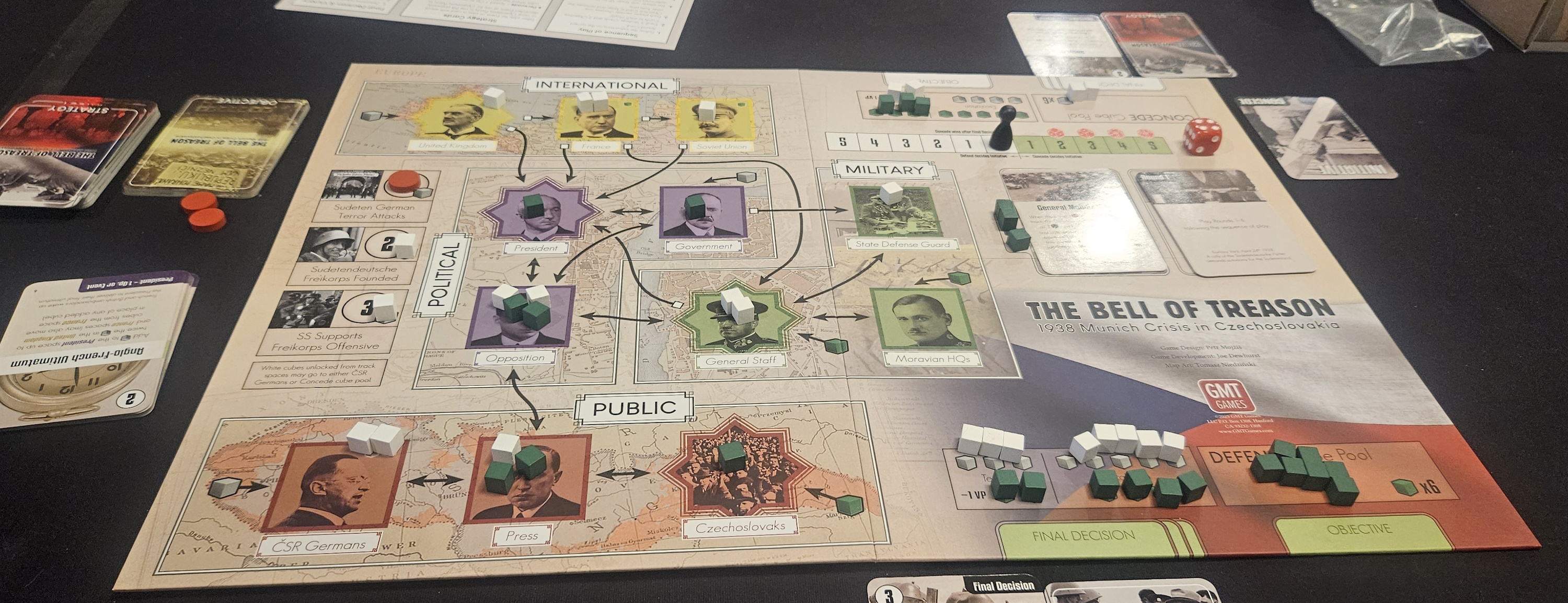
The many intersecting dimensions of 1938 Czechoslovakia.
For those who have yet to play Fort Sumter or Red Flag Over Paris, the basics of The Bell of Treason are simple enough that even newcomers to the form are unlikely to be intimidated. This is the latest in a long string of card-driven wargames, which is to say that cards either trigger specific events or can be spent for operations points. As abstractions go, this is a genre that plays loosey-goosey with the timeline. Where one turn might see players contending with France’s wavering backbone and the ramifications of a nation-wide public training exercise, another features blossoming terrorist uprisings in the German portions of the country and thunderous denunciations from Berlin.
What sets apart The Bell of Treason from its peers, though, is that it doesn’t stray quite as far from historical reality. Rather than commanding the world’s great powers — the United Kingdom, France, the Soviet Union, and so forth — here players are clad in the most dire of suit jackets. This isn’t to say that players control concrete people or even political parties. No, this is a more ideological game than that.
But those ideologies, though somewhat abstracted, suit the divisions of the day. To wit, players are offered two roles. There’s Concede, the faction of the First Republic that believes there’s no hope in fending off German encroachment, and Defend, those who believe the young republic can make a stand. These factions, represented by white and green, influence every corner of the game’s map, itself an abstraction that speaks more to the country’s political topology than anything literal, with intersecting domestic and international political spheres, the military wing, and fluctuating public opinion all up for grabs.
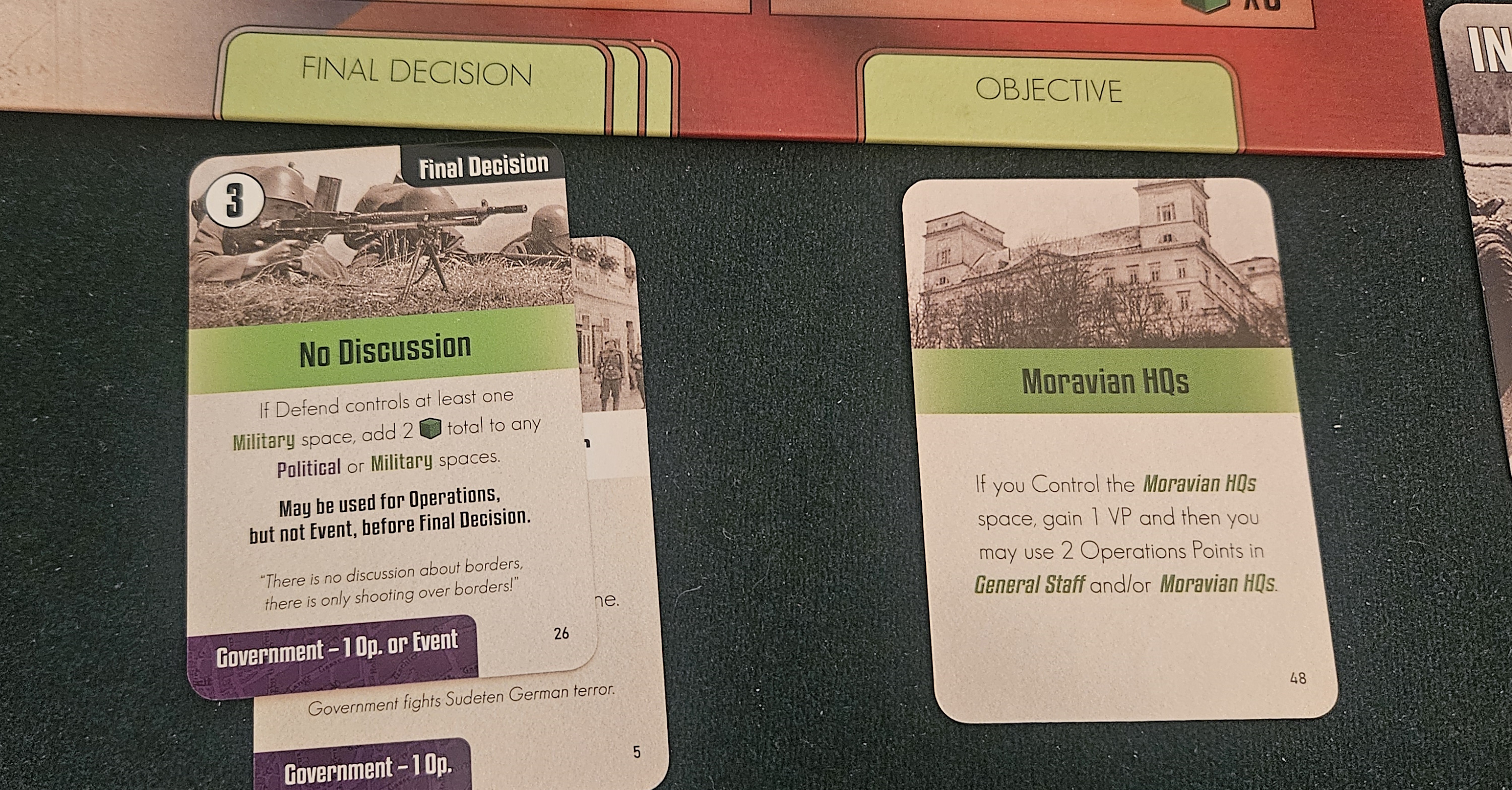
Cards are used for events, operations, or reserved for a final lightning round.
Of course, as any student of history will have pegged, neither of these are especially enviable positions. Concede is the faction that won out historically, persuading President Edvard Beneš to surrender under the assumption that there was no defying the German war machine. And, well, President Beneš was almost certainly right about that. With no help coming from the dominant powers, and with Poland and Hungary champing at the bit to claim their own slice of the pie, Defend may look like a more principled option, but it’s also doubly doomed.
Where Mojžíš finds some wiggle room is in the larger picture. Not too large, it should be said. The United Kingdom is still so determined to avoid a replay of the Great War that they’ll pressure France to ignore their obligations to the Czechoslovak Republic, and the Soviet Union is so dizzy with its own head games that it isn’t likely to march across Poland to render aid when it could instead wait for a Communist uprising. Similarly, the game proceeds through Neville Chamberlain’s ill-fated visits to Adolf Hitler, trading away the Republic’s sovereignty for a scrap of paper. These occurrences are ironclad, keeping the players’ focused on the internal disputes rather than thinking they can derail the locomotive of history outright.
But there are windows of opportunity open to both sides. The unofficial war Germany is waging in the Sudentenland, for example, might allow earlier mobilization and a strengthening of the Czechoslovak will. Indeed, the Defend player has plenty of options open to them, perhaps playing the press more smartly or preemptively withdrawing eastward. All the while, Concede pushes back the other direction, gesturing wildly at international opinion and the groundswell of foreign nationalism from their German-descended minorities.
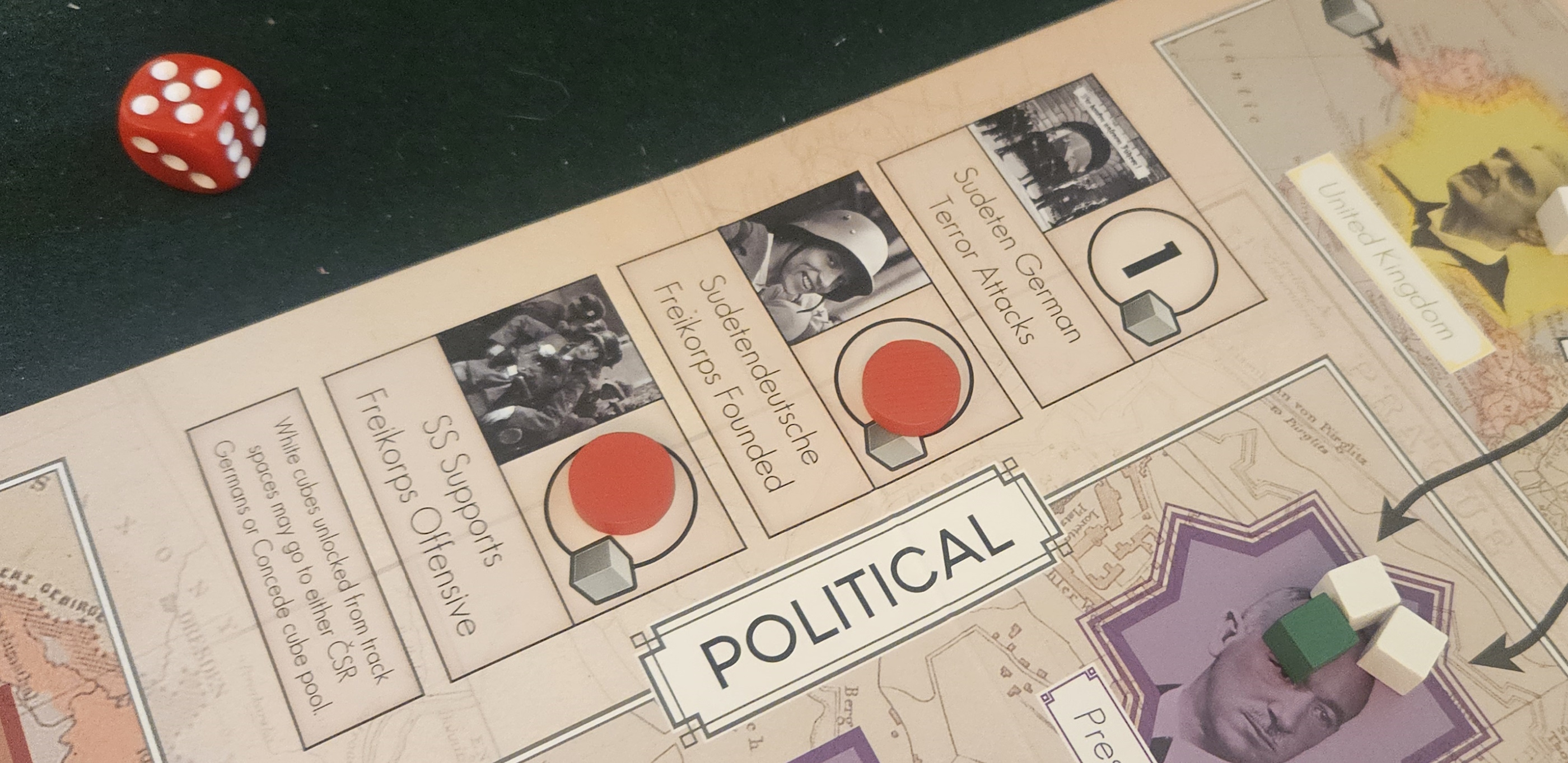
Quite a few atrocities are represented by three red discs.
It’s the smallness of this debate — the fact that neither faction offers a route to victory but rather a distinct mode of failure, one political and the other military — that makes the stakes so razor-edged. The Bell of Treason doesn’t propose that the minnow can either outswim or outeat the shark. Rather, the question is one of which principle will dominate the betrayed republic’s waning twilight.
The questions are uncomfortable to contemplate. Is it better to surrender and perhaps preserve some lives? Or to fight when there’s a near-zero chance of success? I almost certainly would have given different answers at distinct stages of my life. As an invertebrate myself, I’m not even sure I would put down stakes now. Of course, the path taken by President Beneš carries the scars of hindsight. By 1946, so many of the Jewish inhabitants of Bohemia and Moravia, the Nazi-annexed territory that had been the western half of Czechoslovakia, had been deported or murdered that less than twelve percent of their pre-war population remained. The factories that had once produced Czechoslovak armaments became components of the Nazi war machine; that little “t” in the Panzer 38(t) stood for tschechisch, the German word for “Czech.” Would a defensive action have staved off these eventualities? Doubtful. Not without assistance.
To Mojžíš’s credit, he dwells on these questions without valorizing them. Or worse, creating an alternate history where an unaided Czechoslovak Republic might emerge unscathed. The blame lies on men in faraway places. This is not the Bell of Victory; it’s The Bell of Treason, and the clapper has already struck brass. Along the way, Mojžíš draws comparisons to the obligations of modern superpowers, curtained behind channels and oceans, comfortable behind buffer states. In one of the game’s more chilling notes, he points out that Nazi rhetoric and rearmament were already promising war against France and the United Kingdom. How many “small” crises do we turn away from, insistent the bill will never come due? I can think of a few.
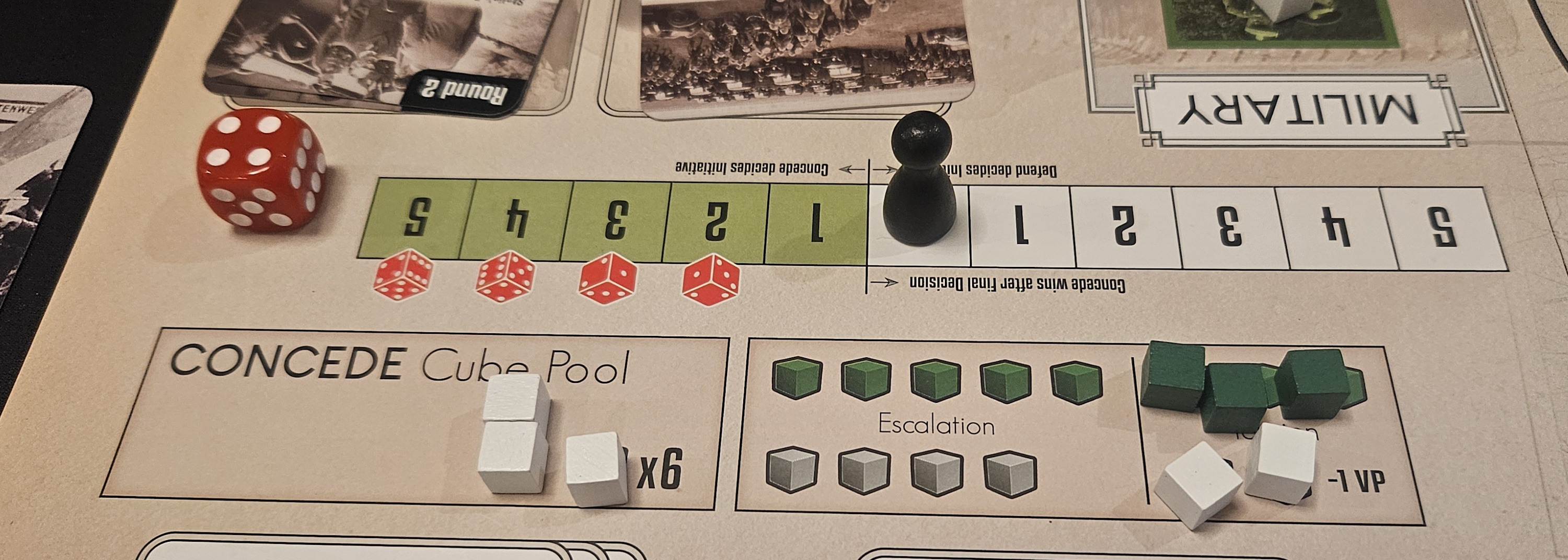
At all times, The Bell of Treason feels like a situation spinning out of control.
As with Red Flag Over Paris, which improved on Fort Sumter in every regard, The Bell of Treason represents a new wing of wargaming. This wing is more approachable than the wargames of yesteryear, a little easier to break into, not quite as dominated by the old guard. There’s never been a better time to test the waters.
More than that, this new schema is concerned with questions that go beyond battalions and bullets, that examine the causes that sparked or permitted the wars to begin with. In letting the Second World War loom over the Munich Crisis like some slouching terror blotting out the sun, Mojžíš has crafted a game that’s at once intimate and terrifying, small and portentous. It’s a Cassandra of a board game.
A complimentary copy of The Bell of Treason was provided by the designer.
(If what I’m doing at Space-Biff! is valuable to you in some way, please consider dropping by my Patreon campaign or Ko-fi. Right now, supporters can read my second-quarter update!)
Posted on September 5, 2025, in Board Game and tagged Board Games, GMT Games, The Bell of Treason. Bookmark the permalink. 12 Comments.

 SPACE-BIFF!
Ha, I played this for the first time last night! Timely review. 🙂
I enjoyed it quite a bit. I LOVE the art and visual design of RFOP but…. I have issues with how some of it works. The military Removals, for example, or the 2 types of scoring, and the weirdness of how to decide Initiative. It’s a beautiful game, but a flawed one.
BoT, on the other hand, feels streamlined. Yes, there are some wrinkles (the German track; the way you use Final Crisis cards) that set it apart, but even after only one play, I find BoT to be more enjoyable, because I spend more time PLAYING and less time checking a rule. Also, I find the player aids to be clearer. So, overall, this is a welcome addition to my collection, a good filler game for those day-long conventions.
My gaming partner had never played either; we played RFOP right after we finished BoT (with a Defend win, by him!), and he agreed that BoT was clearer and cleaner in how you play it.
I completely agree (again, after only one play) – the streamlining from RFoP to TBoT was refreshing, and I appreciate how the removal of some of the more prickly/finicky parts of RFoP made way for TBoT’s more subtle yet still impactful textural flourishes. The numerous one-way adjacency arrows and multiple “virtual control” spaces together do a fantastic job building in asymmetric force application without the overhead of RFoP’s wonky (and for the Commune, punishing) momentum tracks. I also enjoyed how escalation and tension were re-worked.
Overall, a really fascinating entry and I’m keen to try again.
Great review, want to add for you origin of name – Bell of treason – it is from poem from 1938.
The song of anxiety / František Halas / from the collection Torso of Hope
How many times my verse
how many times you stumbled
in the pain of love grief my
private
how many times my verse
how many times you danced
Now march with a step of arms
my verse
♪ With a pedestrian rhythm sound the words ♪
♪ Anxiety-ridden ♪
♪ That twelfth anxiety ♪
Ring the bell of betrayal ring the bell of betrayal ring
Whose hands rocked it
France sweet proud Albion
and we loved them
I’ve seen tears in women’s eyes
I’ve seen fists clenched
Wait a little while only
But you’ll know us
You ruler of the seas, all-powerful
The sea tears ours
The fruit of wrath ripens quickly
The anchor of hope is already roaring
♪ The bell of betrayal is ringing ♪
♪ Whose hands swung it ♪ ♪ France sweet proud Albion ♪ ♪ And we loved them ♪
You France sweet France
Where’s your cap Marianne
Your sun shield is cracked
And your yes is ashamed
It’s night and in the shelters of the trenches
The pulse of the earth’s blood sounds
For you, world, for this Europe
The soldier’s last shame
The bell of betrayal rings The bell of betrayal rings
Whose hands swung it
France sweet proud Albion
And we loved them
Our fields cry Treason
Our forests roar Shame
Our rivers murmur Treason
Our mountains storm Shame
Silence now silence rises Voice
O soul of the people how you stutter
Geni Genie of our land
on thy wings
is full of tears
Geni Genie of our land
in evil hours
let thy sword ring soon
Thanks for sharing, Václav! I considered using a line from the poem for the title of the review… but also, I couldn’t find a good translation.
I used Deepl to translate it, but maybe it is not so great for poems 😉 so I tried Grok this time … https://x.com/i/grok/share/YzkKCDYrqMXLD3NeQwUDkgwUk
Sadly, LLMs are even more terrible at translating poetry than they are at everything else.
@Václav @Dan How is this translation working?
https://www.vzjp.cz/basne.htm#Halas
(You need to scroll down to “song of trepidation”)
Certainly less cluttered! Thanks for sharing.
Amazing review as always! And I’m glad we’re of the same opinion on the game.
Thanks! I appreciated your review as well.
Thanks for the review. The subject matter is one close to me. I’m still not sure which of the two options would have been better, though I still find myself leaning towards defend. I know many of those alive now would never have been born, with their parents killed, and many cities would have been bombed away. But the destruction of a nation’s self-confidence and will to fight (not just militarily) has haunted the Czechs ever since and has yet to be recovered – and I feel that is the worse of the two harms. And it might have been a weaker Germany that had taken on Poland, France, and everyone… Definitely a game I’ll be looking into getting. Glad to know it’s well designed.
This game has really impressed me. For such an abstract piece, it really does a good job of portraying the history. And I agree that it is shocking how relevant this topic is today.