Tick Tick Toe

If there’s anything that tickles the pleasure center of my brain, it’s seeing a designer put their own spin on a classic. Even better when that classic is soggier than bread that’s been tossed into a duck pond. Robert Hovakimyan isn’t the first person to tackle Tic Tac Toe this year. But compared to Brett J. Gilbert and Trevor Benjamin’s Tic Tac Trek, Bombastic is the straighter adaptation, right down to the nine-square grid and make-three gameplay. The big distinction is that everything has already been played to the board. Face-down.
Oh. And there’s a bomb.
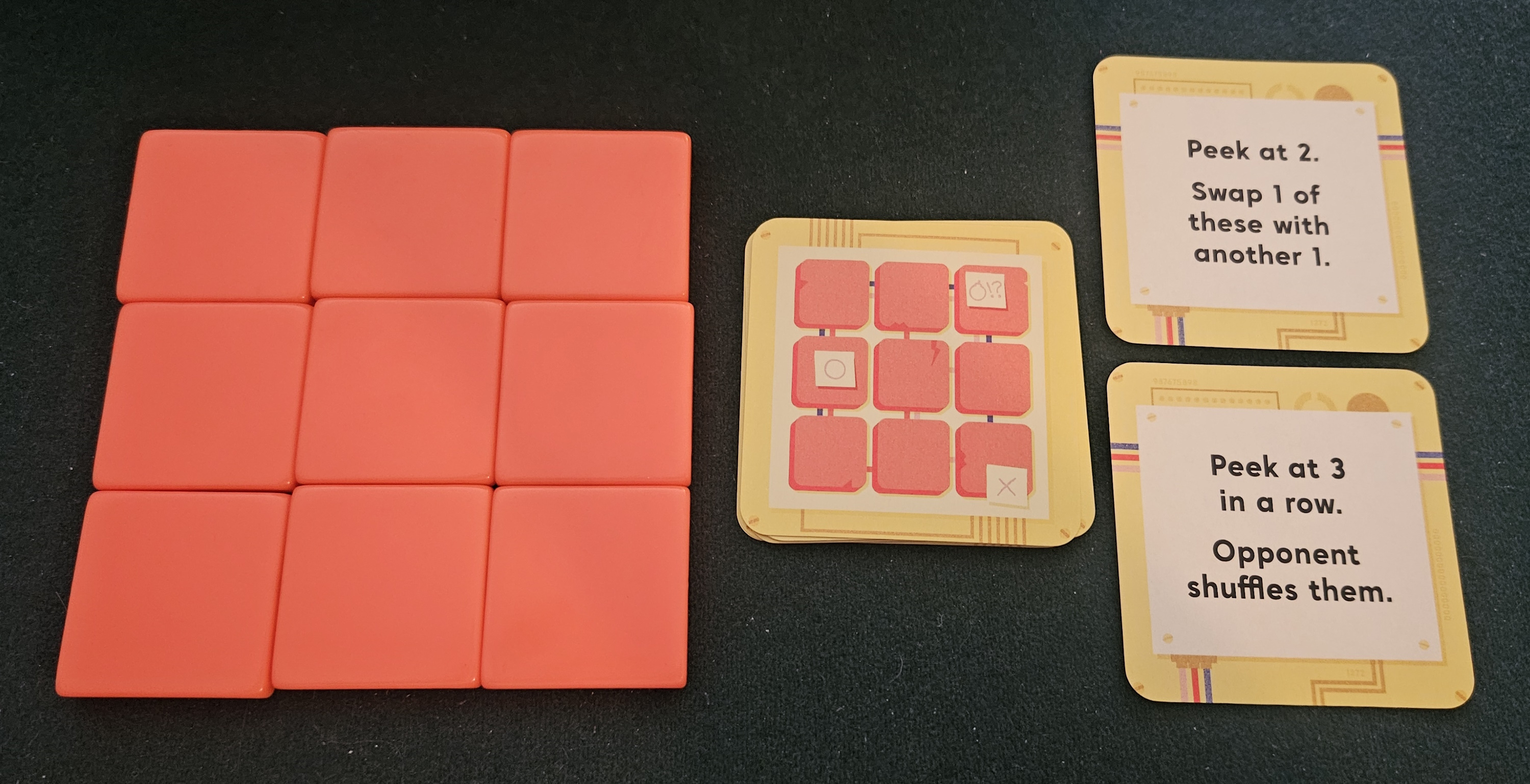
Behold the game. The board game.
Four X’s. Four O’s. One black-powder grenade mere seconds from producing a cartoon kablooey.
Playing as either X or O, your goal, naturally, is to make three in a row. On any turn, you can choose to reveal such a row. Should all three tiles display your symbol, you win. Anything else, and that’s information you’ve tipped to your opposition.
And the bomb? Show that and you lose.
That’s roughly 90% of the game. The last crucial ten percent is in the cards. If you’d rather not wager everything on a blind flip, you can instead select a card to resolve. There are two available at any given moment, offering their own instruction sets. Such as: Peek at two tiles, then choose whether to swap them. Or: Show three tiles to both players, then secretly rearrange them. Perhaps: Peek at as many tiles as you want — but if you happen to peek at the bomb, you lose instantly.
That last example is one of the more interesting options. Every card raises the stakes, but some raise them more than others. Like the one that lets you peek at a single tile before forcing you to “go for it,” the game’s terminology for revealing a row. My favorite card is the one that asks you to show three tiles, but in the shape of an L. If they’re all yours, you win! Hooray for alternate victory conditions! But if you show even a single tile that isn’t yours, you lose. Boo for alternate failure conditions!
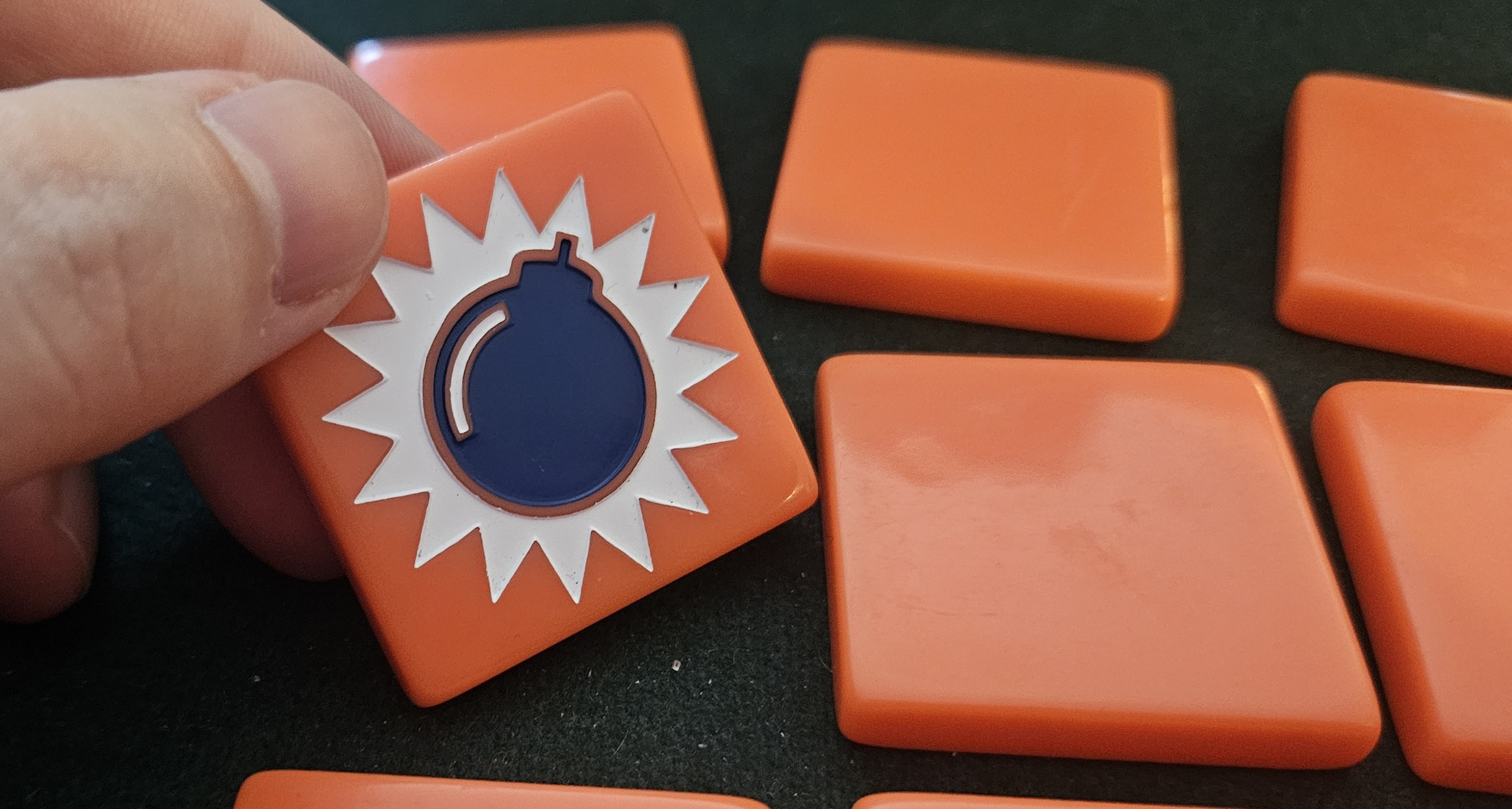
Uh oh.
It’s tempting to do a compare-and-contrast with Tic Tac Trek, but that would make both titles victim to their proximity rather than digging into what makes Bombastic interesting in its own right. Anyway, their main point of comparison is that they’re both so brisk. A full session of Bombastic might last eleven minutes or as little as ninety seconds if somebody decides to Go For It the instant they have the vaguest notion that they might reveal a winning trio.
That brevity, but also that flexibility in its brevity, is the game’s most appealing aspect. In obscuring the usual Tic Tac Toe grid — and in providing the tools necessary to reveal only tiny portions of that grid at any given moment — Hovakimyan transforms a game that everybody knows but nobody loves into a masterclass in pushing your luck. In many respects, it’s about doing the best with the information you have right now rather than waiting for your opponent to further clutter it with an ill-timed rearrangement. There’s an element of memory, to be sure, but given the compact play-space it’s closer to logic than outright recall. The temptation to reveal a row when you have two of the necessary symbols locked in is always present. Bombastic is about resolving static into a coherent image — but not waiting too long to do so, lest your opponent flick the antenna.
It helps, too, that Bombastic’s presentation suits its nature so well. The pieces are simple and clacky; the case is a clamshell with a zipper and a carabiner; the rules pamphlet is irrelevant after one play. My only hangup is that I wish Bitewing had sprung for polyvinyl chloride cards to make the whole thing a waterproof companion to Hive. [EDIT: Available as an add-on, apparently!] As it stands, this is a game I can play anywhere, anywhen, and with anybody — except on the river or in the rain, which slightly dings its travel appeal. Still, it works for the most part. At this week’s Labor Day gathering, we alternated five-minute sessions with letting my two-year-old niece load and unload the case and fling the pieces into the dirt. Her parents expressed concern that she would ruin another game. Nah. Bombastic was built for this.

Is this couch co-op? (No.)
For what it does, Bombastic is more or less perfect, occupying only a sliver of an hour and riffing on a busted classic in such a way that makes the old seem new again. To be clear, this is still Tic Tac Toe. It’s even technically possible to win or lose on the opening move — concluding, ironically, even faster than the pen-and-paper original. Even so, it’s a strong variation on a theme we all know, a de-solution that feels both familiar and fresh. One more and we’ll have a trilogy.
A complimentary copy of Bombastic was provided by the publisher.
(If what I’m doing at Space-Biff! is valuable to you in some way, please consider dropping by my Patreon campaign or Ko-fi. Right now, supporters can read my second-quarter update!)
Posted on September 3, 2025, in Board Game and tagged Bitewing Games, Board Games, Bombastic. Bookmark the permalink. 4 Comments.

 SPACE-BIFF!
Kids these days have so many great options for ignoring church. We’re really in a golden age.
Personally, I’ve been using the new zero-hour meeting schedule.
Are you familiar with Mijnlieff?
It’s tic-tac-toe with scoring and an ingenious ruleset (basically each piece has a placement rule your opponent has to follow on their turn.)
Interesting! I hadn’t seen this before.