Not a Blackthorne in Sight
Hard to believe it’s been two years since General Orders: World War II. The brainchild of Trevor Benjamin and David Thompson — and distinct from Undaunted, their other shared WWII series — the inaugural General Orders was an ultralight wargame blended with worker placement. I liked that opening salvo well enough, and despite some hangups there wasn’t any reason to not take a gander at the system’s second outing.
I’m glad I did. General Orders: Sengoku Jidai turns back the calendar to the warring states of 15th century Japan, swapping airplanes and artillery for ashigaru and… well, still artillery, but it’s somewhat less efficacious. More importantly, every detail of Sengoku Jidai, from the game’s more coherent visual direction to its fluctuating battle lines, is punchier and more confident than before. The result is a near-perfect small-box title that packs thunderous drama into a slender half hour.
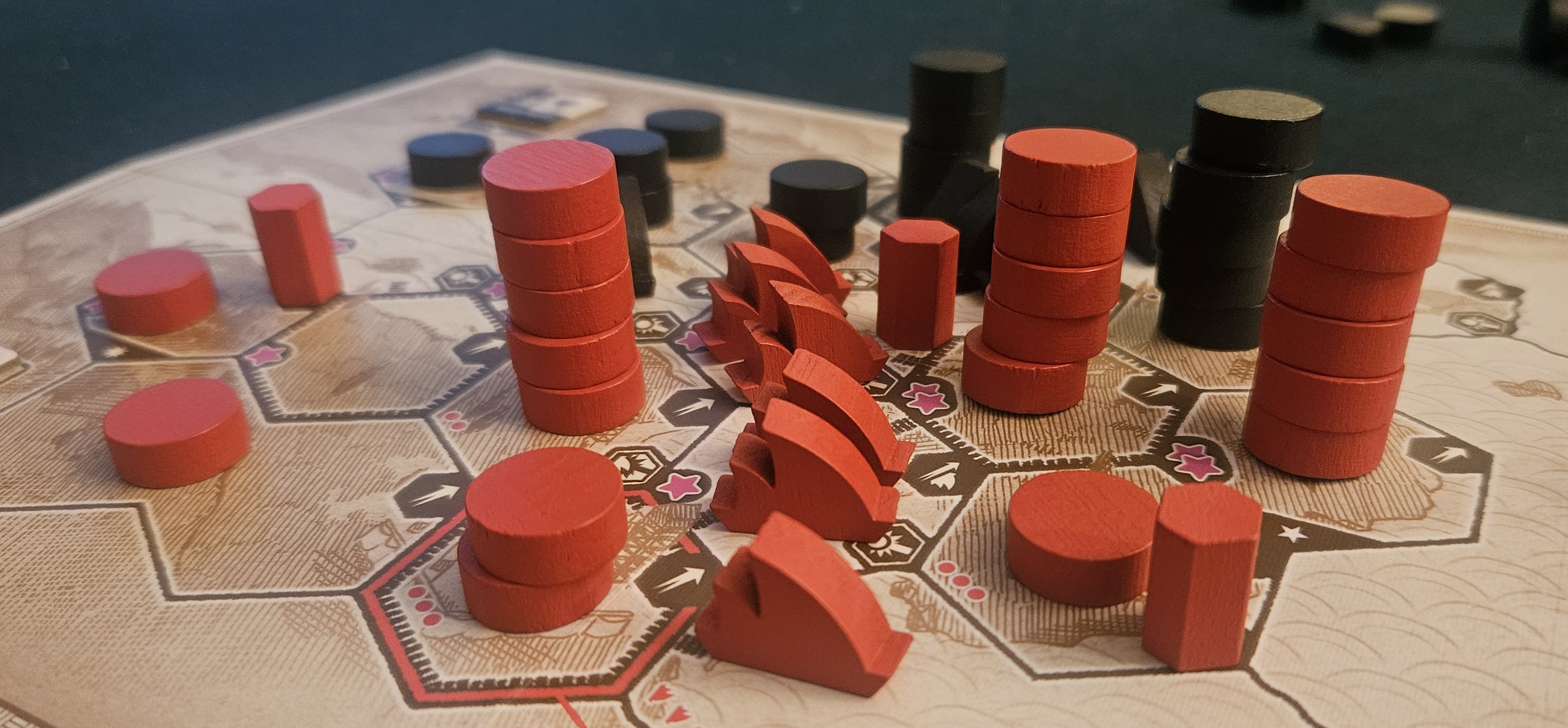
The presentation is top-notch.
The basics have survived the transposition of time and place. As in the game’s 20th-century predecessor, General Orders: Sengoku Jidai is a fifty-fifty split between worker placement and military maneuver. Rounds see players exchanging placements of commanders. To invade a province, you must place a commander in its space to move in troops, which in turn blocks any further advancements into that space for the remainder of the round. Reinforcements and cards are procured in similar fashion, with early adopters receiving additional troops or ships. Bombardments from ships to shore, or vice versa, are also handled by these placements.
But while the overall system is more or less the same, any flabbiness has been screwed tight. Your commanders, for example, are set in stone. Both sides receive five or six, depending on the map, and will never receive even a single extra. Similarly, while there are still questions of supply and control to consider, making flanking maneuvers a worthwhile consideration, the absence of airborne units make it harder to sever your rival’s routes from the rear. The addition of ships, meanwhile, is the game’s hidden weapon, doubling the tools at your disposal and forcing most conflicts into a question of combined arms.
The battle lines are firmer, is what I’m saying, and their resoluteness transforms General Orders for the better. This is the era of flinging soldiers against fortifications, and while Sengoku Jidai is only marginally more interested in evoking its setting than World War II was, this does wonders for the actual gameplay. Invasions are less about cutting off supply and more about careful advancements: bridging rivers with ships, pouring in attacks from multiple spaces, softening up enemy positions with siege weapons before setting iron against iron.

Not all commanders are spent on the main board.
Most of the time, rounds play out as a series of escalations. Nearly every placement makes itself felt. When I dash into a fortified space before you, my swiftness is rewarded by a home field advantage in later rounds. But then your commander will deprive me of something precious in turn, nabbing more cards than I’ll be permitted, securing a particular strait, striking my new fort from the water, making a thrust along the far side of the map.
There’s also just enough wiggle room that every move feels dangerous, despite the compactness of the game’s two maps. There are two ways to win, either by holding more objective stars at the game’s conclusion or by murdering the occupants of your rival’s main base, and it’s often the case that massing armies for a conclusive push in one sector will deprive you of a sufficient bulk to defend yourself elsewhere. More than once, I’ve stood on the cusp of seizing the battlefield only to watch helpless as my foe pushes into my unprotected rear line. Everything is a tradeoff.
This is most evident in the operations cards. Without the planes and paratroopers of WWII, it’s more important than ever to invest at least a few commanders into drawing cards. Each map has its own separate deck, and while there are duplicates — the “ambush” card springs to mind, letting a defender roll an extra pair of dice, which is evil incarnate — for the most part, these decks complement the way that map is intended to be played.

You don’t need cards to win, but they sure help.
Those maps, by the way, are superior to the first game’s battlegrounds in pretty much every regard. The first, Rivers, is all tight waterways and nasty bombardment positions. This is the symmetrical map of the pair. Both sides have their own shoreline, easy to secure right away, but must quickly decide between launching an invasion of the opposite shore or contesting the island in the middle. The cards, meanwhile, emphasize various ways to use those navies, whether embarking them straight into combat or bombarding enemy troops. It’s simultaneously flexible, hopping troops between shores and springing multi-pronged attacks, and suffocating, every twist in the river desperately contested and shelled.
The second map is even better. I didn’t much care for World War II’s asymmetrical map, but this one, Fortress, is excellent. Ships still play an essential role, but the open sea feels wide-open compared to Rivers’ claustrophobic waterways. Here the wrinkle is that players are jostling over fortified spaces that are suicide to assault directly. The solution is a third piece, the world’s most adorable siege engines, that can soften up a position before you rush into battle. Appropriately, the cards for this map amplify those sieges, letting you fire extra volleys during an attack, or perhaps even advancing under fire of your siege engines. Of course, counterattacks and cover play a role as well, letting defenders sally at the most inopportune times.
The beauty of the whole system, though, is that the cards are just one element of the whole. This is no card-driven wargame. General Orders remains a worker placement game first and foremost, every turn asking which maneuvers or reinforcements you prioritize most highly, and then biting you in the ankle with regrets. It’s one of those games where every command dredges a loud “Darn it!” from the opposite side of the table.
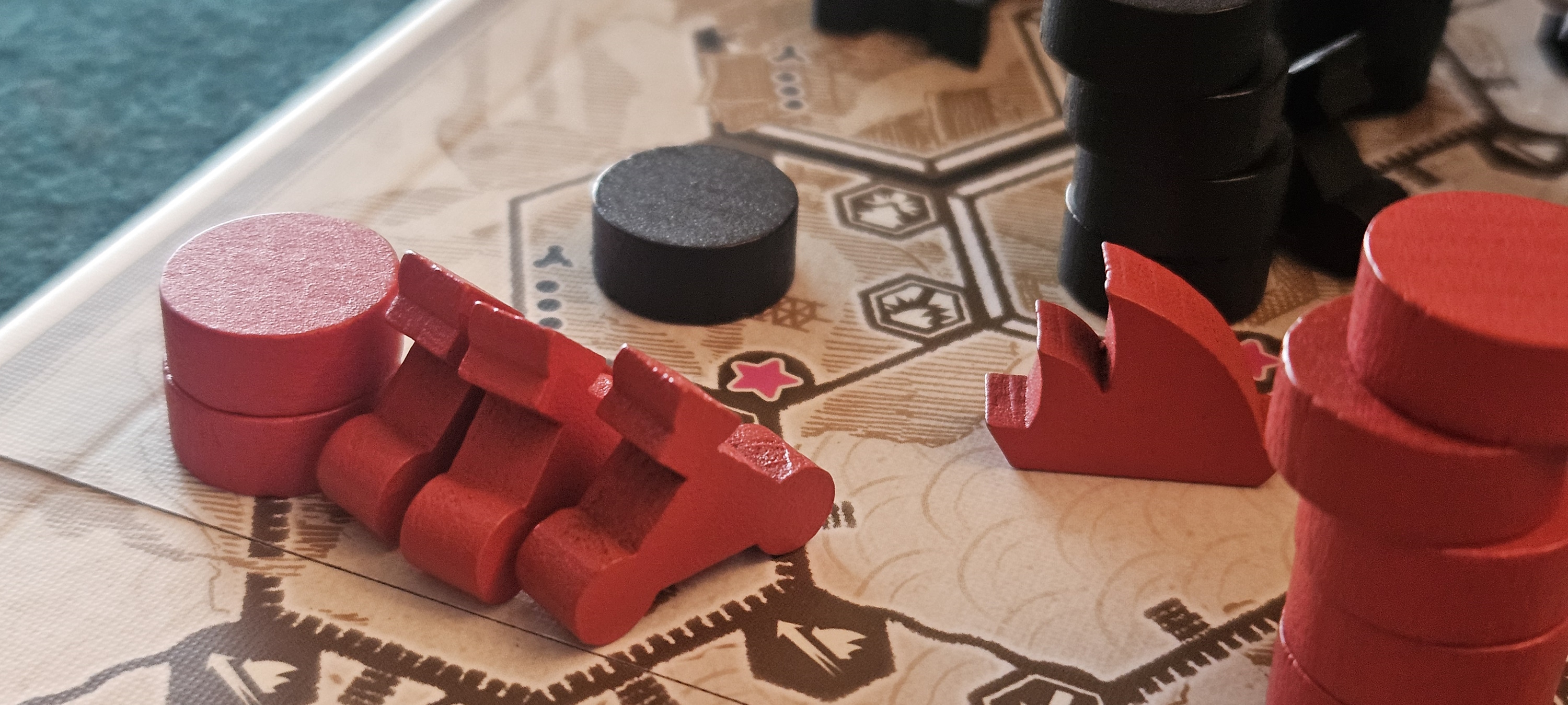
Closing in on my rival’s final defenses.
Do I have quibbles? I guess. The spaces are rather small, turning the stacked discs into something of a dexterity game to manage. And so many of the icons feature little explosions that it can be tricky to tell them apart. There’s even a peculiar issue where your stacks grow so thick and tangled that they obscure the commander spaces on the board. Then again, I find this somewhat charming, as though the game is asking you to study the battlefield from multiple perspectives. Not sure how to proceed? Shuffle around the corner for a glimpse at some different possibilities.
On the whole, though, General Orders: Sengoku Jidai is an excellent offering. The addition of ships represents a much-needed shakeup, making the lonely army discs of World War II seem like thin gruel by comparison. It turns out that multi-spectrum warfare is precisely what this system needed to thrum to life. As a result, the battlefield feels more dynamic, producing tense duels that are more than the sum of their parts. That Sengoku Jidai feels more exciting even without soldiers who magically rain from the sky is a huge accomplishment.
In short, this is the good stuff. It’s short, it’s hard-hitting, it’s dead simple to learn. At the same time, it’s anything but simple in the clashing priorities of its commanders, armies, and navies. If this is what we can expect from this series going forward, count me in.
A complimentary copy of General Orders: Sengoku Jidai was provided by the publisher.
(If what I’m doing at Space-Biff! is valuable to you in some way, please consider dropping by my Patreon campaign or Ko-fi. Right now, supporters can read my second-quarter update!)
Posted on August 27, 2025, in Board Game and tagged Board Games, General Orders, General Orders: Sengoku Jidai, Osprey Games. Bookmark the permalink. 6 Comments.

 SPACE-BIFF!
Thanks for this! I wouldn’t have known this existed, and it’s right up my euro-style-gamer-who-likes-historical-wargames alley.
I hope you get to try it!
Probably you meant “20th-century” here? Unless there is another General Orders game I haven’t heard about
Dammit! I always struggle with that. Corrected. Thank you.
To keep it thorough: It’s 16th century Japan.
Great job on pointing out the differences/improvements and how they change the feel of the game. I was indecisive which version to buy – until now. Thank you!
This series may end up burning a hole in my wallet, haha.