Simps All the Way Down

Gastby. You know Gatsby, right? Throws fancy parties. In love with a woman who couldn’t care less whether he lives or dies. Always staring at that green light.
When it was announced that Bruno Cathala and Ludovic Maublanc were doing a board game version of F. Scott Fitzgerald’s The Great Gatsby, the response was mostly derisive. I get it. We’re tired of this multiverse crap. And who are these new characters anyway? Everybody knows you can’t go disrupting fans’ headcanon by adding characters to a century-old book.
In this case, though, it works. What’s a better homage to Jay Gatsby than inventing two new characters who were presumably hovering in the wings the entire time, only he never noticed? Unsuccessfully simping for somebody’s attention is as Gatsby as it gets.
Too bad about the rest of the game, though.
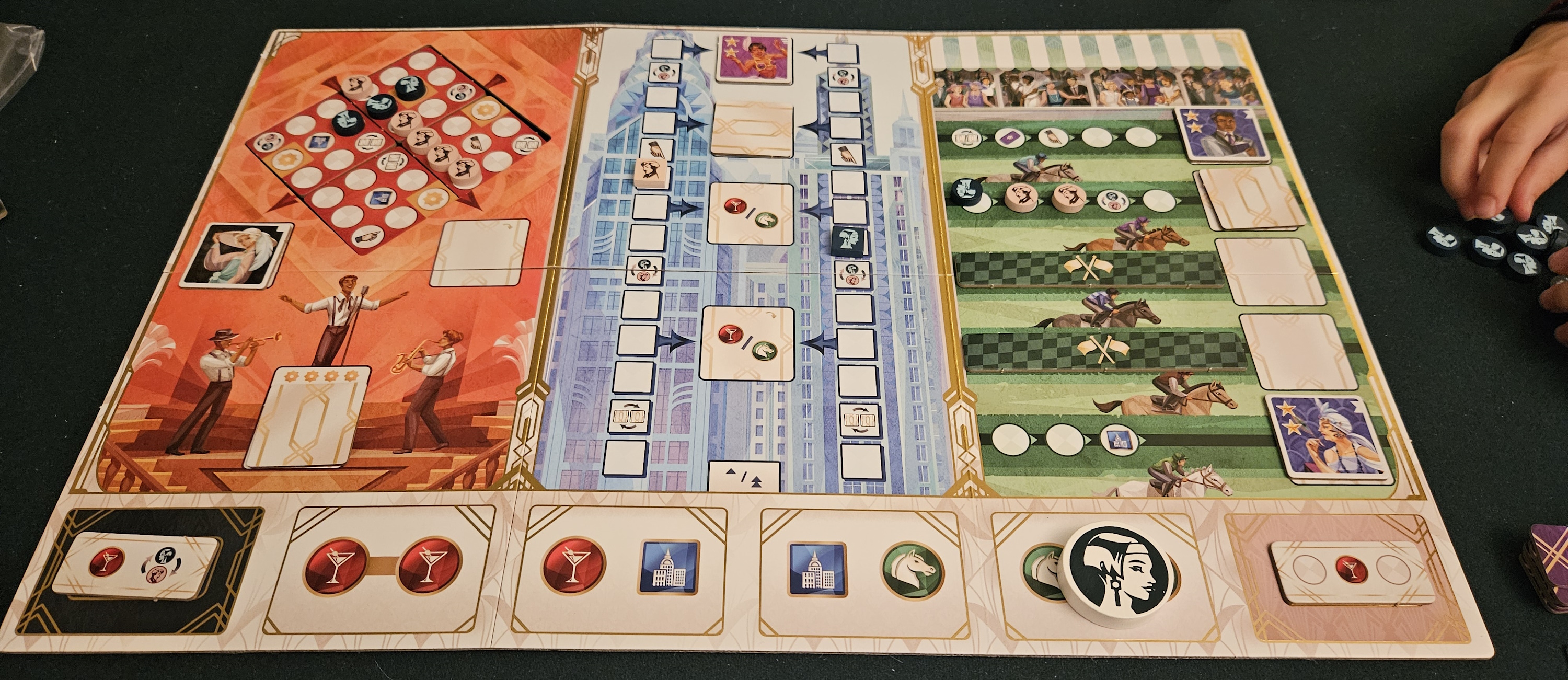
Clubs, high-rises, racetracks: some real Gatsby-era stuff.
Welcome to the Roaring Twenties, an era that consists of precisely three things: parties at nightclubs, parties in high-rises, and parties at the racetrack. Players control two characters. I can’t remember their names, nor can I be bothered to look them up, so we’ll call them Bob and Bobbie. Your objective is to catch Jay Gatsby’s attention. This is done by making friends who are not Jay Gatsby, spread across five suits and various ranges of prestige. If you happen to make three friends in the same suit, or one in all five suits, you immediately win, presumably by winning Jay Gatsby’s affection and snuffing out the green light. (Not included.)
How does one make friends? Why, only by attending parties and completing various minigames, of course. There are three minigames in all, each of which offers its own path to friendship. There’s the one in the nightclub, where tokens are placed to trace a line between sides — as in John Nash’s Hex (which he swiped from Piet Hein!) — another where players race to the top of a high-rise, and a third placing wagers at the racetrack.
It’s all rather thin. The horse racing minigame, for instance, shouldn’t fool anybody into thinking it’s about actual horse racing, unless horse racing is about placing more wagers on any given horse than your friends. The whole thing is a simple majority contest. If you have the most tokens on a race once it’s filled up, then you win that race. Meanwhile, the high-rise minigame is just a track that you’re hoping to move along faster than your rival. The most interesting of the set is the club, requiring at least some degree of prioritization between connecting the grid’s edges or unlocking bonuses. Note that “most interesting” is a relative thing.

Selecting actions.
Of course, the real trick to Gatsby is that none of these minigames are meant to stand on their own. This is really a game about picking your battles. Turn by turn, you flip a disc along a row of possible actions, selecting which combination of minigames you’ll manipulate this time. The disc can only be placed on a space that it didn’t occupy before, so if your rival spent all her time schmoozing at the club, then you’ll have to do something else. Like half-schmoozing at the club and half-schmoozing in the high-rise.
Around the game’s halfway point, one starts to wonder if perhaps this is all a fair bit cleverer than it seemed at first glance. Each of these contests is minor on its own, but the challenge of threading all three needles at once is more demanding. Now you’re asking questions, like “Should I sacrifice the high-rise altogether to focus my efforts on the racetrack and nightclub?” or “Should I swap these two acquaintances so that I’m more likely to form the best possible clique?” That last option is the game’s smartest one, offering little moments of devious rearrangement that promise an early conclusion.
Meanwhile, there are ample opportunities to trigger combos. By placing a token in the club, maybe you’ll earn a bonus in the high-rise, which will let you swap out some tokens to seize the advantage at a horse race, which you can then capture by catching up to your opponent on your next action in the high-rise, stealing the race out from under them. Each contest feeds back into each other.
It’s interesting, is what I’m saying, although only in comparison to the dulled edge of those minigames. It’s like going into a horse race half-soused when your competition is chest-deep in gin. You’ll feel clever, only to blink yourself clear of the daze a few moments later and realize you were riding the horse backward.

The club minigame is by far the best one.
It would be one thing if Gatsby weren’t as clever as it thinks it is. Plenty of games manage that. But Gatsby goes one further by including some truly miserable possibilities.
The main offender is the icon that lets you choose where your opponent will place the action-selection disc on their turn. This isn’t quite a skipped turn, as it still permits the skipped player to make their mark on something. But it rankles all the same, especially when you’re stripped of any decision-making potential, such as at the high-rise. And that goes double when your opponent weaponizes your turn, an occasional but not unthinkable outcome when it comes to the racetrack, which you might be forced to play onto and thereby complete a losing race. Ouch.
Is there anything to say in this game’s defense? Eh. I suppose it’s hollow and unrewarding in the same way that Gatsby’s high society was hollow and unrewarding, smitten with spectacle and amusement over self-reflection or sincere connection. Does that count as “theme”?
What this game is missing, really, is the eyes of T.J. Eckleburg. Like those Ivy League Gatsby parties, this is all veneer without any of the underlying substance. I mean, you didn’t need me to tell you that, it’s apparent just by glancing in the game’s general direction. But what a missed opportunity to show the ash-heaps and tenant houses in between all the hot spots. Or the casual violence. Or the sweeping carelessness. Or some gameplay. Gatsby isn’t removed from its setting because it features Bob and Bobbie, our new guests to Jay Gatsby’s courtyard. It’s removed from its setting because it’s all smiles and no grimace.

The real simps were the simps we met along the simping.
Nobody expected this to be profound. Alas, I held out hope that Gatsby would deliver in even the smallest degree. Is my misplaced hope the most Gatsby thing ever? Well played, Gatsby. Too bad about the rest of it. So it beats on, shovelware against the golden age, borne back ceaselessly to the bargain bin.
A complimentary copy of Gatsby was provided by the publisher.
(If what I’m doing at Space-Biff! is valuable to you in some way, please consider dropping by my Patreon campaign or Ko-fi. Right now, supporters can read my second-quarter update!)
Posted on August 25, 2025, in Board Game and tagged Board Games, Catch Up Games, Gatsby, Pandasaurus Games. Bookmark the permalink. 2 Comments.

 SPACE-BIFF!
You’re simp-ly the best, Dan.
Aw, thanks!