Chicago Gets It Up

Imagine checking into a hotel in 1861. Not just any hotel, but a six-story brick building. Over the course of your stay, the front stairs have grown noticeably steeper each time you return. When you check out five days later, the windows that once sat at eye level are now several feet above your head.
This isn’t a ghost story. It’s an actual anecdote from the raising of Chicago, when engineers used thousands of screwjacks to lift the city’s brick structures six feet above their previous elevation. In some cases, as with the Tremont House Hotel, the laborers worked in covered trenches, permitting business to be conducted as usual. This brought the city above the water line, permitted the construction of a sewer system, and hopefully prevented another outbreak of cholera from killing one in twenty inhabitants. Chicago was saved. At least until the next decade, when a cow would kick over a lantern in Mrs. O’Leary’s barn.
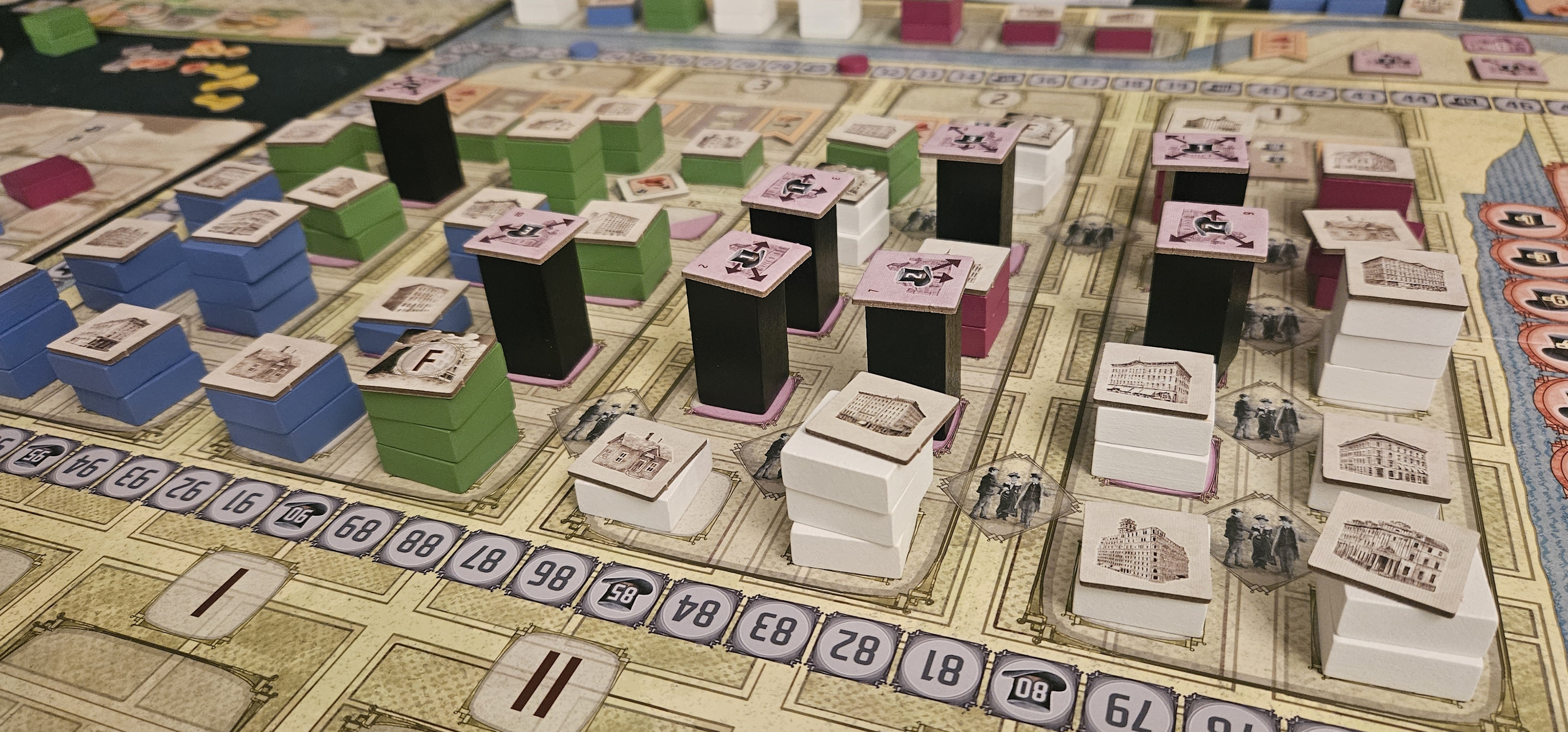
Chicago is a city on the rise! (and in the game)
Matt Wolfe’s Raising Chicago is a spiritual sequel to his earlier Squaring Circleville. And to be clear, “spiritual sequel” is our fancy way of saying that they don’t have much in common beyond their shared interest in urban planning. As a member of a consortium of engineers, you’re here to bid on various projects, spend the necessary materials to jack them up, and hopefully expand your wealth and prestige until you’re rich enough to found a company town where your workers will be so mistreated that their eventual strike will halt the mail, see federal troops enter Chicago, and spur Grover Cleveland to designate the first Monday in September as Labor Day. Huh! History!
Apart from letting you play as labor villain George Pullman, Raising Chicago also happens to be something of a mess. Its building projects, for example, are printed on tiny chits. These are arranged both randomly and in carefully ascending order, turning setup into a chit-sorting and -shuffling headache. Oh, and their printed values are tiny. Hopefully you have good illumination over your table. Otherwise this migraine won’t be easing up anytime soon.
But here’s the thing. Raising Chicago is fiddly, overlong, and its graphic design was done by an eagle. For all that, it’s also an excellent auction and area control game.
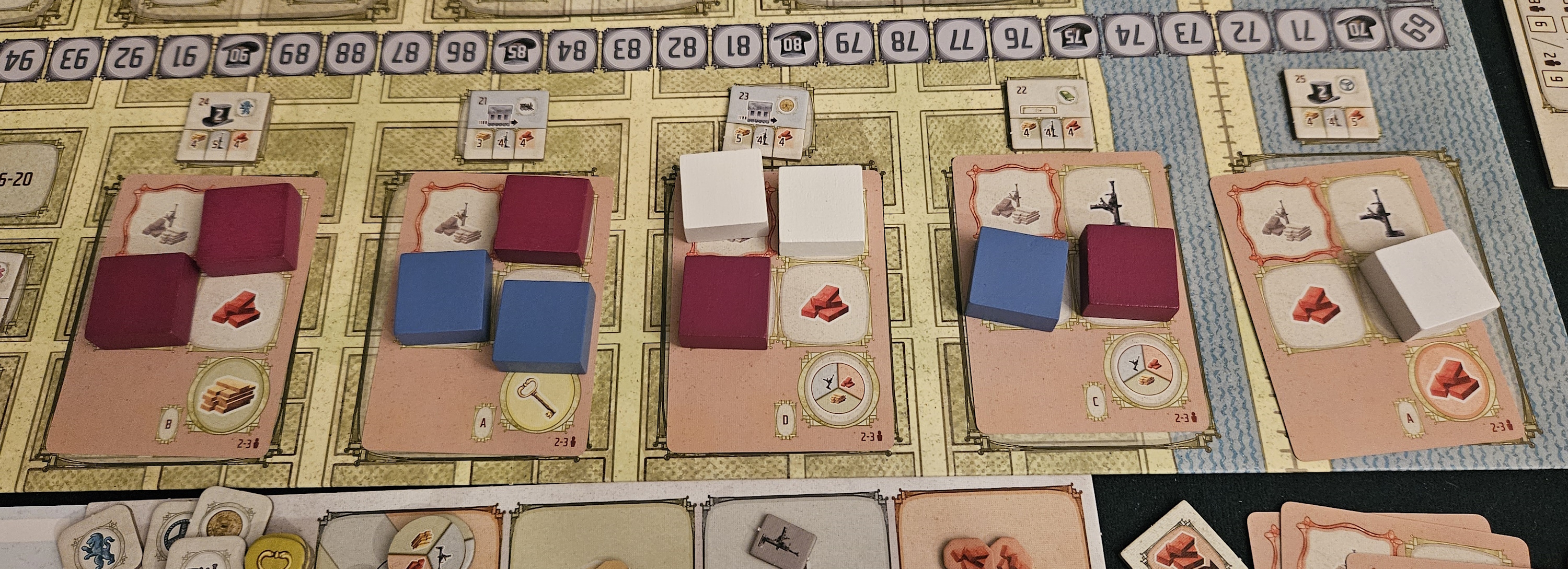
The auctions are the big draw here.
It begins with the auctions. At any given time, five projects are up for grabs, divvied into paired lots of the project itself and a resource card. Placing one of your blocks on the card signals your bid, while also acquiring whichever resource — bricks, timber, or screwjacks — you just covered up.
Right away, bidding in Raising Chicago is preoccupied with tiebreakers. It’s rare for a winner to need more than two blocks to secure a card, and it isn’t outlandish for a single block to win. The formula is simple, with higher blocks beating lower blocks, and leftmost blocks beating those to their right. This affords texture to the bids as a whole and allows the top-left space of every resource card to function somewhat differently. Rather than awarding resources, this square costs the resources that have yet to be covered on the card. This transforms that space into something of an ultimate tiebreaker, especially once the card has been otherwise filled in.
For the most part, then, these auctions feel less like exercises with barkers and paddles, and more like the corporate bids they actually represent. Each placed block can signify intent, a surefire sign somebody is horning in on a contract you thought you had cinched, but might also mean they just need some extra bricks.
And that’s just the first layer. Projects will eventually be claimed and placed on the board, which we’ll cover in a minute. But even the resource cards stick around, becoming your company’s operations. These churn out extra resources, boosts to your reputation, or maybe even favors with the city, which can be spent when you can’t cover a project’s full cost on your own. These are all beneficial in their own way, but it’s worthwhile to give at least some consideration to your long-term needs. As projects increase in price with each passing round, it becomes more and more necessary to plan ahead.
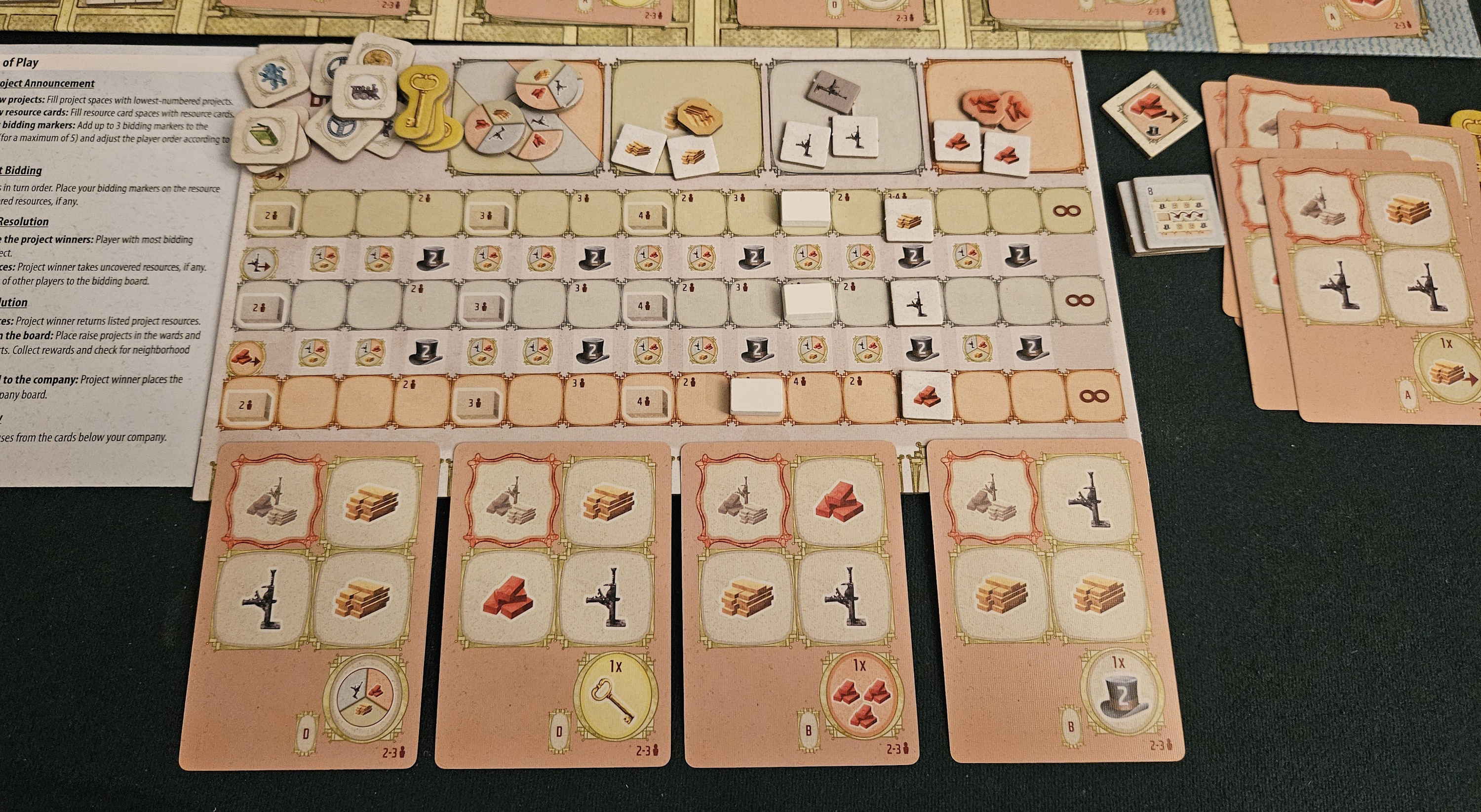
We’re running a company here.
I won’t belabor the company-side stuff. Suffice it to say, gaining experience in the various feats of engineering needed to lift an entire city six feet above its current elevation translates into deep discounts, some of which may be necessary to avoid falling into debt. By game’s end, it’s entirely possible that you’ll be so skilled at lifting brick structures that one or more resources will have become obsolete entirely. Keep on reusing that timber. It’s almost a relief the city burned down before all those cut corners came due.
As for the buildings, this highlights Raising Chicago at its best and worst. Both the step-by-step process and the physical act of stacking your blocks are finicky, with lots of little steps to remember and nary a reference card to keep them sorted. There are two very different types of project. Normal projects are added to the city proper, stacked atop the blocks you used to bid on them. Their height scores points, but in a more handsome turn also becomes the basis for the neighborhood scoring minigame, turning your engineers into borough bosses who bully their way into high society.
Out-of-town projects, meanwhile, see you rolling the city’s wooden structures to the outskirts to clear room for fancy newer structures. This process requires even more steps than the first one, awarding some bonus tile for your labors and also erecting a newer structure in town that awards points to the owners of neighboring buildings. It’s all very silly, historically speaking, but generates tight contests to control various neighborhoods. It helps, too, that all these stacked blocks look fantastic. Witnessing Chicago on the rise, literally, is some tremendous component-based storytelling.

As in real life, the city council is best avoided.
Between the auctions and the area control shenanigans, there’s plenty to keep anyone occupied. If anything, the game teeters on the brink of offering too much.
For instance, the optional city council module illustrates the underlying fragility of this entire enterprise. This adds an extra pile of scoring objectives that only trigger if you secure enough of the corresponding resource cards — indicated, again, by microdot letters only visible to bugs. It sounds nifty to schmooze city councilpersons for extra prestige, bringing you into true Power Broker territory, but in practice it’s more clutter than it’s worth. Now resource cards represent bids and their tiebreakers, resources spent or earned, your company’s growing expertise, and which members of the city council you’ve cozied up to. It’s a bridge too far.
Sans the city council, and once all those little steps are internalized, and maybe with the benefit of opera glasses, Raising Chicago heats up to a warm glow. Its auctions are devious, forcing players into constant confrontations over the smallest bids. And while the city-side stuff is conceptually derpy, it feels good to seize control of neighborhoods and watch the city grow vertically.

In which we learn that Raising Chicago is the prequel to Up.
On the whole, Raising Chicago is a strong auction and area control game. Despite its overcomplicating tendencies — and its zest for under-pointed font — it’s a worthwhile endeavor for the sheer pleasure of watching its city on the rise and the ability to outmaneuver your rivals with a single block. At the very least, its existence is a reminder that in the 1860s, an entire city was shifted upward by nearly a full story. Now that’s cool.
A complimentary copy of Raising Chicago was provided by the publisher.
(If what I’m doing at Space-Biff! is valuable to you in some way, please consider dropping by my Patreon campaign or Ko-fi. Right now, supporters can read my second-quarter update!)
Posted on July 22, 2025, in Board Game and tagged Board Games, Capstone Games, Raising Chicago, Spielworxx. Bookmark the permalink. 2 Comments.

 SPACE-BIFF!
On BoardGameGeek there is a thread about a supposed “starvation strategy”. And a possible issue about Reputation Track…
https://boardgamegeek.com/thread/3514579/has-anyone-tried-the-starvation-strategy
What do you think?
We speculated that this might be a problem. There really ought to be a recurring penalty if you keep onboarding debt. I’ve seen debt lose somebody the game, but it does seem like you could focus on building as much as possible while neglecting resources entirely and come out ahead. Maybe, maybe not. I suspect it would be risky but possible.