Gastrotheism

There’s an old anthropological theory that religions naturally develop from polytheistic to monotheistic. Like many anthropological models, this one is outdated and hated by pretty much everybody. Religious folks dislike the theory because it implies their religion evolved over time; everybody else notes that there are plenty of modern polytheists, not to mention religions that defy the monotheist/polytheist rubric altogether. Anthropology: uniting theists and doubters since 1647!
Despite producing some rather bad science, the notion of a pantheon gradually winnowing itself down from a whole extended family to a singular daddy-god is the topic of Monotheism, a deck-in-hand card game designed by Frank Brown Cloud and illustrated by Jennie Plasterer. It’s delightfully unhinged.
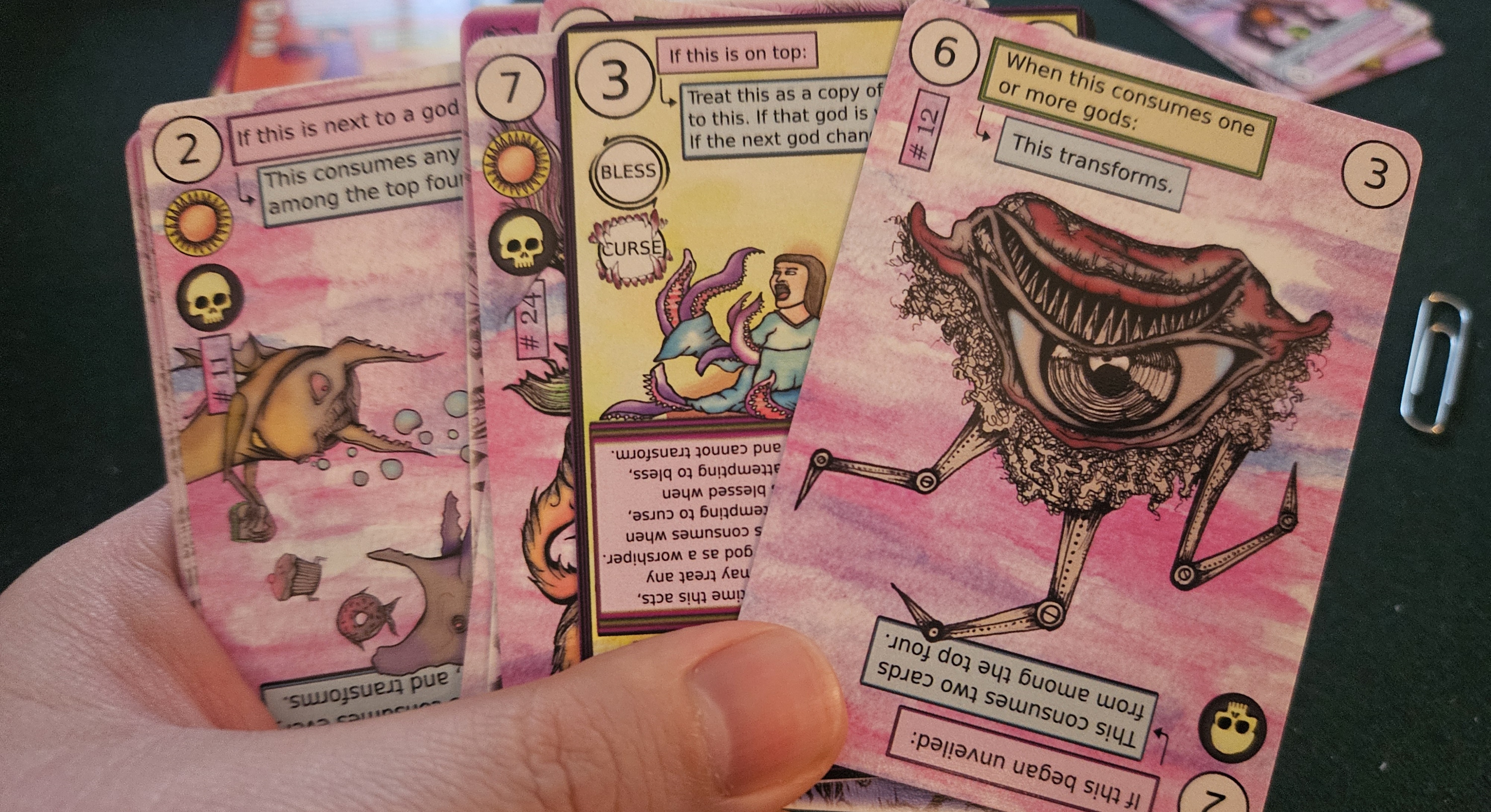
GAH!
In the beginning, there was a deck of thirty-ish cards.
Twenty-nine of these cards were gods. Veiled gods. Interpreted from the tongue of the people of that place, this means “face-down.”
One to three of these cards were worshipers, depending on the number selected when the deck was prepared.
And thus spake the Designer, “Thou shalt unveil the top card.” And it was done.
And thus spake the Designer, “Thou shalt activate the top card.” And it was done.
And thus spake the Designer, “Thou shalt now move some number of cards to the bottom of the deck, depending on the numbers inscribed upon the topmost card. Also, thou mayest freely arrange the placement of the topmost card within the cards moved to the bottom.” And it was done.
When these labors were completed, the Designer spake, and said, “Didst thou move a worshiper to the bottom of the deck? Remember, my little bonbons, O remember, that whenever a worshiper is moved to the bottom of the deck, they must be cursed, for this is the rule of this accursed land.”
And it was done.
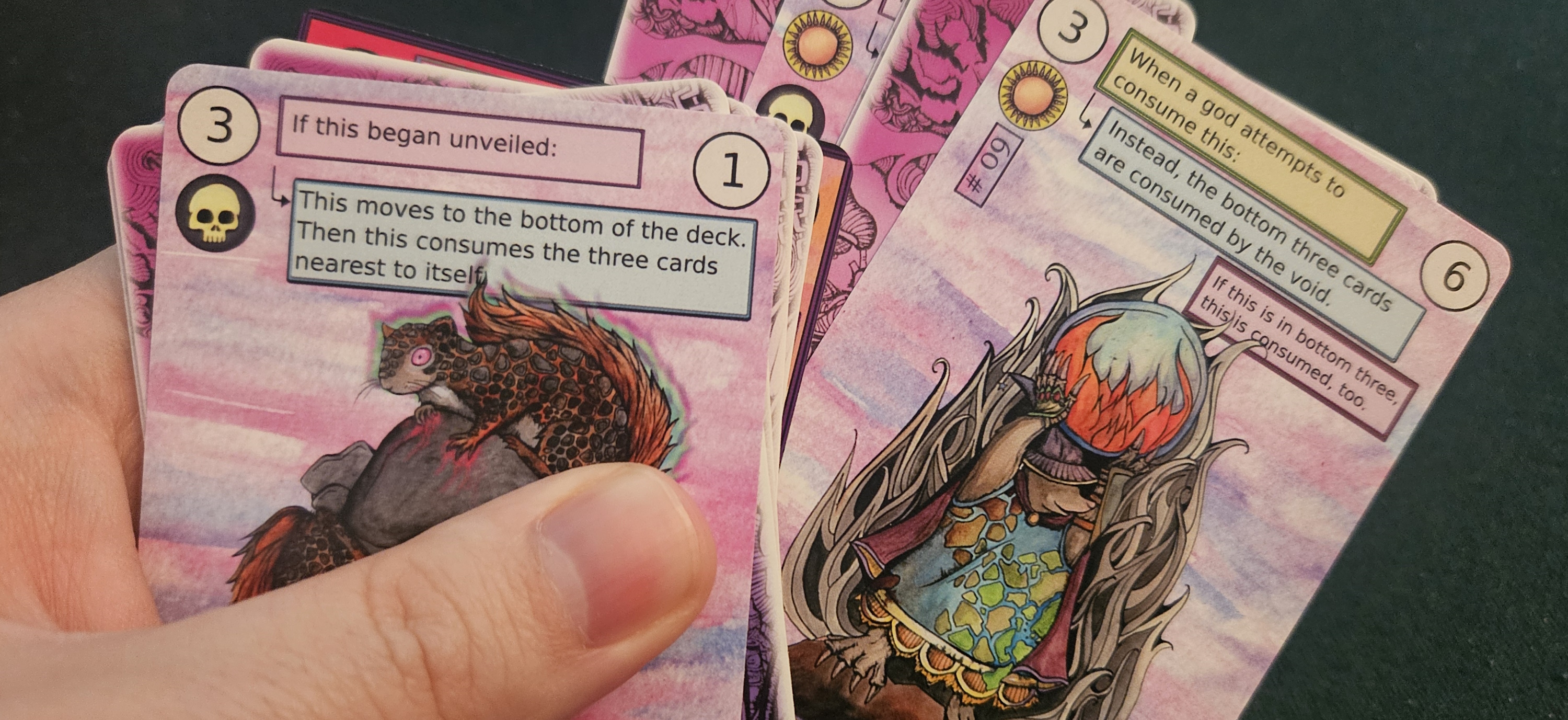
There’s room for some truly nasty combos. Sometimes, anyway.
Provided you were raised on King Jamesglish, you can now play Monotheism. The rules are dead simple. If the top card is face-down, you flip it over. You resolve its instructions. Then, if that card hasn’t moved elsewhere, you shift some number of cards to the bottom of the deck. You have some control over how those cards are arranged, but not so much that the decision spirals out of control. Breezy.
Of course, as with other deck-in-hand card games — I’m thinking of Palm Island or All Is Bomb here — the complexity of Monotheism doesn’t arise from the rules so much as the permutations of the deck itself. Your goal is to reduce this sprawling pantheon down to a single god while keeping at least one worshiper alive. The problem is that gods are only removed by being “consumed” by their fellow deities.
This is easier said than digested, especially since there’s no one way to force a god to chow down on its kindred. One god might consume any unveiled god in the deck, but only if it’s currently situated next to two other gods with the solar aspect. Okay, time to rearrange some cards. But then you’ll stumble upon another god whose ability triggers when there are no solar gods at all. It’s early going, so you don’t have too many solar deities kicking around, but that still means you need to eliminate a couple sol invictae before you can trigger this all-powerful ability. But then you’ll flip up a dragon god who blesses one of your worshiper cards. That’s good! Normally worshipers can only cycle through the deck so many times before they die, and blessings function like extra hit points. Except, uh oh, blessing your worshiper also transforms the dragon, rotating their card and revealing an entirely new ability, one that threatens to consume a whole bunch of cards in sequence, maybe even including your worshipers. You can feed a dragon-god, but that doesn’t mean the beast is placated for long.
Sessions of Monotheism go on like this, overflowing with “and then” moments. The whole thing has an improvisational air. You’re always riffing on new abilities, watching as previously powerful gods get gobbled up by unveiled pretenders, and scrambling to keep your worshipers from suffering too many curses.
Those worshipers, by the way, are Monotheism’s way of introducing varying degrees of complexity. There are four sets in all, each offering their own perspective on how to best handle this hostile pantheon. The Haruspex of Scriptures is a proof-texting nerd who receives blessings instead of curses when she weasels her way to the top of your deck and then shifts a bunch of cards downward. Or there’s a trio of monks based on the Three Wise Monkeys. These guys start out clustered together, but when spread across the deck can inflict some real damage to the surrounding gods. The rules aren’t altered — you’re still flipping cards and following their instructions — but every worshiper brings their own approach to the table. Er, to your hand. No table required.
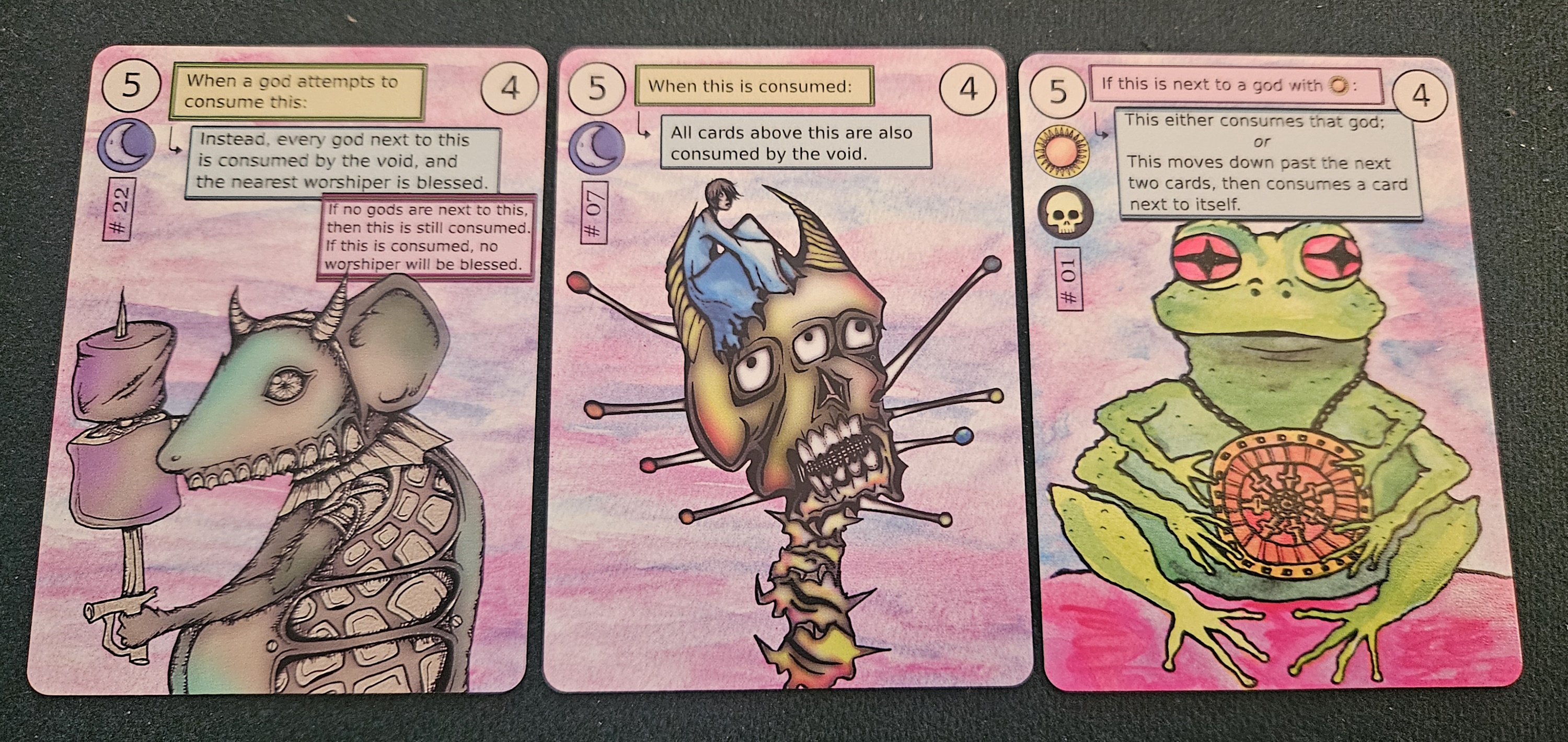
The Derpy Trinity.
As I noted in the lede, perhaps the best thing about Monotheism is just how unhinged it is. Persuading one god to consume three others, only for one of those snacks to pull an “I Am Madeth of Rubber and Thou Art Made of Glue” to turn the tables and eat the instigating deity, and then to not have to curse your worshiper because the first god got et, always feels tremendous.
But this isn’t limited to Brown Cloud’s gameplay. Plasterer’s illustrations are so vicious, so alien, sometimes even so distressing, that they say something altogether different about the pantheon your worshiper hopes to reduce to a more sensical number. These are unknowable gods. Sure, they sometimes adopt familiar shapes, but their ways and intentions are as distant as the clouds. I mean, as distant as the clouds were to somebody a few hundred years ago, not today. They’re strange and frightening. Worse, they might be appeased for a moment, only for your deck’s numerological reasoning to return them to the top at the worst possible moment. The whole enterprise of engaging with the gods feels appropriately dangerous.
Capricious, too. Monotheism is, like most deck-in-hand games, a profoundly reactive affair. Especially in its early stages, when all the cards apart from your worshiper(s) are veiled, many turns consist of flipping a card, seeing it can’t be triggered, and then rotating a bunch of cards to the back. A full session is short, maybe ten minutes, and quickly takes shape as more tangible decisions become apparent, both of which prevent its aleatory nature from feeling like a drawback. Just be warned that the god of dice and random digits lurks in the wings.
I’ll confess, too, that the game tickles my fancy as somebody who’s spent the last twenty years studying religion as a highly changeable, ever-transitioning thing. Even when I don’t manage to slice the pantheon down to a single pantokrator, I can’t help but flip through the remaining cards. Brown Cloud doesn’t assign names to his deities. Honestly, I prefer it that way. My imagination can fill in the blanks just fine on its own, thanks. The Derpy Trinity of my most recent play is all the stranger thanks to the absence of proper nouns. That way, War-Mouse (Patron of Toasted Marshmallows), the Knowledge That Exists Separate From And Independent Of The Corporeal Form, and Necklace Toad are allowed to inhabit their own essential niches in my imagined cult. Join us. Our parties are famously sticky.
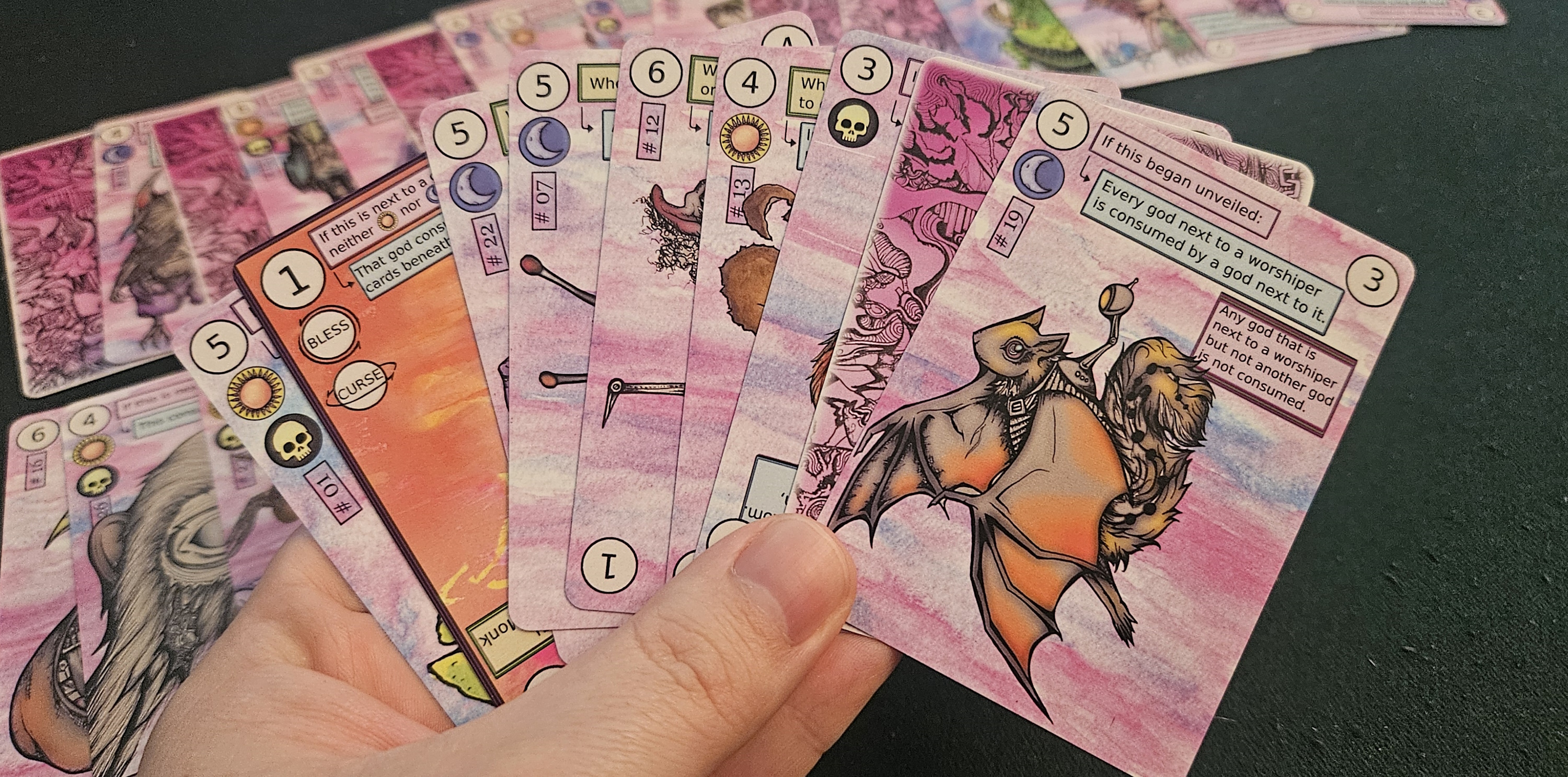
Monotheism gets harder as the pantheon is thinned.
In that regard, Monotheism feels like it was designed with my sensibilities in mind. Deck-in-hand games are too thin on the ground, and while Monotheism isn’t quite as sturdy as All Is Bomb, there are far worse ways to riffle through a deck of cards for ten minutes. On the whole, this divine feast is worth a look. You can find it over on the Game Crafter or as a free print-and-play file.
A complimentary copy of Monotheism was provided by the designer.
(If what I’m doing at Space-Biff! is valuable to you in some way, please consider dropping by my Patreon campaign or Ko-fi. Right now, supporters can read my second-quarter update!)
Posted on July 17, 2025, in Board Game and tagged Alone Time, Board Games, Monotheism. Bookmark the permalink. Leave a comment.

 SPACE-BIFF!
Leave a comment
Comments 0