Cvlt of the New

If you’d ever like to add some awkwardness to a social gathering, ask the table what they feel the difference is between a religion and a cult. The soundbites are guaranteed to be insufferable. And to answer your forthcoming question, I avoid dinner parties at all costs. I’m too much fun.
These days, I’ll confess to some wariness when it comes to trick-takers. It’s a lovely, storied genre, and I can play them with my in-laws, but too many of the things put only the slightest spin on the formula. I’ve reached the point where I can’t even keep these myriad trick-takers straight. Wait, was this the one where you want to take your chosen suit or avoid it? Are there fourteen ranks or only ten? And what’s the deal with these blank cards? It’s a jumble.
But then along comes a title like CVLT. It’s pronounced “cult,” by the way. That’s how we earn Alex Garland’s love. Anyway, CVLT was designed by Ashley Hauenschild and Taylor Fontaine, and it’s one of the most distinctive non-hybrid trick-takers I’ve played in recent memory. At the very least, I won’t be confusing it with any of its peers.
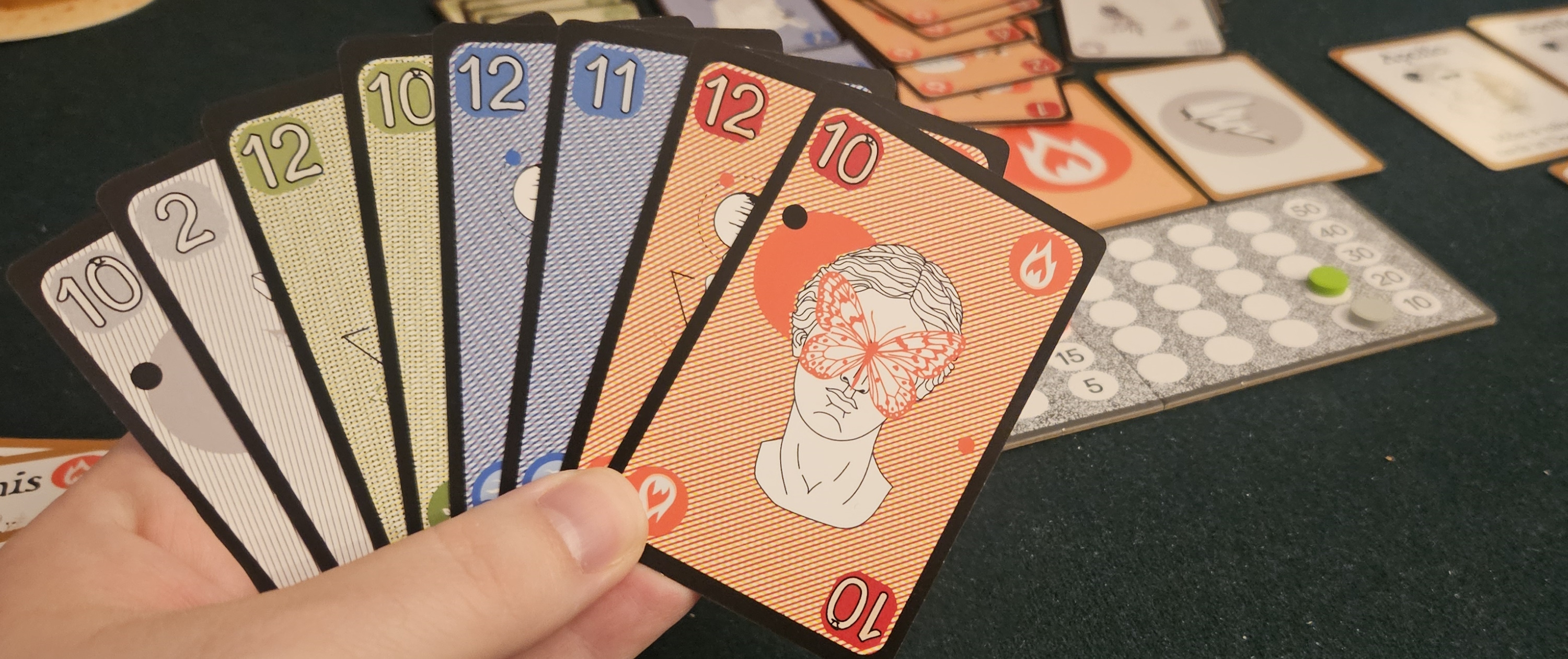
The art direction is nasty good.
As you might have guessed, your objective in CVLT is to organize your very own cult. Whether this is a cult in the modern sense, the disparaging sense, or the anthropological sense, I have no idea. Nor, really, does it seem to matter. The allegation that trick-takers are designed to be as athematic as possible won’t be dispelled today.
As a card game, however, CVLT is whip-smart. It starts with the smallest of adjustments. Rather than declaring one of its four suits to be an inviolable triumph suit, here the triumph is determined by rank. Should somebody lead a card — say, the 9 in the red suit — but you aren’t holding any reds, you can instead play that same rank in another suit. Bam. Triumph. Just like that, CVLT includes all the tension of unexpected wins without handing an advantage to whomever happened to draw the most of a particular color. Triumphs are rare, but enough of a presence that a high-ranked card isn’t guaranteed to win.
Like I said, that’s a small adjustment. Others are more significant. The scoring, for example. Points come from two sources, and as the hand develops you’re given some latitude in how you approach both.
It goes like this. At the conclusion of any given trick, the winner selects one of the cards that was just played. Going clockwise, everybody also claims a card. This gives the hand a measured feel. Depending on what has been played, you’re always assessing whether to win this particular trick, bow out altogether, or maybe do something even sneakier — like press for the person to your right to win, since that will land you in second-place in this card draft.
Those cards, meanwhile, are added to one of two piles. Your first pile, called offerings, is placed face-up. At the conclusion of the hand, every card in every player’s offerings will then be added to a scoring splay at the center of the table. You win the points equal to the ranks you deposit here. Except, and this is a tectonic “except,” your cards only score if all the offerings thus far count up to that rank.
It’s hard to overstate how clever this is. Without much rules overhead at all, this offers an incremental scoring system that steps upward over the course of the game. It’s trivial enough to score a rank 1 or 2 card in the first hand, but it won’t be until the third and final hand that ranks 8 or higher will be worth points. In some cases, the game will even conclude with players swinging 13 or 14 points per card.

As a rule, I’m opposed to appeasing the gods. That’s probably why I keep losing.
But these earnings are blockable! Instead of putting everything into your offerings, you also have that face-down pile. These are your dreams, and they pull triple-duty.
For one thing, as I’ve already intimated, cards in your dreams aren’t added to the splay of offerings. So if somebody is showing the green 5 and 6 in their face-up pile, you can plop the green 4 into your dreams. Oh nooo. Are your offerings worthless? Boo hoo. Better luck next hand.
More than that, your dreams trigger another set of scoring cards. These are the objectives, called “visions,” offered by the gods this round. There’s another draft to consider, this one subtractive, where players eliminate any objectives that don’t work with their hands, a light version of a contract bid that doesn’t bind you to a single number but still relies on your understanding of your hand (and by extension, everybody else’s). Point is, each hand opens with a winnowed set of three visions to pursue. These offer objectives like “have the most 8-value cards in your dreams” or “avoid water dreams” (even though those are the best kind of dreams!). Claiming a vision confers a tidy sum.
If I had any one complaint with CVLT, it has to do with that third purpose for your dreams. Basically, the four cards you’ve stored face-down also become half of your hand for the next round. This isn’t a problem on its own. If anything, it’s a nice way to build toward a better hand even if you can’t claim any cards that will score right away. Rather, the problem is that a big portion of the deck isn’t in play right away. This strips out some of the format’s certainty, making it very hard indeed to score offerings early on. Will there be the necessary 1s and 2s to make offerings worthwhile at all? Who knows.
On the whole, though, it’s a small complaint, especially since those early takes are so piddly next to the quantities one can pull in the second and third hands. And it’s a meager price to pay for a trick-taker being this multivalent. At any given time, you’re forced to consider cards that can tick up your score in increments, those that will fulfill the gods’ visions, and those that will bulk out your hand for the next round. It’s as much a drafting game as a trick-taker, but, look, I’m not complaining. The more these things tinker with the format, the happier I am.
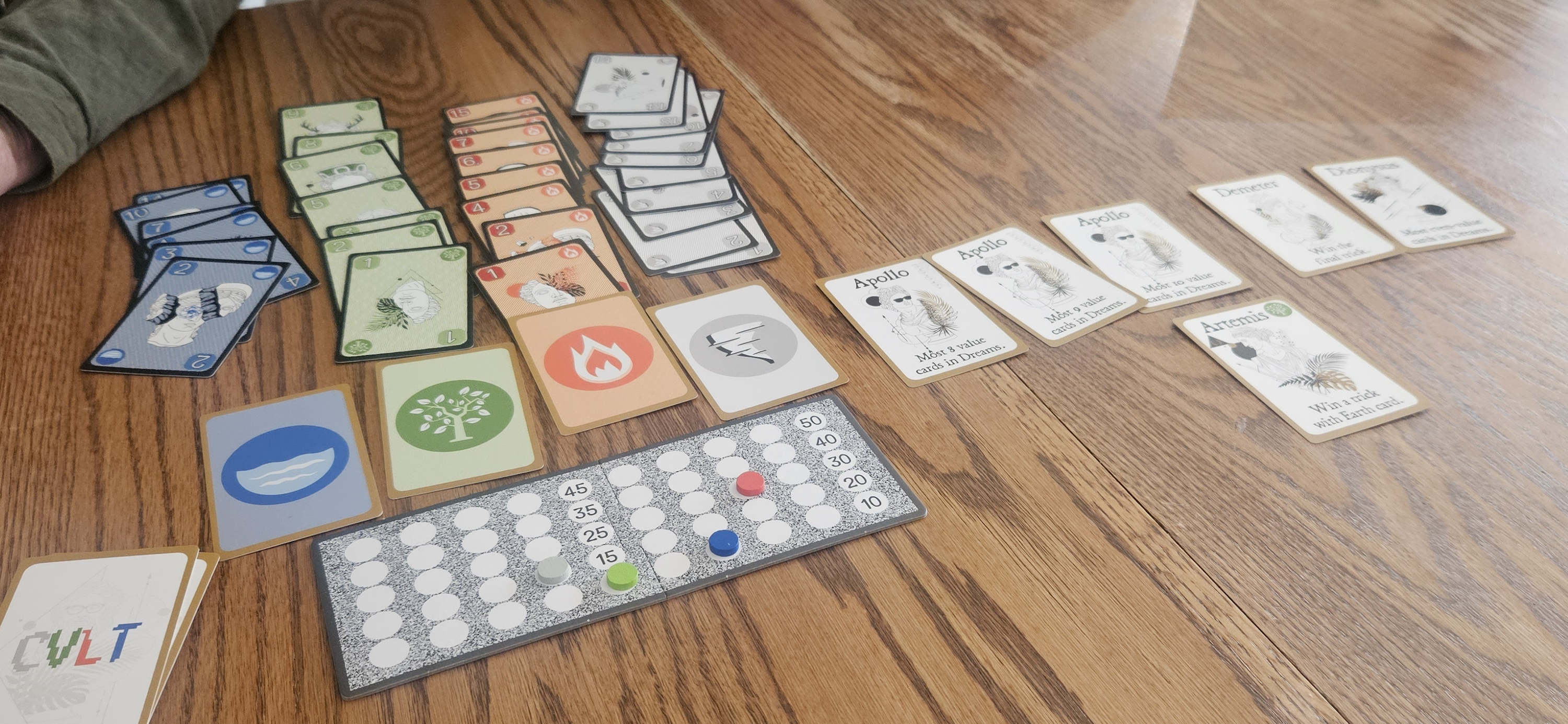
Runaway cvlt leaders.
That, in a nutshell, is CVLT. It’s a smart trick-taker that mostly plays it straight, but knows when to bend away from the norm. It takes a few hands to come to terms with how everything matters, the relative value of a vision versus an offering versus a dream, but it comes together to produce a truly devious take on the genre. It doesn’t say much about cults, and indeed probably couldn’t offer a single insufferable opinion on whether a cult is just a religion that’s gotten big enough to legally own property, but that’s beside the point. I’d rather ruin a dinner party by pulling this from my pocket.
A complimentary copy of CVLT was provided by the publisher.
(If what I’m doing at Space-Biff! is valuable to you in some way, please consider dropping by my Patreon campaign or Ko-fi. Right now, supporters can read my second-quarter update!)
Posted on July 15, 2025, in Board Game and tagged Board Games, CVLT, Long Tail Games. Bookmark the permalink. Leave a comment.

 SPACE-BIFF!
Leave a comment
Comments 0