Better to Live Under Robber Barons

Barony feels old. When we first played the new Royal Edition, my mind automatically sorted it into the early 2000s. It fits the period. The feudal setting. The perfect information. The simple rules. Even the emphasis on direct conflict. This is what Eurogames once resembled, before the endless recombination of systems into recursive engines and checklists of scoring criteria. Before everybody decided to chase that Vital Lacerda money.
But Barony is not old. Not that old. Marc André designed this thing a mere decade ago, in 2015. That’s a year after he gave us Splendor! The same year Trickerion: Legends of Illusion hit the scene!
As a not-quite-throwback, Barony is an interesting case study. In some ways it’s refreshing; in others, it’s mired in sensibilities the hobby has largely left behind.
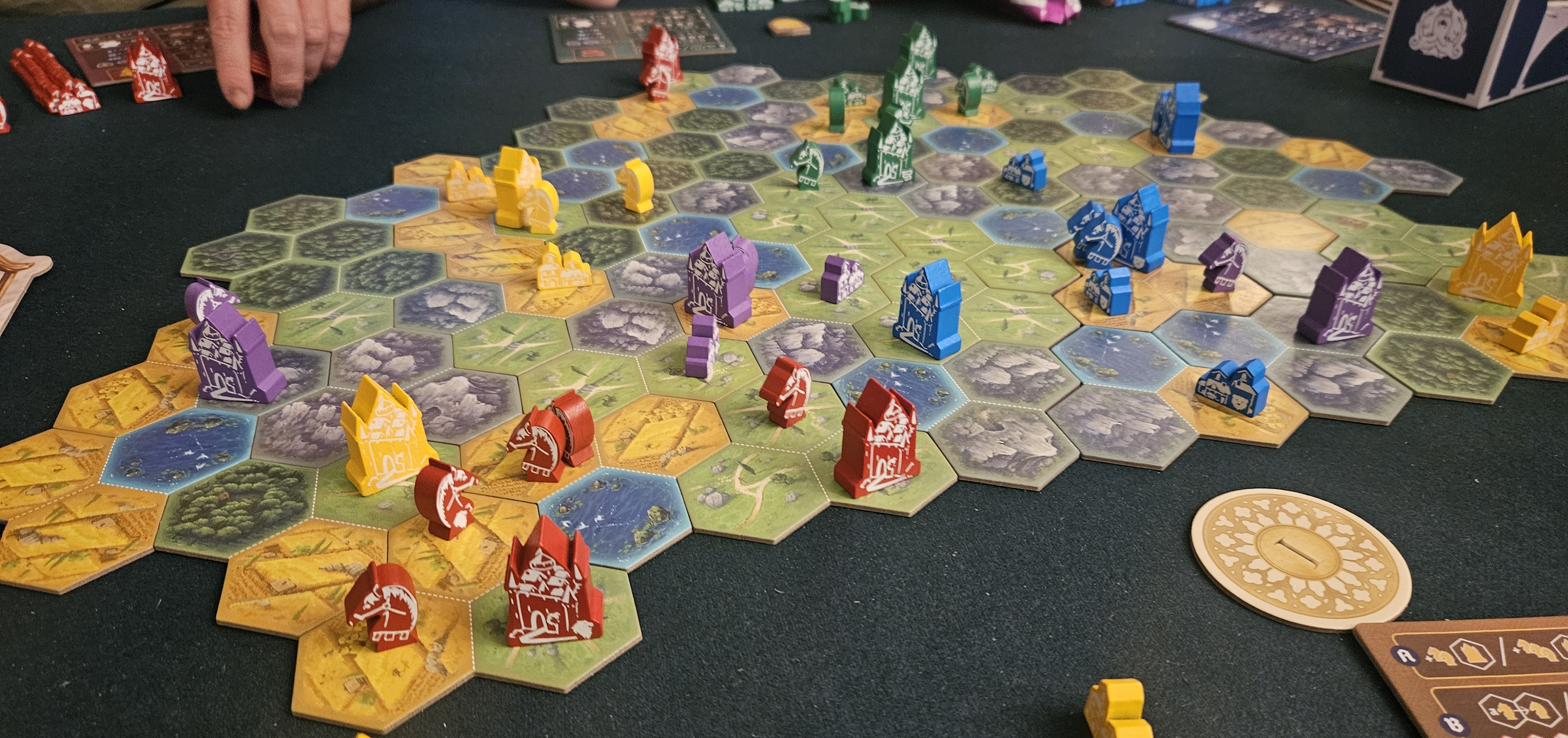
Surely this feudal system will not result in pointless squabbles.
Welcome to Feudal Europe. As a knight in the service of the king, you and a handful of others have been tasked with settling an otherwise pristine landscape. “Pristine” as in “devoid of human habitation.” Hoo boy, we’re really ripping through the Classic Eurogame checklist! Anyway, your objective is to send knights to the realm’s richest tracts, found towns and cities, and gradually exchange your wealth for noble titles.
Barony lives and dies by its transparency. Apart from the plans concealed in your rivals’ noggins, everything is laid bare. The game opens with a snake draft where everybody settles three cities, each accompanied by a knight. The movements of these knights across the forests and hills are plainly visible, as are the resources you gather when they transform into towns.
And these resources are key. Your overarching objective is to level up your title from knight to baron, earned by spending fifteen resources a pop. Some, like those earned from fields or grasslands, are richer than the meager produce of mountains and forests. Ranking up might be as efficient as swapping in three field tokens or as wonky as cobbling together a tithe gleaned from two grasslands, a forest, and a pair of mountains.
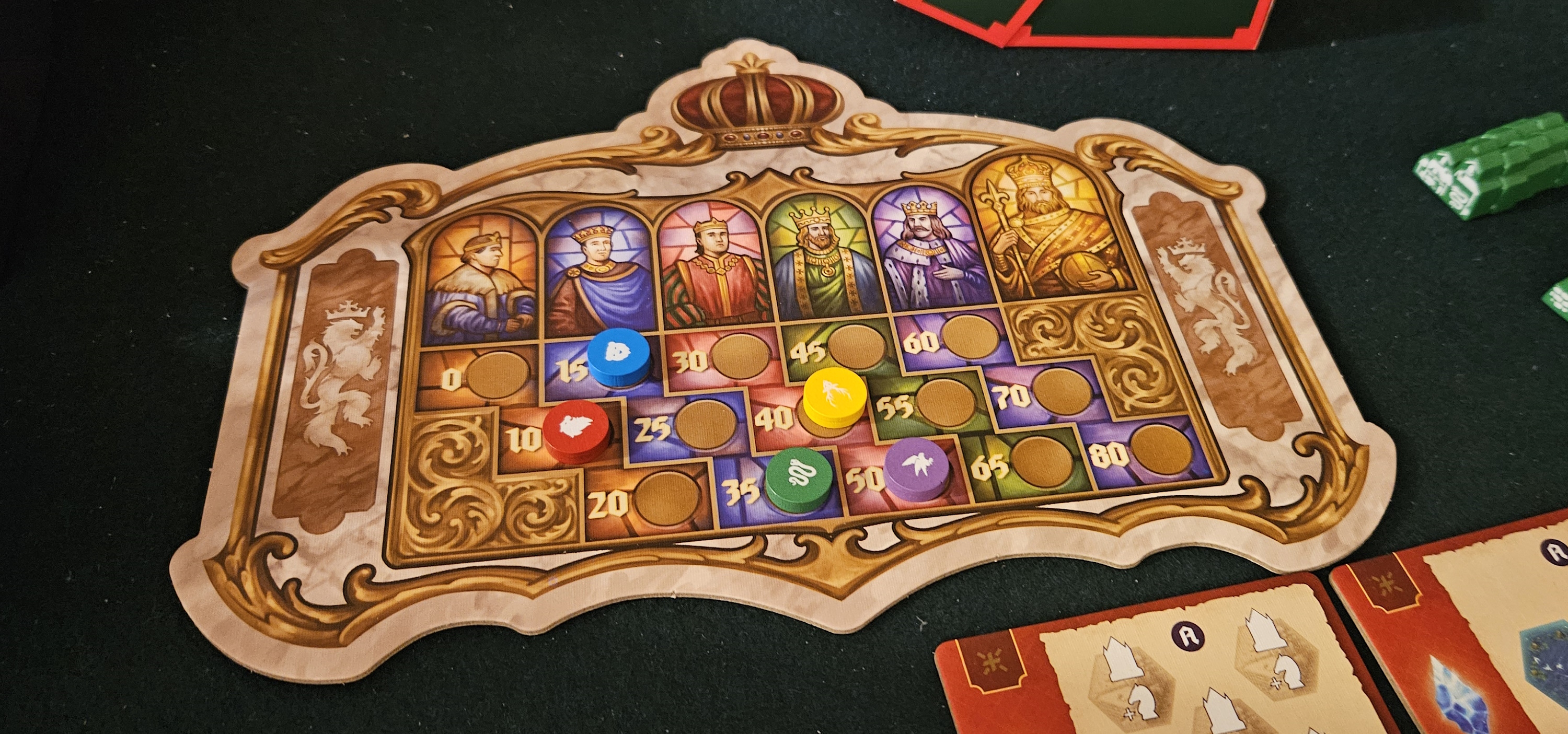
Above all, the scoring in Barony is a race.
This matters, too, because efficiency is crucial. You’re only permitted one action per turn — Barony is entirely free of the tendency to permit two actions to become a sequence of free activities that leave other players asking for confirmation that everything was strictly legal. Want to move knights? You get two moves, that’s it, period. Pay tribute to the king? One rank at a time, if you please.
The big exception is found in founding settlements. As long as you have knights out in the world, you can found as many as you like, swapping out the knights for towns and collecting the corresponding resource tokens. But this is more laden than it sounds! The longer you take moving knights to tantalizing destinations, the more time your foes have to position their knights nearby. Barony doesn’t have combat so much as sackings. If ever one of your knights or villages is caught by two opposing knights, that’s goodbye to your stuff. In the case of a village, they also get to steal one of your hard-earned resources.
The tone this produces is specific, both an economic race fueled by optimization, fertile soil, and carefully guarded mountain passes, and a spiteful series of escalations. It isn’t difficult to secure your territory — a single knight in a village will prevent enemies from trampling your serfs, and strongholds and cities are both inviolable — but such defenses often represent a stark opportunity cost. You can only field so many knights, which makes billeting even two or three of them onerous. Cities and strongholds are strictly piece-limited as well. The topography of the map must be considered; in some cases, a single stronghold might secure an entire avenue of approach, while a pair of knights terrorizes a broad swath of rival land. Barony requires a distinct frame of mind, one that’s less concerned with the flashier aspects of warfare than on the ways a small number of pieces can inflict sweeping costs to a foe’s maneuverability.
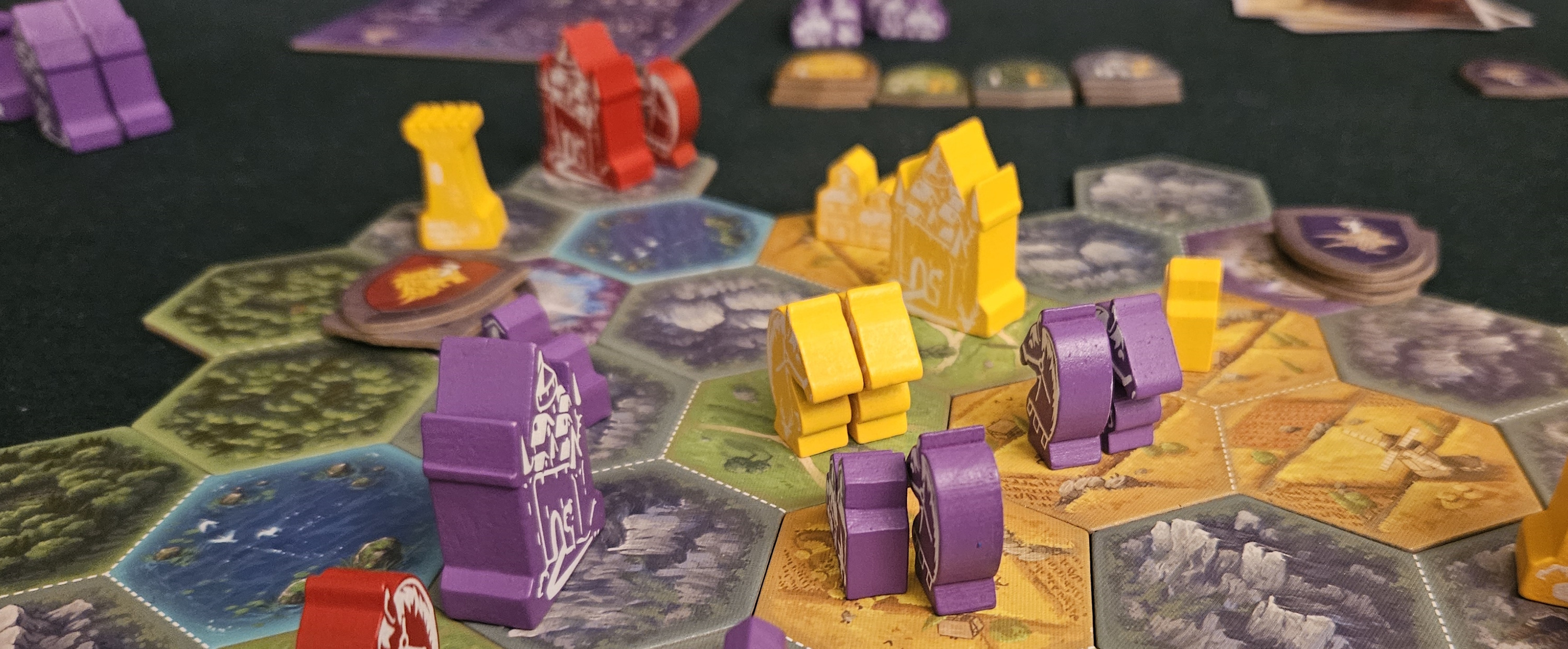
Trapped cities and circling knights.
This, too, comes at a cost. Barony’s timbre can strike the modern ear amiss. When everybody does the heads-down thing, focusing on the optimization of their own lands, the game simply doesn’t work, becoming little more than a race to gather and trade in tokens.
But that, it should be noted, is not how Barony is meant to be played. As a plaything, the game grows smarter along with its players. Certain actions, like one that lets you permanently sacrifice a knight in order to place another knight somewhere along the board’s edge, can seem fruitless at first. In terms of efficiency, losing access to one of only seven knights is a real drag! The danger this poses to a rival, however, ought to be the headline. Cities and strongholds might be invincible, but Barony strips away the usual map-edge immunity. Moving even a single knight onto a foe’s otherwise secure swaths of farmland can force them into a scramble. Such a move is still inefficient, economically speaking. But socially? As a foil to an over-ripe rival? As a war pick, ready to be levered into the eye-hole of your enemy’s helmet? In those terms, it’s a keen tool in any potentate’s arsenal.
That might give the impression that Barony is heavy on the combat. It really isn’t. Rather, it’s heavy on the threat of pillage. Sometimes those threats work, sometimes they don’t. In one case, my daughter moved a pair of knights the long way around my defensive cordon to where I was planning to settle some farmland. At the last second, I transformed a knight into a stronghold, blocking her passage and erasing multiple turns of effort. Whoops. But in another instance, a friend positioned two knights on my hinterland and began methodically eradicating a line of ill-defended villages. That time, my only recourse was to hurriedly send my resources to the king and then delay further production until the there were no more villages in the area for him to ransack. At least my so-called friend wouldn’t eat the fruits of my labors.

Magic is interesting but also raises new problems.
If this sounds both promising and frustrating, it most decidedly is. The experience Barony produces is delicate, prone to setbacks and runaway leaders and situations where the eventual winner is whomever didn’t get mired in petty revenge or back-and-forth exchanges between demesnes.
Much of the time, those dynamics are precisely the draw. Even when its antics didn’t quite land for me, the appeal is obvious. Barony resembles an earlier (and much simpler) version of Christophe Boelinger’s Rise & Fall, to such a degree that I wouldn’t be surprised to learn that Boelinger had drawn inspiration from André’s creation. Both games are thick with perfect information, absence of randomness, actions that become increasingly effective as more of the corresponding pieces are positioned in advance, threats that resemble overtures more than outright combat, and rough reversals of fortune. Failures and successes alike cascade like snowballs rolling down a mountainside.
It isn’t all rosy, and not only because Barony’s appeal feels so alien to the modern tabletop landscape. The new Royal Edition includes a module that adds magic, and while I appreciate its efforts to shake up the formula, it mostly serves to force players into predictable bottlenecks in the game’s earliest stages. The gist is that there are a handful of special actions that must be paid for with magical crystals. To acquire said crystals, your knights must visit desolate locations of the map. The first to explore these hexes receives three crystals, second place earns only two, and so forth.
The problem is that this narrows the early game’s decision space to a tightrope. Rather than deciding between recruitment or rushing to secure good terrain, now it behooves everybody to beeline to as many crystal-producing sites as possible, lest they be left out of the selection of special actions altogether. The module adds variety, but at the expense of a more constricted early game. Two steps forward, two steps back.

Rushing the valuable spots.
On the whole, Barony calls to mind Rise & Fall in one other way. Namely, while I appreciate its accomplishments in the abstract, I don’t actually find it all that pleasant to navigate. While I don’t mind perfect information or zero randomness, I do miss the uncertainty that rolled dice or flipped cards can add to an area control game. Barony is too straight for my tastes.
Still, the appeal is there. Provided everybody comes to the table with their teeth on edge, Barony’s sessions are tight and competitive. It feels older than it really is, but not entirely in a bad way. This is what Eurogames once looked like, full of tight little competitions and plenty of aggression. It isn’t quite a classic Knizia, but it has that cutting edge.
A complimentary copy of Barony was provided by the publisher.
(If what I’m doing at Space-Biff! is valuable to you in some way, please consider dropping by my Patreon campaign or Ko-fi. Right now, supporters can read my second-quarter update!)
Posted on July 9, 2025, in Board Game and tagged Barony, Board Games, Grail Games. Bookmark the permalink. 2 Comments.

 SPACE-BIFF!
Instead of comparing Barony to other area control games, how do you feel about it when viewed through the lens of a two player abstract game? Mentally I always categorized this with games like Santorini, including the questionable value of 3 or 4 player modes.
For what it’s worth, I enjoy Barony a lot and most players I have introduced it to also liked it. I actually haven’t played it at 2, only 3 or 4, which both felt excellent. But then I tend towards Kniziaesque games with simple rules, high interactivity, and potential depth. I didn’t feel the need to get the new edition though and was not interested in the magic stuff. Good to know I didn’t miss too much (except maybe slightly improved components and graphics).