Trick-Taking Tranche
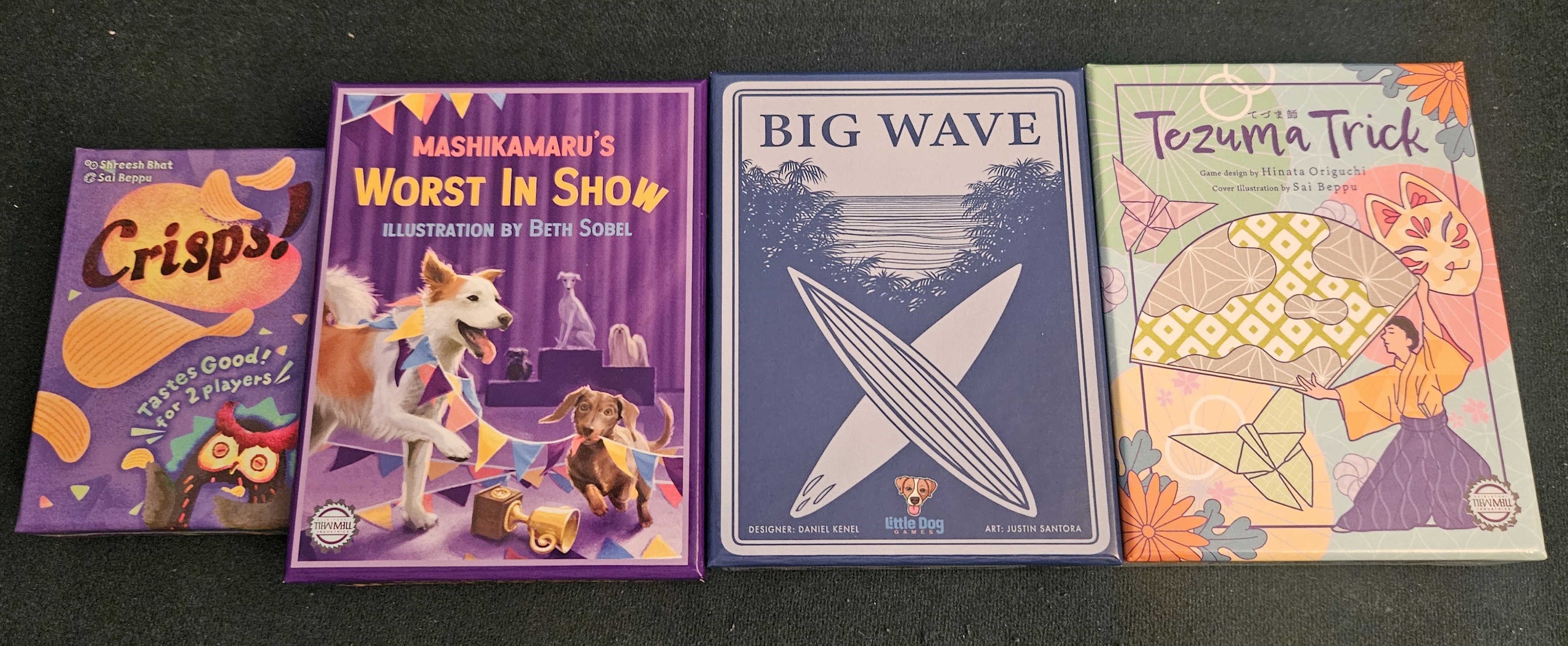
All I play anymore is trick-taking games. Or at least that’s the case when I receive another tranche of the things from New Mill Industries. There are four this time around — five, actually, although I wasn’t sent the last one for some reason — and I’ve gotta say, there’s not a stinker in the bunch. Let’s figure out which is the best of the pack.
Crisps? Chips? Dehydrated processed potato forma?
Crisps!
Ah, crisps. That’s a word some people use to describe potato chips. Such as Pringles, which are not legally permitted to be considered potato chips. Is that an urban legend? Who can say.
Crisps!, on the other hand, is a ladder-climbing and shedding game by Shreesh Bhat, whose Aurum we appreciated a couple years back. This is the slenderest of the set’s offerings, only requiring two players and around fifteen minutes. And while this flavor of card game is notorious for using settings as tinsel, it somehow captures the compulsion of popping just one more of those salty potato-things into your mouth.
At its baseline, Crisps! doesn’t seem all that different from other exemplars of the ladder-climbing genre. I play a meld, you either make a better version of the same meld or you go out. Back and forth we go, waging little contests of tempo until somebody wins. Yeah. Basic.
Good thing Bhat knows how to flip a card. Here there are two wrinkles — nay, ruffles — that give Crisps! its salty savor.

To flip or flap? Tis the question.
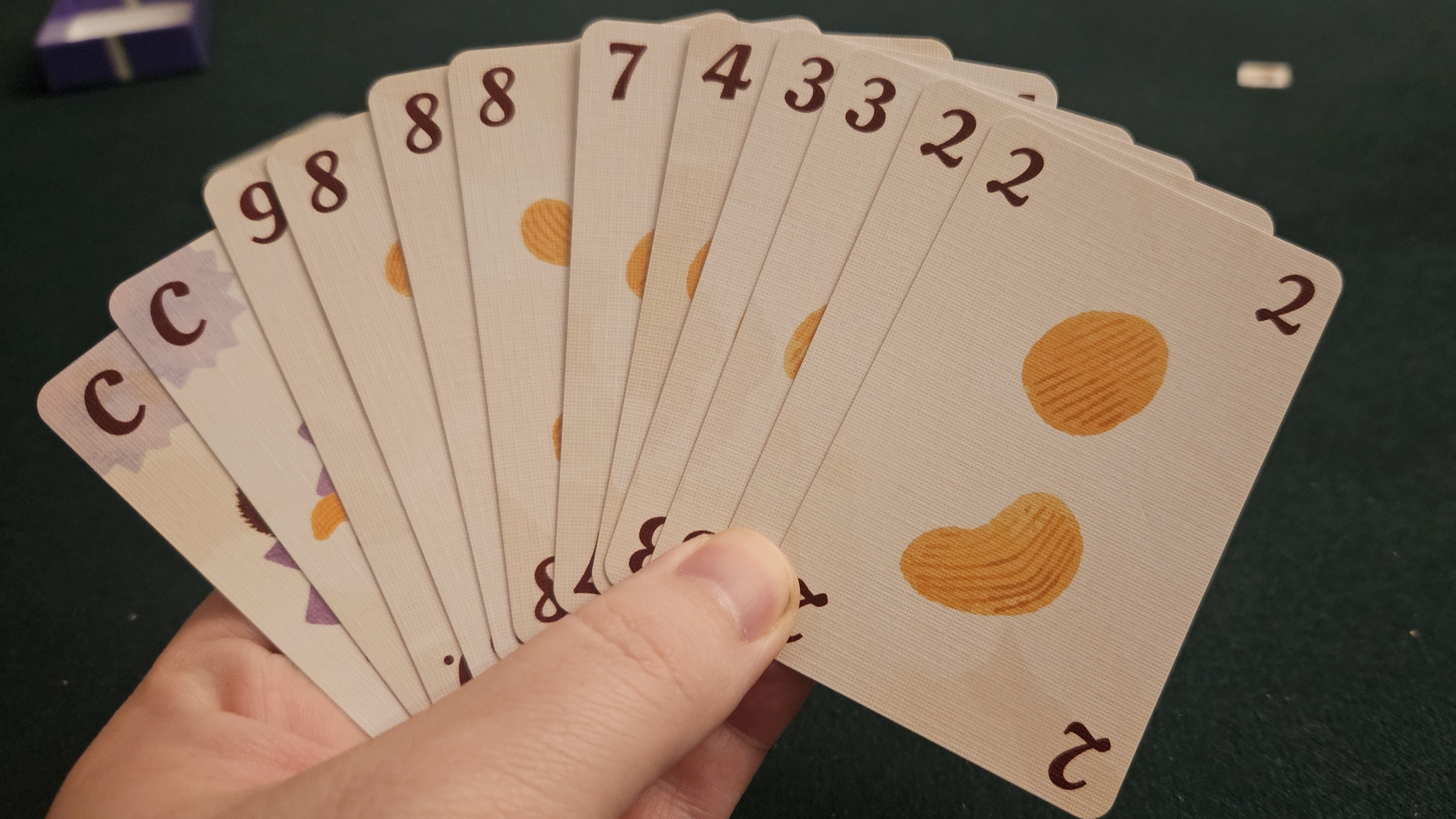
The first is a special rank, labeled C, which is technically the highest rank but struggles to slot into other melds. Because C is a letter and not a number, it can’t be used in runs, but serves well in singles or sets. Remember the old axiom: If you’re holding two C’s, you’re the bee’s knees.
Except C-ranks are a double-edged sword. Under normal circumstances, you’re only allowed to react to a meld with a similar meld. If you play a set of two, I’m required to play an identical or better set of two. That is, until those C’s get involved. This lets me shake up the formula by swapping to a more powerful combo. Every C, then, not only stands for “crisp” and “cracking,” but also “caustic.” Yes, I’m running out of good C words.
The second ruffle is that each contest concludes with both players receiving a card from the deck. There are two to choose from, a face-up card and the concealed one atop the deck. The conqueror of the current combo chooses cardinally, culling the choice to the contrasting card for their challenger. It’s a crunchy conundrum, either cushioning your collection or giving your cheeks a cruel, uh, cicking.
Okay, enough of that. Here’s the protein. Crisps! is a minor climber/shedder, but that’s also what I like about it. Two players, a few minutes, there you go. Meanwhile, Bhat’s ruffles are just enough for these flattened potato products to scoop some extra dressing. It’s the smallest offering of the entire set, but it’s also my personal favorite.

Note the divider.
Worst in Show
In terms of adorableness, Worst in Show is hard to beat. Here are its vital stats: three to five, must-follow, great danes are triumphs. And if the previous sentence didn’t hit your ear amiss, you might be playing too many trick-takers.
The idea behind Worst in Show is certainly a worthy one. You’re a dog trainer who’s reached the final stages of a protracted dog show, only the pups have had it up to their wet noses with behaving all high and mighty. Now they’re frolicking. Just making a mess. Living their best lives.
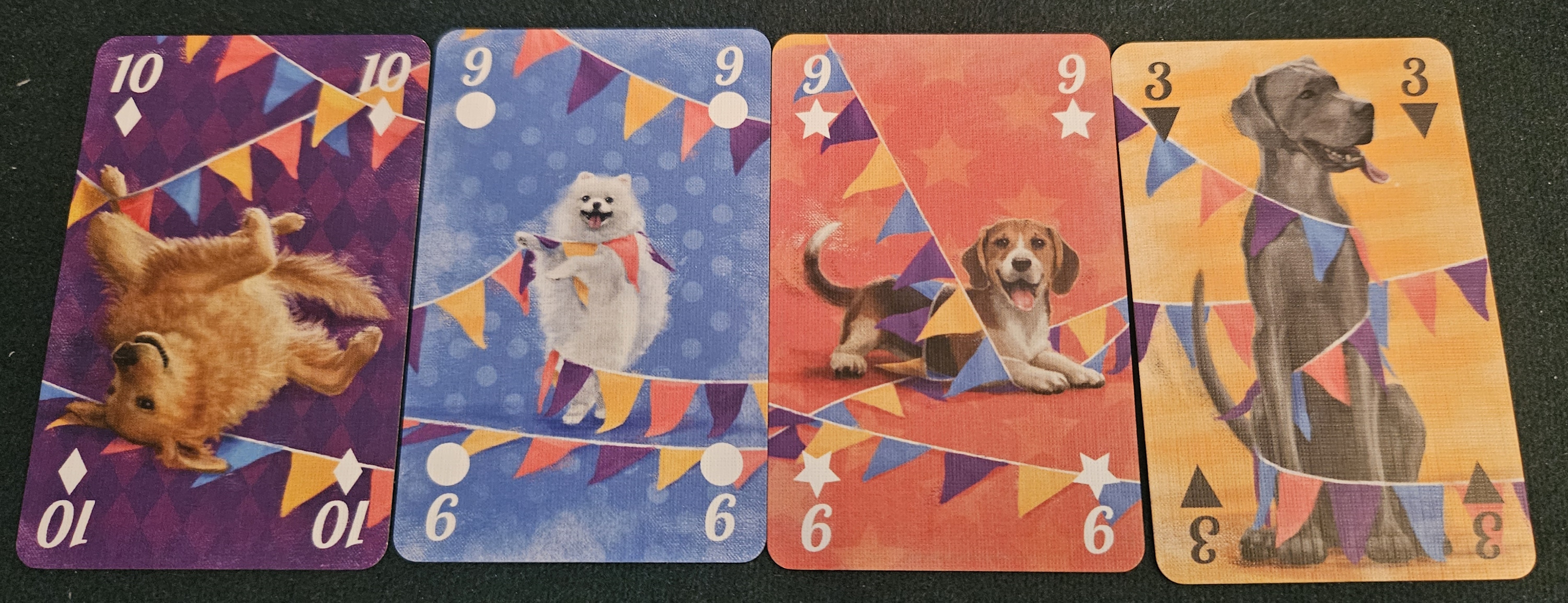
To appropriate the previous game’s term, Mashikamaru tosses in one heck of a ruffle. When you receive your hand, you’re not permitted to rearrange the thing. Yes, like in Scout, although the similarities end there. This time around, you slip a divider card into your hand. The number of cards to the right of this divider is your bid, the number of tricks you hope to take / persuade your punch-drunk doggos to perform this round.
But it’s more than that. The placement of your divider also separates your behaving canines from the misbehaving ones. During play, the cards to the left function more or less as normal. Must-follow and all that. The usual stuff.
In some cases, though, there are advantages to misbehaving. Provided you could follow, you’re instead allowed to play a dog from the right side of your divider. Because this dog is misbehaving, it can be anything — any rank, and more importantly any suit. This gives you some command over your cards. A limited degree of command, to be sure; again, you can only misbehave if you could have followed with something from the left side of your hand. But it lets you shake up the usual proceedings, not to mention throws aspersions on the genre’s card-counting tendencies.
They’re good pups. Even when they’re naughty.
That’s still not all. The divider not only sets your bid, not only even establishes which dogs are (mis)behaving. It also offers a second path to scoring. Because, sure, meeting your bid is valuable. Coming close to your bid even awards a pity-point. But the real bonus comes from clearing your misbehaving cards.
Crucially, this isn’t as simple as being the sternest disciplinarian. Clearing out those misbehaving cards scores a point, provided you’re the first to do it. But the best awards go to those who eliminate misbehavior in the middle of the pack — second in a three-player game or third with four or five players. Thematically, there’s some idea that you’re letting your pups blow off some steam before getting back to the competition. Too little and their pent-up energy flubs the show. Too much and they’ll still be rowdy. Something like that.
This transforms Worst in Show into a real brain-melter. Choosing where to stick that divider card is a big deal, pulling triple-duty as your bid, your special actions, and the pool of misbehavior you need to clear. It’s tough! Maybe too tough for me. Certainly too tough for my mother-in-law, the witting victim of all the trick-takers I get sent. It’s an interesting concept, but also a tough one to grok, eschewing the precision the genre tends to demand.
In other words, Worst in Show is way too good for a “worst in set” joke, but it’s right there. So I’ll pluck that apricot. Worst in Show is the weakest of a strong tranche of trick-takers.
Which beach to surf?
Big Wave
Daniel Kenel is another designer we’ve covered before. Remember Gnaughty Gnomes? I do. I do indeed.
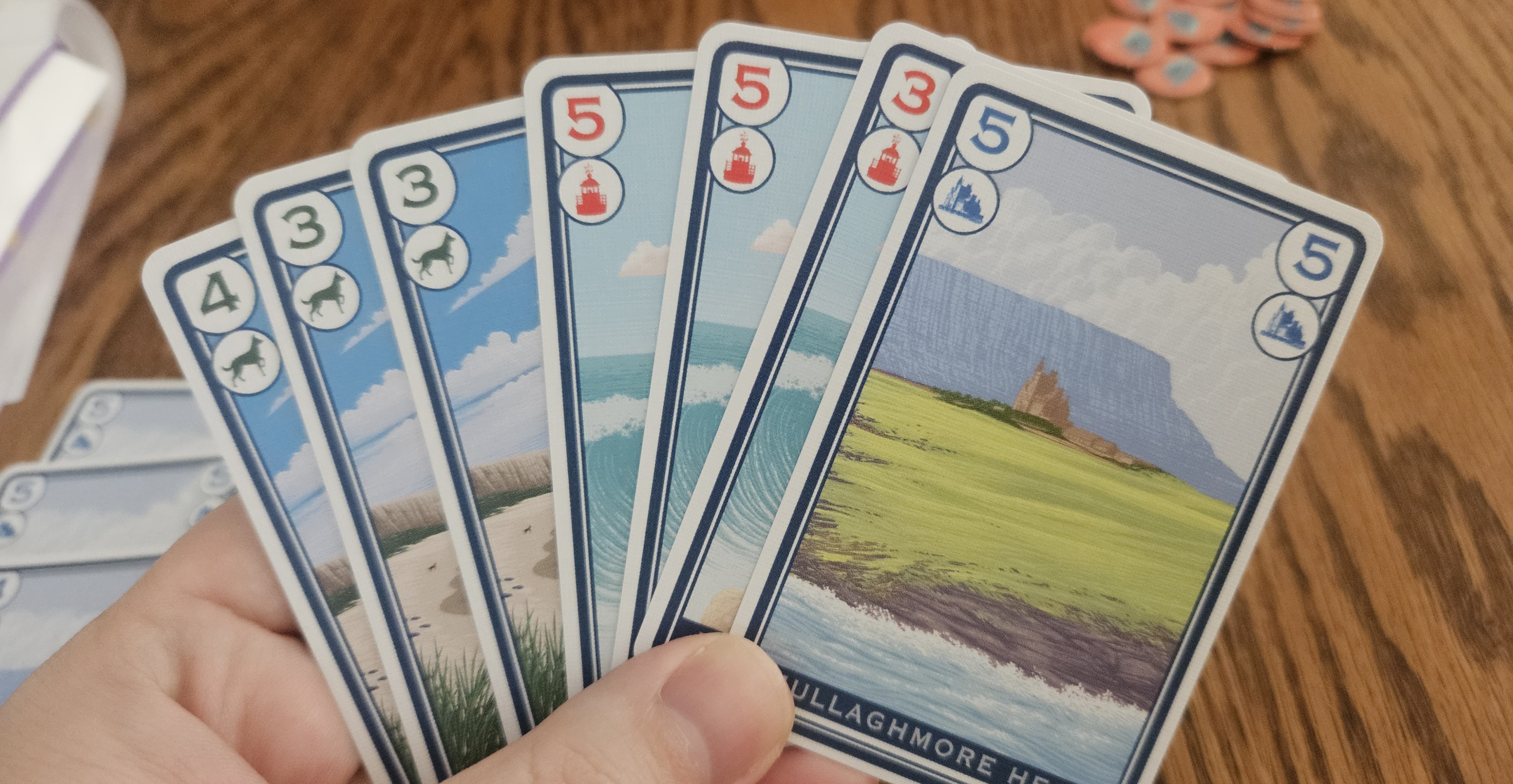
Big Wave plays the fiddle straighter than that one, although not by much. In contrast to the others in this set, Big Wave is a must-not-follow tricker. With only four suits, rather nicely illustrated by Justin Santora as various surfing destinations, this tends to place a burden on the last player. “What can I play, again?” isn’t an uncommon question. The same goes for tiebreakers. This is thanks to the game’s pyramid distribution of ranks, with lots of 1s and fewer and fewer as we step upward. “Do we break ties to first-played or last-played?” will be asked. The answer is first-played. Even knowing that, however, individual tricks tend to be somewhat more cumbersome than usual, as you’re required to establish the relative position of every player at the table, not only the trick’s winner.
But there’s a reason for that! The winner of the trick takes their winning card and dumps it into their scoring pile. Well done, you! Only, this is where the decisions begin. Starting with the lowest-ranked player, everybody chooses a special action. Some of these hone your hand, either letting you grab a card played into this past trick or drawing two from the deck. Another awards a bonus point and lets you select the next trick’s leader — and let it be known that picking the player to your left is a super strong move. The last one grants a token that affords a +2 to a future card. That’s a big deal, the high rank being a 5 and all.

The scoring track is always in flux. Usually in flux.
Meanwhile, the value of the cards in your scoring pile is always on the move. Winning suits move up the scoring track, potentially earning four points a pop, or as little as only one. This produces some big swings, especially in the last few tricks of any given hand.
The decision space is solid. Building a better hand is a must, turning those card-honing choices into real contenders. Then again, grabbing some of those +2 tokens to turn the momentum in your favor at a key moment is also a good idea. But also, you want to control the player order, since going last is incredibly potent. When you can’t play anything into a trick, your surfer “chills out” by dumping any card at all into their scoring pile. In a sense, you’re riding the wave of everyone else’s victories.
What makes Big Wave special, then, is that there are plenty of ways to get ahead, but no easy answers about which approach will net the most points. Sure, each trick takes a little longer than I would prefer to resolve, what with all the relative ranking and everybody but the winner having to select one of those bonus actions. In practice, I don’t mind. It’s a slower trick-taker, that’s true, but it’s also a thoughtful one, with lots of room to position yourself for a big break. For larger groups, this is probably the coolest of the bunch.

Big stonkin’ draft.
Tezuma Trick
Tezuma Trick wins the award for offering the most intimidating selection. Fortunately, it’s easier to grok than Worst in Show.
We’ve seen this designer before. Hinata Origuchi previously gave us Seven Prophecies, a game with scoring that didn’t win me over. Tezuma Trick gets points for presenting its rubric in a more straightforward manner. You place a bid and earn points. Breezy. Right?
Only in this case, your bid is drafted. As is everything, really. Not your actual hand cards — let’s not go crazy here. But once you’ve seen your hand, everyone at the table partakes of a snake draft to determine three things:
(1) Your bid. Sometimes this will offer a range of numbers, each with their own point valuation. Other times you’ll have to hit a more singular target — say, five claimed tricks exactly — or you score nothing. Ouch! Better draft this first.
(2) Your pain suit. Every card you claim in this suit will be worth a negative point. Depending on the composition of your hand, with triumphs in various suits or high ranks, it’s entirely possible that you’ll be facing more negative points than you can claim from any bid. Ouch! Better draft this first.
(3) Your special power for the round. Want to declare who leads the next trick? Win triumphs no matter which suit has been led? Win a trick outright? There are heaps of powers to choose from, some of which eclipse others or can swing the entire hand into your favor. Ouch! Better draft this first.

Okay, not too big.
The real meat of Tezuma Trick lies in the draft itself, a sequence of bite-sized morsels that threaten to be either malnourishing or too much to swallow. Everything you claim offers pain points elsewhere, letting a spiteful player draft something that was essential to your particular combo. It also functions as an early tell, leaking information all over the table like sticky icing. If somebody nabs a bid that rewards points for only taking a few tricks, why not grab the power that all but guarantees they win more often? The whole thing is loaded with hippo-caliber nastiness.
At the same time, those decisions don’t prove too overwhelming, especially after a hand or two. There’s some interesting stuff going on with Origuchi’s triumph cards. Rather than there being a single triumph suit, every suit has its own triumphs that only trigger when they’re played against the led suit. This manifests little irregularities where nobody can be quite sure who will swoop in and claim any given trick, and defrays the strength of drawing half a hand of triumphs. Here, they’re given just enough of a counterweight that it isn’t possible to bank on any given card working in your favor.
The result falls onto that slender walkway between too much and not enough. Tezuma Trick is perhaps the smartest option in the set. And while it doesn’t strike my fancy quite as thoroughly as Big Wave or Crisps!, it’s a title I’m keen to continue exploring.
Complimentary copies of Crisps!, Worst in Show, Big Wave, and Tezuma Trick were provided by the publisher.
(If what I’m doing at Space-Biff! is valuable to you in some way, please consider dropping by my Patreon campaign or Ko-fi. Right now, supporters can read the first part in my series on fun, games, art, and play!)
Posted on July 2, 2025, in Board Game and tagged Big Wave, Board Games, Crisps!, Little Dog Games, New Mill Industries, Tezuma Trick, Worst in Show. Bookmark the permalink. Leave a comment.

 SPACE-BIFF!
Leave a comment
Comments 0