Wet Behind the Gills

Over the past year or so, my eleven-year-old daughter Cate and I have tried a handful of campaign adventure games. By far her favorite — our favorite — has been Tidal Blades 2: Rise of the Unfolders by Tim and Ben Eisner.
Not that Tidal Blades 2 is without its peculiarities. It’s an odd duck, a sprawling cooperative campaign that’s also a sequel to a game that was not, apparently, itself a sprawling cooperative campaign, set in a far-future world where fish and crocodiles are sentient bipeds, axolotls live in hive-mind communion with trans-dimensional beings, and a big old time warp called the Fold sits over the flash-frozen husk of a nearby civilization. The Fold, by the way, is what your heroes will be unfolding. Not, say, their little sister’s origami.
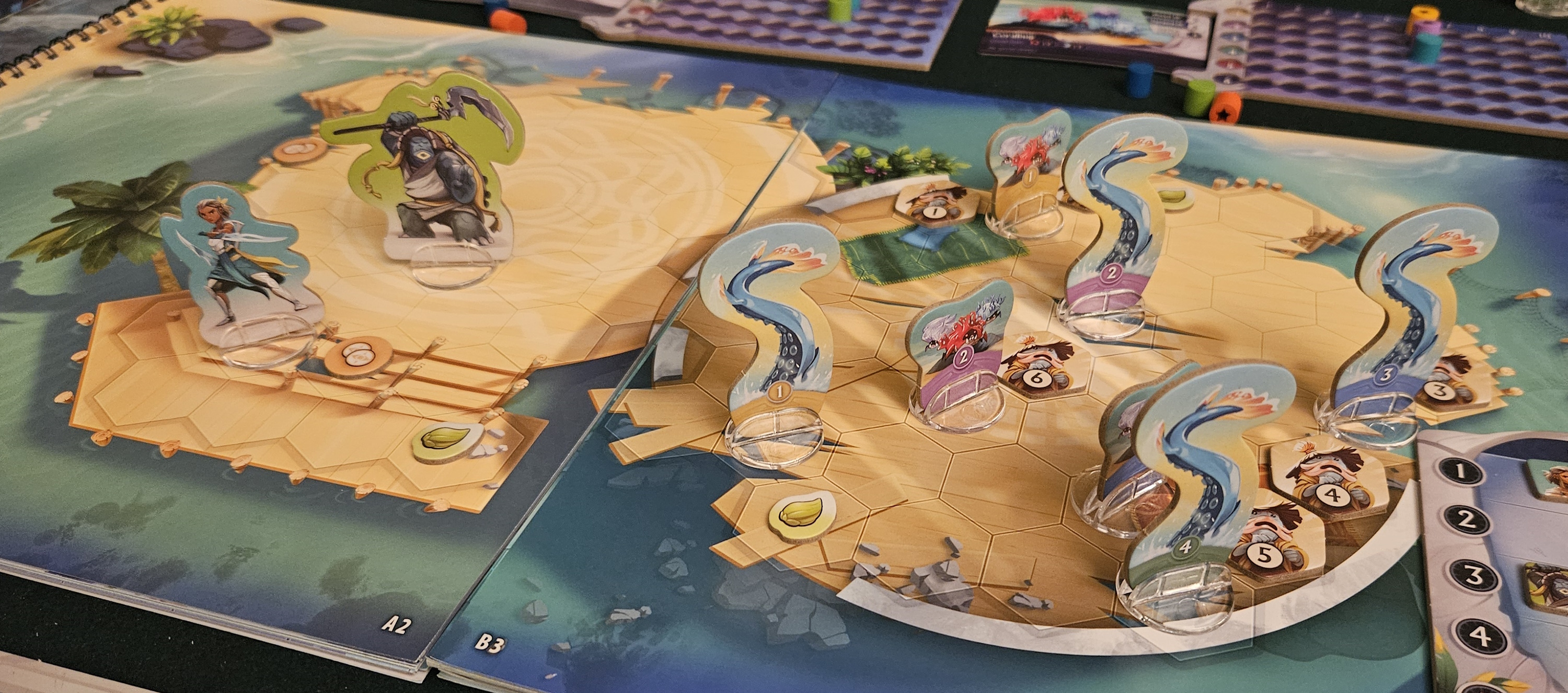
I already prefer standees to miniatures. These ones are especially pretty.
Right away, the world of Tidal Blades sets itself apart as unusually vibrant. Its central destination is Naviri, an archipelago city bustling with moored ships, suspended bridges, and floating citadels. Like any fantasy city, the usual barnacles have attached themselves to the hull, smugglers and villains crusting the edges, but its ordinary denizens are so chipper and bright, that unique mixture of helpful and helpless, that it’s hard to stay detached. When some bubbling mer-person asks for help renovating their house before it tumbles into the brine, the game’s encounter card permits players the illusion of choice. But, really, are you going to turn down the chance to lend a hand to an adorable fishdude?
Your heroes, meanwhile, are the titular Tidal Blades, freshly minted guardians who are here to replace the previous cadre, all of whom disappeared fifteen years prior when they necessarily deployed the Fold over the previous city to stop its outpouring of mutated beasts. Your squad carries the scars of that displacement. There’s the kid whose mother went missing that day, the crusty old turtle (neither ninja nor mutant nor teenager) who was left behind when his fellow Blades were Folded, the lizard who… well, better not spoil anything. Even the reformed crime-syndicate croc and upstart desert rat are keen to prove themselves in a world recovering from the trauma of such a loss.
Which is to say, there’s an unexpected but worthwhile friction between the brightness and optimism of the setting, its marketplaces and schools, the affability of its dwellers, and the tragedy they suffered within living memory and the obvious precarity of their survival. Naviri sits in sight of the Fold, almost in its shadow, its white orb and whistling storms calling to mind one of those underwater atom bomb tests that dwarfed nearby warships with their enormity. Tidal Blades 2 is about reckoning with a world gone wrong, but it never succumbs to despair.
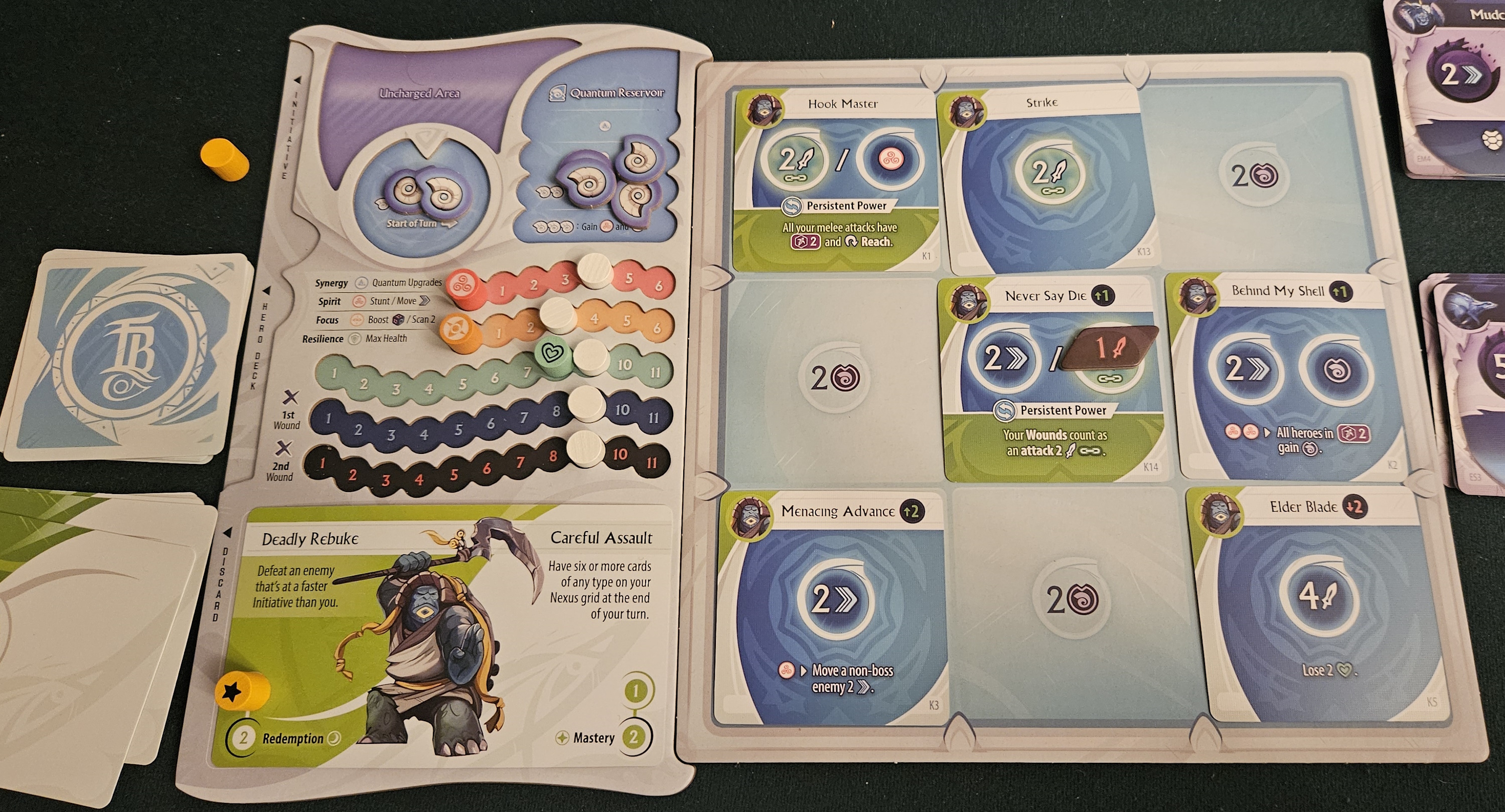
The grid system is clever and generates a strong tempo to your actions.
Speaking of despair, it’s hard to avoid comparisons to other adventure campaign games, in particular Kevin Wilson’s Kinfire Chronicles. Indeed, the similarities are so pronounced that my daughter, when requesting a session of Tidal Blades, almost invariably asked if we could play Kinfire. The plucky cast empowered as avatars of elite power, the city under siege, even the framework that sees your heroes bouncing between spiral-bound battles and segments of urban exploration, all feel like they’re working from a similar template.
This makes their departures all the more pronounced. Where Kinfire Chronicles bordered on despair and gradually wearied us of its setting, it was rare for us to not hurry into the next session of Tidal Blades, eager to see how our crew would disentangle themselves from their current scrap. The writing isn’t amazing; Naviri is as awash in adverbs as in seawater, and the Eisners seem to be under the impression that describing something twice is the same as describing it evocatively. But the characters! The sense of place! The intrigue! Where Cate and I often found ourselves forgetting the who’s who of Kinfire, the cast of Tidal Blades 2 was always easy to recall. Maybe it helps that they hail from so many different species. Either way, this in turn kept us grounded in the story. It’s tropey as all hell, but the kiddo gasped in shock once or twice, and even this jaded old fart was charmed by its earnestness.
Which makes it all the more surprising that Tidal Blades 2 is the more tangled game. Setup takes a fair while. Components are spread across a dozen bags and decks. Combat has its peccadilloes. But these complexities, while fiddly, give rise to gameplay that’s textured and exciting, asking players to plan but also adapt to changing circumstances. Battles are poised halfway between martial undertakings and dance routines.
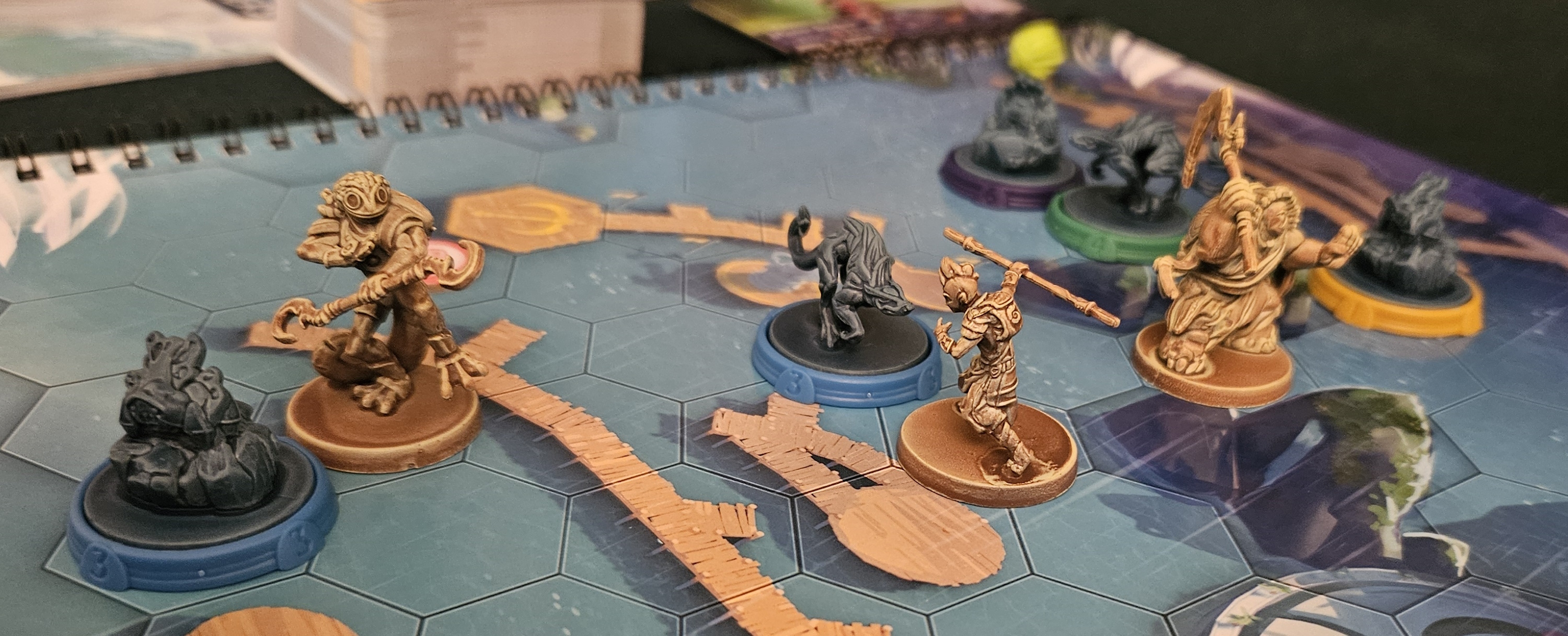
My eleven-year-old, however, has been mesmerized by the miniatures. (Not included in the base game.)
The fundamental building block of these encounters is the matrix system, a three-by-three grid for holding your combat cards. Each turn sees everybody decide on which card they will deploy, determining where everybody winds up in initiative order. From there, each card is placed in its owner’s grid, activating its entire row or column.
This produces a wonderful sense of tempo. One card on its own doesn’t offer much, resulting in minor turns where you move or attack, rarely both, and maybe gain some minor advantage from the icons printed on the grid itself. But as cards accrue, your turns become larger and more bombastic. Some attacks chain together, resulting in crippling strikes against armored foes; others see your hero darting to the next flashpoint or tumbling out of danger. There’s a healthy variety of verbs to consider. Your Tidal Blades can attack and move, of course, but there are also shields to maintain, quantum reservoirs that can be depleted to trigger rerolls, pools of both spirit and focus that allow extra movement or squeeze greater damage from a flubbed roll, and more besides. The effect is pronounced. Individual cards offer distinct moves; together they flow into balletic sequences that are more than the sum of their parts.
Later, once a whole row or column has triggered, its cards are swept away. This drops the tempo back to baseline. Or it can. There’s nothing stopping you from arranging your cards to produce two crescendos one after the other, or gradually metering your cards so that you’ve always triggering two at a time, until your matrix is so crowded that you have no choice but to crash against your opponents. The result is a system that borders on abstract, not to mention cluttered with its combination of dice and card activation, but never quite tips over the edge. It’s expressive without being too open-ended, limited to competing concerns of initiative and timing, but not as hidebound or complex as the card system of Gloomhaven.

Shades of Gloomhaven for only a fraction of the upkeep.
That same texture extends to every other corner of Tidal Blades 2. Leveling up your character, for instance. There are experience points, but also fruit that can be plucked during battle and either gobbled for a boost to your hit points or saved as currency. There’s fame, your cast’s overall measure of success, and two skill lines that trigger when you meet private objectives during missions. Oh, and the arrangement of the deck you drag into each battle is never far from your thoughts. Gaining or pruning cards is often the most time-consuming portion of the interludes that send your heroes scampering through the city.
Again, it’s a lot, but it also feels more reactive than most games of this stripe. More than once, I was pleasantly surprised by how mine my character had grown to feel. My items? Selected to shore up my weaknesses and paid for with fruit I gleaned during battle. My deck? Painstakingly carved into wholeness one card at a time. I won’t spoil where the game takes your characters, but they develop along other lines too, some of them transformative in their own right.
Best of all, none of this would matter but for the game’s utterly exceptional scenario design. Once again, the Eisners imbue their maps with character, color, and most importantly a wide-ranging verbiage. In the game’s early stages, I worried it would soon grow stale, reducing the campaign to a chore. There was no cause for worry. Before long our heroes were leaping between towering pillars, creeping into nests to swipe eggs, rewiring a prison’s circuitry and hoping we opened the right cells, battling a two-ton jellyfish while anchoring ourselves among a twin waterfall’s currents, bypassing spectral defenses, thumping holy beasts on the nose while doing our darnedest to not actually slay them, picking our way through overgrown mazes, and weathering time-lapsing citadels. These scenarios are wildly inventive, always a treat to uncover, and sometimes even leverage the limitations of the medium to their advantage.
More than that, they’re often funny. In one case, Cate howled with laughter as my turtle warrior was carried away on a stampeding caravan, forcing him to waddle back to the main formation, only to be borne away the very next turn. Later, when a scenario instructed us to rotate one of the map books again, once more rendering the battlefield from a new perspective and splitting apart our duo, we groan-laughed and set to work trying to fix this new quandary.

Punch that jiggler!
There are only so many superlatives I can heap on Tidal Blades 2. Of all its many details, though, perhaps the most telling is that I’m contemplating a second playthrough.
Every night Cate and I would play, her younger sister would emerge from her room, bounding on tiptoes so her mother wouldn’t hear. She would crawl onto my lap, unpack the character she had chosen for herself, and declare that, when she turns six, she will join us in our fight to save the fish-city. She would point to the spots on the map where she intends to move, talk about the cards in half-comprehending terms, pore over the items and speculate about the function of all those little icons. She plans to play as the tiny axolotl warrior. She even insisted we purchase an axolotl stuffy, pink and frilled, as a rite of preparation.
I think we’ll do it. When she’s old enough — I’m not so sure about six — this will become the first campaign that’s good enough, clever enough, creative enough to warrant a second visit. There will be three of us instead of only two. The game will adjust its monsters and mutants to match our reinforced complement. And our Tidal Blades, our little heroes, wet behind the ear or gills or whatever breathing organ we rely on, will unfold its challenges one more time. I can’t wait.
Complimentary copies of Tidal Blades 2: Rise of the Unfolders, the miniatures set, and the hardback RPG book, which I have not played but my children insist we will be thoroughly exploring, were all provided by the publisher.
(If what I’m doing at Space-Biff! is valuable to you in some way, please consider dropping by my Patreon campaign or Ko-fi. Right now, supporters can read the first part in my series on fun, games, art, and play!)
Posted on June 10, 2025, in Board Game and tagged Board Games, Druid City Games, Tidal Blades 2: Rise of the Unfolders. Bookmark the permalink. 10 Comments.

 SPACE-BIFF!
You touched on all the points that ‘carried’ us through the campaign. The variety of scenarios and the art—the colours, the scenery—it is just so refreshing. We played 2-player and have already agreed on repeating with different characters. It was such a joy; great to see our experience reflected here too.
Nice! I’m happy to hear it was a positive experience for you as well.
This sounds fantastic, and if I wasn’t already backlogged on campaign games (that is: in the middle of one and planning one next, leaving me booked likely until 2027) I’d be hovering over that buy button.
One distracting note, from the alt text: “…a whole lot less summing two initiative numbers.” Is that still in reference to gloomhaven? If so, either my group had that game’s initiative system wrong, or you did.
(And lest that sounds like raw pedantry — it really doesn’t matter to me if you got that rule wrong! I’m just curious; I like to hear about rules mistakes; it makes me better at teaching games.)
I’m almost certainly misremembering. Don’t mind me. And doubly don’t mind the alt-texts!
This piece and many others you’ve wrote on hobby games you’ve played with your own children outside the usual Target faire makes me think it would be great if you had an ongoing/evolving piece of games you found to be really fun with your kids at different ages. Even as just an index like the GOTY posts to point to previous blogs. As my own children start to age in the wake of your own, I know I’d be searching your blog anyways with various ages to figure out what’s actually good! Great reading as always!
That’s a good idea! I’ll have to noodle with what it might look like. I was thinking of writing a piece on our favorite summer games, just something short and listy to highlight what we’re playing on the picnic table. But I also like the idea of an evolving or more regular piece. Thanks for dropping a note in the suggestion box!
Pingback: Skyblivionrockmarsh | SPACE-BIFF!
Pingback: Summer Ludens | SPACE-BIFF!
Pingback: Best Week 2025! All My Children! | SPACE-BIFF!