Opera Is Danger
Last year’s The Battle of Versailles was a revelation, treating the world of high fashion as seriously as combat, and in the process teaching me something about an art form I’d always regarded as frivolous.
Here’s a piece of good news: apparently Versailles did so well that it’s now the basis for an entire series. For its first sequel, The Battle of the Divas by Albert Reyes, the topic is opera, a form I’ve never considered frivolous so much as impenetrable. But in Reyes’ hands, the lifelong feud between Maria Callas and Renata Tebaldi becomes gripping, a tale of self-mastery, success and setback, and hitting those high notes.
Also cattiness. So much cattiness. It’s good that Divas is leaning into what made Versailles so playable.

A view from the balcony.
Indeed, cattiness seems to be the order of the day, the first of many thematic threads between Versailles and Divas. Even the layout on the table is similar, with Reyes swapping the catwalk for a sequence of opera houses, crossing the globe from Milan to Buenos Aires, each of which soon becomes a battlefield between Callas and Tebaldi as they vie to become to most renowned soprano of their time.
It isn’t long before Divas reveals itself to be the more complex, dare I say cluttered, of the two. It takes a couples of sessions before the spotlight reaches that critical warmth. After my first play, I was ready to write it off. It wasn’t until my third session that its subtleties brought me around on this particular rivalry. In a way, that marks it as both similar and dissimilar to Versailles, which is more immediately comprehensible but at times also off-putting, seeming lost in its own world rather grounded in a reality we mortals might share with these artistes.
To wit, Callas and Tebaldi initially seem cold, just as the gameplay seems diffuse and unfocused. Turns are phasey in a way that those in Versailles were not, requiring multiple steps, any one of which is likely to prove underwhelming in any given turn. It takes some degree of mastery, even practice, to string together those far-flung notes.
Let me illustrate by walking you through the steps.
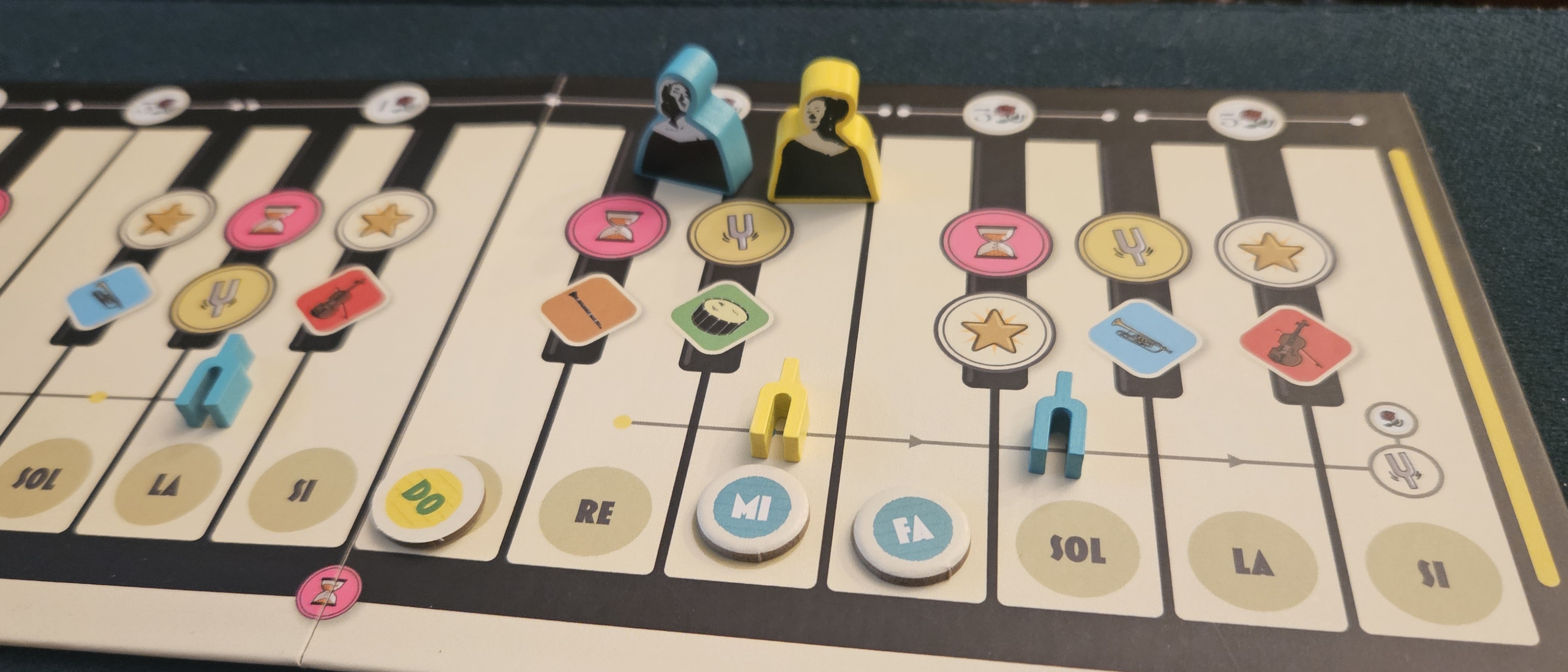
Your divas tune their vocal cords on the piano.
The defining portion of every turn requires your diva to play a card to one of those four opera houses. Depending on the card’s icons, this may nudge the opera in your favor, scoring applause that brings you ever closer to declaring yourself the mistress of that particular piece.
But that’s not all. The notes on your selected card — ranging from one to four — also determine how far you can move on the piano. This tracks a few things, notably your diva’s vocal tessitura, the range of notes she can comfortably sing. If you happen to land your pawn within your tessitura, you get to place a note on that key.
But that’s not all. Now your diva also gets to use one of the black keys next to where she landed. There aren’t as many actions as the icons would indicate — four of them are the same action mapped to the different opera houses — and most of them are simple enough to execute, such as those that expand your tessitura or fame.
The others, though, might produce yet another step. Performing an opera allows you to move one of those piano notes down to the opera itself, provided a match is available, further increasing your applause. The final option involves playing a card to the timeline. We’ll talk about the timeline in a bit.
Taken on their own, none of these steps are egregious. Added together, they’re as complex as any chord. You’re looking to play a card that will match its icons to both an opera house and the opera being performed within, move you the necessary number of keys on the piano to hit the right notes and activate the right actions, and then spend those notes in the indicated opera house. On rare occasions everything will line up, producing a monster of a turn that returns rapturous applause, wows audiences with your range, and instills despair in your rival. More often, at least one of those steps will land like a wet note in the middle of the crescendo.

Jostling to master each opera.
This is to be expected, and while it’s more persnickety than anything in The Battle of Versailles, it also speaks to the athleticism required by these performers, the sheer physical control needed to hit every note in its proper order and pitch.
Not to mention their barbed interactions. It’s a rare move that doesn’t inspire some spite on your opponent’s behalf. Keys on the piano can be blocked. Notes can be stolen. An opera that seemed clinched for Callas might transform into a tour de force for Tebaldi. When scored, operas award points to both divas depending on their level of applause, making it worthwhile to sneak in a few claps of your own even when you aren’t going to win. In those moments you’re piggybacking on your rival’s success. It feels tremendous.
And then there’s the timeline. Cards don’t only raise applause and dictate your moves on the piano. They also represent events from both divas’ lives, presenting a playful tessitura of successes, setbacks, acquaintances, and sometimes tragedies. When deployed to the timeline, these are always placed from left to right, creating a linear sequence. The hitch is that each event also bears a year. At the final tally, only properly ordered cards will score. This adds yet another dimension to the game, incentivizing your diva to leverage her fame to reorder events to her liking.
It’s a clever system. Depending on how many cards are played, it can also create quite the lineup, a mess of events that wraps around the edge of the table, some of which will be nigh impossible to reorder.

The timeline can become somewhat finicky, especially in the game’s latter stages.
But the timeline is also The Battle of the Divas at its most thoughtful, presenting these women’s lives as a series of flashbacks. Some cards, such as acquaintances, only score when placed next to an event — one in its correct sequence, I should add — lending to acts of sabotage as one diva divorces you from a friend. When your opponent drives a wedge between you and Grace Kelly, it hurts not only your score, but your pride as well.
Other events might hurt your rival, snatching away her notes or even stealing her applause outright. Afterwards, these occurrences become hers to reorder and profit from. What was once a terrible trial, strained vocal cords or the death of a loved one, might transform into a challenge that was overcome, a bittersweet memory that still speaks to the wholeness of this person as they reminisce on a life well lived.
In this way, Reyes carves out a unique identity for his game. The Battle of Versailles excelled at emphasizing the relevance of high fashion, its ability to inspire national pride and spark creativity. Reyes does something similar with The Battle of the Divas, emphasizing the monumental nature of mid-century opera. But by expanding the scope of Callas and Tebaldi’s rivalry, he also focuses his lens on the nature of feuds, both their highs, as these women pace one another to greater success, and lows, as one another’s triumphs undermine their happiness. It’s a remarkably complete vision, or can be, depending on how the game shakes out.

The cards cover two entire lifetimes of tragedy and triumph.
In that sense, the timeline is a microcosm of The Battle of the Divas itself, sometimes complex but also textured, capable of being manipulated but not always easily, and unusually thoughtful for a card-driven “war” game. While it doesn’t achieve quite the same impact that The Battle of Versailles did, this represents a worthy sequel, seriously investigating another cultural battle with grace and style.
A prototype copy of The Battle of the Divas was provided by the publisher.
(If what I’m doing at Space-Biff! is valuable to you in some way, please consider dropping by my Patreon campaign or Ko-fi. Right now, supporters can read the first part in my series on fun, games, art, and play!)
Posted on June 4, 2025, in Board Game and tagged Board Games, Salt & Pepper Games, The Battle of the Divas. Bookmark the permalink. 3 Comments.

 SPACE-BIFF!
Another design on a fascinating subject, but it’s a totally unequal contest. Where acting, singing, and charisma was concerned, Callas totally triumphed. Now Callas vs Price would be something!
I will defer to your obviously greater knowledge on the subject!
Listen, any awareness of this outdated, archaic art form is good awareness, I suppose.