That Wizard Came from the Moon

Fabio! Lopiano! Truly, he has the most pronounceable name in the entire hobby. I’m something of a provisional fan, after being impressed with Merv but mixed on Autobahn and Sankoré, both of which proved too overwrought for their own good. Shackleton Base, which Lopiano co-designed with Nestore Mangone, finds the pair back in stride. It’s complex but not too tangled, indulges in the occasional digression but never loses focus, and above all takes us to a semi-plausible moon colony that feels absolutely great to bang into working shape.

Down in the crater.
The Moon! Pardon me if I accidentally call it Mars. Heaven knows I’ve done that once or twice (or a dozen times) per teach. You would think the gray regolith would provide a clue, but that’s me, old Dan, the only person in the world with red-gray colorblindness.
Right off the bat, Shackleton Base produces a plausible approach to lunar colonization. As players, we represent national entities, the USA, Canada, Japan, and Europe, working in concert to found an international base in Shackleton Crater, the real-life impact site on the southern lunar pole. This goes some distance to explaining some of the game’s placement rules; only one installation per player in each hex, for instance, or the installation’s frustrating energy-rationing that sees some players erecting solar panels only for everybody to mooch off their efforts. This is, it turns out, an international effort, but that doesn’t mean everybody is pulling the same weight.
Much of our work, meanwhile, is being underwritten by corporations. This has been a significant part of the game’s marketing, that every session will feature three of seven possible different corps. We’ll return to those in a moment, but it’s worthwhile to keep their presence in the back of your mind, threatening to thin your air’s oxygen content if you don’t make your rents on time. Ahem.
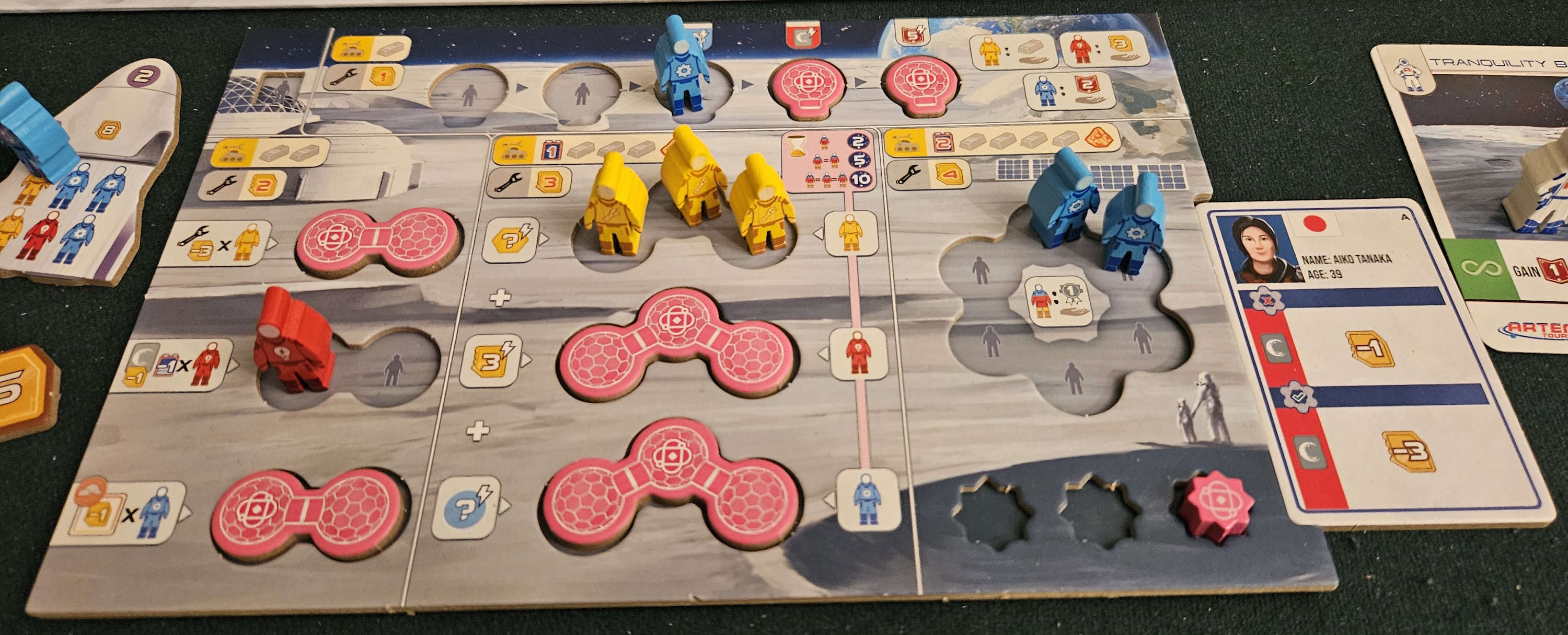
There isn’t time to build everything, so priorities must be made.
The first big plus of Shackleton Base is that Lopiano and Mangone prune back a significant portion of the complexity that marked their previous collaborations. Each turn opens with a straightforward draft, a selection of shuttles filled with astronauts — in three varieties, technicians, engineers, and scientists — and resources — similarly divvied between titanium, rare earth elements, and credits. Everybody picks their shuttle, determines a position in the turn order, and it’s time to go.
From there, the actions are… well, look, it would be overselling this thing to call them “simple.” There are only three actions, but with a big set of doubt-quotes around the “only.” Two of those actions are undemanding enough, sure. There’s exploitation, which sees astronauts ringing the crater to bring home metals, credits, or special corporate goods, depending on whether the deployed astronaut was a technician, engineer, or scientist. It’s redolent of the rows-and-columns stuff from Merv, except this time arrayed on a hex grid, followed by some interesting area majority contests to recruit those astronauts into the employ of whichever player controls the most structures in their assigned row.
The second action is similarly breezy, sending somebody over to the lunar gateway to hire a different astronaut to come work in your base, manning the domes to produce resources, tooling around in workshops to reduce overhead, performing research, or maybe just hobnobbing in your headquarters to produce prestige-boosting TikToks. The main point of confusion for newcomers comes down to the fact that astronauts on your shuttle and astronauts in your base are not the same thing. The former are temp workers, fulfilling their contract and then going their own way. The latter are permanent employees, sticking around your base for the remainder of the game. They look the same, and in some cases the former become the latter, but don’t mingle your shuttle’s astronauts with your base’s astronauts or everybody at the table will start hooting and hollering about what a big fat cheat you are.
But then there’s the third action. Lest you be caught unawares, it is not, in fact, one action. Rather, it’s a trifurcated menu of three sub-actions, each of which may gain some minor bonus if you deploy the right astronaut, but doesn’t kick up a fuss if, say, you send a scientist to oversee the construction of a boring old dome or whatever. Basically, these options come down to “build stuff,” “buy a card,” or “finagle with the corporations.” Plus some extra steps and sideways combo bonuses to placate the Euro Gods.
Good? Good. Now we can move onto the good stuff: placating your corporate overlords.
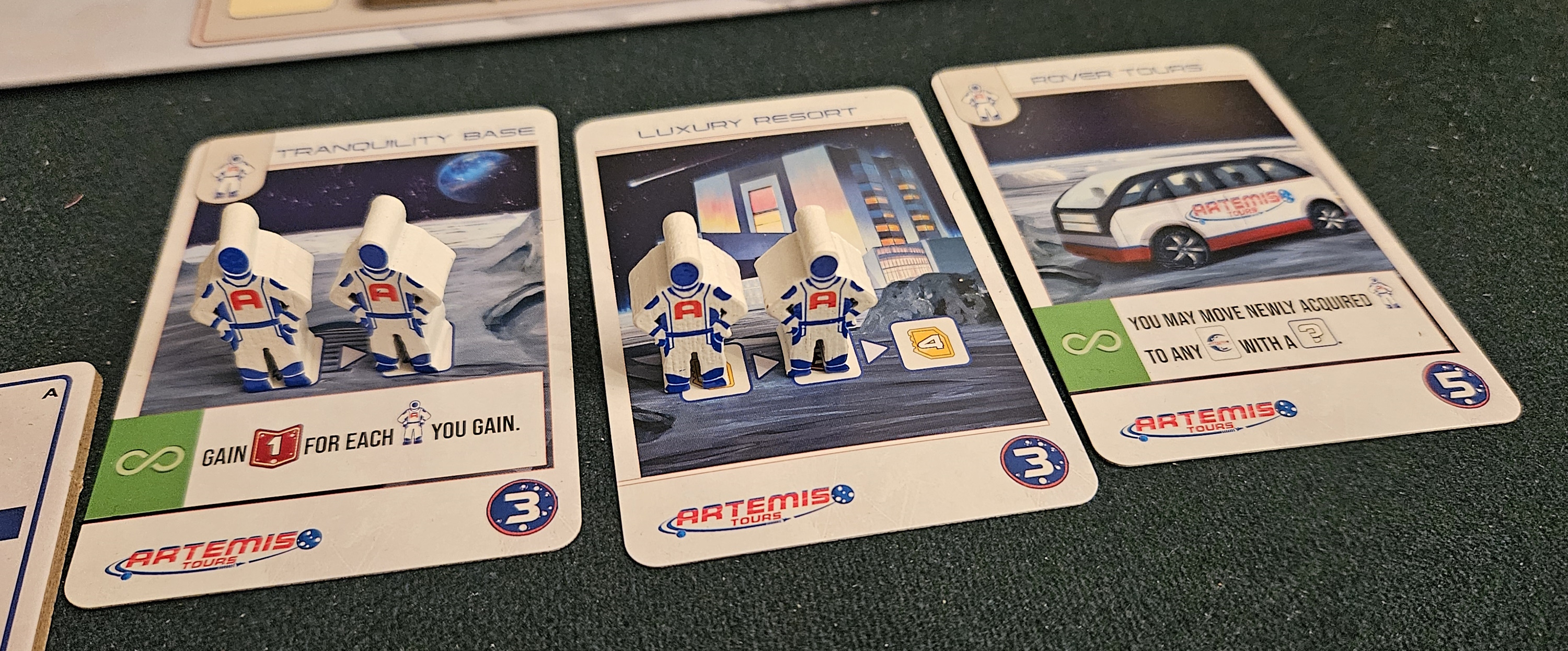
Now you too can have Bezos snub Shatner.
Ahem. Your corporate partners.
Which is to say, Shackleton Base doesn’t seem all that interested in commenting on the depersonalizing effects of corporate sponsorship, but there is a ludic aperçu to be found in the way so much of your score is derived from corporate appeasement rather than actually building a base on the Moon. More than national interests, more than the lunar topography itself, the corporations are Shackleton Base.
There’s been some recent pushback to the notion that variable setups or asymmetry always produce meaningful replayability, and rightly so. Fortunately, Lopiano and Mangone deploy their corporations with a defter touch. Each offers its own twist on the formula, altering not only the backdrop, but the way the game’s wider elements configure with each other.
I’ll give some examples. Perhaps the easiest corporation to interface with is Selenium Research. This, like the rest of the corps, scatters special resource tokens across the crater, all of which can be harvested with scientists. In Selenium’s case, those resources represent lunar samples that can then be turned in as sets in exchange for points and other bonuses. What makes this interesting is that these samples are not generic copies of one another, but rather identify the precise combination of samples that can be gathered. This forces players to carefully consider their placements, both where to erect new structures and where to deploy scientists, adding extra teeth to the already-toothsome contests for control of the crater.
Some of the other corporations do something similar. Evergreen Farms sees everybody setting up greenhouses. These are third-party fabs that belong to nobody in particular, but dish out regular rewards to those who control their lanes. It’s a different sort of control from that posed by Selenium Research, more concerned with long-term contests and last-second takeovers.
But! Other companies might throw a monkey wrench into the works. One module warns that an incoming asteroid could wipe out an entire portion of the crater. Everybody now has the option to invest in Sky Watch, dedicating resources to reveal the asteroid’s path and then, maybe, invest even more to diminish or even cancel the apocalypse. But what happens when it’s revealed that the asteroid will only impact one player’s territory? Moreover, the winner’s territory? Now Shackleton Base takes on a tinge of semi-cooperative gameplay, asking whether it’s worth the effort to save a rival’s structures or leave them to their fate.
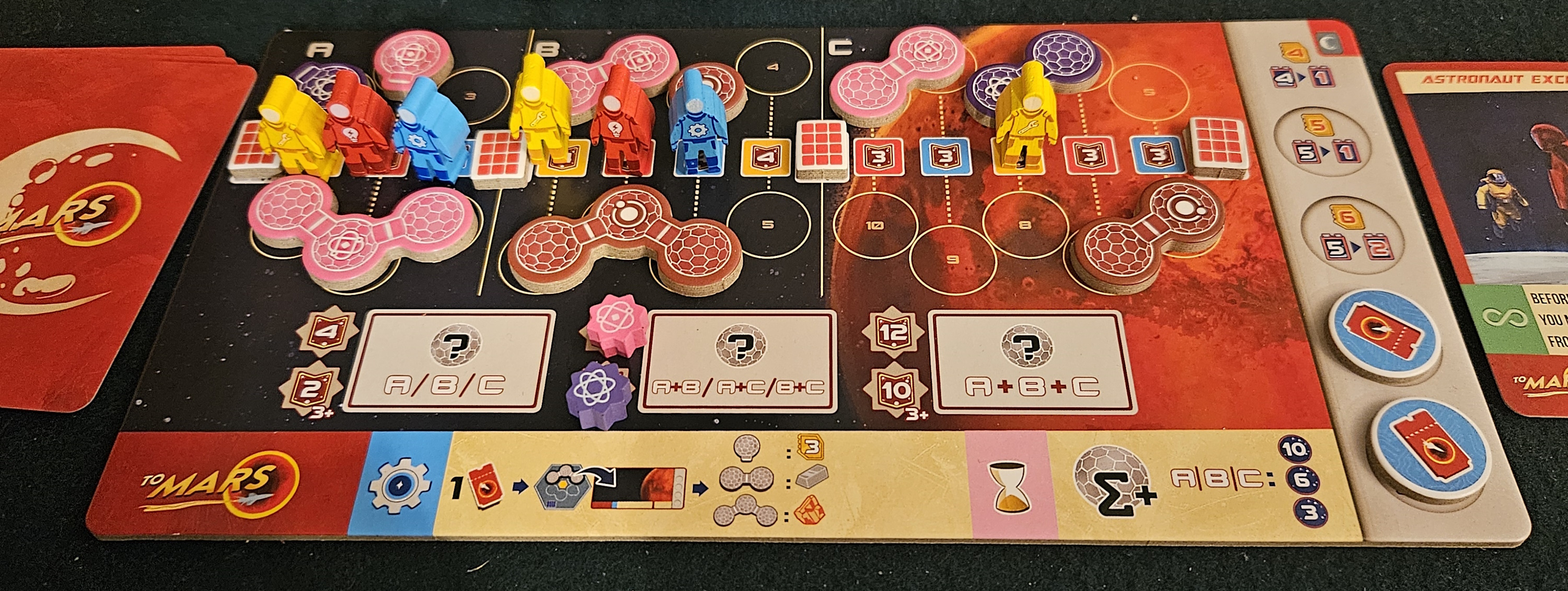
Our Mars ship (mistakes complimentary).
In some cases, your corporate interests might clash — or even conflict outright. In one recent session, we were presented with three sponsors. Early on, the creatively named Moon Mining was the preferred front-runner, letting us ship helium-3 and rare earth elements back home for heaps of points. Meanwhile, Artemis Tours saw everybody building up their infrastructure to squeeze lunar tourists of their hard-earned credits.
Over time, however, we began shipping our modules off-surface to become the framework for a Martian cycler. This altered the landscape. As all those mining operations were repurposed, what had once been a bustling crater slowly decayed into a ghost town. This in turn reshaped the nature of the game’s lane majorities. The result was a reverse arms race, everybody hustling to minimize their investments.
What’s intriguing about Shackleton Base is the way these impulses ping off one another. Building that Martian vessel when there’s no particular ground rush will result in a starkly distinct game from those that see players quibbling over greenhouses. In effect, Lopiano and Mangone have tweaked the incentives that underlie the game itself. But rather than defining them outright or smoothing over any rough patches, they allow those modules to brush fingers or bump elbows as the case may be, and let players sort it out. There’s even a hint of speculation to the proceedings. My instinct is that each corporation is balanced well enough to provide a great many points. But some corporations may struggle when combined with certain peers. Groping through the thicket of those competing interests is the red meat this gray game thrives on.

Feuding over greenhouse rights.
Along the way, there’s plenty of narrative for those who look for such things. (Like this old dope. Me. I. This guy.) The cards carry their identity like those of Terraforming Mars, although here they’re in shorter supply and tend to pack more individual punch. The particulars could be accurate or fantasy, I couldn’t say, but the whole thing feels credible enough, charting the rise and sometimes decline of a lunar colony. My only regret is that I have to leave it so soon — a hell of a thing to say when I’m simultaneously thrilled with the playtime. A full session can easily wrap up in under two hours, provided everybody knows the basics.
In other words, it’s great to see Lopiano and Mangone in such fine form. As I noted up above, Shackleton Base is one of those rare games that can get lost in itself, but never quite loses focus. Even its snake’s hands are an essential part of the whole, leading players along exciting routes that usually produce a few worthwhile heaps of points. This one is highly recommended for those who like their space-packet granola crunchy.
A complimentary copy of Shackleton Base was provided by the publisher.
(If what I’m doing at Space-Biff! is valuable to you in some way, please consider dropping by my Patreon campaign or Ko-fi. Right now, supporters can read the first part in my series on fun, games, art, and play!)
Posted on June 3, 2025, in Board Game and tagged Board Games, Pandasaurus Games, Shackleton Base, Sorry We Are French. Bookmark the permalink. 6 Comments.

 SPACE-BIFF!
What a gem of a game. Bought it since the SUSD review and I’m enjoying it very much. Like you so elegantly said, every game feel different, even if it come from the same framework. I’m quite impressed.
I wasn’t even aware that SUSD had done a review! I’ll have to give it a watch.
“The main point of confusion for newcomers comes down to the fact that astronauts on your shuttle and astronauts in your base are not the same thing.”
And I feel like the rules for this game went through at least three drafts where they called the latter “colonists” before someone finally convinced the authors that It’s Not Cool To Use That Word…
I hadn’t considered that before! It certainly would have been nice to differentiate the two “brands” of astronaut between contractors and permanent colonists.
Pingback: Calimala Olives | SPACE-BIFF!
Pingback: Sun Besties! | SPACE-BIFF!