Boss Cells

I don’t envy the creative team tasked with adapting Dead Cells to cardboard. The video game is all twitch reflexes and light-speed assaults — a state I’ve heard called “submission,” more about submerging oneself within a game’s flow than about responding to any specific stimulus — which isn’t exactly the most conducive mode for taking turns or planning ahead. How does a designer transpose a video game that’s about subordinating one’s consciousness to sheer reactivity into a medium that generally works the other way around?
For the most part, the answer is that Dead Cells: The Board Game doesn’t bother.
Don’t get me wrong, there’s a living spring of talent behind this adaptation, a wundersquad that consists of Antoine Bauza (7 Wonders, Ghost Stories, Oltréé), Corentin Lebrat (Faraway, Draftosaurus), Ludovic Maublanc (Cyclades, Ca$n ‘n Gun$), and Théo Rivière (Sea Salt & Paper, The LOOP). For this collaboration, the squad approaches the original design like a fold-up snowflake, snipping around the edges of the video game for the stuff that’s easily ported to the game table and leaving the rest scattered on the carpet.

Dumpster diving.
For those who aren’t in the know, Dead Cells is about failing, failing, and then failing some more. The video game, which I haven’t played in many years, revolved around a wormy spirit that possessed one decapitated body after another, working its way through dungeons and along ramparts in its efforts to reach and murder… somebody. Look, my memories of the game are probably false at this point. Point is, each body offered a fresh start, beginning the cycle of violence anew.
Roguelike or roguelite, I can’t tell the difference anymore, but Dead Cells was very much one of those games where progress came in contrasting forms. Within the game, enemies dropped “cells” that could be spent on persistent upgrades, offering new tools that made your future attempts all the stabbier. Other upgrades, called runes, also served to open alternate paths forward. Meanwhile, you, the person on the couch playing the game, developed your own skills and judgement, learning how to approach all those enemies and hazards standing between you and your objective.
This is the stuff that Bauza & Squad preserve more or less intact in the board game. Your goal, broadly speaking, is to die well, having earned enough cells to add new cards and blueprints to the mix. Every so often you might unlock a rune, permitting new interactions within the game’s biomes, or opening new starting points altogether.
Progress is slow, incremental, but also tangible. Like many of its kin, death is more than a frustration. It’s a chance to hone your talents, buying the essential upgrades that will make your next run, and the next, and all runs thereafter, all the easier. In some cases, when a run reveals itself as doomed, death might even come as a relief. This body wasn’t working out. Maybe the next one will find a better starting weapon than a sharpened spade.

Combat is all about timing. Just not reactive timing.
The biggest departure from the video game is combat. No surprise there. A faithful adaptation would have dog-eared the game’s cards in short order, resulted in countless paper cuts, and probably started a fire in your living room.
To their credit, the squad has landed on an alternative approach that captures the spirit, if not the tempo, of the video game. This is accomplished by putting the focus on questions of timing. When you stumble across a group of enemies, they’re seeded onto a combat board that shows their attacks across three steps. Your own combat cards are similarly divvied into three parts.
For lack of a better definition, these are the split seconds in each encounter. Meet an archer, for instance, and they’ll spend their first moment drawing the string and nocking an arrow, only to loose their assault a heart-flutter later. A shield-bearer, on the other hand, will raise the defense of both himself and any soldier hiding behind him. A swarm of toothy bees might first approach your position and then dash themselves against your rotting flesh.
Your task is to preempt these attacks. After a few runs, you’ll be sufficiently upgraded to fell your average zombie before it gets in a thwack, but there are other methods as well. Shields can be raised. Enemy attacks can be frozen. Depending on which corpse you’re inhabiting today, enemies can be lit on fire or poisoned. Oddly, the dive-roll, perhaps the most famous maneuver to come out of the video game, is absent, which sometimes comes across like playing the video game with a broken B button.

Cells can be spent on permanent upgrades.
At any rate, the combat works as intended, and the squad even tucks a request into the rules that players make their decisions at a clippy pace so as to replicate the video game’s breathless speed — a surefire way to end a run prematurely, but there it is. Individual encounters are fast, ask players to assess whether to kill enemies or merely avoid their attacks, and include more decision points than you might assume at first glance.
Astute readers will have noticed that I keep referring to “players,” plural, as opposed to the singular. One of the biggest departures from the video game is that Dead Cells: The Board Game is designed with multiplayer in mind — although there’s no need for the lonesome among us to despair, since it’s still possible to play solo. To facilitate solo play, there’s a special option that sees your hero accompanied by a floating sword that amplifies your attacks depending on what you’ve tossed into your discard. This mode is… let’s call it functional. The smoother solitaire option is to play two-handed, selecting a pair of condemned bodies to march out of the prisons and juggling both of their hands at once. At least then you won’t be saddled with a goofball pal who seems perfectly kitted to do screw-all to the run-concluding bosses.
In both cases, this emphasis on multiplayer speaks to a larger change to the fabric of Dead Cells than even the combat. Or, perhaps more accurately, it’s a change that seeps into every corner of the design, including the combat. Encounters are all about managing your hand, or more often managing multiple hands in conjunction. In battle, it’s common for players to trigger abilities to complement one another, whether delivering a life-saving blow in the nick of time or marking a target so your buddy can finish off a monster. Even traversing the map, it’s common to run into hazards that require specific discards lest they blow up in your face. Playing with only one character’s suite of abilities and cards comes across as twiggish, not quite athletic enough to endure a run’s many dangers.

Your upgrades are tracked on a fold-out board.
With its focus on multiplayer, the obvious touchstone for Dead Cells: The Board Game is last year’s Slay the Spire: The Board Game, Gary Dworetsky’s tremendous adaptation. In that case, Dworetsky was presented with less of a mechanical leap from screen to tabletop, as Slay the Spire’s original incarnation was also a deck-building game. But as I noted in my review, it would be reductive to think that adapting Slay the Spire was as simple as re-tuning the cards to work with lower integers than the video game’s large-digit assaults. There, as here, the transformation lay not only in altering the play space from digital to analog, but also in scaling the player count upward from solo to multiplayer.
In other words, Slay the Spire: The Board Game was a success not only because it faithfully reproduced Slay the Spire, but also because it played so perfectly in company. By embracing the close-knit nature of tabletop games, it had, in effect, become wholly a board game as well as an adaptation of a video game. This, of course, is the kernel of adaptation. It isn’t enough to remain faithful to the source material. A good adaptation also transitions that material according to the strengths and limitations of its new medium. In that sense, Slay the Spire: The Board Game was both less and more than the original game. What it lost in terms of its predecessor’s wildness and possibility space, it gained back by permitting players to work together to overcome novel challenges.
Dead Cells: The Board Game does something similar, although the effects are somewhat rougher around the edges. There’s an unresolved tension between its origins in solo play and its newer function as a multiplayer game. Facing most of the game’s challenges, it quickly becomes apparent that mixed groups are more dynamic and effective than solo runners. Sometimes this effect is doubly pronounced, such as for certain in-game avatars whose abilities are negated as soon as they run into a boss.
More often, the game’s multiplayer quirks work themselves into granules in the sole of one’s boot. Take, for example, how cards are used in battle. Each battle sees players deploying three cards into the fight. It’s an odd number — one too many for two players, which therefore requires somebody to invest an extra card, and one too few for four players, necessarily leaving somebody out of each fight.

Setting up… all over again.
Crucially, though, those cards are played face-down and only revealed once everybody has committed their move. This introduces an intriguing tension to the game. As a group, you’re free to (quickly) discuss your options, but aren’t wholly certain about their aggregate effectiveness until everybody has shown their hand. You’re working as a team, in other words, with both the advantages of teamwork (diverse moves, extra item slots, a wider suite of abilities) and the downsides (uncertainty that everybody’s moves will come together to produce the intended effects). This tension disappears completely when playing the game solo.
Meanwhile, little details, such as the setup of each biome, grow more obnoxious in company. On the whole, the biomes are lovingly crafted, each offering its own monsters, blueprints, hazards, and so forth. At their best, some of them even inject little wrinkles into the proceedings, like lanterns that must be lit to see what you’re fighting or leeches that threaten to, well, leech your heroes of life. But these biomes can vary wildly in duration. Early areas tend to last maybe ten to fifteen minutes, while later ones might see you lingering for half an hour. Pausing the game midway through to set up a new biome, complete with randomized spaces and shuffled decks feels like an unwanted intrusion into the game’s otherwise rapid play.
It’s the opposite of Dworetsky’s rendition of Slay the Spire, which invited players to settle in for the long haul and maybe even pack away the game between boss battles. Ironically, the relative speed of Dead Cells works against it, constantly intruding into its ludic proceedings with administrative tasks. The same problem is highlighted by its rapid-fire cycle of death and rebirth. Sessions are so quick that it’s common for players to want to see the fruit of their latest purchases by diving into another run, but this obliges a fresh sequence of breakdowns and setups.
The result is a game that’s paradoxically both too short and too long, too filled with changes of scenery but only incremental alterations to your approach. And where Slay the Spire nailed its balancing act, Dead Cells teeters wildly between extremes. Against all odds it stays on the high-wire, but it doesn’t exhibit much grace tottering around up there.
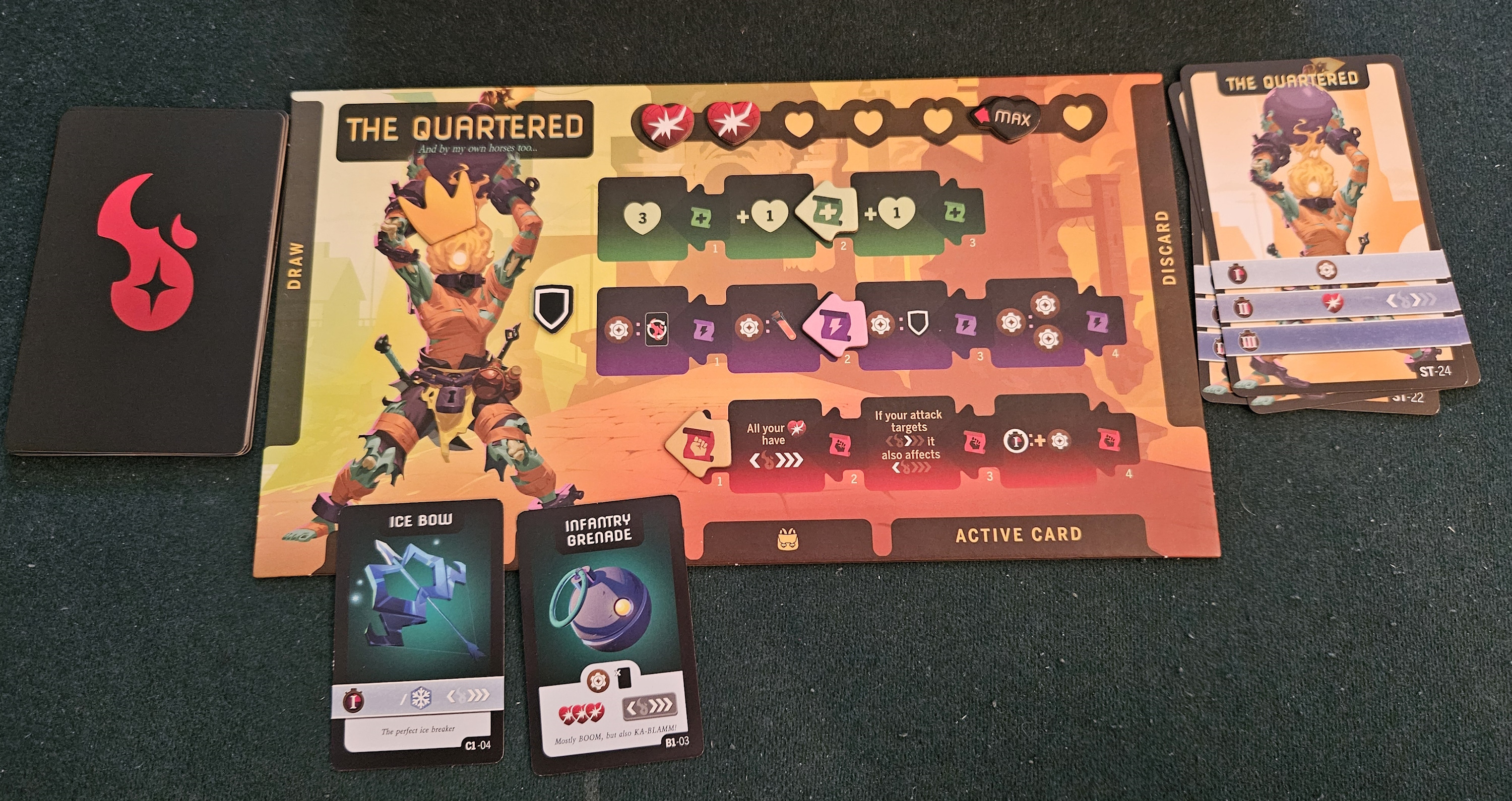
Hopefully I finish this run in one piece.
On the whole, I’ve enjoyed my time with Dead Cells: The Board Game. Rather than slavishly repeating its source material’s highlights, its designers wisely alter its fundamental makeup, emphasizing the shared experience of sitting around a table and making decisions as a group.
At the same time, it would be inaccurate to say that my enjoyment hasn’t been seriously tempered by the game’s more abrasive edges. Its tight loops, its overly constrained bosses, its awkward approach to deck construction, its constant resets. There is so much to explore in this box. But it’s a journey that keeps starting, and starting, and starting again, with each attempt requiring another topped-off tank of gas and another forgotten article dug out of the closet. On the whole, an intriguing but deeply flawed adaptation.
(If what I’m doing at Space-Biff! is valuable to you in some way, please consider dropping by my Patreon campaign or Ko-fi. Right now, supporters can read my quarterly report on all things board games!)
A complimentary copy of Dead Cells: The Board Game was provided by the publisher.
Posted on April 29, 2025, in Board Game and tagged Alone Time, Board Games, Dead Cells, Scorpion Masqué. Bookmark the permalink. 4 Comments.

 SPACE-BIFF!
My group has been having a blast with it. Typically on an evening we’ll constrain ourselves to a single “route” through some biomes and leave them set up, just re-randomizing the biomes we made it to on death. Only triggering a significant re-set-up if we decide to change routes, which we generally don’t do.
The game definitely plays optimally with exactly three. But there aren’t without some issues…
The rules were almost certainly not written in English (some of the contents in the game like the board still bore French) and the translation wasn’t great. We’re not the type of group that has to consult FAQs often, but during the third session I kept my phone open to quickly voice-record rules questions, because there were a LOT.
Some of the design is also not built with optimizers in mind. There are certain upgrades that are significantly better than others, to the point where we found ourselves trying to avoid unlocking items in some biomes because it would thicken our pool and make good items harder to find. There are ways to thin the pool, but that requires a bit of grind (true to its roots)… but at a certain power level that grind is basically certain. There really needed to be some kind of cap to the amount you can farm the first boss, or some more pleasant way to thin your deck. I hated when our group had to choose between “content” and “efficiency”. I want both!
Also, the power spike is fast and strong. It went from dying in the first biome a couple of times, to dying in the second biome once, to reliably killing the boss each time and getting a ton of cells to upgrade with. While later biomes/bosses are harder and can require a different approach, the game had lost a little of its magical (and fun) difficulty.
Also, the starting characters started wearing thin before too long. Yes I know there are other options, but the starting options stick around long enough, and their upgrade path is constant and simple. It was easy for us to just hit the highlight upgrades each run (and often that meant two of us getting the “interesting” upgrades and the third being passed over until the first two got their keystones).
We walked away from session 1 amazed. Session 2, excited. Session 3, in good spirits. Session 4, feeling a bit of a slog. Session 5, wondering where the magic had gone. We’ll probably get back to it, but it’s been a few months.
Still, lasted longer on the table than Slay the Spire did, and at least was more challenging/involved for a brief time.
Thanks for your mini-review, etheric!
Not to tread upon the coat-tails of the master!
Not at all! It’s interesting to hear how others have approached this one. I was also quite smitten with it at first, and still enjoyed it for the most part as we approached its conclusion, but I was somewhat relieved to reset all those decks.