Don’t Know If It’s Day or Night

A lot has changed with Bernard Grzybowski’s Purple Haze since I examined it three years ago. As wargames go, the final product is more assured and polished, as one would expect, but also less burdened by the prototype try-hard attitude. I might even go so far as to call it one of the finest narrative wargames ever produced.
To explain why, you need to meet my squad.
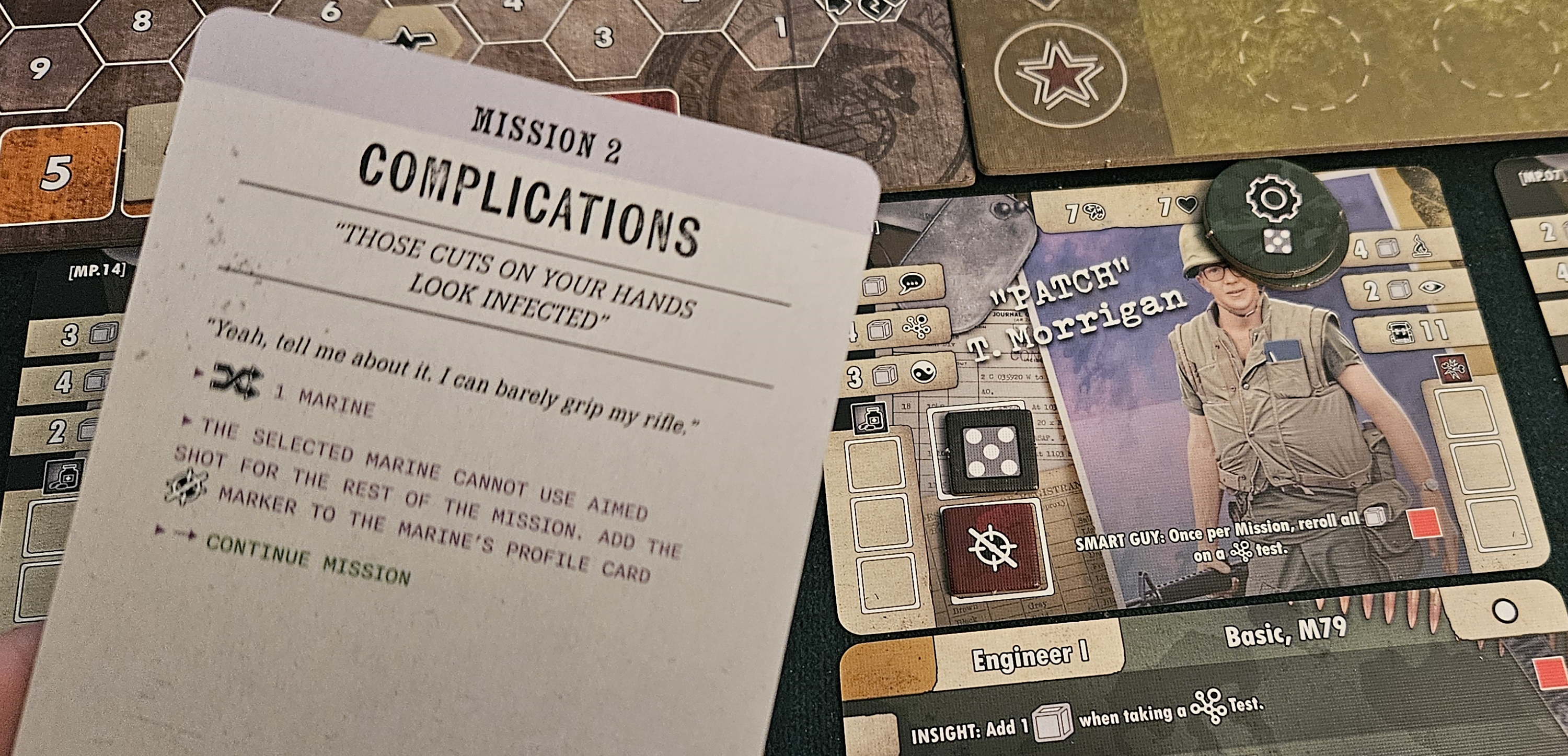
Events rarely turn out in your squad’s favor.
Purple Haze is a game played in layers. There’s the map, where your squad moves across rice paddies and humps across mountainous jungles, hunting Viet Cong insurgents or seeking shelter before nightfall. There’s the tracker board, painstakingly doling out your day in fifteen-minute increments and allotments of stamina. Combat zooms in for brief flashes of action, leaving your men traumatized and injured.
The connective tissue between these layers is your squad. At any given time, this is composed of six marines. Within a few missions, after losing a man or having somebody sent home for psychological breakdown, it becomes a patchwork of hardened veterans and squirrelly replacements.
In fact, this patchwork nature is one of Grzybowski’s best tricks. Rather than selecting your squad at will, you begin the campaign by drawing three marines for each role and choosing whichever soldier strikes you as the best fit. Rather than resulting in a perfect team, this produces little errors, bureaucratic oversights or boot-camp mishaps that have been rolled downhill for you to deal with.
In my case, my character — as in, the in-game avatar of my squad leader — was a corn-fed Midwesterner nicknamed Buddy, a resilient bastard who gradually accumulated psychoses but somehow dodged serious injury until the very last mission. My radio operator, Lartzz, was selected mostly for his relative intelligence and ability to drag our radio across the countryside without too much trouble. Clear was our gunner. I hated Clear. He had the moral simplicity of a shrub, ignoring any number of horrors and inflicting more than his share. Of course he survived the whole campaign without so much as a scratch.
The rear half of my squad was less fortunate. Geek was our point man, a scout whose skinny frame left him light on flak protection. Eventually he crumpled under the pressure and was shipped home. Our engineer, Patch, took a bullet to the noggin more or less the instant he acclimated to life in-country, leaving us with an ill-suited replacement whose low expertise compared to everybody else was a source of much resentment on my part. And then there was Hopper. We lost him first. Which is maybe not a good omen when he’s the one lugging the medical supplies.
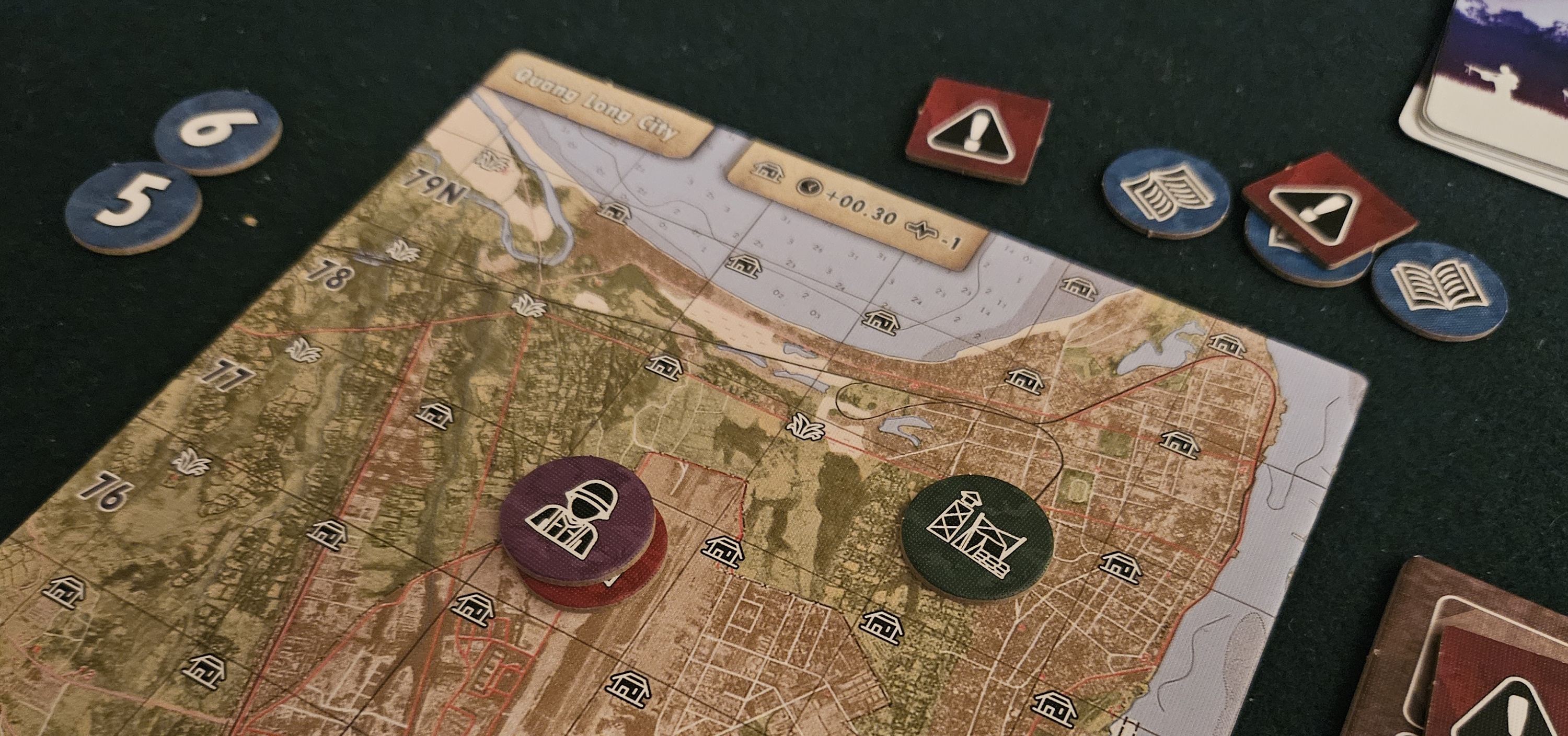
The maps are quite a bit handsomer than in the prototype.
When I talk in emotional specifics, how I resented a replacement or hated the squad sociopath, I’m not adding narrative flavor. If there’s anything Purple Haze excels at, it’s fostering a connection with these characters.
These connections arise naturally. At times, this is thanks to a character’s stats or innate special abilities. Buddy was a good squad leader because his diplomatic rating was high enough to dispel the occasional squabble between teammates. Clear was obnoxious because his high health and clear conscience ability meant he never received any real damage, even while his brothers were chewed up.
In other cases, it’s the sense of investment that does it. Leveling up each squadmate’s role is a big deal, bestowing new abilities that are sorely missed when their marine is given medical leave or gets shipped home. When my engineer died, his replacement was no longer able to operate a flamethrower, a tool that had ended more than one skirmish single-handedly. Later, our replacement medic was more or less worthless compared to the marine whose boots he was filling. Our greenhorns weren’t only fragile; they increased the likelihood that everybody else would find themselves in a tight spot.
This, in turn, elevates the stakes of every interaction. Humping through the jungle is deadly, threatening your squad with events that might assign automatic damage of either the physical or psychological stripe. Every lost hour is a danger, potentially forcing you to bivouac overnight, huddled together, terrified that Charlie will happen across your squad in the dark. As for combat… forget about it. Combat is a meat grinder.

Tracking time, energy, and threat.
There’s also a sense of real risk to the scenarios themselves. There are nine in the box, penned by Srdjan Jovanovski, each with its own booklet of narrative threads to follow, many of which require you to pick between bad choices and suffer the consequences. Not every scenario is created equally, with some of them resolving more or less on rails, but the best of them ask you to make tough decisions about where to go and how to behave.
These decisions are weighted with a healthy dose of ambiguity, especially when it comes to interacting with civilians. In one scenario, I was forced to decide whether to tie up a villager and drag her around with us, slowing our progress across the map, or cut her loose and hope she wasn’t a VC scout. In another, our squad was sent on a zippo raid and had to determine which villages to spare and which to burn to matchsticks. In a third, my idiot American children struggled to tell the difference between Viet and Hmong, forcing a sequence of skill checks as we gesticulated wildly at one another.
In my preview, I expressed some uncertainty as to whether Purple Haze could handle the heft of its subject material. It largely succeeds, in part because Grzybowski edited some of the prototype’s stringier passages. Where one of the prototype’s scenarios saw our marines threatening sexual assault in order to extract information from a village headman, those passages have since been amended to an “aggressive interrogation.”
I’m torn on this approach. As I noted three years ago, I’m not opposed to board games depicting the realities of war, and shrouding our marines’ activities in euphemism ventures closer to pandering to player sensibilities than truth-telling. The writing, though, is serviceable — or downright fantastic if we’re going by board game standards — and it’s tempting to parallel Purple Haze with material like Tim O’Brien’s The Things They Carried. But while there are some tenuous connections, especially when it comes to your men’s fraying mental health, there’s very little in the way of that work’s moral texture. A closer comparison might be Karl Marlantes’ Matterhorn, itself an excellent novel, with its tight focus on the camaraderie and tragedy shared by a company of marines, rather than on the long-term consequences of American warfighting.
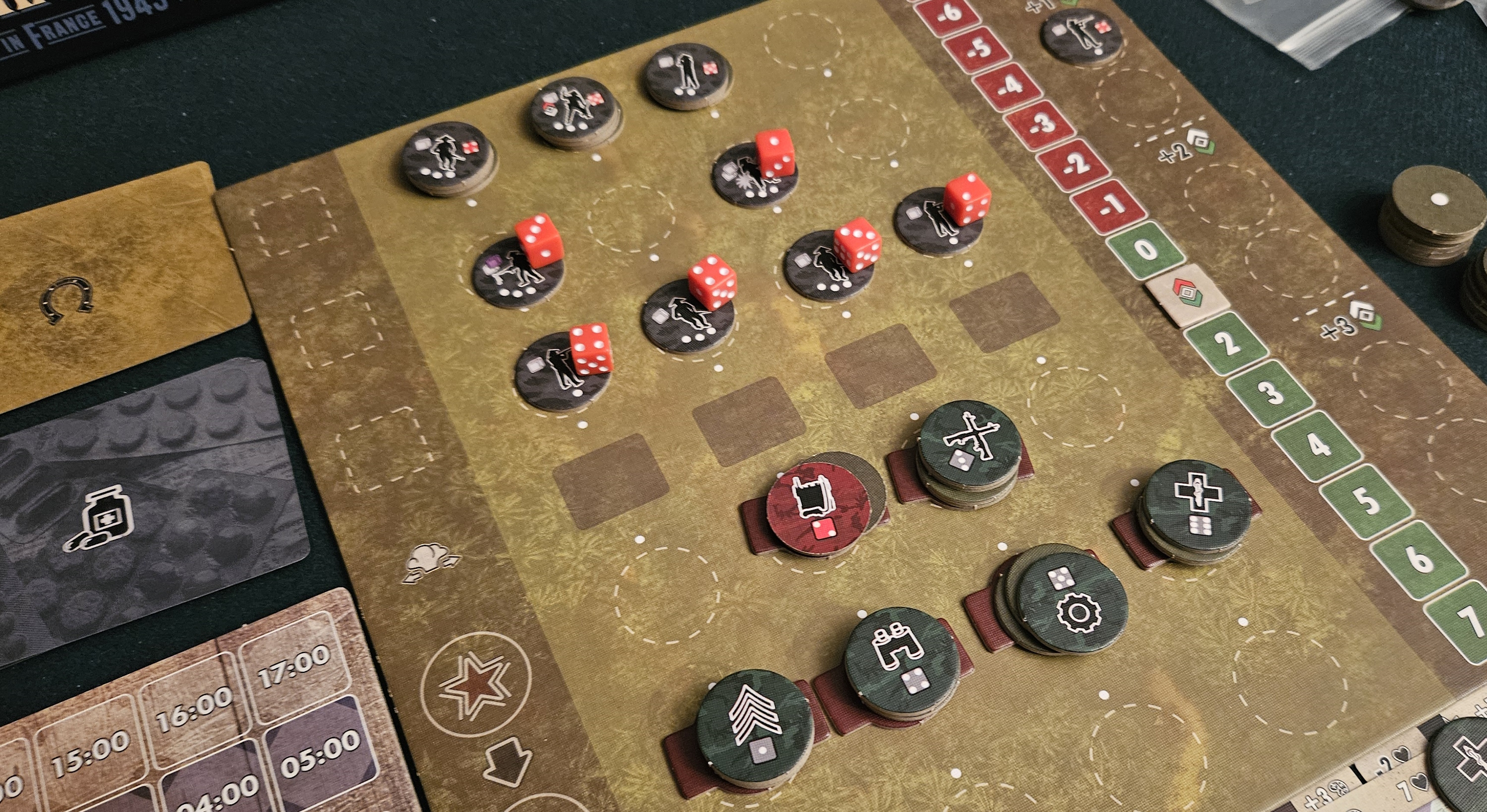
Combat is gripping and impactful, but also a minor pain to set up.
Still, the writing works well enough to get us to the real meat and potatoes of the experience, the ludic language that Grzybowski employs to tremendous effect.
Those branching snippets in the scenario booklets, for example, speak to a degree of uncertainty that are often most strongly expressed through narrative play. Threatening that village headman with an “aggressive interrogation” results in you jotting a keyword onto your campaign tracker. That keyword can come back to bite you in the ass later — or not, depending on how, when, and where you guide your squad, both in that scenario and in the future.
In one case, and I’ll dance around any spoilers, I undertook a mid-campaign mission with such vigor that it turned the local population against our marines despite my efforts to be even-handed. Had I dragged my squad’s feet, spending more time in the bush rather than [redacted], we would have faced fewer opposing squads over the coming scenarios. In other cases, our behavior dangled overhead like the Sword of Damocles, threatening to slice downward but never quite twisting free of its cord. The result is a note of low-grade paranoia that curdles the whole narrative in exactly the right way. Purple Haze is under no delusion that your marines would be looked upon kindly by the villagers they routinely terrorize.
Far from being relegated to flavor text, the consequences of these actions come fast and hard, even finding their way into combat. To wit, the combat system is more complex than that of the prototype, with varying degrees of cover, considerations of range and line-of-sight, special attacks like grenades or mortar fire, and plenty of capabilities on both sides of the battlefield. Oh, and one of the most atypical dice systems out there, which I initially bristled at but which gradually revealed an exciting range of possibilities.
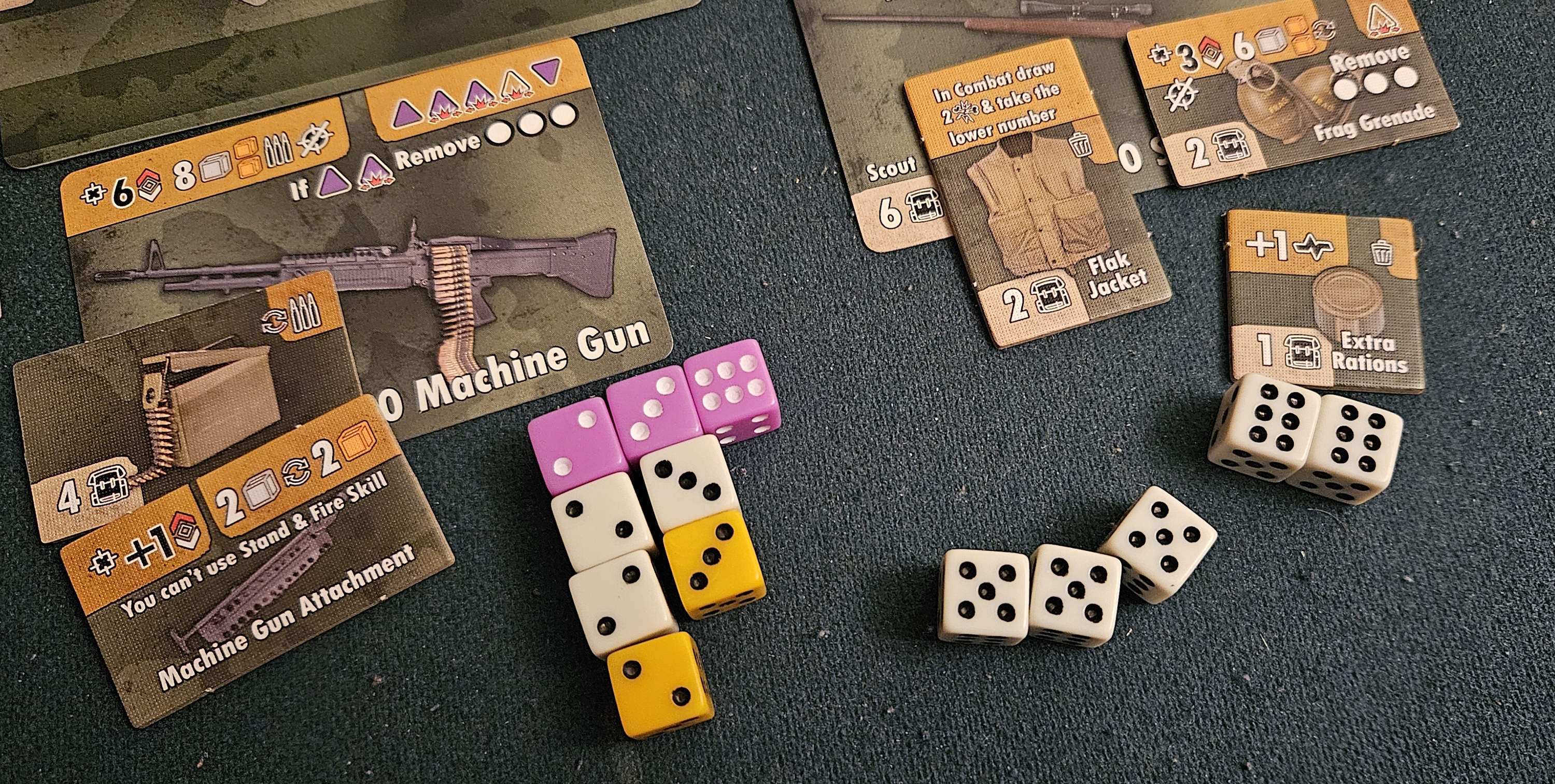
The dice system is rather unusual, but works great.
Before long, combat becomes an extension of the story. Designed by James Buckley, this is where the rubber meets the road. Setup is somewhat more complicated than I would have preferred, but there’s a reason for that. Depending on a range of factors — local insurgents’ awareness of your position is the big one — you might come face-to-face with a few guerrillas or a whole squad of veteran Viet Cong. If you’ve kicked the hornet’s nest, it isn’t uncommon for additional enemies to appear, turning minor scraps into multi-round engagements that threaten to decimate your squad.
I have to say, the handling of combat is fantastic. Engagements run the gamut. At times, I was able to send a group running after one or two volleys. In other cases, my men hunkered down and prayed for our enemy to withdraw after bombarding our position. Board games lend themselves to designs that are parceled into discrete chunks, a movement system here, a sideboard for combat there, a scenario booklet with narrative decisions threatening to slip off the side of the table. By contrast, the greatest strength of Purple Haze is that all of its segments are layered over one another.
It really is impressive. Your squad composition informs how much you can carry, which in turn might speak to whether you have a medkit available when you turn to a particular encounter in the scenario booklet. Later, the absence of sufficient medical supplies might result in an injury, your squadmate now half-carried by their brothers through the jungle. This delay then sparks a nighttime bivouac and a midnight engagement, everybody shooting wildly at nothing in particular. Where most narrative games use the narrative as an integral but separate source of resources or injuries, Grzybowski folds his storytelling directly into the game’s other elements.
It’s here, in its use of ludic storytelling, that Purple Haze demonstrates where games excel. There are passages from plenty of novels that have stuck with me throughout the years: a certain tree in The Things They Carried, the failed detonation of a grenade in Matterhorn, and many more besides. None of the prose in Purple Haze sticks out. It isn’t, I think, really meant to. Rather, its memorable moments are those generated by Grzybowski’s careful marriage of disparate gameplay elements and the random firings of chance.
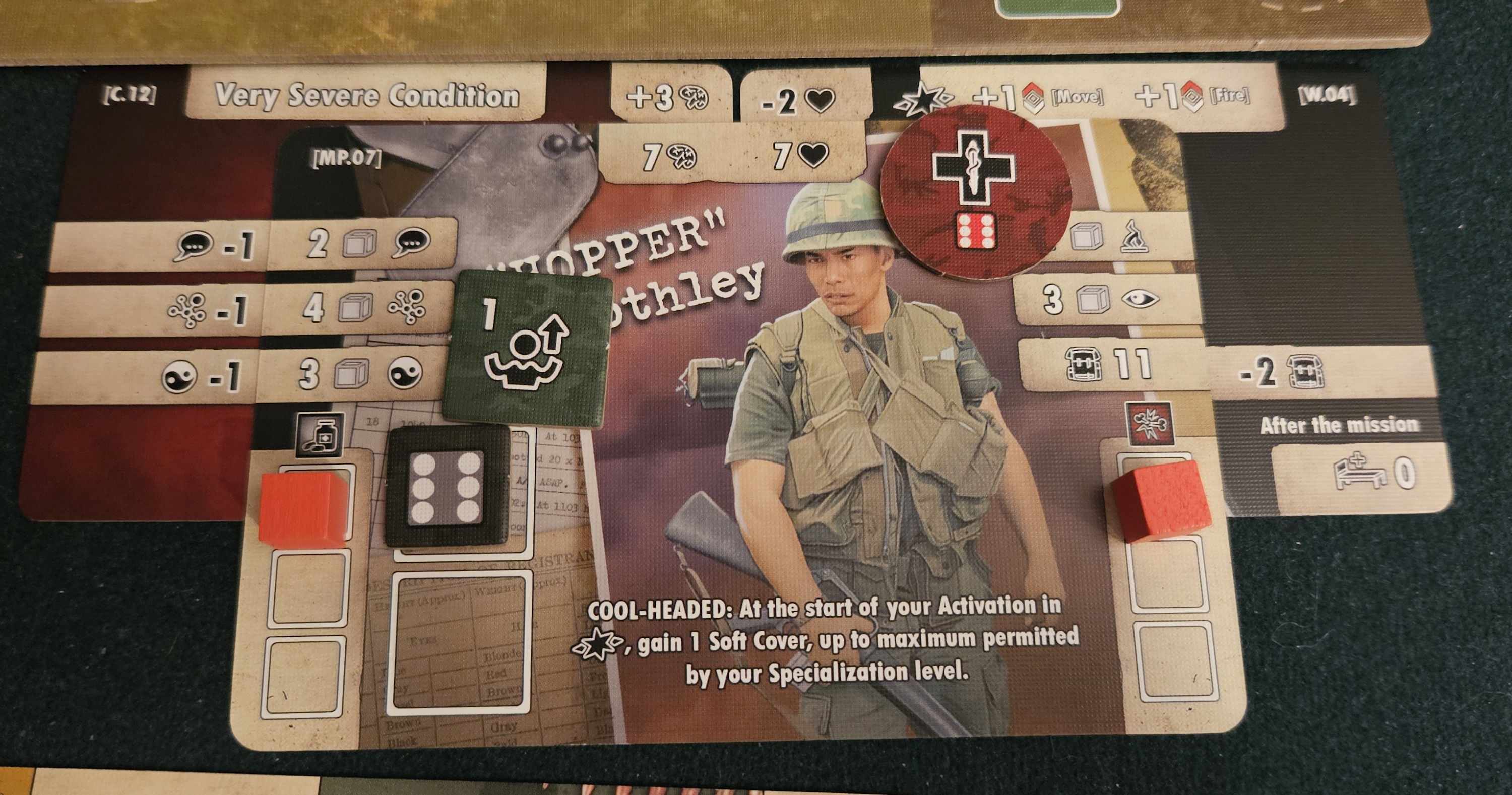
Uh oh.
Here’s one that will stick with me. It was the final engagement of an unending night. My squad crouched in a fortified position, so many enemies on the other side of the wire that we could hardly do anything more than tend to our cover. Lartzz called in an air strike. We counted down the minutes. Lee, our engineer, took a bullet in the head during that countdown. We could hear the shriek of the bombs.
And they missed. In the darkness and confusion, the payload struck us instead of the VC. Our replacement medic, Black, bless his useless heart, was gone. Lartzz, victim to his own misplaced coordinates, gone. Clear… well, Clear was fine. Clear was always fine. As for me, Buddy, the squad leader I’d walked through nine missions, he broke that day. Laid out on a stretcher, the injury finished what his squad’s deaths had started. His mind fragmented. He was shipped back home the next day. Friendly fire.
That’s Purple Haze. It’s monumental.
(If what I’m doing at Space-Biff! is valuable to you in some way, please consider dropping by my Patreon campaign or Ko-fi. Right now, supporters can read my quarterly report on all things board games!)
A complimentary copy of Purple Haze was provided by the publisher.
Posted on April 10, 2025, in Board Game and tagged Alone Time, Board Games, PHALANX, Purple Haze. Bookmark the permalink. 13 Comments.

 SPACE-BIFF!
I was wondering how you’d review our game, and I’m sure glad you like it 😀 But I do have to nitpick at your review a bit. Bernard Grzybowski designed the game, yes, but he isn’t the one who wrote it (the 22 scenarios included in the core game and expansions, to be exact) – that would be me 😉 It took me more than a year, but I’m really proud of how it turned out in the end.
And the way that new combat system looks like is the result of hours and hours of hard work and playtesting by the game’s lead developer, James Buckley. Developers sadly often remain in the shadows, and only the people involved in the project know that they’re the ones who actually made the game great. That said, when it comes to mechanics, Purple Haze in general was a collaboration between Bernie, James and me, and initially another developer, Mariusz Rosik, and we each had a smaller or bigger part in developing it 🙂
Btw, funny you should mention ‘Matterhorn’; I did read it, and took some inspirations from it (James, the author of nearly all the Encounter cards, put a couple of Matterhorn easter eggs in those cards), though my primary (fictional) resource was the excellent ‘Fields of Fire’ by James Webb. It’s mentioned in the Marine’s Handbook along several other great books. If you’re interested in Force Recon Marines & operations, for example, look no further than ‘Killer Kane’ by Andy Finlayson, you won’t find a better book on that subject.
Thanks for your input, Srdjan! I would be happy to add you, James, and Mariusz into the article if you feel it would be appropriate.
Also, I’m glad to hear you had Matterhorn on the mind! I think some of Marlantes’ perspective found its way into the game, which is a very good thing. Draw from the best sources and all that.
Yes, I feel that would be appropriate 🙂 While it does seem self-serving / immodest this very moment, I’m of the mind that everyone should get the credit for the job they did, not the job that was done by someone else. I won’t lie to you, I’m immensely proud of Purple Haze, and how it turned out; this project is the best thing that has happened to me so far, at least on the professional field. That said, you probably won’t be surprised to hear that we’re planning a follow-up game… and I probably shouldn’t say anything more 😉
Well, another game I need to pursue 🙂
Thanks for the review, this sounds quite immersive.
Thanks for reading!
I’m not a big fan of narrative games, Vietnam War games, or solo games. But this sounds tremendously intriguing. Thanks for the great review!
Thanks for reading!
Hi Dan,
You have no idea how much your words and the review you created mean to me.
I never imagined that such a small idea for a simple game on the Amiga would turn into such a complex and developed game.
Once again, thank you so much for the review — and just so you know, that radio operator “Lartzz” who messed up… that was me. 🙂
Enjoy the game and may your future sessions be filled with unforgettable moments.
Best regards,
Bernard
Thank you for crafting such a wonderful game, Bernard! (And I’m very sorry to hear that I led your in-game avatar into such a mishap!)
Thanks for the review Dan (and for the book recommendations!) I like the idea that theme, mechanics and minimal narrative can produce these stories.
As an aside, it’s a lovely coincidence that your review is published in the same week as the one from Player Elimination. Getting to read two of my favourite reviewers’ takes (and in depth takes at that) on the same game at the same time has been fascinating. Seeing the differences has given me something to think about, not just with this particular game, but with how you both review games more generally. It’s resulted in a richer experience. Thanks again.
I was so mad at Charlie for scooping me! And by mere days! 😉
Pingback: Skyblivionrockmarsh | SPACE-BIFF!
Pingback: Best Week 2025! Heart of Darkness! | SPACE-BIFF!