Fire Hazards

Alley Cat Games recently sent me three board games that have one thing in common: each one of them is about a different fire hazard. That’s right, kids. Only you can prevent forest fires.
I guess there are some other commonalities. Like the fact that each of these games is packaged in a mint tin, costs fifteen bucks at most, and knows exactly how to make a tiny board game look amazing. Take my hand as we kindle each fire one at a time — or douse them. It’s safety time!

This Boy Scout encourages better fire safety than this!
Tinderblox
Designed by Rob Sparks, Tinderblox is the opening spark(s) (see what I did there?) that ignites this entire series of small-tin board games. It’s also a good intro to the series as a whole, with its simple components, perfect aesthetic, and just a scooch of unexpected depth.
Before we start measuring scooches, though, I think we need to take a moment to stare into the warm embers of this conflagration. Board games are a visual medium, and Sparks gloms onto that immediately. With one big exception, Tinderblox doesn’t even use fancy custom components. The elements of this fire are wooden rectangles and coal-warm cubes. Plenty of hobbyists probably have plenty of those exact pieces sitting in a drawer somewhere.
With that simple setup, Sparks creates a game that’s simultaneously warm and nail-biting. Not at all unlike building a fire for your first time, come to think of it.
This is a dexterity game. Like some raggedy Jenga, your task is to pile together those logs and coals, building your fire ever higher and doing your darnedest not to send those embers skittering out of the pit. These placements are conducted via plastic tweezers. More on that in a moment.
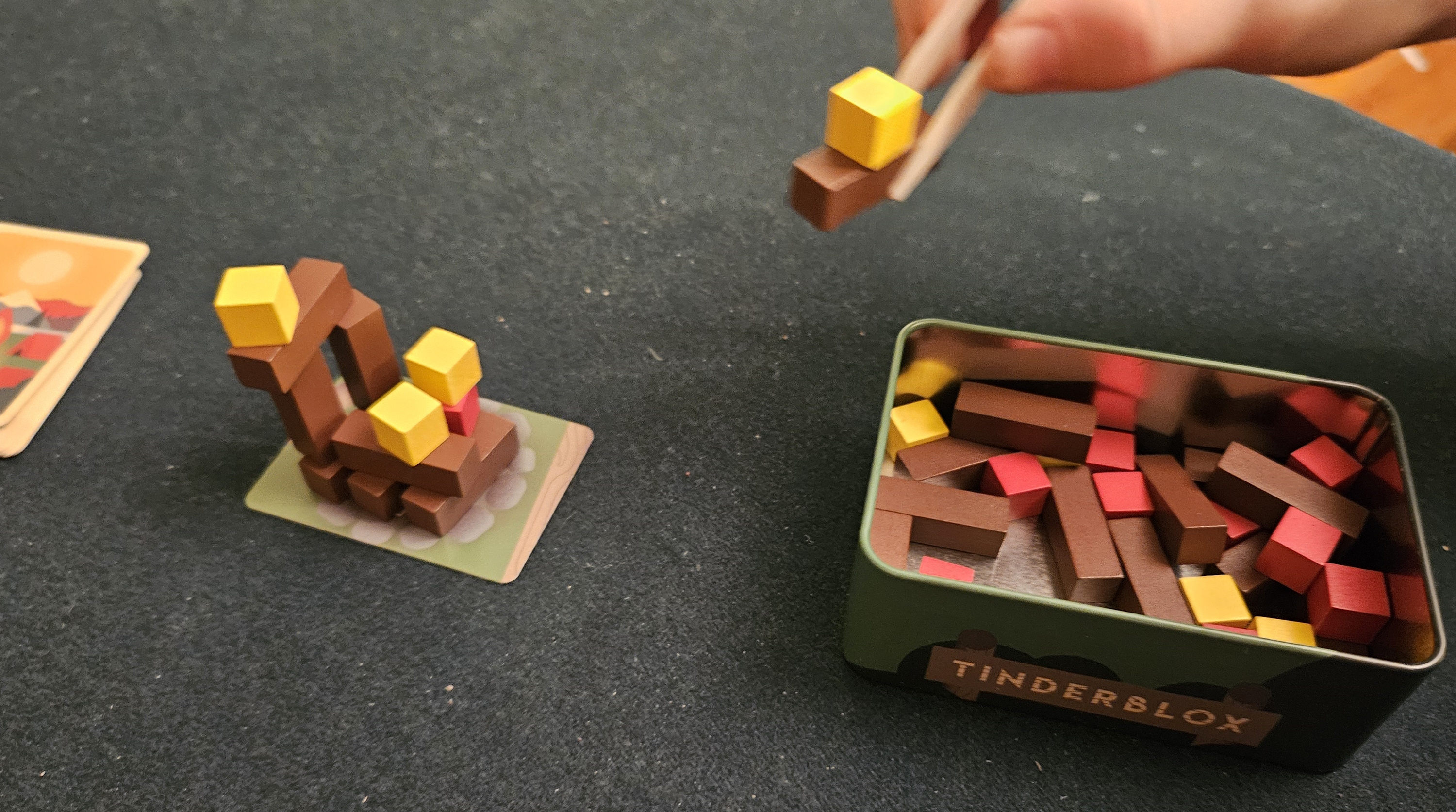
The tweezers are too light for moving stacks of cubes.
It’s a simple game, but a few wrinkles give Tinderblox its essential friction. The first is that you aren’t in control of what you place. For that, you flip a card that reveals what — and how — to pile. One turn will see you adding a yellow coal atop a log, desperately pinching both in your tweezers. The next might then require you to place a log, but vertically, erecting a suspicious pillar for the next load. In some cases, Tinderblox does something I haven’t seen before by demanding that you place your pieces with your off-hand. It’s a great idea, penalizing those of us with exactly one (1) steady hand, and temporarily leveling the playing field for our kin who happen to be ambisinister. Don’t worry, your ambidextrous friends will brag about this singular use for their skill.
Here’s the nifty part. I learned how to manage a fire at age eight, and Tinderblox isn’t all that far off from the real thing. At heart, managing a fire is a dexterity game. You pile logs, do your best to keep the whole thing from collapsing the wrong way, and quickly learn to endure the blaze to nudge the structure into its optimal configuration. The only missing elements from Tinderblox are heat and kindling.
That said, Tinderblox is the weakest of these three tin games. I simply can’t countenance the very real danger posed by haphazard campfires.
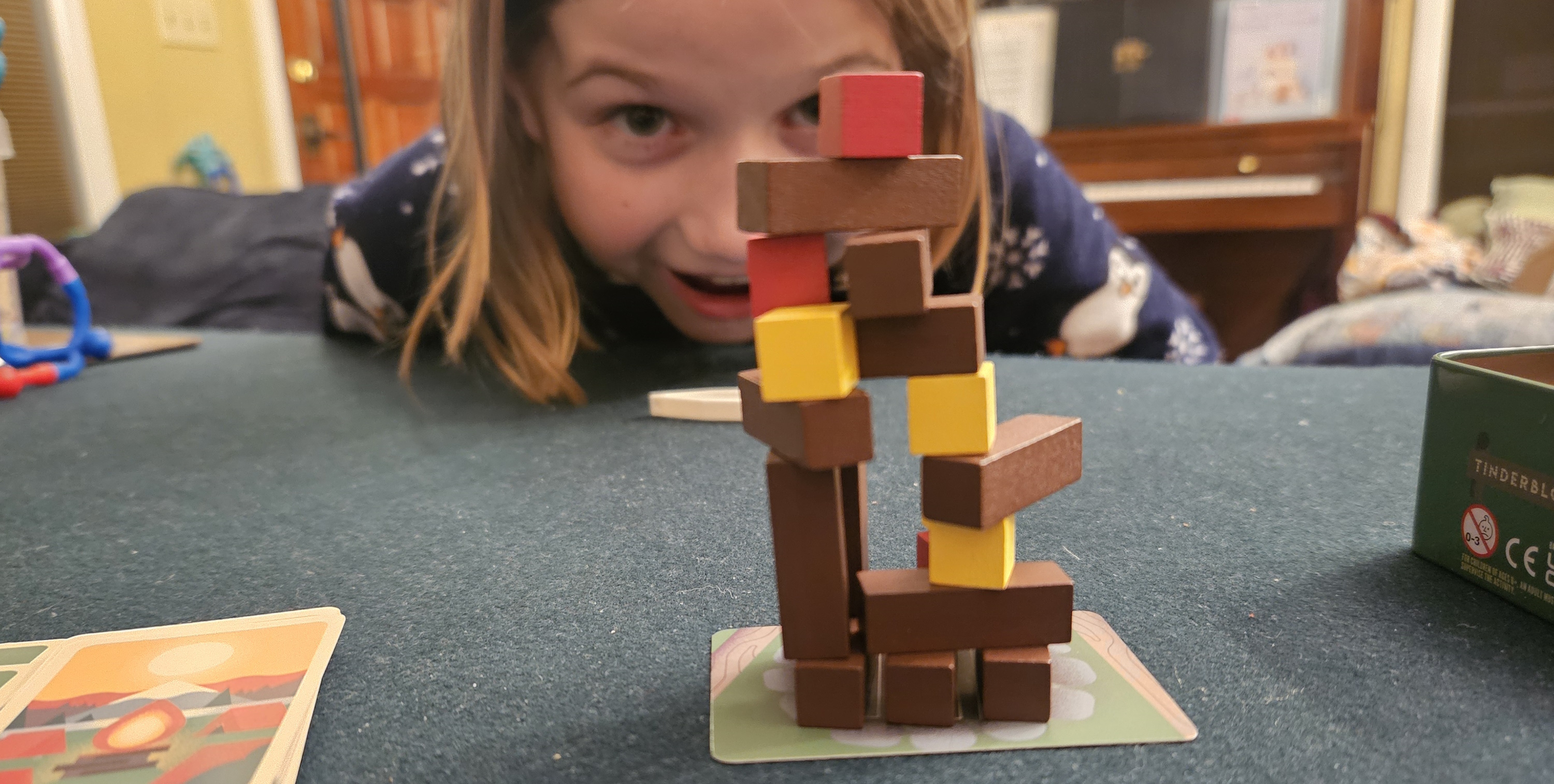
Okay, that’s a nifty tower.
Haha, okay, that’s a lie. The part about campfires, not the thing about Tinderblox having some weaknesses. The real issue is the relative heft of the pieces. Although they’re tiny, the logs are too heavy for the included plastic tweezers. The tweezers are flimsy, for one thing. For another, they only achieve a single point of contact. As tweezers are wont to do! But this means they struggle to hold multiple pieces at once. When a card asks you to handle a single log or coal, that’s nothing egregious. But when it tells you to place a cube atop a log and then move both pieces together onto the campfire — and maybe do so with your off-hand! — those flips feel like condemnations.
In other words, Tinderblox isn’t always a stacking game. It’s also a game that occasionally penalizes players with a task that the game’s components are ill-suited to achieve. I don’t want to hazard a percentage, but it feels like most of our tumbles have little to do with a campfire that’s gotten out of hand and more because a card has asked a player to perform a feat of dexterity that the game’s components can barely handle.
But here’s the good news. While Tinderblox’s fire quickly extinguished itself, its follow-up generates all the same warmth without also cranking up the sprinklers. That game is…
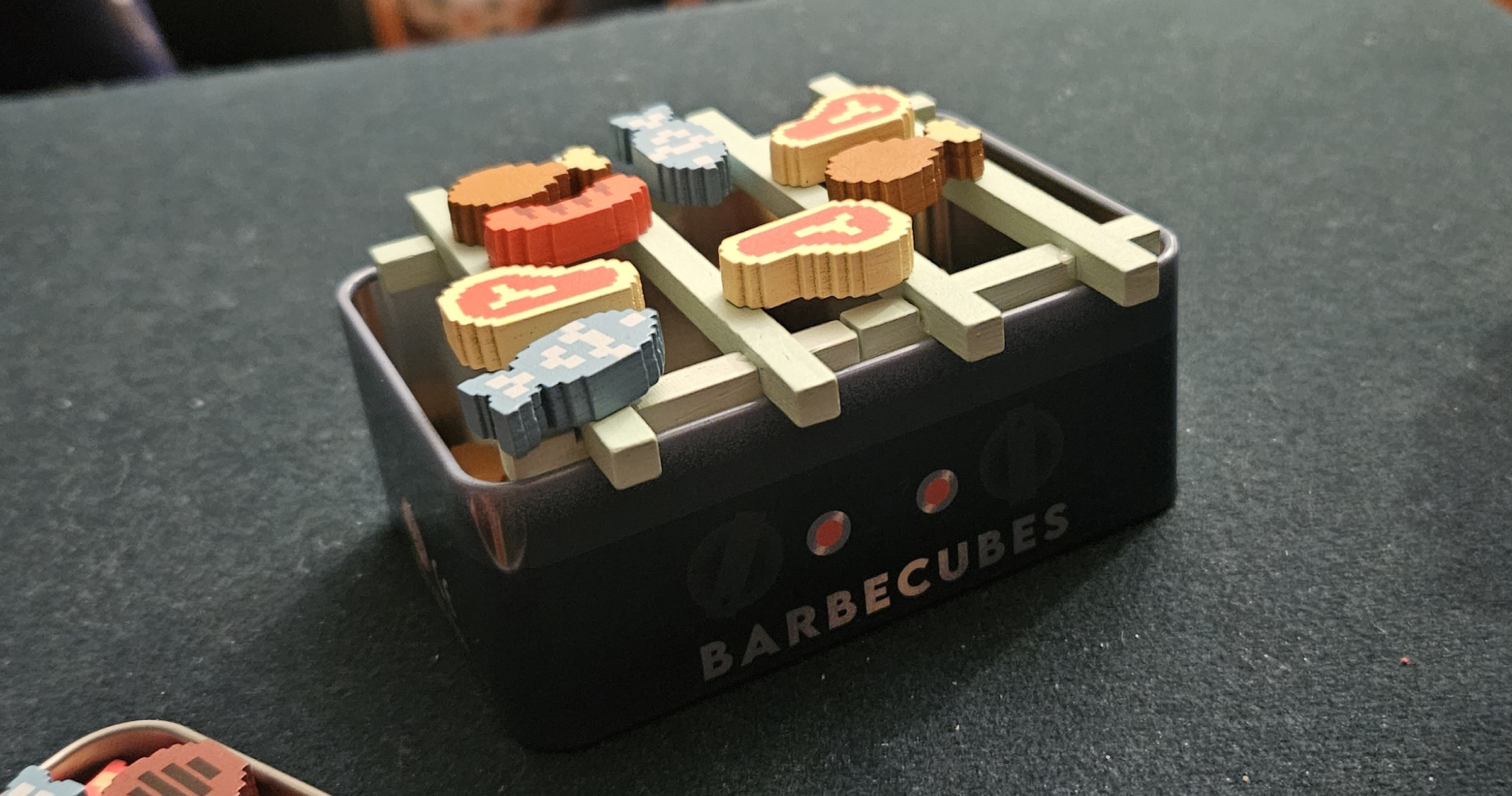
I’m the grill master.
Barbecubes
Ah, the charred fat and licking flames of the barbecue. This time, Rob Sparks is joined by Brett J. Gilbert, co-designer of titles like Mandala, Elysium, and The Guild of Merchant Explorers, although for our purposes today we’re mostly disappointed that Brett’s name does not inspire any inflammatory puns. Sorry, Brett.
Like Tinderblox, Barbecubes is about managing a fire, although this time that fire happens to be contained inside a metal box. As luck would have it, do you know what else comes in a metal box? That’s right: Barbecubes! Setup involves placing two wooden grates over the top of the mint tin, producing as darling a play-space as has ever existed. Combined with the slightly burnt scent of the laser-cut pieces, and we have a game someone less weathered than myself might call “dripping in theme.” Ugh. Gross.

This time around, the tweezers are exactly right for the food tokens.
On the surface, Barbecubes is similar to its predecessor. Each turn, you draw a card that tells you what to place on the grill. The wooden pieces are less common this time around, little fish and hot dogs and hamburger patties, each cut to pixel-style edges that are perfect for stacking. There are some other requirements, such as how many tines you’re required to touch with your steak, and once again sometimes a card will instruct you to use your off-hand, juggling those tweezers like an overworked grill master at a polygamist family reunion.
The tweezers are back, but Barbecubes makes better use of them than Tinderblox did. Food is never stacked on top of other food, which makes all the difference, and none of these individual drumsticks or strips of bacon come close to the weight of Tinderblox’s logs. Barbecubes entirely sidesteps its pappy’s limitations, getting out of its own way so players can focus on the balance and placement of each wiener.
And those placements matter. There’s something of an arc to the game, an appropriately tiny dose of strategy. Your goal, naturally, is to not drop any food. The clank of those wooden pieces against the aluminum interior is wonderful, a less-squishy rendition of a hot dog’s flop into a grease pan. So, yeah, that’s best avoided. But as the game progresses, it gets tougher to find enough space to fit everything. You can nudge food out of the way, but that’s a dangerous process, threatening to consign your T-bone to hellfire.
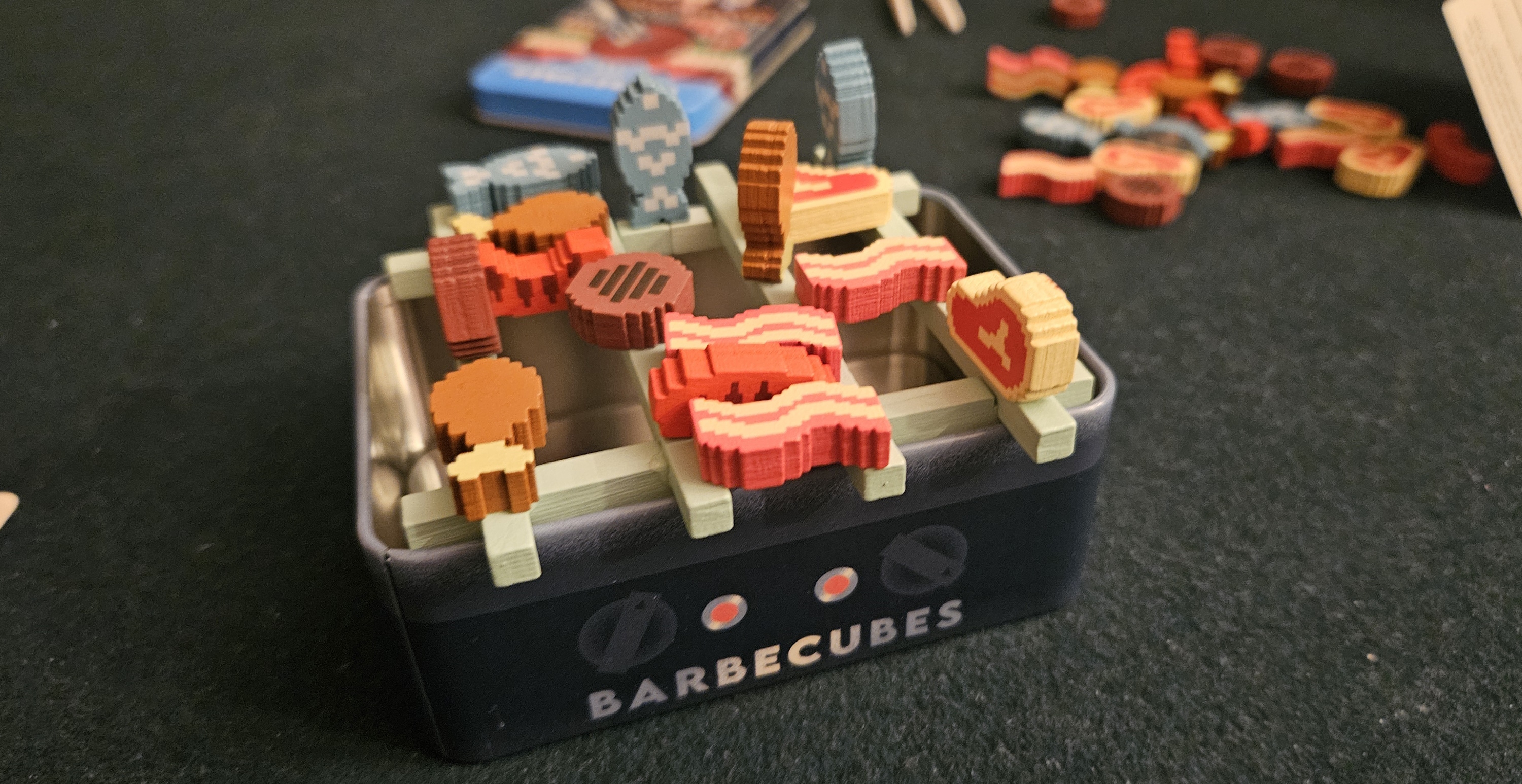
What, no shrimp for the barbie?
Of course, this lends itself to jerky placements. You balance fish on their fins and hog as much room as possible with your bacon. You leave a hot dog tilting at an unearthly angle. Anything to cause the next player to glance something off the burners.
Along the way, the rules are more forgiving than Tinderblox as well. Rather than being marked out after one failure, it takes two drops before you’re done. This speaks to the game’s format; topples in Barbecubes aren’t as cataclysmic as those in Tinderblox, usually leaving most of the pieces untouched. Still, the result is a more pleasant plaything, one that eases the original game’s problems and injects just enough au jus to make the whole thing tender and juicy.
Speaking of tender, the third and final of these tin games has nothing to do with stacking or balancing. Fire, though? You know it has that fire.
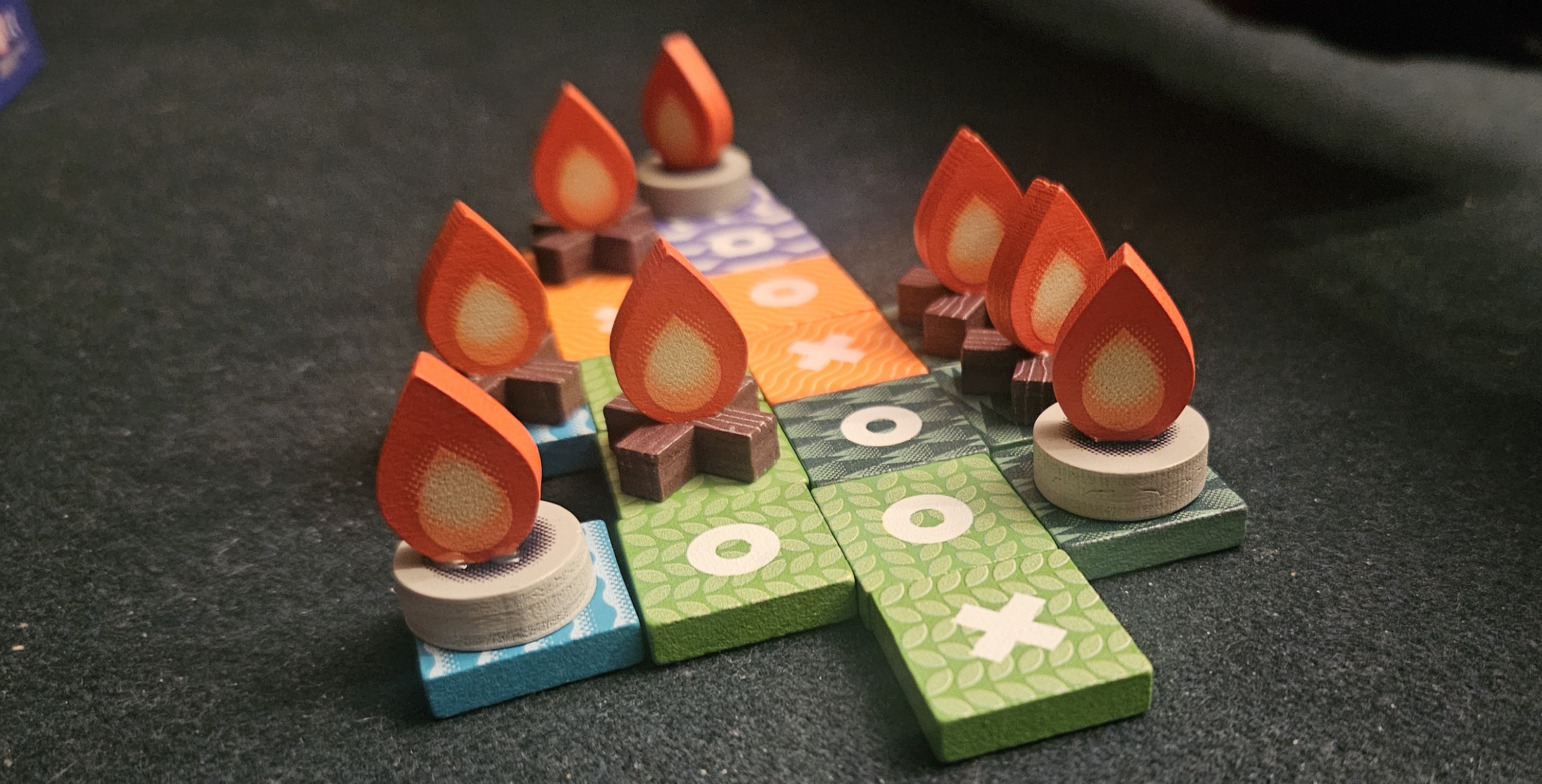
Another fire hazard.
Tic Tac Trek
I wonder if Tic Tac Trek began as a challenge. Co-designed by Brett J. Gilbert and Trevor Benjamin, this is an abstract game that uses everybody’s least-favorite and least-balanced time-waster, Tic Tac Toe, as the kernel for something fascinating.
To be clear, Tic Tac Toe is present in Tic Tac Trek, but it isn’t the limitation you would think. One player is X, the other is O. But as soon as the game begins, you realize there’s something else going on. Rather than being played on a three-by-three grid, these boundaries are moveable. At the start, there are only two tiles side by side, one for each player, drawn at random from a bag.
Turns, then, revolve around drawing another tile and adding it to an ever-growing horizon. Each tile has a different terrain printed on it, and you’re required, if possible, to place that tile so that it touches similar terrain. You also flip the tile to your face, adding either an X or an O to the board. If you happen to make three in a row, you take one of your campfires and add it to the tile you just placed. When the game ends, these will be worth points according to how many empty spaces there are around them — unspoiled wilds, ready to be explored from your base camp.
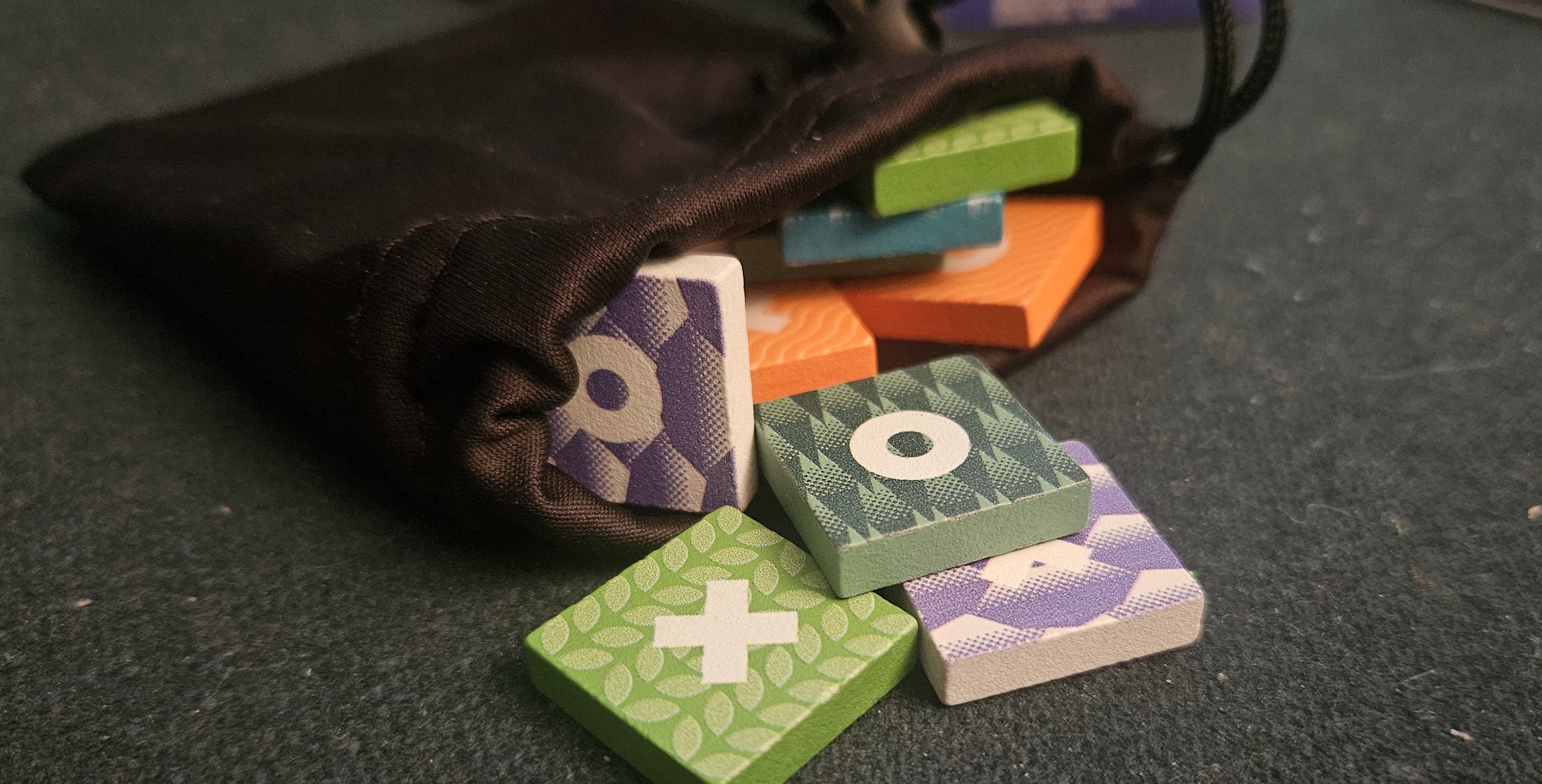
My main complaint: the bag is too small.
Tic Tac Trek has a few things going for it. The first, but perhaps the subtlest, is that it’s a game about playing the odds as much as it is a game about redeeming Tic Tac Toe. It isn’t uncommon to want a specific tile, the next necessary grassland or forest that will provide your third symbol, only to keep pulling the wrong tiles from the bag. Aiding this endeavor, the odds are gracefully easy to assess. Of the four main habitats, there are six tiles apiece. There are also two lakes that serve as wilds, making it easier to complete a line but also allowing your rival to make links more freely. While the draw itself is chancy, the odds are clear.
Meanwhile, Tic Tac Trek quickly reveals itself as kin to area control games. Your campfires function as a miniature heat map, revealing danger spots to your opponent and blocking off future expansion. This paves the way for some truly snitty maneuvers. If I see that you have three adjacent campfires, you can bet your bottom that I’m going to try to park a tile in the empty space next to all three of them. That’s minus three points. That’s huge.
The game’s emphasis on changeable boundaries also ablates the usual first-player concern that dominates Tic Tac Toe and its bazillion derivatives. Igniting an early campfire is worthwhile. Make no mistake, though, it will almost certainly be surrounded in short order. There’s a powerful tension between playing proactively, pitching camps all over the place, and being more responsive, building around your opponent’s camps to ensure you have the pristine wilderness when the game concludes. I’m not convinced there’s a last-player problem, but I would believe it more than the inverse.
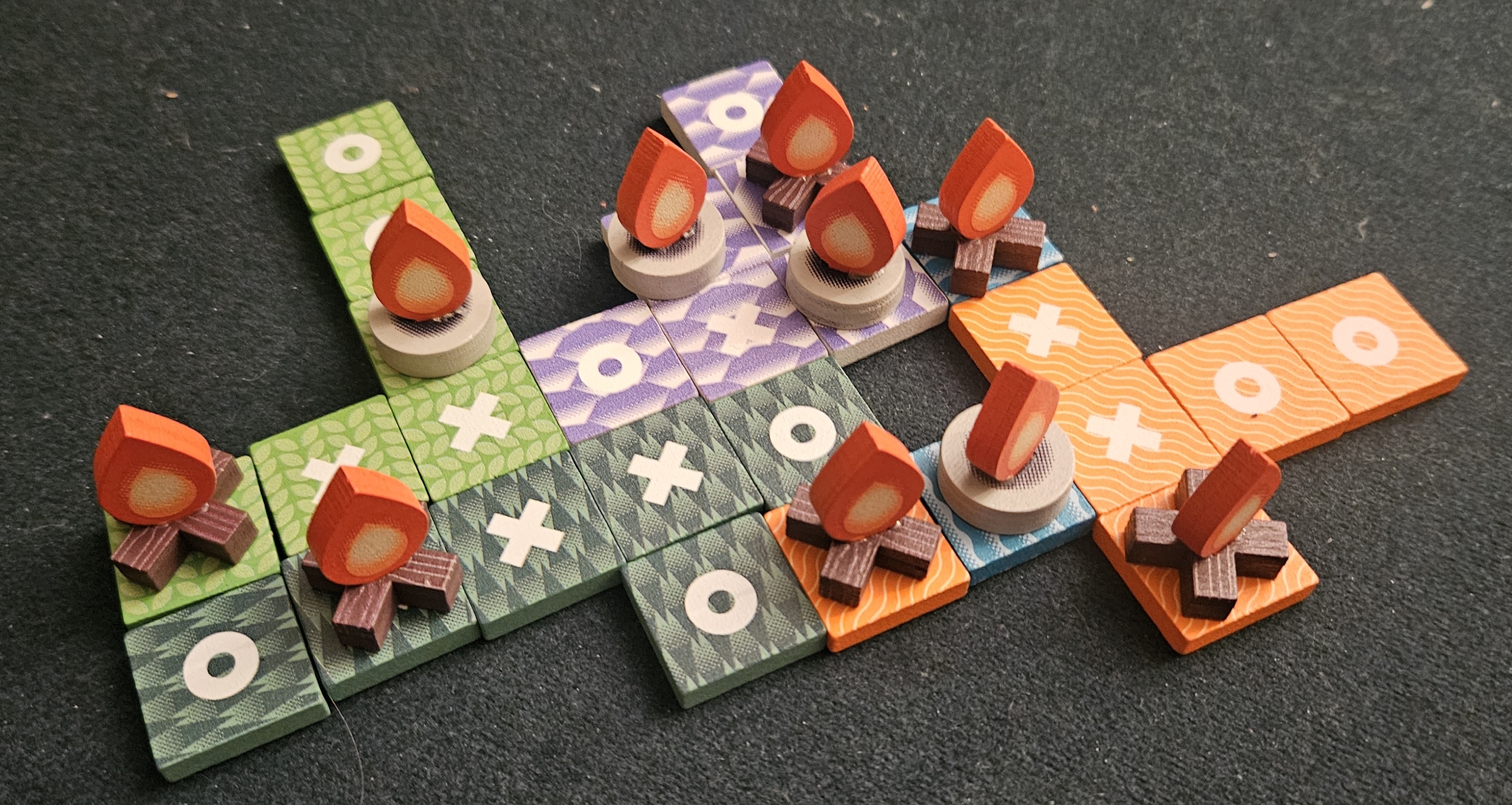
Is this a metaphor for humanity’s impact on nature? Naaaah.
More than anything, though, Tic Tac Trek is downright pleasant to play. It leverages familiar ideas — match-three, terrain matching — and strikes them against concentrated phosphorous. It’s a small game, requiring only fifteen minutes or so, but those fifteen minutes are utterly absorbing, both for their familiarity and how Gilbert and Benjamin upend the familiar in service of the unexpected.
Of these three tin games it’s also my favorite, a close-run thing against Barbecubes but ultimately successful thanks to its shrewd gameplay. It’s the sort of game I can play on the fly with my eleven-year-old, and like its peers it’s sturdy enough to take camping or, in a survival situation, make do as kindling. If it comes to that, though, I’ll be starting with Tinderblox. A fitting purpose.
(If what I’m doing at Space-Biff! is valuable to you in some way, please consider dropping by my Patreon campaign or Ko-fi. Right now, supporters can read big stonking essays on the movies and video games I experienced in 2024.)
A complimentary copy each of Tinderblox, Barbecubes, and Tic Tac Trek was provided by the publisher.
Posted on March 27, 2025, in Board Game and tagged Alley Cat Games, Barbecubes, Board Games, Tic Tac Trek, Tinderblox. Bookmark the permalink. 3 Comments.

 SPACE-BIFF!
Pingback: Summer Ludens | SPACE-BIFF!
Pingback: Tick Tick Toe | SPACE-BIFF!
Pingback: Best Week 2025! All My Children! | SPACE-BIFF!