Conclave: The Board Game
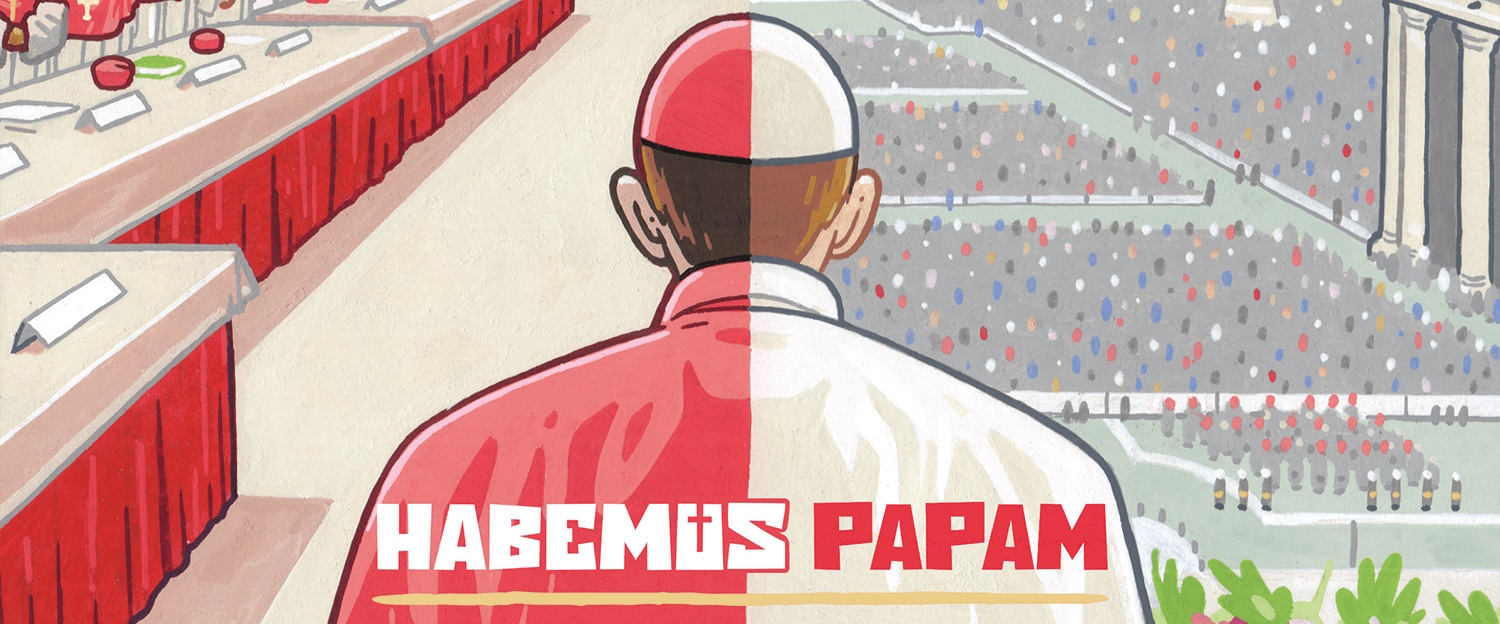
It’s wild that Conclave, the award-nominated movie about papal electioneering, Vatican secrets, and Ralph Fiennes’ preference of regnal epithets has only been out for a few months and already it’s getting a board-game tie-in.
Okay, okay. I swear I won’t turn this into a review of Conclave.
Habemus Papam is the work of Pako Gradaille, whose forthcoming Onoda fascinated me with its solitary gameplay and ethically sticky protagonist. Unlike that game’s antisocial tendencies, Habemus Papam is strictly communal, casting players as members of the Roman Curia tasked with selecting the next pope. It’s an intriguing, if sometimes wobbly, little thing.
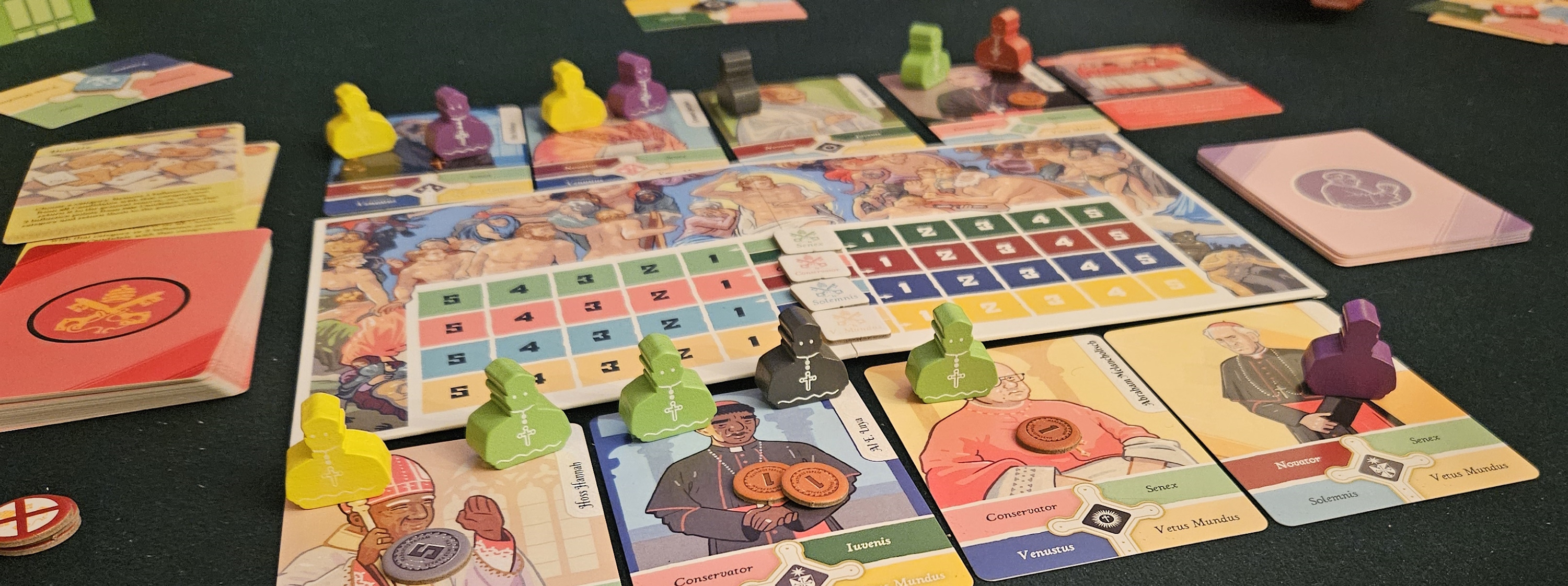
Ah yes, I remember this scene from the movie.
Right from the outset, Habemus Papam delights in muddying the waters.
There are eight cardinals who might serve as the next holy pontiff, each with his own attributes. Some of these are presented as binaries. Is the candidate traditional or an innovator? Charismatic or solemn? From the Old World or the New? Jude Law or John Malkovich? To complicate matters further, every candidate belongs to a religious order. Your goal is to select somebody who matches as many of the criteria listed on your own public-facing attribute card. For ease of visibility, everybody at the table marks any candidate the matches at least three of their criteria with little priest meeples.
These identifiers are important, but they aren’t all-important. In addition to your public attributes, you’re also given a secret objective. Perhaps you’re a fanatic who wants to show a unified front by electing a pope early. Maybe you’re mostly interested in electing a traditional pope while holding the most influence with the curia. Or perhaps a loss of faith spurs you to seek a leader who is your own mirror image.
Theoretically, these secret objectives are the lifeblood of the game. To such a degree, in fact, that despite the game’s multiple phases, their identities are given a premium on the reference cards. If someone at the table is vigorously championing a particular candidate, is it because they like the man’s attributes or because they’re trying to end the bidding early? If somebody keeps casting doubt on any cardinal who becomes popular, are they dragging out the proceedings as a Machiavelli or because they’re secretly an Antipope? As in titles like Coup or Blood on the Clocktower, to play Habemus Papam well requires paying close attention to your fellow electors’ intentions.
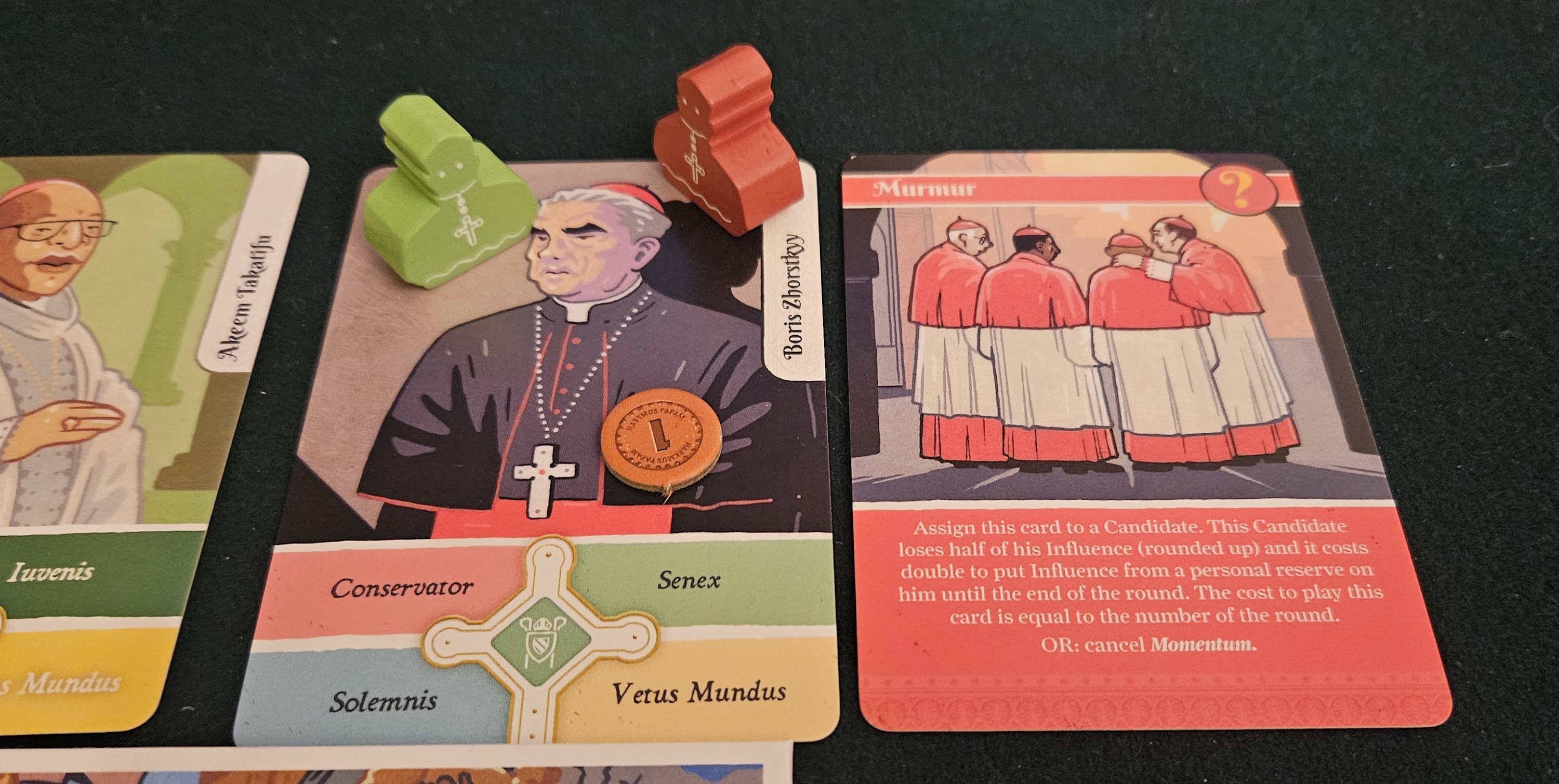
Uh oh, someone fathered a secret baby!
This is both a blessing and a curse. With some familiarity, all this guesswork is gripping. It’s entirely possible that your own goals will be at odds with themselves, forcing you to evaluate the surest route to a winning combination of public-facing and private objectives. The limitation is that Habemus Papam’s array of concealed roles doesn’t lend itself to easy acclimatization. There are nine in total — fewer by far than in a session of Blood on the Clocktower but more than in any varietal of Coup — and they’re sufficiently diffuse that the distinction between one role and another might be impossible to suss out.
Further clouding these holy waters, a significant portion of everybody’s scoring potential also comes down to their final influence tally. This is your in-game currency, and it can be spent in a few ways. The most obvious method is by throwing your weight directly behind a candidate. It takes a two-thirds majority to elect a new pope, making an early election tricky, and also threatening to wipe out the baseline score of anybody who burns through their goodwill too swiftly.
The subtler and less reliable method is to purchase action cards. These are dealt at random each round, but offer a wide range of possible effects. Influence can be shifted from one candidate to another. Popular candidates can be boosted (our last hope to elect a pope who isn’t full fashy!) or slandered (secret baby!). Protests might lead you to alter your hidden objective, while uncovering a fellow player’s journal reveals their secrets.
In some instances, action cards can alter the entire game. Each round, one player functions as the Camerlengo. They’re tasked with running the proceedings, seeding a few points of starting influence on candidates and eventually selecting which cardinal will be ousted from consideration. Naturally this office is open to self-service, and the Camerlengo is free to assist or dismiss anyone that suits them. That’s where those action cards come back in, tilting power back into the Curia’s hands — including by bringing a previously disgraced cardinal back into the competition. So much for that secret baby!
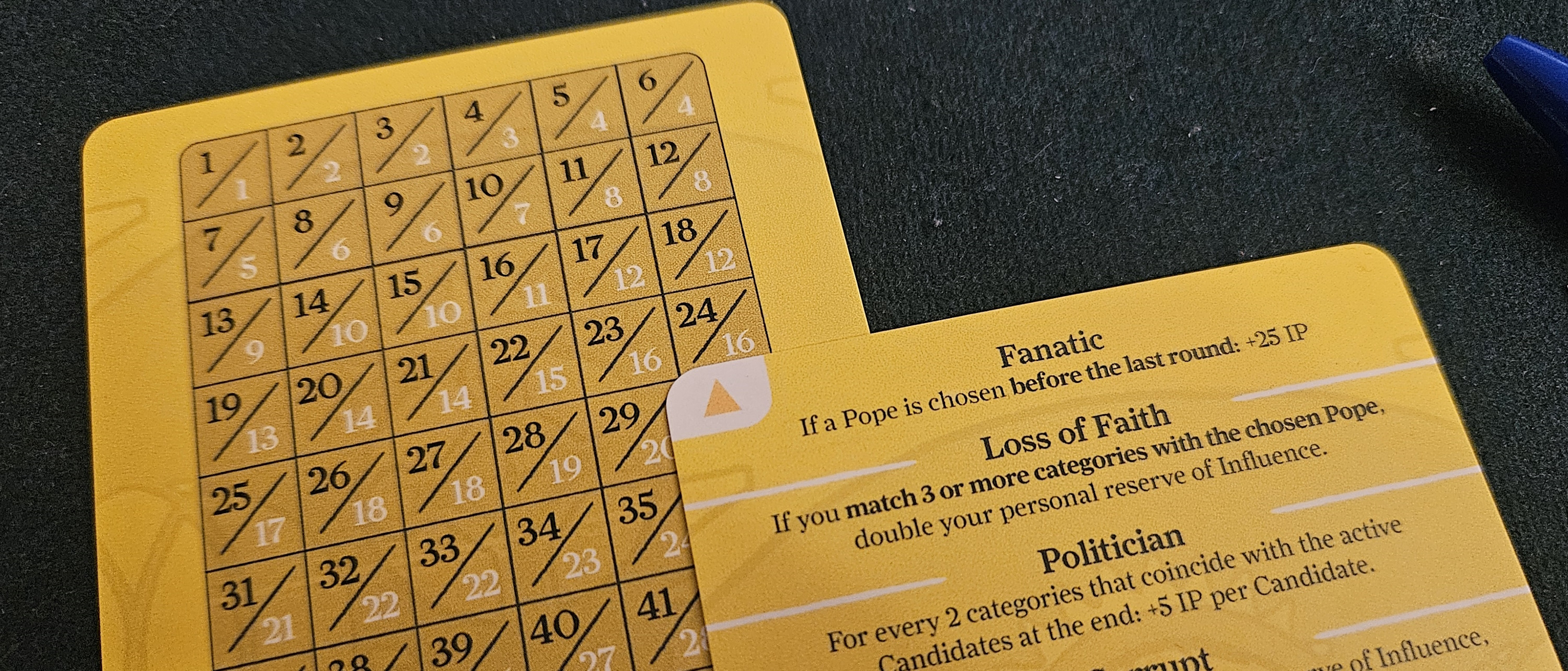
Thank goodness this game doesn’t ask me to do my own math.
As with a recent film about papal elections that I promised I wouldn’t mention again, these possibilities veer between sensationalist and funny, letting everybody roll up their cassocks and play in the mud. In a sense, it reminds me of Amabel Holland’s Nicaea, although Habemus Papam is more “game” and less statement.
Still, as with that game’s blank doctrines, the whole thing is suffused with practicality. This is no earnest discourse about the relative merits of tradition versus progress, the timbre of New World versus Old World Catholics, or what any of these attributes, holy orders, or hidden objectives mean in either our world or within the game’s fiction. This bleeds into the game itself, into its phases and bids and everything else. This is an auction. An auction with clever entangled player incentives, but still an auction. Nobody is ever persuaded.
This could be taken as a weakness — indeed, I don’t see how it doesn’t suffer in at least some proportion — but also allows Habemus Papam to function on its own terms. Persuasion is rare enough in the real world, and maybe impossible to model in a board game. History is filled with people changing their minds and hearts. But not often quickly or easily.
Unlike some of Salt & Pepper’s recent releases, the result is abstract rather than historical, closer to Witchcraft! than Resist!, The Hunt, or The Battle of Versailles. Or Onoda, for that matter. It’s interesting, and with repeat plays reveals some difficult questions about player priorities, deduction, and how to counteract dominant electors, but doesn’t always feel grounded. It requires a few plays before it hits its stride, but not long after that it begins to wear thin.
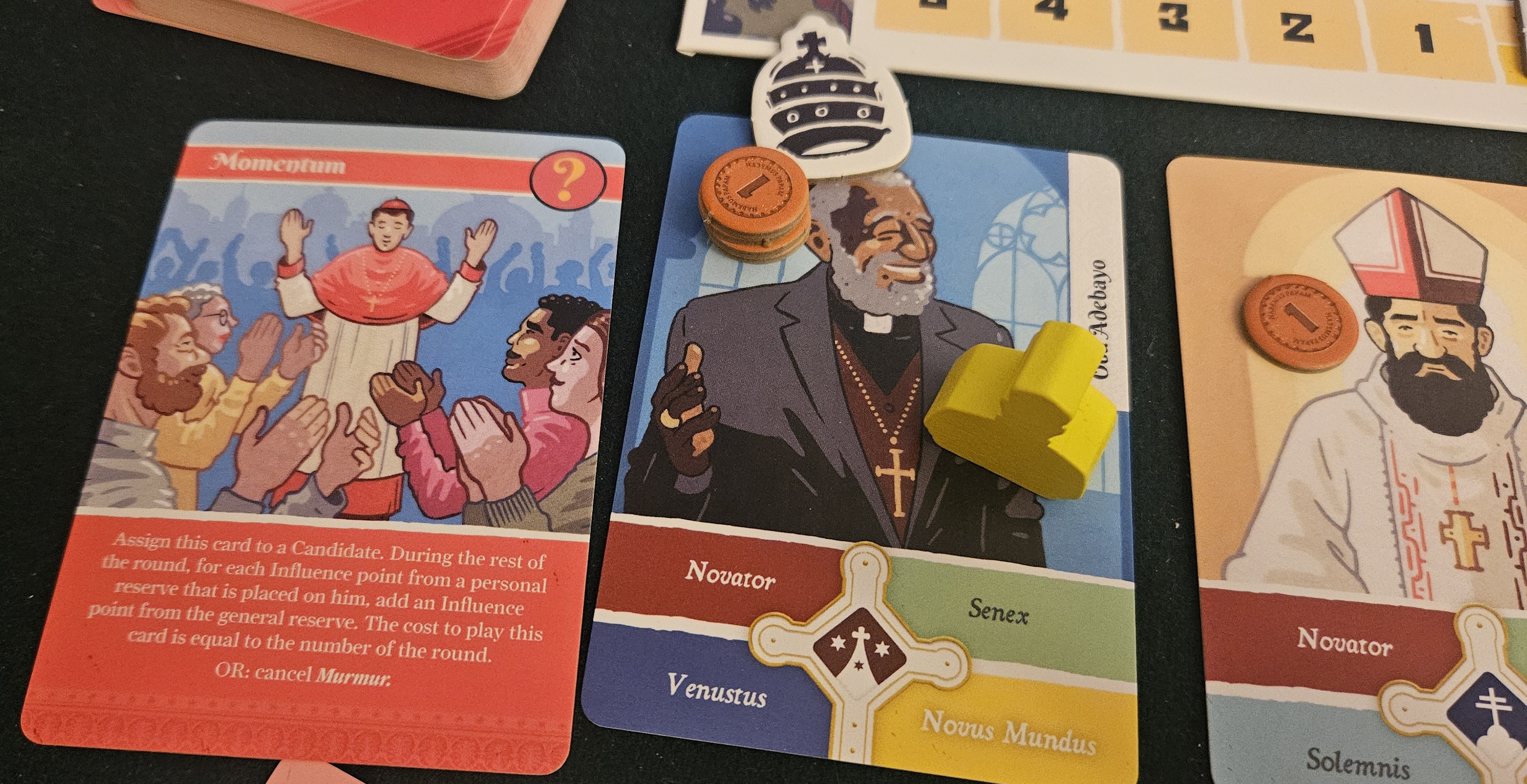
Check out how angry that other guy is, haha.
On the whole, Habemus Papam walks a thin line. There is an undeniable theatricality to the machinations of the Camerlengo, the sturm und drang of its competing objectives, even the lurid expediencies embraced by its cardinals. It has that voyeur’s thrill of peeking into forbidden places and reading between the lines of power. In spite of all that, I wish it had found stronger footing. As it stands, this is another formidable effort from Gradaille and Salt & Pepper — but it’s still a few votes short of papabile.
(If what I’m doing at Space-Biff! is valuable to you in some way, please consider dropping by my Patreon campaign or Ko-fi. Right now, supporters can read big stonking essays on the movies and video games I experienced in 2024.)
A prototype copy of Habemus Papam was temporarily provided by the publisher.
Posted on February 21, 2025, in Board Game and tagged Board Games, Habemus Papam, Salt & Pepper Games. Bookmark the permalink. 7 Comments.

 SPACE-BIFF!
Great review, but what a shame. On the surface this is everything I LOVE about games–public and hidden objectives, up to six players, above-the-table play, 90 minutes. Shame it just doesn’t quite work.
But after this I really want to play Nicaea, but it’s impossible to obtain. Damn you!
To be clear, I feel fairly positively about Habemus Papam! I just think it could have used some additional oomph.
so, did you write the last line of this review first? 😀 I was curious about this game just because of the theme, interesting to read how it works.
Contrary to all expectations, it was the last thing I wrote, only a few seconds before hitting publish!
I’m glad you elected to include it. Not doing so would have been a cardinal sin.
Pingback: 5 on Friday 28/02/25 – No Rerolls
Pingback: Monopoly Ruins a Great Train Robbery | SPACE-BIFF!