Majestic Fifty-Seven

The Pax Series has long been free of Phil Eklund’s original authorship, but Pax Illuminaten, designed by Oliver Kiley, feels like the final broken link in a long chain — or perhaps the final thumb in the old man’s nose. This is simultaneously the most Pax of all Paxes, directly engaging with the Enlightenment thinkers Eklund has always been (selectively) enamored with, and the least Pax, directly descended from P.D. Magnus’s Decktet and eschewing the customary market manipulations for a session of musical chairs in the Bavarian court. It is uneven, sometimes baffling, and, contrary to all expectations, wholly engaged with what made the series so venerable in the first place.
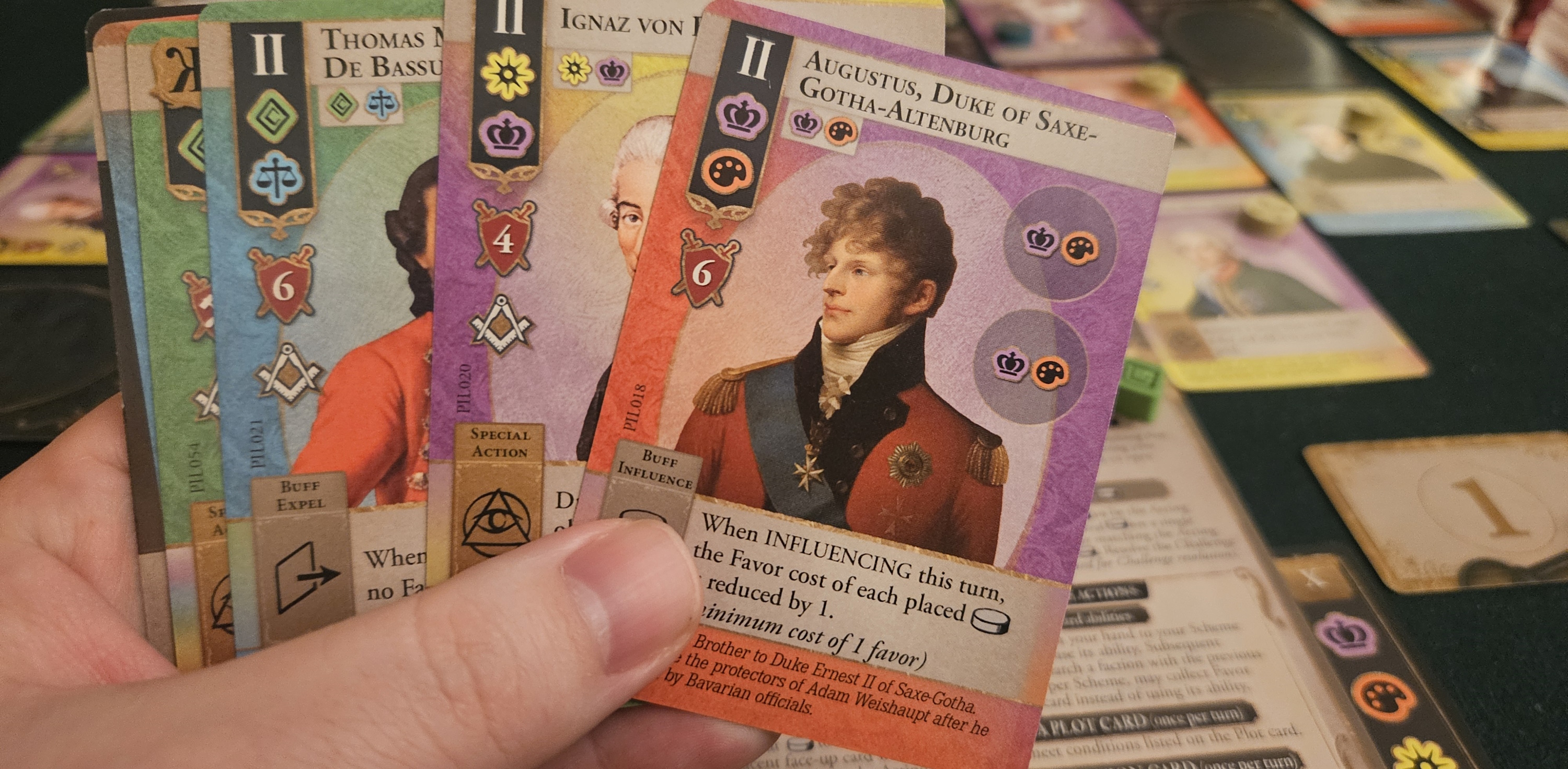
Those are people who died, died.
It is 1776 — yes, that 1776 — and Adam Weishaupt, professor of canon law at Ingolstadt, has decided to found the world’s best-known but least accurately represented secret society: the Bavarian Illuminati.
Right from the word go, Pax Illuminaten stands out for two major reasons. The first is its absence of footnotes or essays, a hallmark of the series since Pax Porfiriana. This absence is striking not because Eklund’s footnotes were especially clear representations of history, but because they provided a metric against which to measure the design itself. Thanks to its copious endnotes, Pax Porfiriana makes sense not only as a competition to fill an impending power vacuum, but also as a treatise on all those enterprises and armies, slaves and serfs, even if the anarchic gameplay does little to reinforce its stated thesis about the evils of holding land in the public trust.
By contrast, Pax Illuminaten tells us very little. As Enlightenment ideals sweep the continent, the Holy Roman Empire exerts a stern hand by suppressing any troublesome clubs or books, hoping to stave off the fervor beginning to grip their neighbors. This, in turn, forces the game’s radicals to act from the shadows.
That’s more or less the sum of it. In keeping its rhetorical cards close to the vest, it isn’t clear what exactly Kiley thinks of these developments. Are we the heroes of this tale or its rabble-rousers? Or perhaps those are much the same thing? Which ideals do we hope to enact, for whom, and to what extent? And would somebody please drop in a miniature essay about methods for extracting copper ore?
Given the response many players have had to Eklund’s essays, including yours truly, this might represent some cautious wisdom on Kiley’s part. But it also lends itself to a certain thematic blankness. Where most Pax games are quick to establish the player’s role, the function of each in-game verb, and the various relationships between its major actors, Pax Illuminaten is vague. We are told that we are areopagites, a far cry from Pax Renaissance’s bankers or Pax Pamir’s chieftains, roles that immediately trigger an instinctive sense. What, pray tell, is an areopagite? A disciple of Adam Weishaupt, of course, and one who hopes to shape the society to our own liking. As is the case for many of the game’s flourishes, however, the context for our dispute is never quite thrown into daylight.
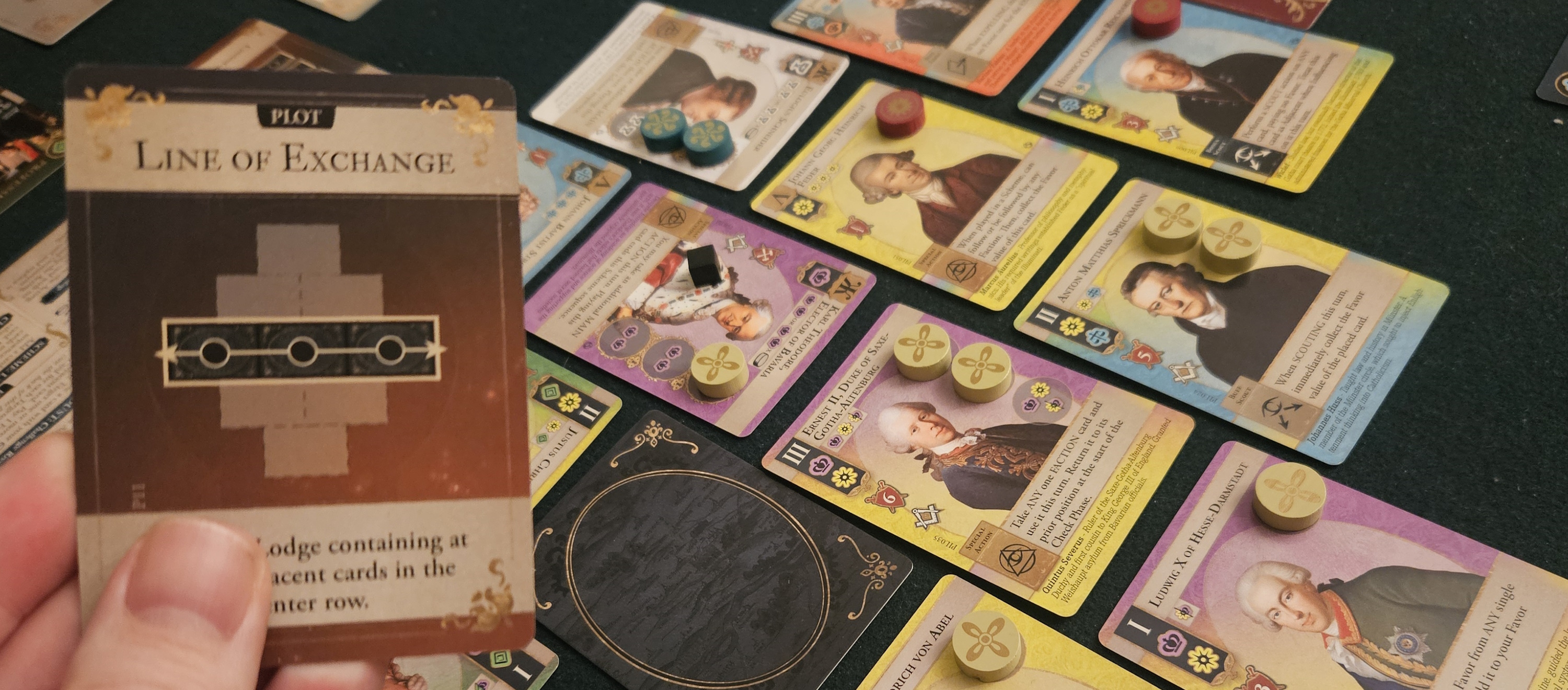
Hatching plots. Why? Don’t think too hard about that.
But that brings us around to the second introductory impression of Pax Illuminaten, that of a social order that does not actually show the slightest sign of cohering.
Over the course of the game’s ninety minutes, we will give shape to the Bavarian Illuminati, scouting out potential members and inserting them into an ever-more-complex web of associations. Once inducted into the order, these luminaries then fall prey to its excesses. They will be extorted for favor with the game’s six factions, shuffled into lodges, jockeyed for political influence, and, eventually, used to fulfill plots that make sense only to those who seek to enact them.
In game terms, the resemblance to most of the Pax titles is stretched. That we are limited to two actions per turn is maybe the closest touchstone. Or maybe it’s that some of the possible actions are burdened with subheaders and provisos. Most are easy enough: scouting a card or placing influence is breezy, giving early shape to our network of conspirators. Others, such as banishing a rival areopagus’s influence or dismissing a card from the society altogether, are more contextual, requiring a firm grasp of the rules or, in the case of contested influence, a brief clash of spent cards that might see both players attempting to trump one another outright. Little by little, our web takes shape, full of plump flies and the little spiders that are our influence discs, suckling them dry. It’s complicated, both to enact and to look at.
Then again, Pax Transhumanity and Pax Emancipation also didn’t look like Pax, once, and these over-complicated activities soon reveal a deeper meaning, one that riddles the entire game with a deep sense of irony.
Namely, that our Enlightenment conspirators are so busy sculpting power to our liking that we aren’t doing any actual enlightening.
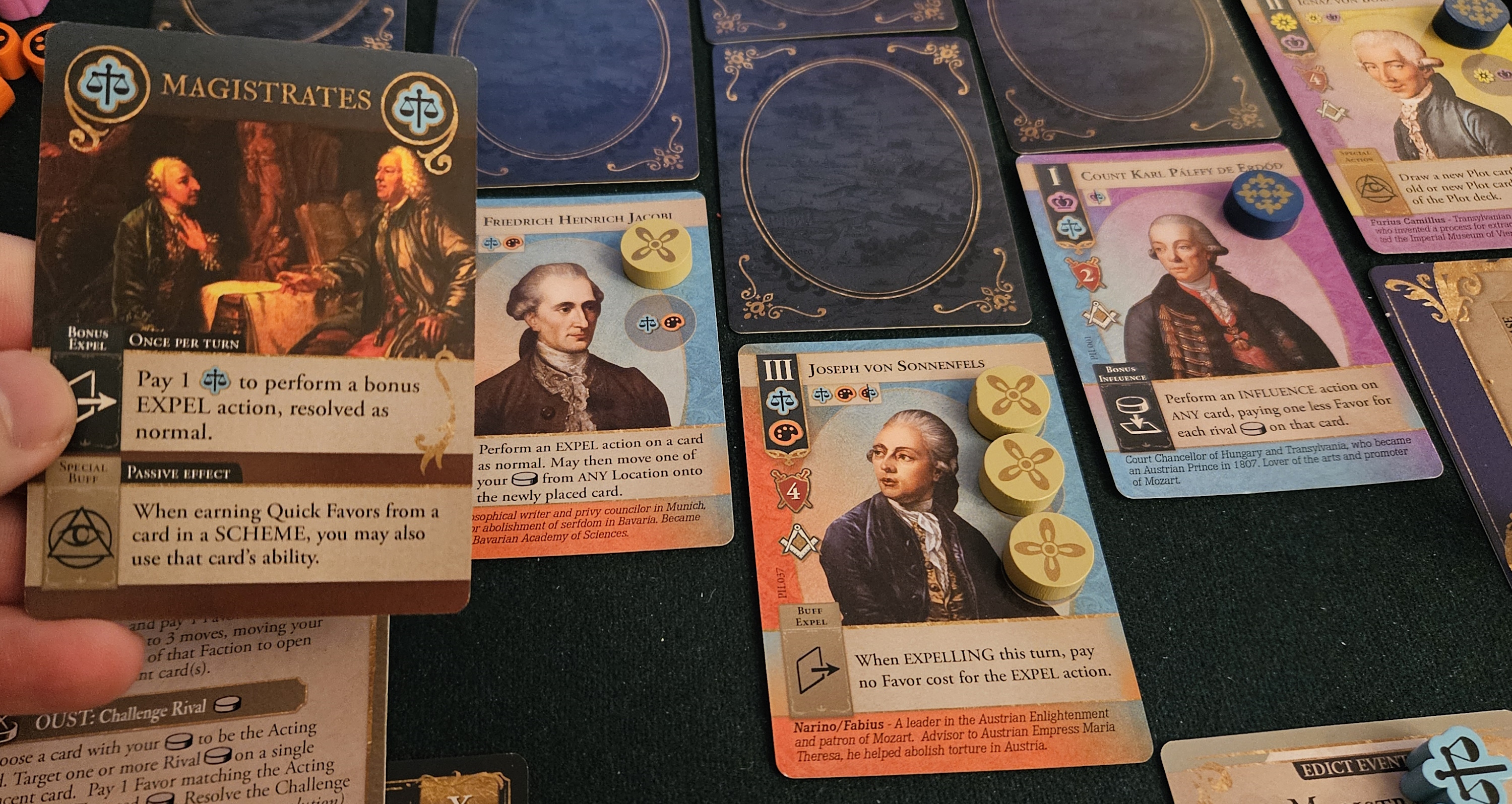
I am the law now.
Nowhere is that core irony more apparent than in the game’s victory conditions. To sway the order to their side, an areopagus needs to fulfill two plots, and every one of them is a logistical headache waiting to happen. At their simplest, we might seek to wield controlling influence over a particular set of cards — three aces, perhaps, or a Freemason within each of the game’s six suits. Others are more contingent, requiring lodges — clusters of shared suits — that span the entire web, or that are contained entirely in the network’s center.
Making Pax Illuminaten very tricky to parse indeed, cards generally belong to two suits at the same time, one of the clearest strands of ludic DNA passed down from P.D. Magnus’s Decktet. This means that any given conspirator might belong to two lodges at any given time, while perhaps simultaneously swearing allegiance to the Freemasons or Rosicrucians. Oh, and their rank, an all-purpose indicator of their relative social standing, also informs which clusters of conspirators can be extorted together.
Pax games have always entangled their incentives, and in this regard Pax Illuminaten not only fits right in at the reunion, but has had T-shirts printed and composed a family anthem. The market is thin stuff, five cards in a row that are gradually reset by a passing chamberlain token, as opposed to the dynamic rivers that are the hallmarks of other Paxes. But then one realizes that the tangled web is the market, the players’ influence discs the speculations, their movements the buyouts and purchases. In that light, the tableau on the table is closer to the marketplace of Pax Transhumanity. Its alterations are more glacial than in most of these games, but no less significant.
Which brings us right back around to these areopagites and their plots. There has always been some degree of tension between this series’ textual and ludic rhetoric, between what the games say they’re about and the alternate histories they play-enact on the table. Pax Illuminaten doesn’t say much on the page, but on the table it expresses reservations about reformers who spent so much time fiddling with secret societies that they didn’t get around to much reforming. To be clear, the cards indicate that certain luminaries were staunch supporters of the Enlightenment, that they founded academic institutions or lobbied for the liberation of serfs. Some of these individuals accomplished magnificent things, whether by enacting social programs, composing symphonies, or writing literature and philosophy. But as a society the Bavarian Illuminati was persnickety and unfocused, obsessed with spycraft and secret signs, and was smothered through noble edict before it had reached its teens.
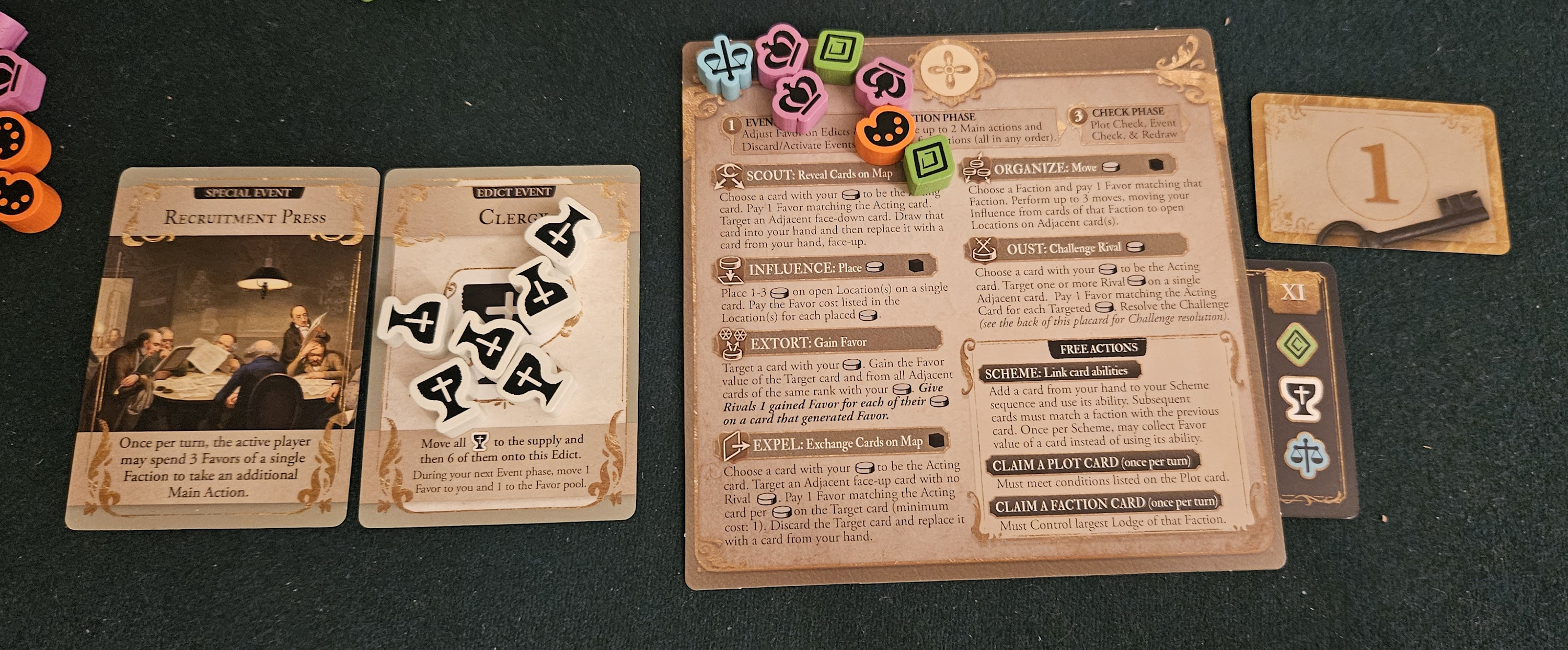
The man crackin’ down.
Pax Illuminaten, then, is peculiarly apt as Pax games go. It is at once an exemplar of this genre’s obsession with entanglement and middlemen, but entirely disconnected from what we might call their accomplishments. There is no moment, for instance, when one is called upon to commission a generation-defining work by Mozart, Goethe, or Herder. Instead, this is a game about hobnobbing with them, leaning on them for influence, straining your relationship for their connections.
Nowhere is this more apparent than in the way cards are deployed. Either they can be added to the shared tableau, where their associations and membership in lodges becomes all-consuming, or they can be burnt from your hand to enact schemes. These function like beaded strings of free actions, additional perks, and windfalls of resources, with each played card permitting or preventing the next. Cards spent on schemes can only “follow” members of their same faction. Some, aces, can follow and start any thread, while others, crowns, always terminate them.
This makes turns testy and uncertain. One can never be sure whether somebody will spend their two actions tweaking their favors or potentially unleashing a range of society-altering cannon shells. Its closest kin would be Pax Pamir, where somebody might leverage the current political climate to unleash multiple free actions. Here, those actions are easier to access but no less impactful, often allowing major upsets on the board. That these rearrangements feel like variations on a courtly dance is all the more suitable to what Kiley seems to be saying with Pax Illuminaten. When one conspirator is swapped for another — say, the Austrian poet Aloys Blumauer being ousted from the order to make room for the statesman Maximilian von Montgelas — everybody leans forward, assessing what this change means for the society.
By which I mean for the Secret Society. Never for Bavarian society at large. Because Pax Illuminaten is not about grand statements and great men, at least not the way other Paxes have been. It’s about great men outing themselves as petty and introverted, about fussing over who gets to sit near whom at the dining table, about starching one’s cuffs while the fabric frays to tatters. Where other entries in the series are paeans to capital or dirges of imperial power, Pax Illuminaten is a comedy of self-absorption.
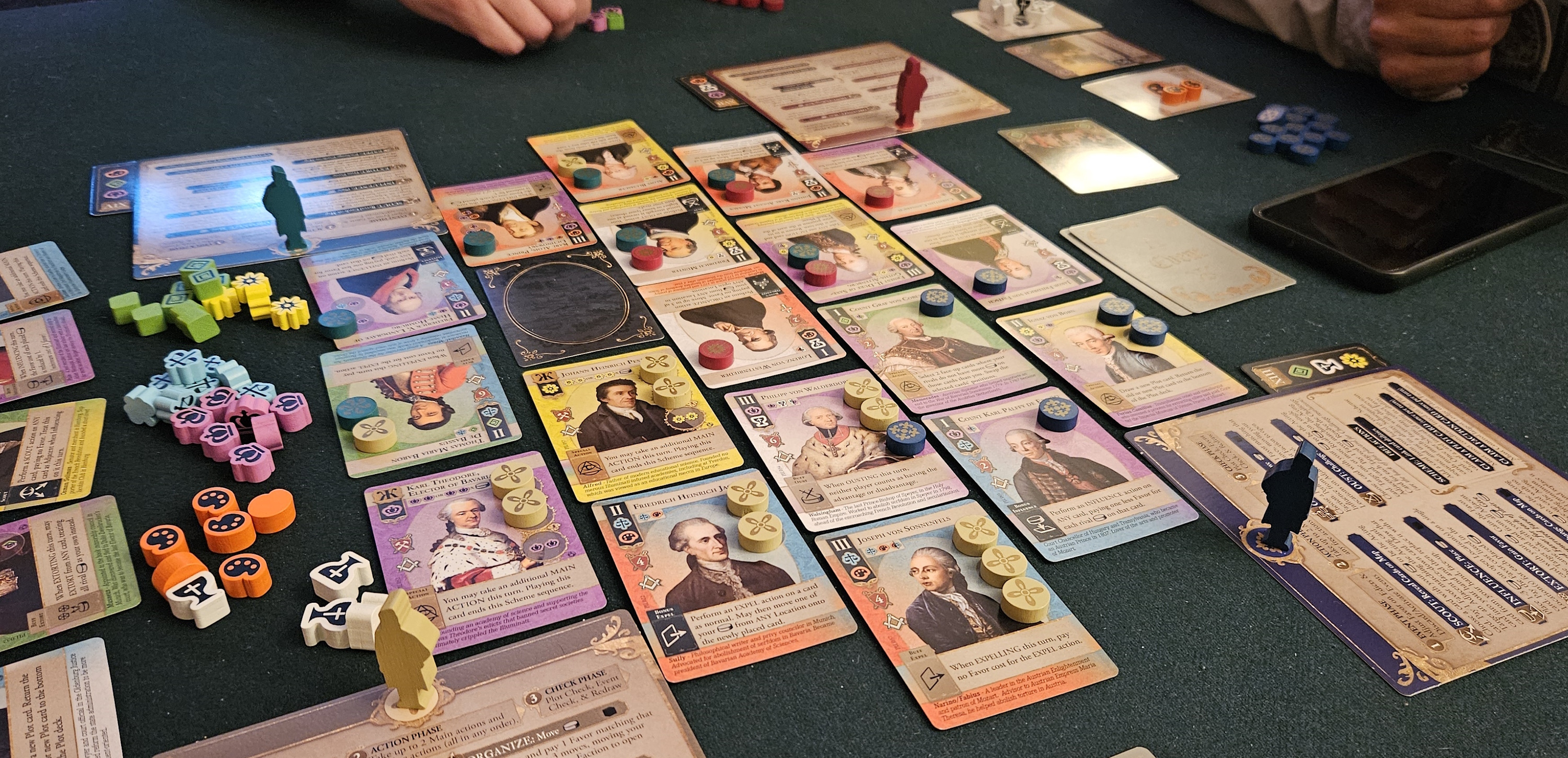
Information comes at you hard and fast in Pax Illuminaten.
Does it feel like Pax? Less so than Pax Penning, more so than Pax Emancipation. I’ll leave it at that. As a series, Pax has always shrugged off orthodoxy like an unwelcome hand on the shoulder. It’s not an especially interesting question.
As a game it fares well, though not without reservation. Make no mistake, its origin as a game about suits and ranks is never far from mind, and one suspects you could repurpose its peculiar deck of fifty-seven cards into a serviceable trick-taker with very little effort. Still, there are deep pleasures to be mined from its crystalline maze of relationships. Sending Mozart to enact your schemes, fulfilling a plot that has no bearing on the world beyond your closed doors, even turning an elector’s edict to your benefit — these are evocative despite the game’s limitations to the contrary.
That evocation, however, is purposely limited. In the same year that marked the beginning of the revolutionary age, the Bavarian Illuminati busied themselves shaping power according to their own incomprehensible logic. There’s a reason nobody thinks of Adam Weishaupt when they hear the word he coined for his secret society. Pax Illuminaten opens a window onto how such a paradox came to be, a portal that’s at once strange and skewed, but in its own way illuminating and prismatic.
(If what I’m doing at Space-Biff! is valuable to you in some way, please consider dropping by my Patreon campaign or Ko-fi. Right now, supporters can read a 3,000-word overview of the forty-ish movies I saw in theaters in 2024.)
A complimentary copy of Pax Illuminaten was provided by the publisher.
Posted on February 5, 2025, in Board Game and tagged Board Games, Ion Game Design, Pax Illuminaten. Bookmark the permalink. 10 Comments.

 SPACE-BIFF!
Thank you for this! I sometimes struggle with games descended from the brain-children of those I find… let’s politely say “individually problematic”. Pax (colonialism apologist) and COIN (former CIA) are my primary examples. The more distant the descendants become, the more I’m interested in seeing what those descendents do.
Happy to help!
Thanks for the review! It brings back memories of when we first discovered Illuminati Deluxe—a strange and fascinating alternative to Settlers of Catan. Now, I!mthinking how intriguing design challenge would be to adapt its wild mechanics to modern standards. An even greater challenge might be whether its thematic framing—such a crucial part of its chaotic narrative—can stand the test of time. It was a very different era, after all, when our biggest uncertainty was the looming Y2K bug.
… That’s the first time I’ve ever heard Illuminati described as an alternative to Catan! (But I think you get your drift, you were meaning more another discovered branch of gaming, rather than a replacement).
Nonetheless, I was recently thinking the same thing—it would be interesting to see Illuminati updated to the 21st century—not only changes to the characters and settings, but in game mechanisms as well (the old “roll and fight” maybe could be adjusted in some cleverer way?)
Either way, beyond theme, I suspect these two Illuminati/en games are really only linked in subject matter—and the themes of each might actually be polar opposites (Illuminati secretly rule the world vs. Illuminati openly can’t even rule themselves)!
Comment
It’s funny that you mention Steve Jackson’s (SJ) Illuminati. That was one of the first designer “hobby games” that I purchased – probably back in 2001 or so. Still have incredibly fond memories of it, we played it quite a lot. It was kicking around in my mind, more as juxtaposition than anything specific, while working on Pax Illuminaten. The SJ version obviously leaned into the conspiracy side of the tale, where this is rooted more in its historic context – but there are similarities. They both feature a “power structure” of sorts that generate resources and key into your victory condition – except here it’s shared rather than individual. Interesting to think about comparing and contrasting the two.
The game shares a lot of mechanical similarities with Impulse by Carl Chudyk, which I really enjoy. Bonus points to the design team for including some extra Illuminati-themed elements in the box!
I’m considering doing a review of the game’s SEEECREEETS.
No mention of the solo mode? Pretty bad review
Pingback: Space-Cast! #44. Enlightened | SPACE-BIFF!
Pingback: Knizia & Kiley | SPACE-BIFF!