Imperium: Kobayashi Maru

More than most fictional settings, Star Trek lends itself to what-ifs. Mirror universes, alternate dimensions, and time travel play a big role in making the final frontier ever more expansive, but we don’t even need to breach the time-space continuum to find uncomfortable alliances and enemies-turned-friends. In its messiness, Star Trek has always been playful. Ever wondered what would happen if a dilithium leak briefly tricked an intoxicated Commander Sisko into courting Lursa Duras? Me neither! But there’s a non-zero chance that someone in the writer’s room drafted an entire Deep Space Nine episode about that very scenario.
Star Trek: Captain’s Chair swims in those possibilities. Designed by Nigel Buckle and Dávid Turczi, and built around the deck-building system they unveiled in Imperium: Classics, Legends, and Horizons, this isn’t the first board game to bottle the spirit of Star Trek, but it is perhaps the one that most exemplifies its endless possibilities.

Hey hey! It’s the market from Imperium!
Right up front, I will say that the game doesn’t benefit from its unifying fiction. According to the rulebook, you’re a cadet at Starfleet Academy in the 32nd century, and all these characters and places, discoveries and species, disasters and ships are details programmed into a massive simulator. (A simulator that somehow omits Captain Kirk, but let’s grant them their expansion material.) It’s a Kobayashi Maru with extra polygons.
I hate that. Because, look, this is Star Trek. I’ll say it again: this is Star Trek! There needs be no other raison d’etre for you to build a crew that sees Phlox rubbing shoulders with the hologram Moriarty and a pack of Tholians. Stranger things have happened during the regular operating hours of your average Starfleet vessel.
While I’m at it, Captain’s Chair imports some of its predecessor system’s biggest problems. The setup has been streamlined, no longer requiring quite as much tinkering with all those individual decks, but there are still so many little steps that it sparks a mighty ache in my forehead ridges. Meanwhile, Buckle and Turczi do little to curb the information-dumping that dominated the cards in Imperium. If anything, they’ve set their ship to maximum warp in the other direction. Even after five sessions with the thing, there are moments when my eyes glaze at the sight of all those little text boxes.
Here’s the turnabout. For the most part, that complexity is necessary. Beneficial, even. Despite the sheer more-ness of it all, despite the occasional ambiguity, despite the minor but crucial distinctions between similar-sounding keywords, Captain’s Chair is replete with cards that feel distinct, that build unexpected but exciting combos with other cards. That, in the end, produce a sense of place and character with admirable clarity.

The splashy addition is that Captain’s Chair is also a lane battler… sorta.
It begins with a captain. Captain’s Chair is generous with its options, another inherited trait from Imperium. There are six commanders to choose from. Starfleet legends Picard, Sisko, and Burnham hobnob with the Andorian Shran, the Klingon Koloth, and the Romulan Sela.
These are the equivalent of Imperium’s civilizations, right down to the distinction between the cards in their starting decks, those that are added randomly whenever you shuffle, and late-game developments that can be purchased for the precious resources you’ve accumulated — all in addition to the neutral cards that can be purchased from the market over the course of the game. For those unacquainted with Imperium, that likely sounds like a lot. It is a lot. Some degree of future shock is inevitable.
But these custom decks perform much of the legwork in advance. Every captain arrives with the tools they need to succeed. Koloth, for instance, earns points through aggression, whether by wiping out rival away team members or securing contested planets. His starting deck is packed with tools of war: the I.K.S. Klothos, with its rapid deployment; the warrior Krell, with his ability to scan for weapons from the cargo deck; Klingon disruptors, good for eliminating Starfleet meddlers. Over time, new cards will trickle into his deck, such as the mining colony Rura Penthe or the rare Klingon scientist Mara. By the end of the session, Koloth will be picking from prototype cloaking devices to outright eliminate rival ships without threat of retaliation or the points-rich Sword of Kahless.
Every captain is like that. They have their own ships, their own crew members, even their own crises that must be handled lest they continue to hound your deck or threaten early failure. Helming the Enterprise as Picard feels tangibly distinct from being a xenophobic prick as Shran.

Leveling up my captain’s science, negotiation, and killmongering.
The real beauty of the system, though, is the way it allows these characters to develop and change. As you might expect, the philosopher-captain Picard is averse to direct conflict. Depending on your foe, conflict might not even be a major consideration. But when it comes around, you’d best believe that Picard will need to adapt to the situation.
The flashpoint for these conflicts, as well as the biggest addition to the Imperium formula, is a row of contested neutral planets. These are valuable for a variety of reasons. Points, sure, but also… well, it depends. Betazed, with its race of empaths, can help any prospective captain race up their negotiation track. The criminal syndicate world Verex III, by contrast, is a great place to disappear characters that otherwise don’t fit into your deck, and earn some gold-pressed latinum while you’re at it. Risa is similar, letting you “beam” characters down to its surface for a sex vacation.
But the similarity between Verex III and Risa is one of a hundred opportunities to show off Buckle and Turczi’s more-is-better ethos. Because while both planets are useful for removing unwanted character cards from your deck, they accomplish their functions in dramatically different ways. Verex III is opportunistic: your character must be either in-hand or in your play area, they are removed permanently, and you earn two latinum cubes in exchange. Risa, as a pleasure planet, lets you send three people to its surface. From anywhere. Your hand, your play area, your discard pile, your deck. Perhaps more importantly, you can pay a latinum cube to bring them back. In Captain’s Chair, there’s an actual gameplay distinction between a vacation and selling somebody to a cartel.
That distinctiveness extends to everything. All twenty planets. Every character. Each of the weird alien races you can court as allies. Every item of cargo, every ship. The only thing missing is the possibility of romance. I mean that. There are weird adventures aplenty, right down to points-draining incident cards that can often be leveraged for some benefit and encounters that are worth heaps of points and bestow game-changing abilities. But a chance for Beverly Crusher to fall in love with a ghost? Sadly absent.
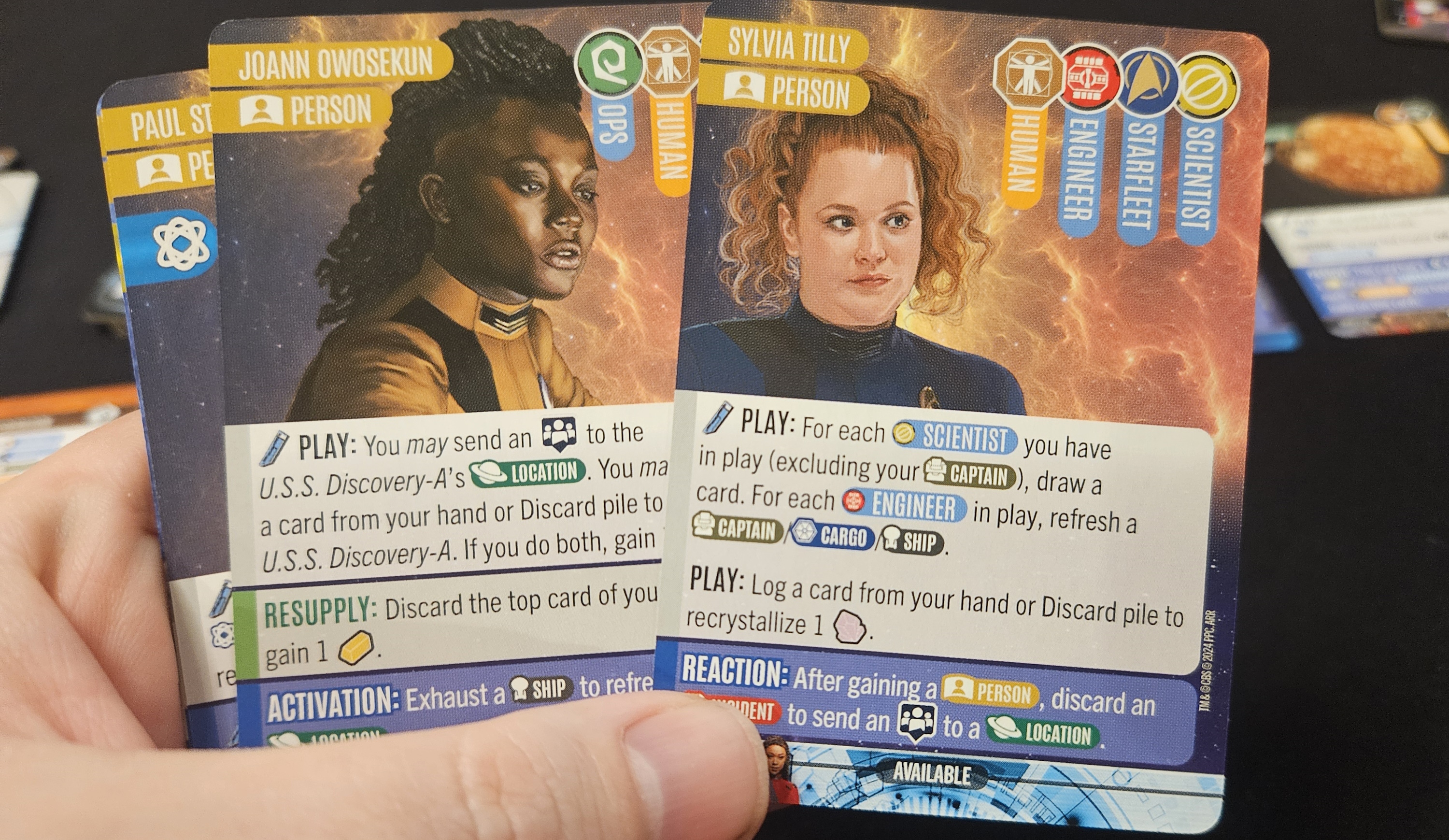
The cards are total infobombs.
Which brings us back around to our peaceable Captain Picard. When a session squares him against Burnham, there won’t be much need to set phasers to anything other than stun. In such matchups, the lane-battler over planets can feel empty, even vestigial to the design as a whole.
But when squaring off against a more vicious foe, Picard may need to alter his approach. This is where all those neutral cards in the marketplace come in. Instead of yielding Risa to the Romulan Star Empire, Picard can begin hunting for cards that will shore up his weaknesses. Perhaps Admiral Jarok will decide to turn against Sela and help Picard beef up his combat skills. Maybe he’ll enlist a Kazon Raider to deplete his foe’s hand. Or maybe he will be forced to smuggle Ferengi Wine to earn enough latinum to deploy a steady stream of troops from Tulgana IV to the Neutral Zone. Indignity!
Combat isn’t a captain’s only possible weakness. Points can be earned from a wide variety of places. Possibly too many, if I’m being honest — when played against a live opponent, assessing your relative standing or where to apply pressure often feels impossible. Still, this breadth allows Buckle and Turczi to run wild. As an aggressive leader, it can be easy to earn points by conquering planets and zapping redshirts, but more sustainable options, such as moving up your captain’s tracks to maximize the value of your deck, are often difficult to attain. While Picard is having his “In the Pale Moonlight” moment, jerks like Koloth and Sela must often pursue supplemental scoring opportunities.
This gives Captain’s Chair an improvisational air. Your narrative arc may be somewhat predestined, both in terms of the cards in your default deck and the missions attached to your captain board. But there is room to wiggle. The effect is not unlike playing as some of the more concept-driven decks in Imperium. In my review of Horizons, I wrote about the Inuit, whose development was locked into a seasonal rhythm. Captain’s Chair isn’t quite as gimmicky, but it leans hard into each captain’s unique ethic while still allowing them room to depart from the template.
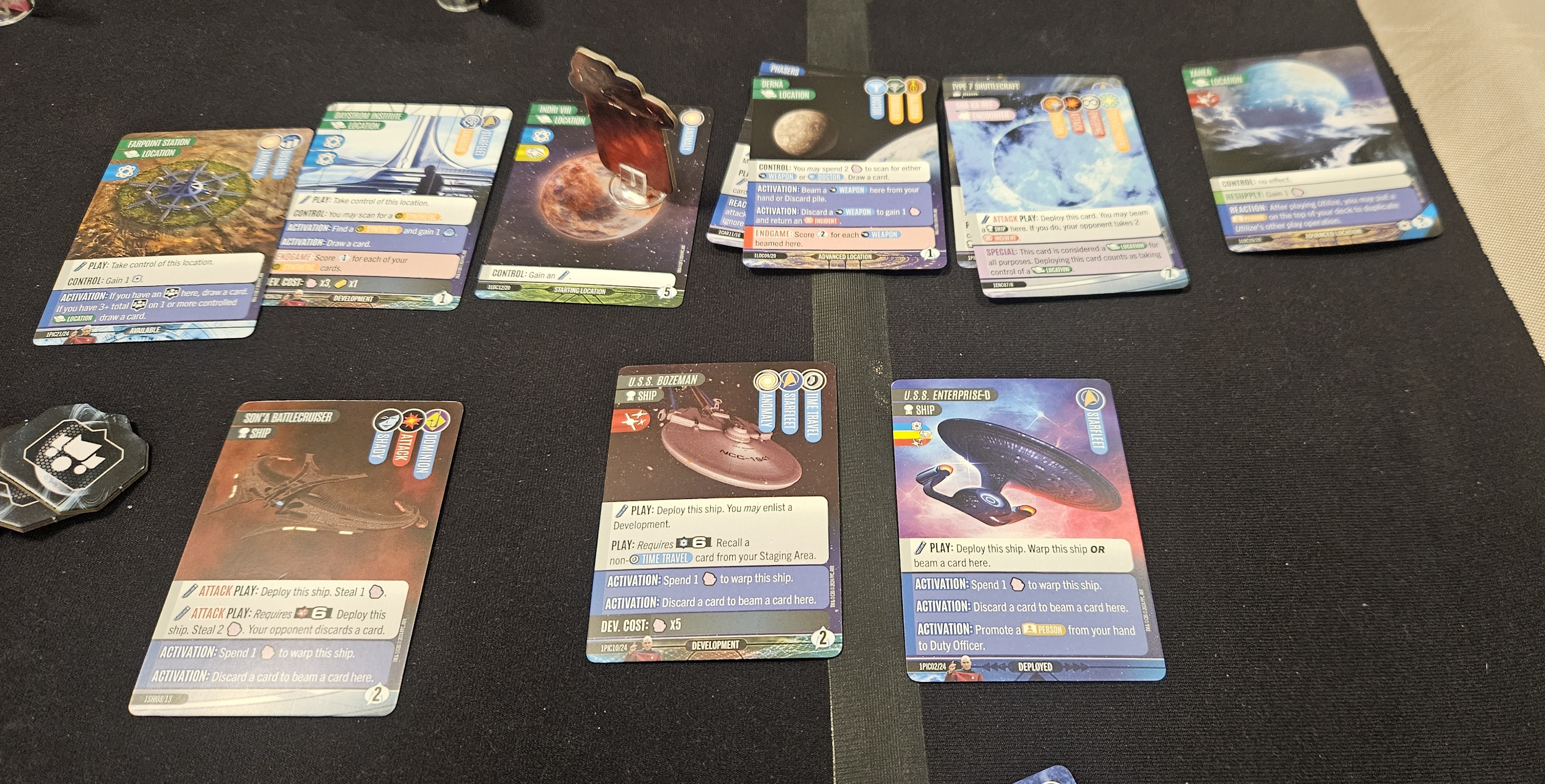
Two-thirds of a late-game tableau.
Let’s talk play modes. There are two main ways to sit in the Captain’s Chair, either solitaire or as a duel between two players. And frankly, this is an excursion that’s best enjoyed solo.
To be clear, the two-player mode isn’t bad, and it’s a sign of awareness on Buckle and Turczi’s part that they snipped out any possibility of playing Captain’s Chair with three or four. I’ve sworn off playing Imperium at those counts for the same reason they’re omitted here. Namely, that turns are thoughtful. Which, yes, is also a nice way of saying that they’re very long. With no threading between actions, Captain’s Chair suffers from long pauses in between turns. It’s possible to examine your cards in advance, of course, but there are a number of ways to draw from your deck or acquire new options from the market. This makes turns reactive, with players riffing on new discoveries or allies as they appear.
Those problems disappear in solo mode. I’d even go as far as to say that this is a game that benefits from quiet consideration. Cards have so many options that it’s liberating to allow yourself fifteen minutes to examine every possibility. To give you some sense of the game’s scope, nearly every character can either be used for its play action or promoted to a duty officer to access some ongoing benefit. Nearly every ship can be stationed in orbit around a planet, have characters warped onboard, or move between locations. Even claimed planets often fold into your tableau, with ongoing benefits for captains who bother to send away teams to their surface. There’s so much to take in that the pressure mounts whenever somebody is breathing down your neck to wrap it up.
Meanwhile, the solitaire bots don’t breathe at all, let alone complain about how you’re responsible for their doomscrolling because it’s been twenty minutes since they last glanced at their hand. They’re handled via the same system that governed Imperium’s solo civilizations. Each turn sees them drawing a few cards and consulting a flowchart to trigger various actions, attacks, and acquisitions. They’re automated time bombs that sometimes throw confetti in your face or swipe something from the market, and the game’s emphasis on tags makes it all the easier to follow their commands. Imperium’s solitaire mode was always formidable, if sometimes finicky. Here, the bots are tougher and less prone to misreading which priority ought to trigger first, resulting in sessions that are a cinch to handle. After the requisite icon-learning and familiarization, anyway.

Monday in the Neutral Zone.
All told, Star Trek: Captain’s Chair is intoxicating in its scope. Buckle and Turczi have expanded their system to the nth degree. In the process of running wild, sometimes they spring a little too far, packing in effects that are perhaps too minute in their distinctions or cramming one too many text-boxes onto this or that card.
But that same rush is also the game’s greatest strength. Captain’s Chair captures the sheer expanse of Star Trek, its creativity, its diaspora of ideas and images and people. For such a small box, it is incredibly generous. More than tactical combat or space empires, this is what I want from Star Trek, an intimate and dense sense of character and place. Bring on Kirk, bring on Janeway, bring on the romantic subplots, and I’ll catch every single episode.
(If what I’m doing at Space-Biff! is valuable to you in some way, please consider dropping by my Patreon campaign or Ko-fi. Right now, supporters can read a 3,000-word overview of the forty-ish movies I saw in theaters in 2024.)
A complimentary copy of Star Trek: Captain’s Chair was provided by the publisher.
Posted on January 28, 2025, in Board Game and tagged Alone Time, Board Games, Star Trek: Captain's Chair, WizKids. Bookmark the permalink. 11 Comments.

 SPACE-BIFF!
One paragraph in, and I knew I was doomed to buy this. The temporal narcosis has me by the nacelles.
Please tell me there’s a Plain, Simple, Garak card!
Weird. It gave me a random name. This is Len though. From previous comments sections 🙂
Behold!
That is so effin cool. Am I reading the card right, that seems like a very powerful ability?
Yes! It is very powerful. Note that it’s a late-game power. Development cards must be purchased, and that’s after you gain all the cards in your reserve deck. So Garak won’t be allying with Sisko until fairly late in the session.
I think about the simulator framing this way: so much wild stuff happens in the Star Trek universe that Starfleet has to legitimately train its officers on things like “what if Sisko had a Borg Cube”.
Oh, I have no doubt! It’s just that I prefer to think about my time in the game as something that “actually” happened. Because why couldn’t Sisko return from the Bajoran Wormhole with a Borg Cube?! That’s, like, one whole episode right there!
Sisko having a Borg cube IS really interesting. Because, on the one hand you have Wolf 359 and how he’d probably work to destroy it or dismantle it the first chance he got. HOWEVER, we all know that Mirror Universe Star Trek characters have facial hair (and/or more daggers) as the clear giveaway that they’re from another timeline full of darker impulses. YET! Sisko starts out clean shaven (reminding Picard of this role in 359 in early DS9), and eventually grows out the goatee. (I won’t accept Picard in his All Good Things beard as a counterpoint. That was just for good practical effects.)So, I guess it would depend on Sisko’s level of facial hair in how he’d handle having a Borg cube. Right???And maybe the facial hair development was a small nod to how things in that show got incredibly dark/realpolitk as time went on.
(historical re-enactment of Len in the DS9 Writer’s Room for a full 30 seconds before Paramount security arrived).
P.S. can i get a photo of Sisko’s card to make a judgement call?P.P.S. the game is arriving tomorrow. As usual, Dan costs me money in the most erudite board game commentary online.
Here you go! Please note, Sisko is inherently different from Garak, card-wise. As commander, he is never shuffled into his own deck. Instead, he sticks around in the tableau forever, availing his crew of his actions and benefits.
A wonderfully nuanced review as always, Dan! Very glad to have been able to pick this one up. Picard has his cadet outing last night and I’m working up the courage to try a match against the bot.
Thanks again for all of the hard work you do to provide the best critical commentary in the biz!
Awesome, I’m so glad that you’re enjoying the game! Thanks for reading!