You Merely Adopted the Mist

Remember when Mistborn: House War made the uncomfortable decision to cast its players as the eugenicist oppressors of Brandon Sanderson’s much-loved fantasy series?
Oh, you don’t. Well, I do, and that’s the first thing John D. Clair’s Mistborn: The Deckbuilding Game has going for it. This time around, you’re an actual mistborn, a metal-guzzling, glass-dagger-stabbing, high-flying superhero in a goofy tassled cape. That’s all good stuff, but the real draw is the way Clair turns the deck-building formula on its head and even remediates one of its long-standing deficiencies, once again proving himself one of the hobby’s most overlooked innovators.
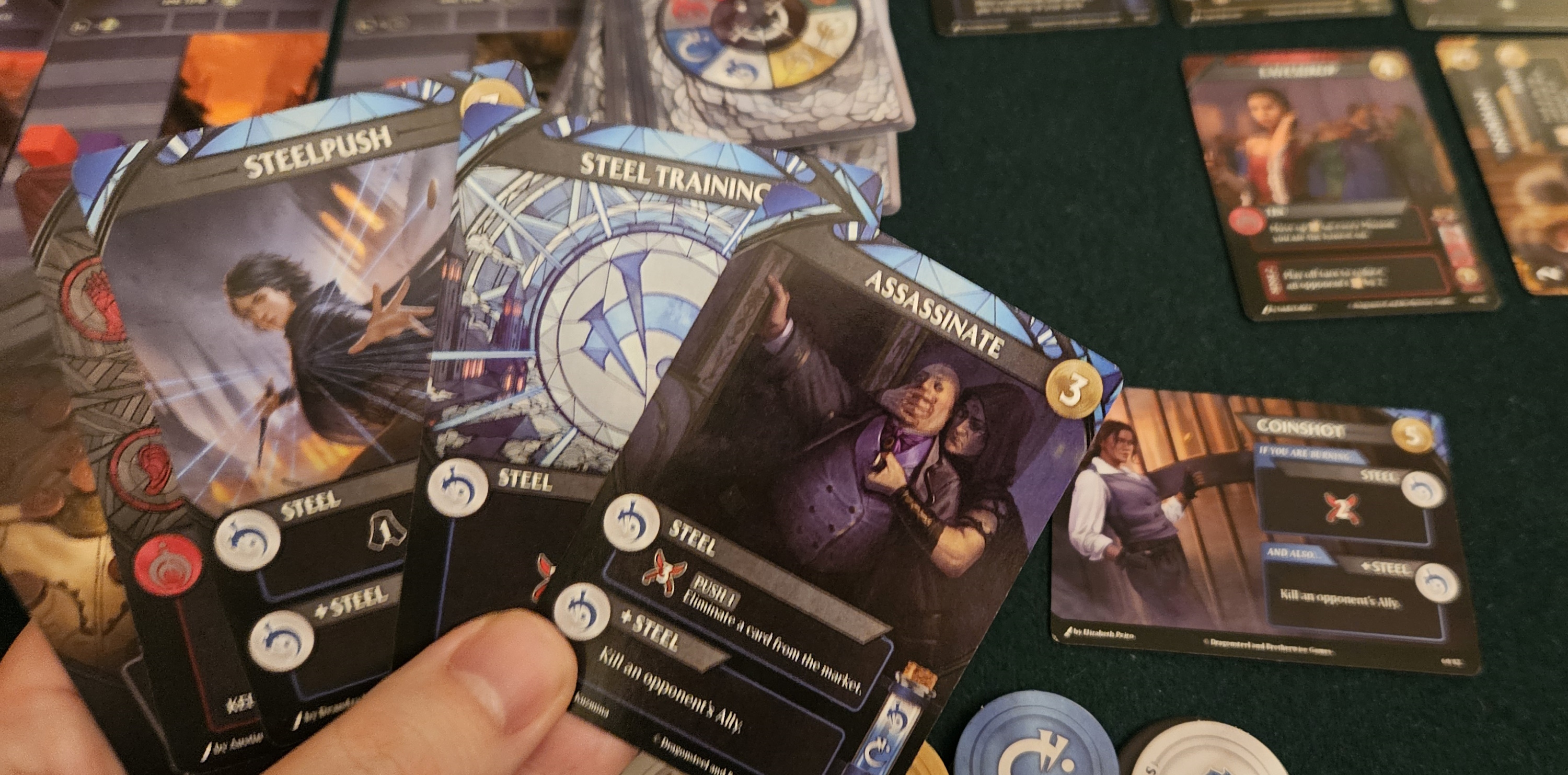
The cards represent verbs that your hero performs. Neat.
I won’t go into the particulars of Mistborn, but the gist should be clear enough to anybody who’s ever stepped into soft-soled wizard boots. You’re a mistborn. There are enemy mistborn. Go down, thou mistborn, and kill.
Even as set dressing, though, Clair understands the importance of tying everything to a single coherent context. Where most deck-builders are a thematic grab-bag, everything in Mistborn makes immediate sense. Cards represent one of two things, either allies that stick around to provide ongoing benefits and absorb hits, not unlike the starbases in Star Realms, or actions that your character has learned to perform, such as withstanding crippling damage or eavesdropping with supernatural proficiency.
These latter abilities make up the bulk of the card offer, transforming your character from initiate to full-fledged warrior. As in Sanderson’s fantasy world, each power is connected to one of an assortment of metals. The short version is that by imbibing and “burning” these metals, gifted individuals can perform various feats, such as pushing themselves off of pennies to fly through the air, chewing on zinc to inflame riots, or simply shielding oneself from observation. While most people are only gifted in a single metal, mistborn are the folks who can snack on any alloy they can lay hands on. Nifty. Also expensive.
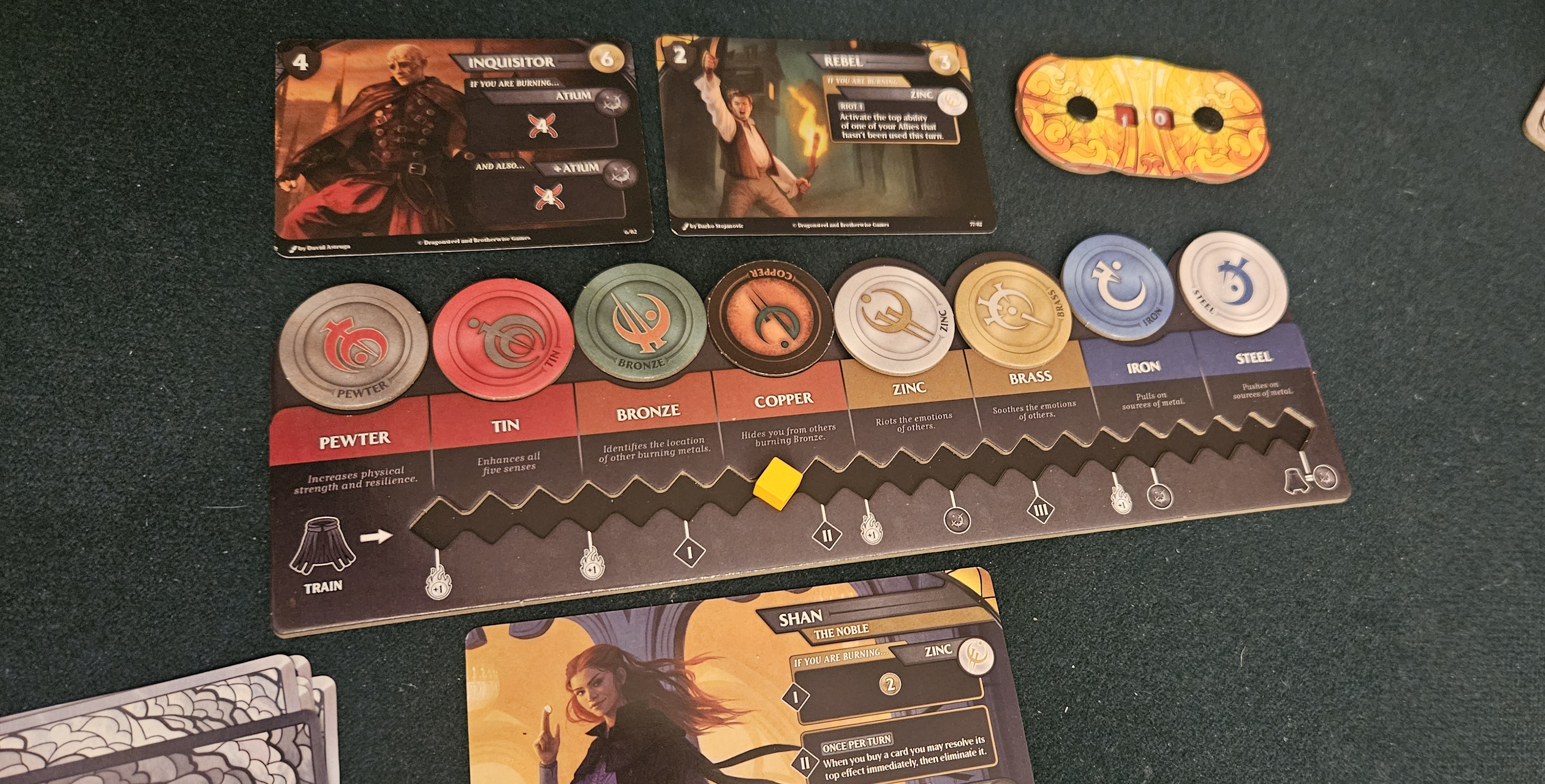
I have dice in every one of these metals.
In game terms, this has a few ramifications. Like some fantasy-themed Batman, you begin with a utility belt of eight metals. These are the first and most important of the game’s resources, letting you activate your various cards. Early on, you can only burn a single metal at a time. If you want to trigger additional cards, you’ll need to “flare” metals, temporarily preventing them from refreshing until you discard something, which I think represents swinging by the allomantic apothecary to pick up some spare iron filings.
Little by little, your character hones their talents. There are gradual level-ups that let you burn additional metals, removing the need to flare your precious supply, and additional cards can be purchased from the market, adding dimension and range to your abilities. With cash, of course. If you couldn’t tell, this game has quite a few resources to track.
What’s more, those cards can usually be boosted by spending more of its associated metal. Since your utility belt only holds one of each flavor, you’re soon required to spend other cards of the matching type. For example, the Infiltrate card burns bronze for its basic attack. With an extra vial of copper/bronze provided by another card — say, a now-underpowered Pursue — it both increases its damage and lets you move up one of the game’s mission tracks. It’s a clever system, analogous to the reveal effects on the cards in Dune: Imperium, churning weaker cards into fuel for more efficacious fare.
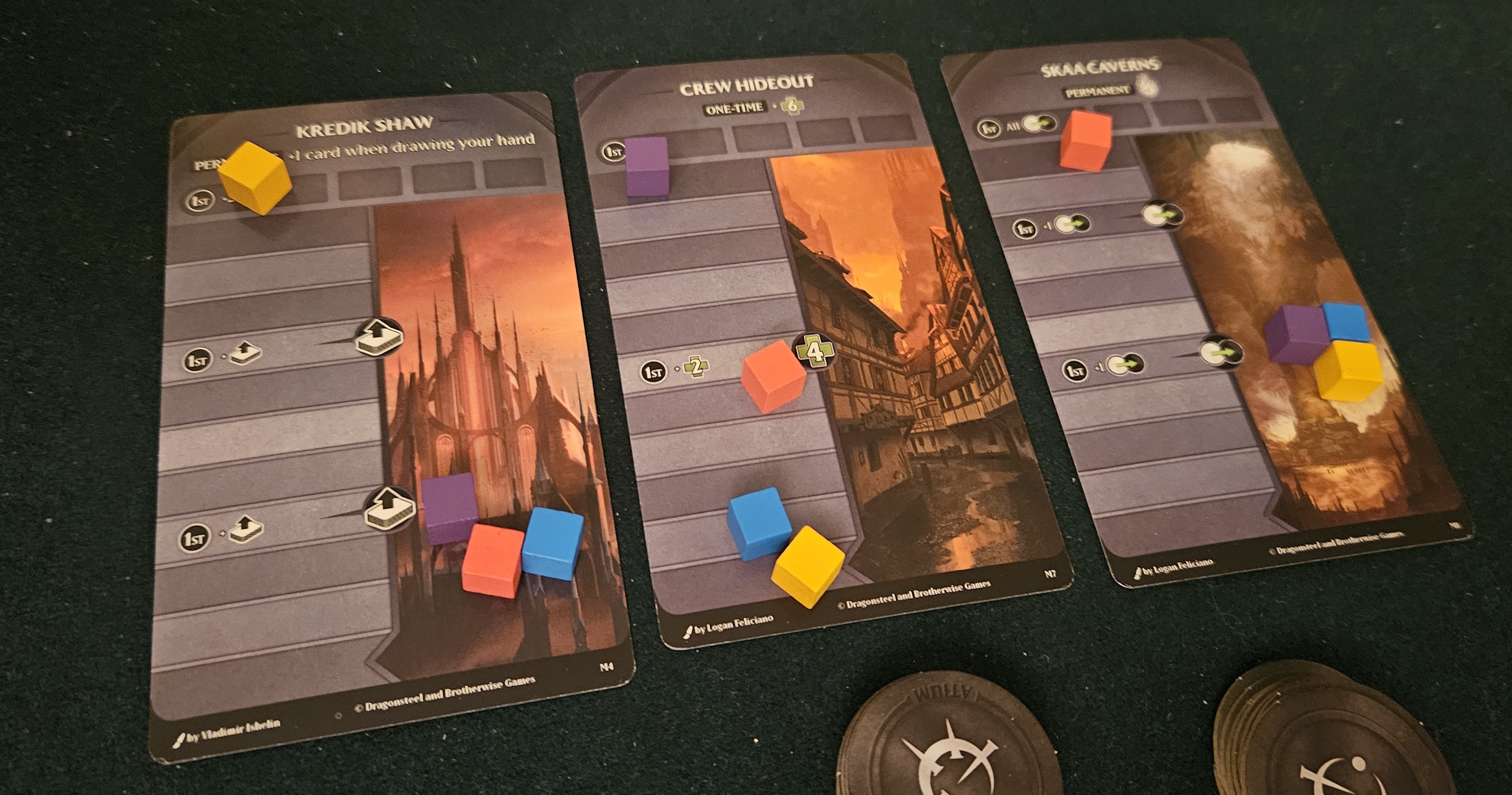
Missions could have used more pizzazz.
For a deck-builder, this is smart. As anyone who’s played one of these games knows, they’re often less “deck-builder” and more “deck-winnower,” as it’s often necessary to prune your card pool down to a skeleton to trigger your best stuff as often as possible. Clair’s metal system encourages players to broaden their sights. Early on, those limited metals encourage diversification. Later, as you develop the ability to burn more stuff at once, deepening your pool so you can enhance any given ability becomes a must. It’s an arms race, and an overly skinny deck can leave you in the dust.
That isn’t Clair’s only intervention into the deck-building format. I mentioned a leveling system. Each character gets three powers, starting with a minor ability that’s unlocked early and a late-game power that triggers whenever you burn atium, the fancy-pants ultra-metal that’s incredibly hard to lay hands on. But the real doozy is the one that lands in the middle. Around the midgame, you develop the ability to purchase a card from the market, use its main ability, and then throw it away for good.
Let me put it this way: HOLY CRAP. For the uninitiated, that’s enormous, letting you take three full actions in a single momentous sweep. Suddenly cheapo cards are viable even in the game’s final moments. Because they aren’t added to your deck, they don’t stink up the place, and their few pips of damage or healing might mark the difference between survival and defeat. For added benefit, the market is kept lively rather than stagnating. This also encourages improvisation and opportunism, letting you take advantage of stuff in the market without wholly committing to any one move or metal pairing. You’re a mistborn, after all. It makes sense that you would think on your feet.
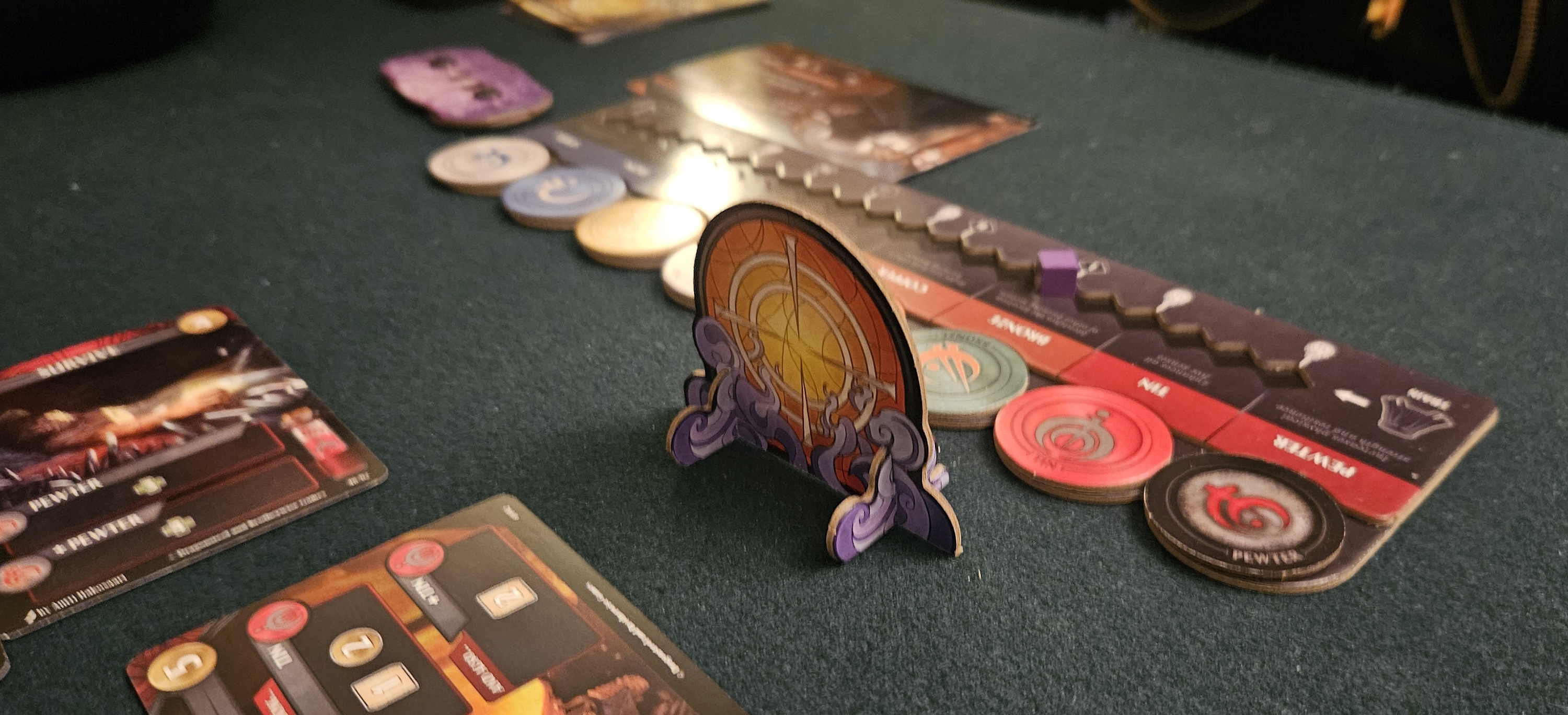
The targeting system keeps things lively.
Other systems are… let’s call them “mixed.” There’s a targeting system that dictates who bears the brunt of any given attack. The idea is that only the marked player takes damage, at which point they can reassign the target to somebody else. However, they’re also given the option to remain imperiled so that their own attacks hit everybody else at the table, doubling or even tripling the impact of each punch and coinshot. It’s a clever touch of press-your-luck, and adds some depth to the four-player game especially, but it falls flatter with three players and disappears entirely when played as a duel.
Similarly, one of the game’s major spheres feels somewhat underdeveloped. Rather than killing your rivals outright, you can also win by reaching the top of three mission tracks. These dole out periodic bonuses, so it’s worth the effort to invest in a mission or two even if you don’t intend to win that way.
Still, the whole concept feels bare-bones compared to everything else in Mistborn. The tracks are columned spreadsheets right down to the tiny icons that are nearly impossible to see from across the table. Even a little bit of adventure in the graphic design department would have gone a long way. Imagine these things as progression trees, with players choosing which branch to climb next! Instead, they’re both boring and hard to parse.
Worse, they simply stop mattering in the solitaire and cooperative modes. These pit you against the Lord Ruler, the first book’s principal antagonist. While it behooves you to reach the top of all three tracks to prevent the jerk from healing himself all the time, it’s still a bummer to reach that last phase of the battle with a bunch of now-worthless icons gumming up your cards. I get the sense that Clair didn’t quite know how to merge everything into the fight against the Lord Ruler. It’s still functional, even exciting, with plenty of long odds and some very harsh moves on the Lord Ruler’s part, but it lacks the dynamism of grappling with other players.
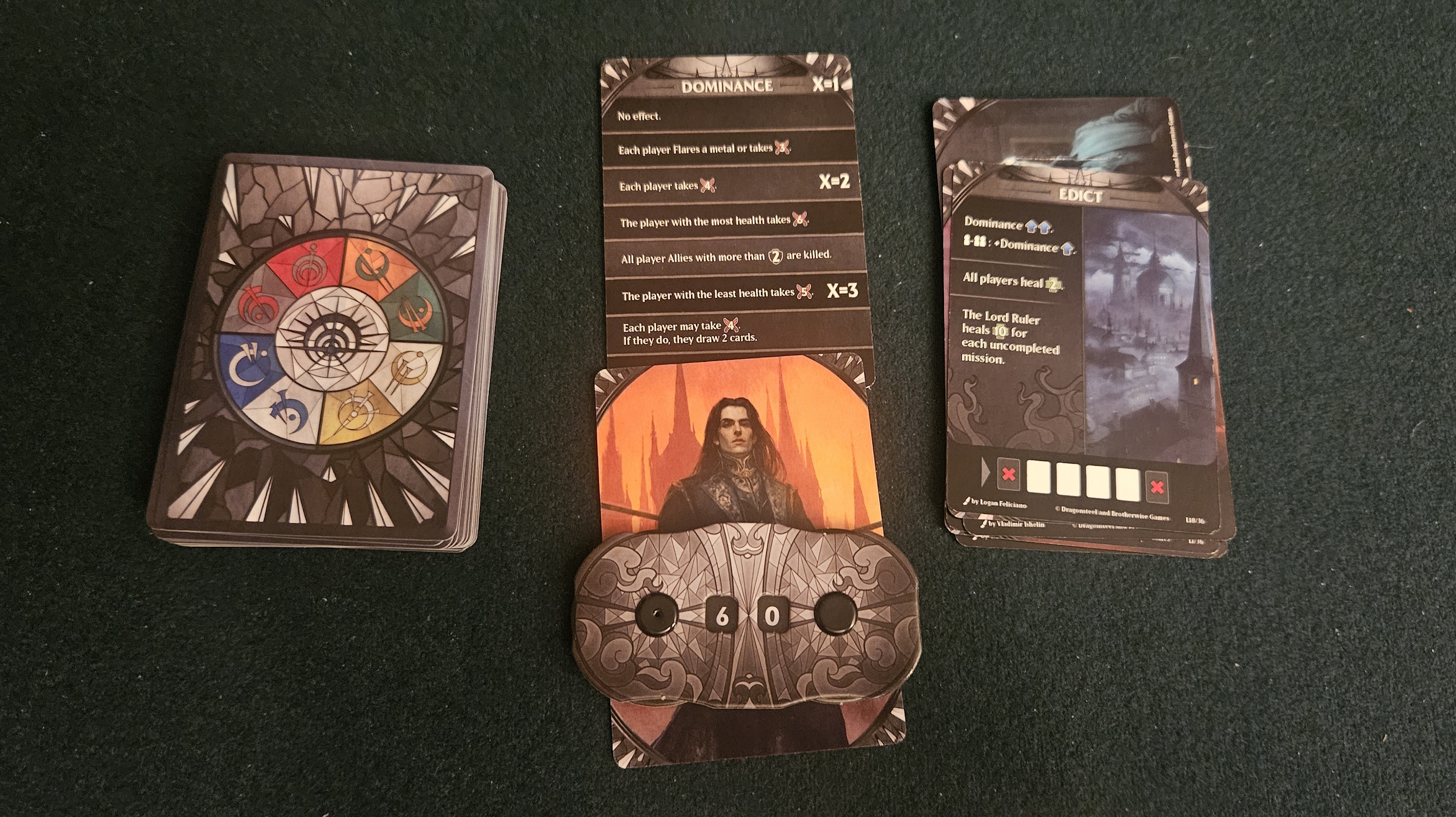
The more I learn about the Lord Ruler, the more I don’t care for him.
In the right context, however, Mistborn: The Deckbuilding Game is a fierce contender. That context is somewhat specific: it’s best in multiplayer, and strongest either as a straight duel between two players or as a psychological match in which four mistborn duck and parry and select their targets on the fly.
The good news, though, is that it works well. Bouts are kinetic, capturing the wide array of abilities and high-flying antics of these characters, encouraging both careful training and seat-of-your-pants reaction. To some degree, it does for Sanderson’s world what Dune: Imperium does for DUNC, albeit without the hybrid trappings or, let’s be honest, the same longevity. Mistborn isn’t quite so ambitious, but it provides ample opportunity for Clair to show off his design chops. Fans of “hard magic,” wizards with diagnosed pica, and deck-building will be hard-pressed to find a better crossover.
(If what I’m doing at Space-Biff! is valuable to you in some way, please consider dropping by my Patreon campaign or Ko-fi.)
A complimentary copy was provided.
Posted on November 26, 2024, in Board Game and tagged Board Games, Brotherwise Games, Mistborn: The Deckbuilding Game. Bookmark the permalink. 8 Comments.

 SPACE-BIFF!
I watched a preview and my impression was that the available Mistborn are all members of Kelsier’s crew: Vin, Kelsier, Marsh, and…somebody else. Is that correct? If so it seems like it would be very odd to play the vs. version, in the same way it would be odd to make a LotR game where Frodo, Sam, Merry, and Pippin fight each other.
not as odd as the base game of Mistborn House War having you play as the bad guys. (they did release an expansion that fixed that)
Kel mentored Vin, but it’s not hard for me to imagine him facing off against anyone in the crew who decided to get in the way of his plans.
The Mistborn: A Secret History novella provides a little bit more backstory on ruthlessness of the character.
Kelsier and Vin are definitely aligned, but Marsh might be a gray area. There’s also Shan, that noble mistborn who’s a real jerk.
Only Vin and Kel were full mistborn – the others in the crew were (forgets word) only able to burn one metal.
It seems to take a lot of inspiration from Shards of Infinity. So much so I wasn’t sure if it was worth playing and then I saw the price difference and wow! Mistborn is way more expensive for a game that may offer a similar experience. It’s a tough sell with so many competing deckbuilders and I’m still enjoying Star Wars: The Deckbuilding Game. Mistborn does look good though, and I’ve actually read the books and liked them. It’s definitely going on the wishlist for now.
To be clear, “try before you buy” is always my recommendation wherever possible. Shards of Infinity is very good, maybe even better than Mistborn. But Mistborn hits quite a few of its own notes.
Pingback: Fetch-Building | SPACE-BIFF!