Gouge Out Thine Own Eye

What if Magic: The Gathering were way nastier? That’s too clean a pitch for Personal Vendetta, the auteur project from designer-illustrator-publisher Nick Meccia, but it communicates the gist. It’s a rare game that sports such congruity between gameplay, artwork, and internal motifs; everything about Personal Vendetta both unsettles and services its central notion that to annihilate your clones, you must also annihilate a portion of yourself.
Be warned, this one isn’t for the faint of heart or stomach. One of my oldest friends got woozy just drawing from the deck.
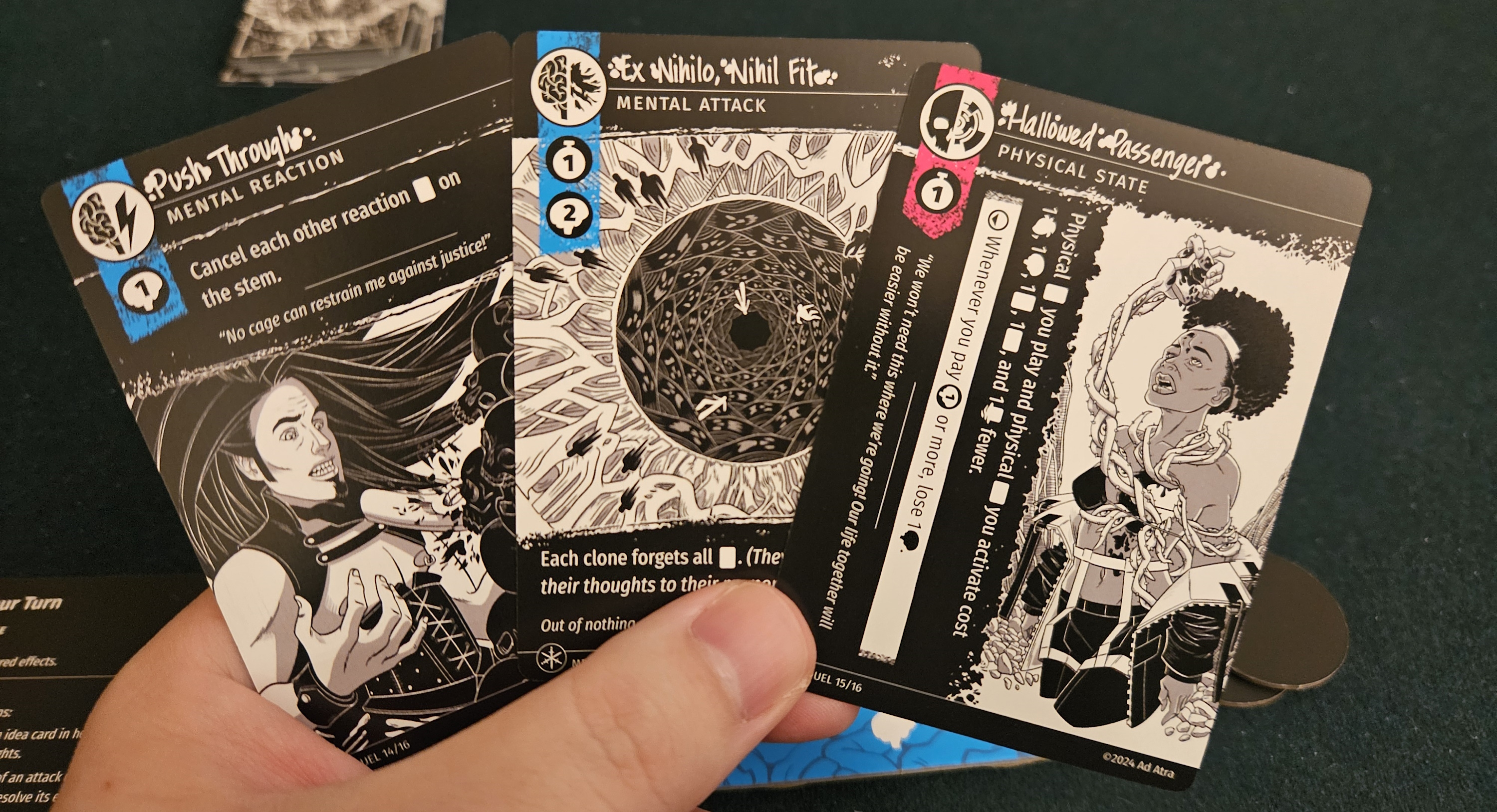
Personal Vendetta is not for the squeamish.
So you’ve been cloned. Do they have insurance for that? Whether it’s Calvin’s mild-mannered alter-ego from Calvin & Hobbes, Evil Logan from Logan, or, well, pretty much any clone from any movie about cloning, let’s agree that this is probably not the smartest technology to put out into the world without a few fireside chats about ethics. Still, after a half-dozen plays, I haven’t decided on the nature of these clones. Are these physical clones who inhabit the same city block, or mental clones jostling over the same seventy-ish cubic inches of gray matter? In the latter case, at least the collateral damage would be limited to one body.
Collateral damage comes fast and hard in Personal Vendetta, self-inflicted in the interests of expunging one’s duplicates. In fact, it’s rather difficult to find a card that doesn’t somehow cause self-harm. As has been the norm since Richard Garfield despoiled the hobby in ’93, you have twenty life points, although here you’re given two separate pools, corpus and cerebrium, color-coded pink and blue, and which we quickly defaulted to calling body and brains. These aren’t the first in-universe terms you’ll need to learn in order to play Personal Vendetta, nor are they the first pastiches of that old theory of mind that your body and brain are somehow disconnected from one another. Separate these health pools may be, but one neglects their mental health at great risk to the body and vice versa.
For the most part, this emphasis on self-harm makes each turn into a delicate balancing act. At best, cards consume time, a relentless drain since you’re only given two “clicks” per turn. At worst, they might consume time and injure your body, bruise your mind, or see your memories slipping away. There are card effects aplenty, and Meccia does that Phil Eklund thing of attaching so many individual terms to everything that they start to mash together. Not unlike Netrunner, with its clicks and ice, but with subtle distinctions between your “head” (the shared draw pile) and “headspace” (the similarly shared marketplace), thoughts (your hand) and memories (your discard pile), and so forth.

Biohacking antlers onto myself. Cool.
As I was saying, turns quickly turn into a form of judo waged atop shattered glass. You might throw your opponent onto the shards, but you can bet your footwork will incur lacerations. The trick lies in wending your way to victory before your body gives out altogether.
Easier said than done, in part thanks to Meccia’s spread of card effects. Ordinary attacks exist, but they’re rarities. More often, a card will instruct you to conduct a subtler operation, such as repressing (distinct from “forgetting”) a rival’s thoughts. With enough cleverness, these effects can be chained together. Another card might inflict mental damage equal to the number of ideas in their thoughts, which, for the astute among us, doesn’t quite gel with the previous assault. Whoops.
The game’s most interesting cards are its ongoing effects. With only minor exceptions, these are double-edged swords that see you grasping the blade to bash with the hilt. While they offer ongoing advantages, most cut both ways. A back-alley augmentation turns every card into a physical assault on your opponent, but also makes you more fragile; transforming into a multi-limbed slug bestows utter invulnerability, but also kills you dead at the end of your next turn. Stuff like that.
Those two examples also highlight Personal Vendetta at both its strongest and weakest. When the game leans into its gonzo excesses, it’s vibrant and exciting. You can only keep hold of a few cards at a time, preventing hand-building in lieu of plucking one or two ideas from that shared headspace. The pacing is profoundly tactical, encouraging little jabs and attritional exchanges rather than big plays, only for one or two such big reveals to make themselves known per session. It isn’t uncommon, for example, to “brainstorm” (translation: draw directly from the deck) a bunch of cards in hopes of producing some synergy, and instead stumbling across an assault that would have been vicious under any other circumstance than the one you’ve put yourself in. Personal Vendetta is about cornering yourself as much as it is about cornering your rival.

Ongoing effects are universally nasty.
I hope I don’t sound ambivalent about Personal Vendetta. It’s a hard game to be too centrist about. The issue is that for everything it does that I love, it pairs with some niggle.
Take, for example, the central conflict and the role Meccia’s slippery artwork plays in that. Every detail has clearly been lovingly labored over, producing images that are simultaneously repugnant and appealing, like sniffing one’s own bandage or the joyous agony of picking at a crusted blister. We are, at root, walking sacks of wet tubes, and body horror allows us to probe our corporeal anxieties, exploring dreams where our teeth turn to mush or our tonsils yawn wide to produce stones the size of apricot pits. The same goes for stories about cloning. It isn’t that we’re afraid of being replaced; it’s that we’re afraid of the selves we might become in defiance of this self we are right now. The story where we meet an evil clone isn’t all that far off from the story where time travel lets us meet a younger version of ourself. The reaction in both situations is a desperate fascination.
In Personal Vendetta, all this squicky artwork and ludic self-harm produces a conceptual framework that’s both alien and all too close to the bone. The key, I suspect, is right there in the title. Confucius said that thing about digging two graves when you set out for revenge, but this telling is less cutesy, with cards that nip at your fingertips without always triggering damage on the object of your hatred. It speaks to the deformities we self-inflict whenever we hate, when we declare war on our neighbors or even our actual enemies.
If only I liked the actual gameplay more. Don’t get me wrong, these matches are often tense affairs. But they also come across as nitpicking more often than not, little exchanges of a few pips of dead gray matter here, a pip of bruised physical health there. I prefer it with more than two players, but there’s no concealing that the whole thing devolves into bash-the-leader, and rightly so. In either case, it’s rare that I feel clever for stringing together the right cards. Usually the sensation is closer to lucky, hinging on the refresh of that shared headspace market or a brainstorming session from the deck.

Nom nom.
Even now, I am decaying. I can feel it in my knees, in my fuzzy head, in old scar tissue that flares when it rains — and right now we’re being treated to a frigid autumn downpour. Personal Vendetta sidles up to that decay, prods it with one yellow fingertip, nods at the mottle. I like the direction it’s going. I wish I liked it even better.
(If what I’m doing at Space-Biff! is valuable to you in some way, please consider dropping by my Patreon campaign or Ko-fi.)
A complimentary copy was provided.
Posted on October 29, 2024, in Board Game and tagged Ad Atra, Board Games, Personal Vendetta. Bookmark the permalink. Leave a comment.

 SPACE-BIFF!
Leave a comment
Comments 0