Intertidal Zone

High Tide is wonderful. Designed by Marceline Leiman and currently only slated to be sold in limited quantities at the forthcoming Indie Games Night Market in December, its petite format conceals surprising breadth, the way a seashell might contain a mollusk or hermit crab or the whole rounded cacophony of the ocean.

“Go gather by the humming sea some twisted, echo-harboring shell.”
When the game begins there are only the hexes, hand-painted and stamped in three colors, then jumbled together to form a single grid. One player is pink, the other is blue. Tan pieces are neutral; they can be manipulated by anybody, provided they adhere to the game’s rules.
Those rules are decidedly easy. On your turn, you must shift something — either one of your pieces or one of those neutral shells — onto an adjacent space. The bigger constraint is that your pieces must always move up a step. Bit by bit, towers are formed from commingling species scrambling atop one another. It’s a familiar scurry for anybody who’s cooled their heels in a tide pool as the water changes, the little creatures bobbing for purchase in the froth. The game isn’t overly constrained. Whether you want to move a piece up one level or five makes no difference. Sometimes a piece is sealed in, too near the middle of the grid to slide free. These are trapped and cannot be moved, like pieces surrounded by friendly and rival bugs in John Yianni’s Hive.
Or, from another perspective, these wanderers have found their anchor. High Tide, you see, is about carving out a safe space for yourself. As the denizens of the pool knit into formation, your available moves decrease. Plenty of pieces will be stuck underneath their peers. Others reach an apex and can no longer climb any higher. It’s a short process. A match lasts, oh, five minutes. Maybe seven if you really think through your moves.
As soon as somebody can no longer move, the pool is frozen in time. You win the session by having the most creatures showing. If that tally is tied — it often is — then the highest shell wins. If another tie results, then whomever made the last move wins. The tiles throw up a pleasant clatter as you mix them together again. Best to three or five is the usual threshold for victory.
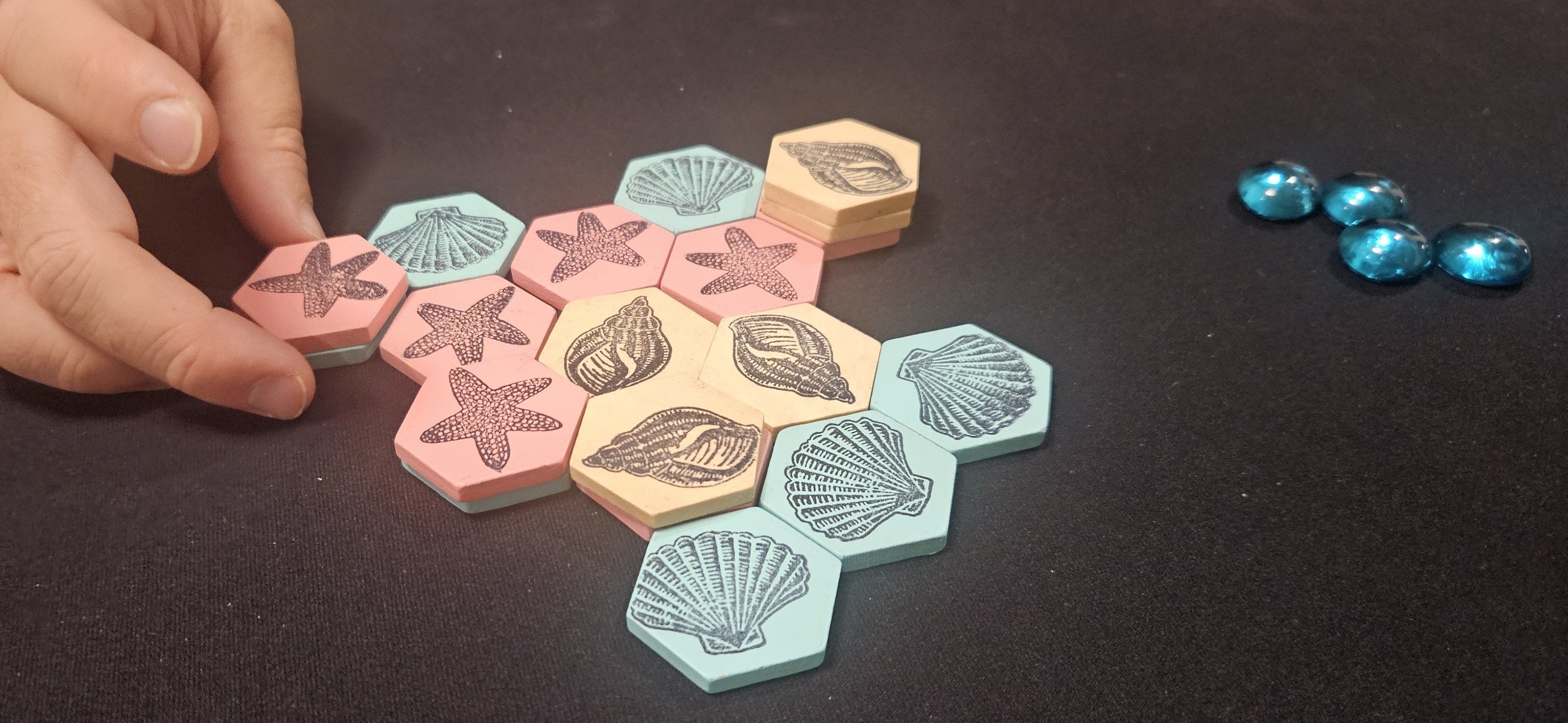
Moving up in the world.
There’s a beauty to High Tide, one that has to do both with the game’s naturalistic feel and its sense of finding your place, however impermanent, within the world. It feels right, for instance, that the game should be made of something natural, in this case wood, as opposed to fired clay or molded plastic. Plastic in particular would feel intrusive, an inversion of how this thing is meant to handle, with that worldly clatter that signals the investment of earth and air into its creation.
It moves along similar leylines. As a design, Leiman has created something that feels both familiar and new, like walking a trail you’ve never been down. There is a definable strategy to the whole thing. Covering an opposing shell is handy, but also risks exposing that shell again if you’re forced to move away, resulting in reversals of fortune for the incautious. Similarly, the gradual shape of this particular pool — often spiraling, coming together into a few towers, or simply unspooling into a tangle — is small enough to accommodate cleverness without really adding to the playtime. High Tide never overstays its welcome, but neither does it understay it.
Do I worry that it can be mathed out a little too readily? Oh, certainly. If anything, High Tide is one of those games that becomes less interesting as its players grow better at its strategies, and especially as they grow more competitive. Some matches are more or less foreordained, especially when one color finds itself landlocked.
But that’s a minor worry, and one adjusted better by attitude than via outright modification. The more I play High Tide, the more impressed I become with its small but subtle playspace. It’s possible, for example, to yield a contested threshold to win on a tiebreaker, or to carefully manipulate your opponent’s possible moves and thereby maneuver them into zugswang. Indeed, most matches feature terminal moves of one stripe or another, where somebody grudgingly vacates a prize space because nothing else is left to them. Such moments are not only sharp and decisive, but also appear with regularity.

Population trumps elevation.
If you can’t tell, I love this little game. It’s also precisely the sort of thing one hopes to uncover at an indie games market, a hand-crafted bijou that feels delicate and precious at the same time. I think of the knitted kitty-cat my daughter purchased from a craft fair at our local library; even two years later, worn and balled with loose thread, it’s still one of her most prized possessions. High Tide is like that, a personal craft about finding a place for yourself despite the bustle of this tide pool we call a planet, and no slouch when it comes to clever gameplay.
(If what I’m doing at Space-Biff! is valuable to you in some way, please consider dropping by my Patreon campaign or Ko-fi.)
A complimentary copy was provided.
Posted on October 24, 2024, in Board Game and tagged Board Games, High Tide. Bookmark the permalink. 12 Comments.

 SPACE-BIFF!
This looks wonderful: I hope it becomes available in Europe soon. I can’t work out where the market you mention is located. The Indie Games website doesn’t say anything about the town or city it’s in, as if anyone reading is just supposed to know! But I’m going to assume it’s in the USA, right?
Not the easiest to find, you’re right! “PAX Unplugged on Saturday, December 7, 2024”
Which I found is in Philadelphia.
This reminds me very much of Tokan by Steffen Spiele.
I can’t help but think how nice and witty this would be if reimagined as a 3P game.
Hey, use that as a starting point for a brand-new design!
Pingback: The Gooey Decimal System | SPACE-BIFF!
Pingback: Journeys in the Dark | SPACE-BIFF!
Pingback: Best Week 2024! Snacked! | SPACE-BIFF!
Pingback: Photograph of a Battlefield | SPACE-BIFF!
Pingback: Summer Ludens | SPACE-BIFF!
Pingback: Nebulae, Medusae… Crownae? | SPACE-BIFF!
Pingback: Walletbiters | SPACE-BIFF!