Send in the Doughboys

As a player of board games, there’s always the sneaking suspicion that all we’re doing is playing with toys. Then along comes a game like Clint Bohaty’s Necromolds to confirm it.
Necromolds is the sort of thing one might have seen on television in the ’90s, likely in the breaks between Saturday morning cartoons, full of children breathlessly enthusing about action figures or slime or the latest gimmick board game. Coincidentally, Necromolds is all of those things at once. This is a game about assembling monsters from clay, smashing them against your buddy’s monsters, and then literally smashing them with a ring. Their disintegrated forms then function as impassable terrain. It’s cool as hell.

What was I made for?
When it comes to one’s inner thirteen-year-old, every detail in Necromolds seems designed to trigger an internal riff of electronic ska.
Consider how you craft an army. You roll a ball of clay, insert it into a spellbook, and smoosh, here’s a brand-new golem, just a few peeled leftovers away from being sent to its second death. Later, after your dozen-or-so creations have been arrayed on the board, you flip those same spellbooks to reveal the monster’s stats. These are every bit as trim as your clay offerings, little more than ranged and melee stats and a defense number.
There’s no room for flab. It would only add noise the trumpets and bass. The same goes for battle. There are props, standees of cardboard terrain to block your army’s forward march, but deeper tactical considerations are a distraction. Two golems come into collision. We roll the dice. Someone gets smooshed. Maybe both of us get smooshed. The smooshing, by the way, is conducted with a caster ring, the same font of power that lends us the ability to craft golems. This is never not a delight.

My living throne goes marching off to war.
There’s a forty-page storybook included in the base game of Necromolds. I make a point of reading the materials included in every game I review, and you know what The Rise of the Necromolds reminds me of? I was twelve when the first Starcraft came out. I had played it at a friend’s house and, freshly alerted to Santa’s irrelevance in the process, begged my parents to give it to me for Christmas. Give it to me they did. And then we headed off for a week to some Lawrence Welk-themed golf course in California.
Naturally, I couldn’t take my PC. I didn’t yet own so much as a GameBoy. But I brought that manual, with its overwrought descriptions of each unit, that solemn backstory that felt portentous in the way only a preteen could handle, the vicious illustrations I fastidiously concealed from my family. For a week I devoured it like a Zergling snacking on some Confederate colonist. Upon returning home, the video game barely lived up to the enormity of that telling. The wars were replaced by squabbles, the hordes reduced to wolf packs, the power-armored marines swapped for 40hp and a squicky explosion of blood that came far too soon. When I think “Starcraft,” I barely even think of the game. I think of that manual.
Necromolds goes somewhere similar. Its rulebook tells of great wars and betrayals, of realms remade, of the hidden history behind the golems. People carry around epithets like Cromlech and Basalt LaSeur without making a beeline to the state courthouse for a name change.

The dice command system is straightforward.
The game itself, meanwhile, falls into that strange middle ground, both radical — as shouted by some kid in a ’90s commercial, not as a marker of innovation or extremism — and strangely trad.
So you’ve made an army and it’s time for battle. Dice are rolled, first to determine initiative and then to assign orders; later, more dice will be rolled to determine the outcome of battle. Each of these steps is straightforward. Units can march forward, potentially resulting in a melee clash if they physically collide with another golem, or unleash ranged attacks that are safer from counterattack but lack the immediacy and lethality of a hand-to-hand tussle, or reveal magical abilities that, at least in the units I’ve seen, don’t often amount to much.
Instead of hesitating around the edges, death comes hard and fast. In the base game there are no hit points; units are either alive or dead, with nary a state in between. This fosters a certain forthrightness with the units, who are little more than sacrificial offerings, and with the overall strategy, which follows the rule of cool over the side of a cliff. There’s no cause to mourn the death of a Mud Mump or Ankropora. In life they were bundles of battle stats, with little else to distinguish them.
While this could be considered a problem, it also feeds into the game’s sense of self. When at first I deemed my army’s smaller units worthless, their dice pools too sparse to inflict a killing blow on anything but the furthest odds, I soon discovered that they were best put to work as corpses to block approaching avenues so my ranged Graveghouls could pick apart my opponent’s hulking Insectomites. I cackled. My ten-year-old cackled. And then we went back to the serious business of smooshing one another’s golems.
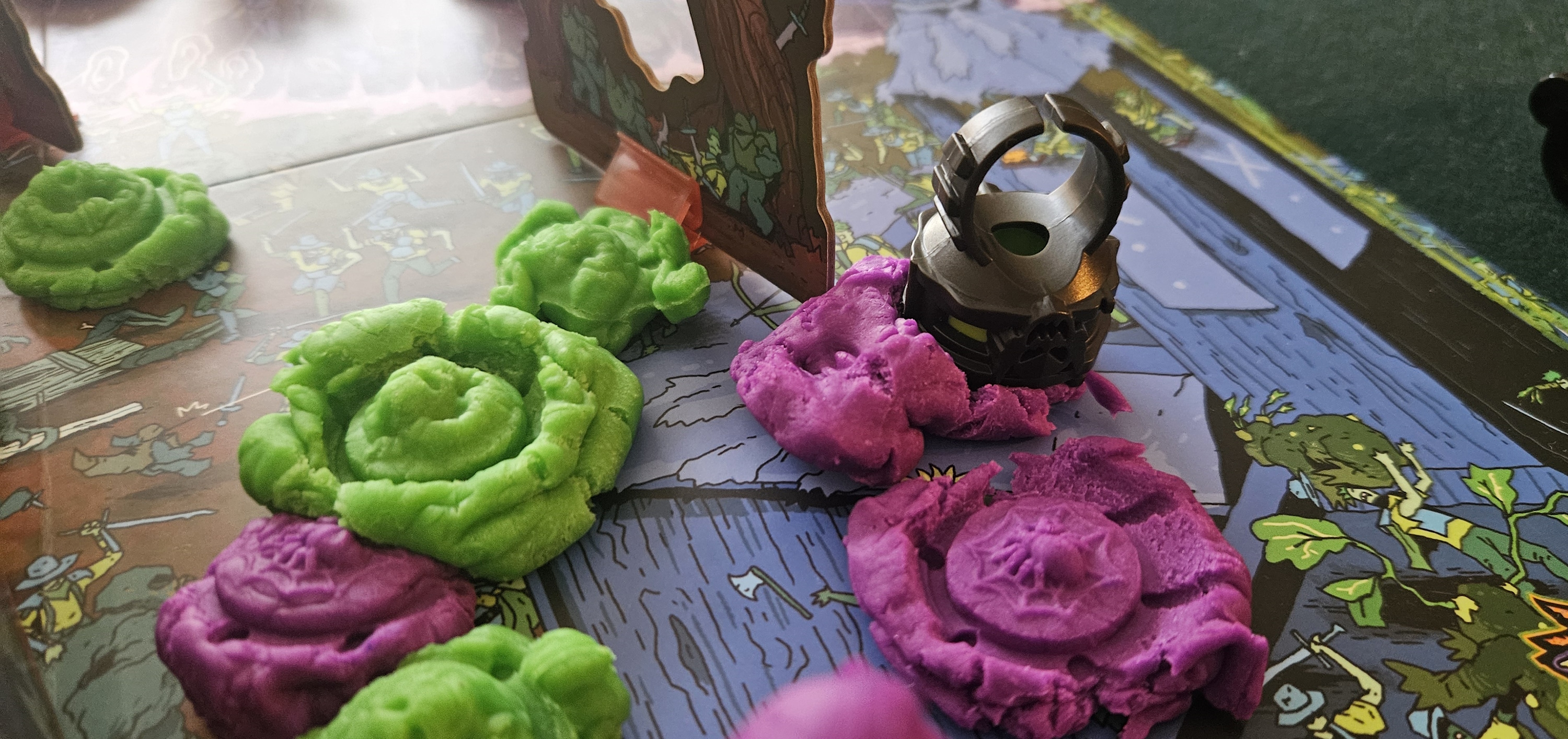
Smoosh!
This is undoubtedly Necromolds’ purest delight. Playing with a child in her own phase of preteen seriousness strips away the arguments against such an artifact. It’s too simple? Simple for whom? The rules handily come with three degrees of complexity, its middle level bookended by simpler fare for youngsters and more complicated options that are not in fact very complicated. These add a few necessary snags, such as spending gems for rerolls. And the kindlier options are telling: one recommends letting kids squish their own monsters to remove the sting of losing a battle. Smart.
If anything, my ten-year-old found even the base game’s advanced rules too light for her tastes. Granted, she plays a great deal more board games than most of her peers, but she still wondered aloud if there wasn’t a more interesting way to win a battle than by wiping out all of the opposing army. By the end of our first session, she announced that she’d had fun but didn’t see any reason to play again.
It took the first big expansion, Call to Arms, to solidify the game’s identity in her mind. This adds a whole heap of stuff. Some of its additions are excellent, such as items that stick into your golems’ bodies to confer special benefits, like walking straight through obstacles or making an extra move after attacking. Along the same line are wounds, little daggers and hatchets and swords that embed into a golem to show that it has been weakened. The application of these injuries is somewhat muddled. Because the base game doesn’t provide an avenue for hit points, they’re only assigned via special effects, and they serve mostly to cause a golem to roll wimpier dice rather than, say, gradually lose pieces of itself until it keels over. But my kiddo delighted so much in jabbing swords so far through those little bodies that their blades protruded from the other end, or splitting a head down the middle with an axe, that we came up with our own house rules just so we could inflict fresh injuries on our clay monsters.

Some of the expansion stuff is a bit overcluttering.
The biggest addition of Call to Arms is commanders. These add a bit of flavor to your casters via a selection of abilities. To be frank, these are a mixed bag, so reliant on the game’s hieroglyphic language that deciphering even basic abilities becomes a pain in the ass, not to mention stymies the comprehension skills of the game’s target audience. My kid struggles to pronounce words she’s never seen, let alone decipher command strings that read, “If this [skull icon in dish] [skull icon with fringes] [skull icon with horns], move it a [movement icon with one pip] [parentheses around hatch marks] immediately after combat.” More than once, she stopped using her caster’s abilities altogether after one or two abortive tries. I can’t blame her.
At the same time, casters also introduce a sorely needed element to the battlefield: an actual objective. Annihilation might sound cool in principle, but it often takes far too long to hunt down and smoosh every last enemy golem. Now one golem becomes your champion, an avatar of your caster that acts as the locus of their special abilities and, in a touch that’s infinitely easier to handle than their hieroglyphic abilities, gets to roll an extra die that inflicts wounds and ruins everybody’s day.
To render it in thirteen-year-old, champions are badass. They’re the beating heart of your army, the source of enemy wounds, your most powerful unit, and the pathway to ultimate victory. Your goal is no longer to kill everything, but to stamp out the opposing champion. This introduces an essential tension between wanting to plop your champion in the middle of the fray for the advantages they confer or keeping them safely in reserve. This being a Rule of Cool game, trouble nearly always beats out caution, resulting in the occasional duel between champions while the battle continues around them. For the slightest moment, Necromolds reaches the apocalyptic heights of its reading material.

Shoving sharp implements into enemy monsters is never less than a delight.
I can’t tell you that Necromolds provides a perfect time. Too often, it plants its stakes in the awkward middle ground between simplicity and the adornments of tactical miniatures games. For all the delight of crafting its units, they’re almost as featureless as their substrate. For all the joy of breaking apart a clay warrior, it shies away from letting us truly put these things through the wringer.
But there are reasons I can’t help but feel affectionately toward it. My ten-year-old girl, obsessed with dueling dragons, was so delighted with the stickpin items and body-piercing wounds that she insisted on inventing new rules for our session. She cackled with delight as she pinned my soldiers’ corpses to the ground with ragged red swords. When her champion slew one of my golems decked out with a magical hat, she announced that it would make more sense for her champion to steal the headgear rather than for the artifact to whisk itself away to a replacement owner.
I agreed to all of her requests. Because Necromolds isn’t just a game. It’s a story. It’s a toolkit. It’s a leftover fragment of childhood.
(If what I’m doing at Space-Biff! is valuable to you in some way, please consider dropping by my Patreon campaign or Ko-fi.)
Complimentary copies of the base game, Call to Arms expansion, and Monster Pack 4 were provided.
Posted on October 1, 2024, in Board Game and tagged Board Games, Necromolds. Bookmark the permalink. 13 Comments.

 SPACE-BIFF!
I agree that the StarCraft manual was something amazing. It was my main reading material for some very formative days in my youth (a child during a divorce, in a house that wasn’t mine) and it stuck with me too. I’m my youthful boredom-fueled creativity I almost created a role-playing game in the world that book described.
Oh gosh, that sounds like a rough deal. Glad to hear you found some solace in that manual.
This brings back fond memories of playing Clay-O-Rama in the early 1990s. A more freeform version of Necromolds wholly given to the creativity and imagination of the players. All you needed were a brief set of rules and a few buckets of playdough.
I remember a kid at a convention getting his creature kicked so hard that it got stuck on a sprinkler in the ceiling. The gamemaster ruled that if it fell back down before the game ended, he could continue playing with it. It landed with a thud when there were only a few other battered lumps of playdough left at the table. And poked and pounded any remaining semblance of anything out of them.
The rules are freely available online for anyone who dares to release their inner child.
Thanks for the info!
Yes! My friends and I played so much Clay-O-Rama in the late 80s. The freeform rules flexibility + artistic creativity were awesome.
I was usually GM, and I learned a lot about making/costing weird abilities through trial and error.
This looks so effing cool. Gonna have to pick it up to try with the 12 and 9 y.o.s. Thanks Dan!
I hope you enjoy it as much as we have!
MAD Scientist Monster Lab was cool but then the creatures were just kind of there, this is a pretty nifty evolution, making it into a game
added to the 15-year longterm gaming plan for my kids of age 1 and 3. So much good stuff to come
It’s an adventure, for sure.
How apropos to read this the same day Clint announces the first entry in a free campaign. There are army lists and alternate win conditions and everything. You can find it on the Necromolds homepage.
Intriguing! I’ll have to check it out. Thanks for the info.
Pingback: 5 on Friday 04/10/24 – No Rerolls