Wrex. Shepard.
What is there even to say about Mass Effect? It’s old. The final installment came out twelve years ago. Not counting Andromeda. Which we don’t around these parts.
But, sure, I’m a sucker for Commander Shepard, the Normandy, the whole goofball crew. I have a pile of opinions nobody cares to hear, fond memories of blasting through human supremacists and robot supremacists alike, even some suppressed affection for the Mako, that tumble car I rolled sideways down every mountain in the Armstrong Nebula.
Now Mass Effect is back as a board game. Why now, you ask, a dozen years after all the cosplayers were airbrushing themselves blue? Pffft, who cares. Designed by Eric Lang and Calvin Wong Tze Loon, Mass Effect: The Board Game — Priority: Hagalaz is one heck of a mouthful that I intend to never repeat. It’s effectively a generous side quest set during the third game’s galaxy-spanning war against the Reapers. And, some hiccups aside, it’s a nostalgic treat to see the gang back together for one more bash.
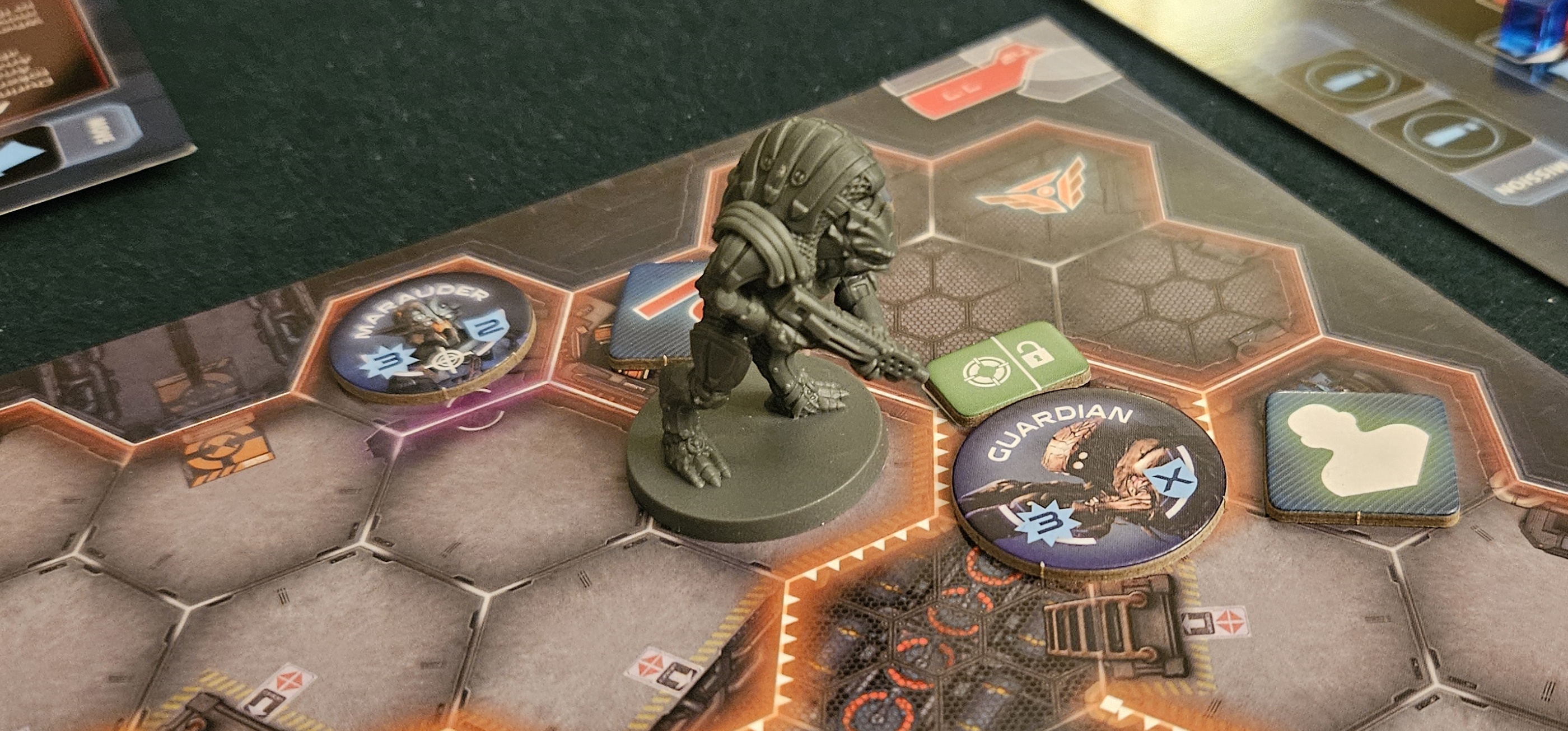
Wrex is about to wreck this bug.
Remember Hagalaz? It’s the planet Shepard visited in the Shadow Broker expansion to Mass Effect 2, the one with the slow rotation that causes massive electromagnetic storms to orbit the whole globe. Well, a Cerberus research vessel was concealing itself in the thunder clouds — copycats — until something caused it to go down. Probably the mind-controlling Reaper tech they were researching onboard. Now Shepard has deployed his most trustworthy fighters — the battlemaster Wrex, analytical sexypants Liara T’Soni, marksman Garrus Vakarian, and drone operator Tali’Zorah — to retrieve what data they can scrounge out of the cruiser’s databanks and then scuttle the thing so Cerberus can’t recover their tech.
To the game’s credit, how you feel about its shenanigans doesn’t entirely depend on how drowsy you got reading the above paragraph. While one of my co-players was familiar enough with Mass Effect that we passed turns to one another by dryly intoning “Wrex. Shepard.” until my wife called us big nerds, the rest couldn’t tell a turian from a salarian. Despite that, everybody found the game’s combination of tactical combat and squad customization exciting in a way that, say, The Mandalorian: Adventures was not, despite both games chasing similar thrills.
And it had better, because many of the hallmarks of the Mass Effect series have necessarily been left behind. You won’t be jetting around the galaxy, playing mineral-mining minigames, or making flirty-eyes at everybody unfortunate enough to share this flying tin can with you. Instead, you’ll be fighting through waves of baddies, leveling up your characters, and choosing which of a handful of branching missions to tackle next.
There are fourteen scenarios in all, but a full campaign consists of only three to five — three main missions plus two optional “loyalty” missions that see your squad taking a detour to study alien relics or gather doodads. These are side quests to this side quest, basically, but it’s hard to imagine skipping them when they dole out additional skill points. More on those in a moment.

I’m Commander Shepard, and these are my favorite dice on the Citadel.
Like a handful of recent titles, not only the aforementioned Mandalorian but also the likes of Gloomhaven: Jaws of the Lion, missions are presented via a booklet, with setup instructions, mission parameters, and special rules printed on the left side and the actual battle map on the right. It’s slightly cramped at times — enemies are cardboard discs, sometimes with tiny abilities only half-visible between their damage and shield values — but it beats having to jigsaw cardboard terrain together.
Especially because these fights tend to be punchy, both on the table and above it, where most scenarios only last around an hour. Your squad deploys into the area, trades fire with enemy forces, and tries to complete some objective before the clock runs out. The main scenarios are split into contrasting objectives that mimic the paragon/renegade morality system of the video games. Paragon objectives are tougher but award extra dice in future missions, while going renegade gives you tokens that let you realign your rolls a limited number of times. There’s also a track that gauges your ongoing progress against the Reapers, with paragon generally tilting the balance more in your favor than expediency.
I keep mentioning The Mandalorian because there’s some parallel invention going on. Both are speed-freak tactical combat games that streamline details like line-of-sight rules and enemy turns, offload their action menus to cards or dice, and — this is the downside — are somewhat too breezy for their own good. But where The Mandalorian sanded down its combat until there was barely any friction, Mass Effect provides a bit more grounding. There’s cover, useful for sliding out of sight to catch your breath, and shields, which prevent lasting damage but collapse under fire, and an absolutely enormous range of character abilities.
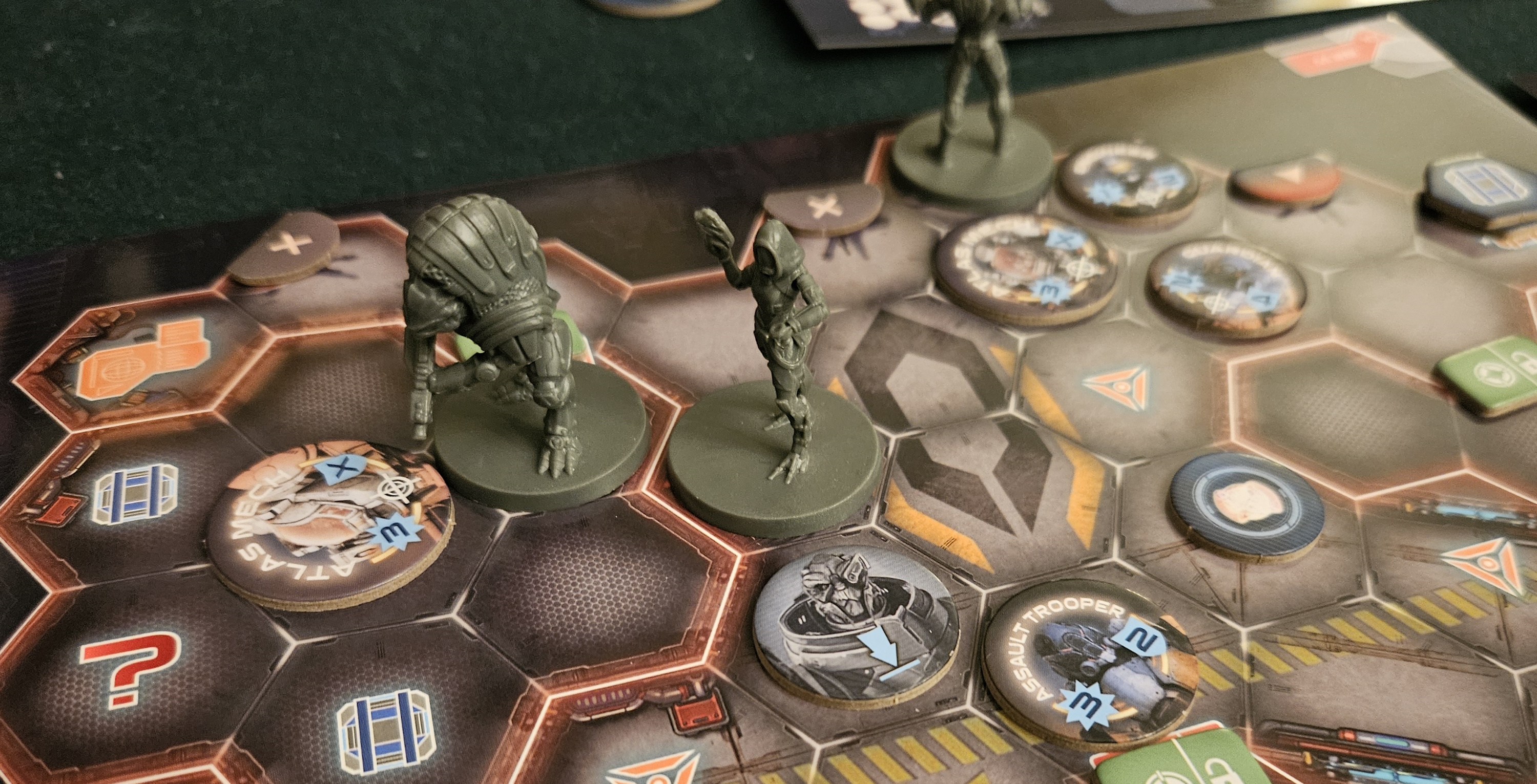
Garrus is down. No surprise.
Character abilities. Okay. We need to pause a moment, because the character abilities are the highlight of the whole thing. At its rawest, each of the game’s five characters brings their own abilities to bear. These hone over the course of a full campaign, earned one kill, recovered data pad, and special objective at a time.
But what makes these abilities special is that each character has their own distinct identity, not only as an image on a sheet or some small variance to damage and defense values, but in how those characters express themselves on the battle map. Scenarios with tight corridors and doorways are the ken of Wrex, with his multi-blast shotgun and berserker rage that first simmers and then boils over. Open spaces, on the other hand, allow Garrus to line up incredibly powerful sniper shots. Missions packed with turrets or locked doors will benefit from Tali’s drone, which can hack a path for your characters, while elite enemies tend to crumple in the face of Liara’s biotic attacks.
What’s funny, though, is that these descriptions still don’t quite access your characters’ potential. Garrus, for instance, is a sniper. Got it. But he’s also the only character who can upgrade his movement to step away from enemy discs without taking damage. Another of his upgrades is proximity mines, which blast enemies who try to flank him. This transforms him into one slippery character, both a sniper and an infiltrator and a trapper. And that’s the point. Rather than slotting into easy archetypes, each character brings their own irreplaceable identity to the table.
It’s a natural fit with the dice system, which I haven’t discussed largely because it’s so basic. The gist is that you have a huge handful of dice. Whichever squaddie is on point rolls the whole pile, assigns three to their sheet, takes the corresponding actions, and then passes the rest. Then the next squaddie rolls the remainder, assigns three, and… look, you get it.

Each character develops their own skills.
Over time, characters unlock new dice slots. Now Liara or Tali, previously your underpowered hitters, can blast entire crowds with biotics or force enemies to turn on each other. Or Shepard, your big doofus commander, is now a medic who also lights his enemies on fire just by rolling dice. Wrex… Wrex mostly shoots more. The point is that the dice system is a natural fit. Each character gets their moment to shine, rolling and assigning freely, only to find themselves wearing thin a few turns later as they pick from the leftovers. There’s no need for some bolted-on stamina system. It’s right there.
Which isn’t to say that Mass Effect is a perfect game. In one last parallel to The Mandalorian, it’s often too easy. Missions have an inbuilt timer thanks to the enemy activation deck, but my group never felt pressed for time. Nor were we often imperiled by Cerberus operatives or Reaper monstrosities. In most cases, our most deadly foe was our very own Commander Shepard thanks to his habit of sprinting into danger and nearly getting downed before everybody could catch up to rescue his dimpled ass.
And scenarios tend to get easier as they progress. Early on, their abundance of enemies requires at least some caution. Later, after the herd has been culled, the trickle of reinforcements largely serves as a handy repository for your squad’s residue ammo. Now and then a scenario will introduce an elite enemy, but it’s often trivial to kite even the toughest enemy when the arena has been depleted of backup.
Look, I understand that there’s a design philosophy here. This is a Mass Effect board game for Mass Effect fans, not a hardcore tabletop gamer’s game. It’s also a modern cooperative game. About a decade ago, the default feeling on co-ops was that players ought to only win one out of three sessions. That produced a lot of very frustrating cooperative games. I prefer a game I can win to a game that’s going to gank me just to preserve its ideal win:loss ratio.
But I still want to earn my victories. I want to struggle. I want to face failure because the clock is running out or our enemies are outflanking us, not because we grew so confident in our inevitable success that Geoff entered Commander Shepard into a punching match with an Atlas Mech.
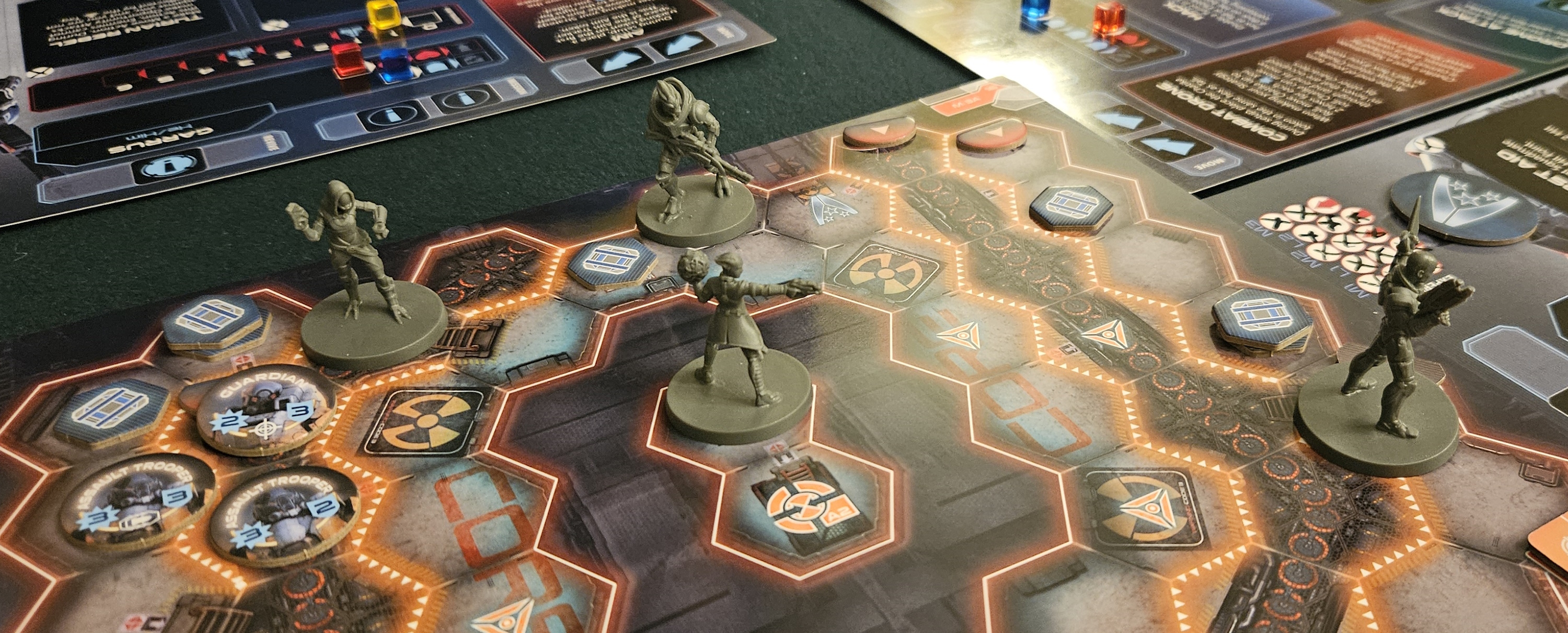
Shepard heads off to complete his own private mission.
As a game about developing characters, assigning dice, and revisiting a few old friends, Mass Effect is unparalleled. It’s like putting on a pair of well-worn sneakers or bumping into an old friend at a restaurant and deciding to share a table. As a squad tactics game, though, it’s a bit like pushing over some babies that have only just learned how to sit up.
Okay, it isn’t that easy. But it’s pretty easy. Maybe they’re toddlers rather than infants.
Still, it’s nice to have the gang together for one last mission, even if that mission is them dunking on Cerberus. Lang and Wong have created something special. I would love to see them produce yet another side quest.
(If what I’m doing at Space-Biff! is valuable to you in some way, please consider dropping by my Patreon campaign or Ko-fi.)
A complimentary copy was provided.
Posted on September 18, 2024, in Board Game and tagged Board Games, Mass Effect, Modiphius Entertainment. Bookmark the permalink. 5 Comments.

 SPACE-BIFF!
Shots fired at Andromeda!! 😀
The game sounds a little stale for the IP in question? Have you tried the board game Rogue Angels? Another reviewer called it the Mass Effect board game. I guess that was before the official title came out 😀
Would you recommend Mandalorian above Mass Effect? Sounds a bit like it in your review.
I have played Rogue Angels, although only in prototype on TTS, so I really couldn’t compare the two.
I like this better than The Mandalorian. By a lot. But there’s a very good chance that’s based on the setting.
Pingback: Ode to the Depot | SPACE-BIFF!
Pingback: Some Rando Viking | SPACE-BIFF!
Pingback: Best Week 2024! Adapted! | SPACE-BIFF!