Ogling the Seers Catalog

Of the three recent trick-takers from Bézier Games — the others being Xylotar and Sandbag — far and away my favorite is Taylor Reiner’s Seers Catalog. Yes, the name is a strained riff on the Sears-Roebuck mail-order empire, one that proposes that oracles, augurs, and all manner of prognosticators also like to thumb through a heavy paper volume of mostly useless products. But that’s also part of what makes the game so effective. Scratch the surface of the pun and you’ll find a critique of American commercial identity.
Not that you need to care about that part, of course. But it’s nice all the same.
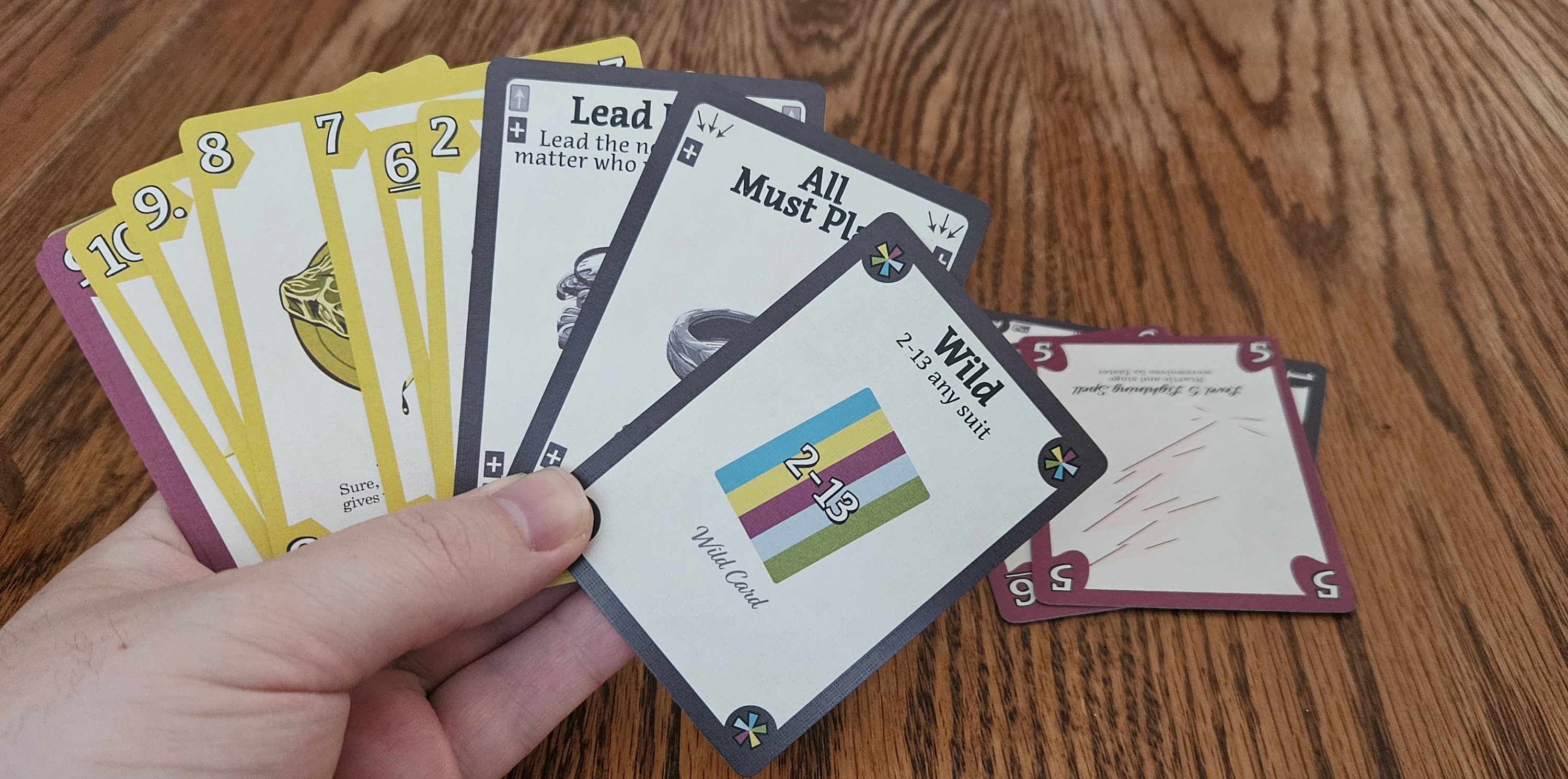
Now, how to play these cards?
As befits the game’s source material, the cards in Seers Catalog are mostly junk. Geared toward seers and werewolf hunters, you’ll find such bric-a-brac as dowsing rods, crystal balls, and lick-and-stick tattoos. The text for blue hair dye announces that “you can’t be a real seer if your hair isn’t blue,” inflicting body image issues on budding prophetesses. Some cards boop the fourth wall’s nose by featuring Bézier titles One Night Ultimate Werewolf and Werewords.
More useful are the game’s artifacts. These special cards are the staples of any given session, mixing up the traditional trick-taking formula. In addition to twelve regular cards, each player receives two such artifacts and one helpful wild card. To a one, artifacts are handy. The Rod of Reincarnation lets you pick up all the cards played this trick, padding your hand. The Gift of Fate passes the lead to another player, useful for those moments when you want to sit back and see how things develop rather than putting yourself forward. The Cauldron of Sorcery modifies a card’s rank up or down one.
That last one is surprisingly powerful because Seers Catalog is a meld game. Like rummy. Or Kei Kajino’s wonderful SCOUT, for those among us who aren’t familiar with the genre. Rather than being stuck playing a single card at a time, you’re also allowed to play matching ranks or suited runs in an effort to bleed your hand away. When somebody plays a certain meld — say, a run of three cards — you can only follow with a better version of that meld. In the game’s parlance, your hand is all the junk you’re tempted to buy from the catalog. Bit by bit, you’re exercising restraint by persuading yourself that you don’t need everything on your wishlist. Better to purchase one or two choice items than to rack up a bunch of debt.
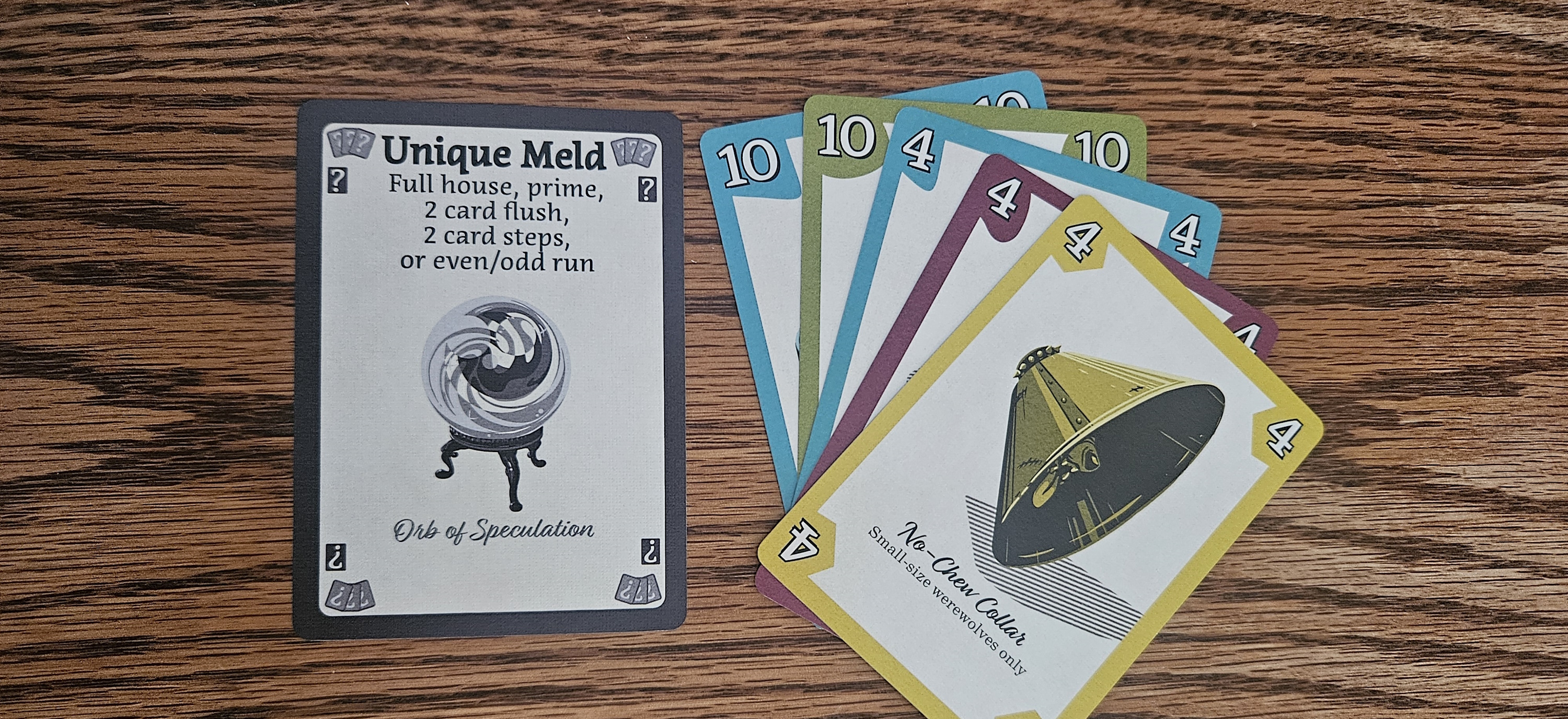
Some of the artifacts are wild.
Which brings us to Seers Catalog’s unusual scoring system. Unlike SCOUT, you aren’t trying to drop your hand to zero. Oh no. What’s the point of reading a mail-order catalog without treating yourself to something? Here your objective is to have a small hand, five cards or fewer. The instant you hit that threshold, you flip your bonus token. This indicates that you’ll score your lowest card when the round ends. That’s the only way to score positive points, by the way. But it also forces you to play into any future tricks. No more holding back. The instant somebody goes out, the round ends and everybody loses one point per card.
In other words, it’s entirely normal to go into debt. Point debt. Thematically, real debt. You want to have a trim hand, but that way lies the danger of being forced out of the round too early. Except, of course, sometimes that’s a good thing. Better to score zero points than negative seven.
I called it unusual. At first, it verges on unnatural. You want to get rid of cards, but only until you achieve the bonus state. You want to play powerful melds, but hope to hold onto your high-value cards for their scoring potential. You want to reserve your artifacts for watershed plays, but being worth zero points means you don’t want to be holding them when the round concludes. It demands a hyper-awareness of not only your own cards, but also the relative strength of everybody else’s hand and the points game being played in the background.
Once that threshold is crossed, though, it’s brilliant. In two senses, really. As meld games go, this one’s a rattlesnake. As a commentary on unchecked commercialism, it questions the dopamine hit we get from smashing the order button. Look, I get it. The only reason I review board games is because I love receiving packages in the mail. That tingle of anticipation can soothe even the worst anxiety. Until the bill comes due. Then it’s tummy rumbles all over again. That’s the cultural sweet spot Seers Catalog occupies, a trick-taking meditation on the tendency to over-consume.
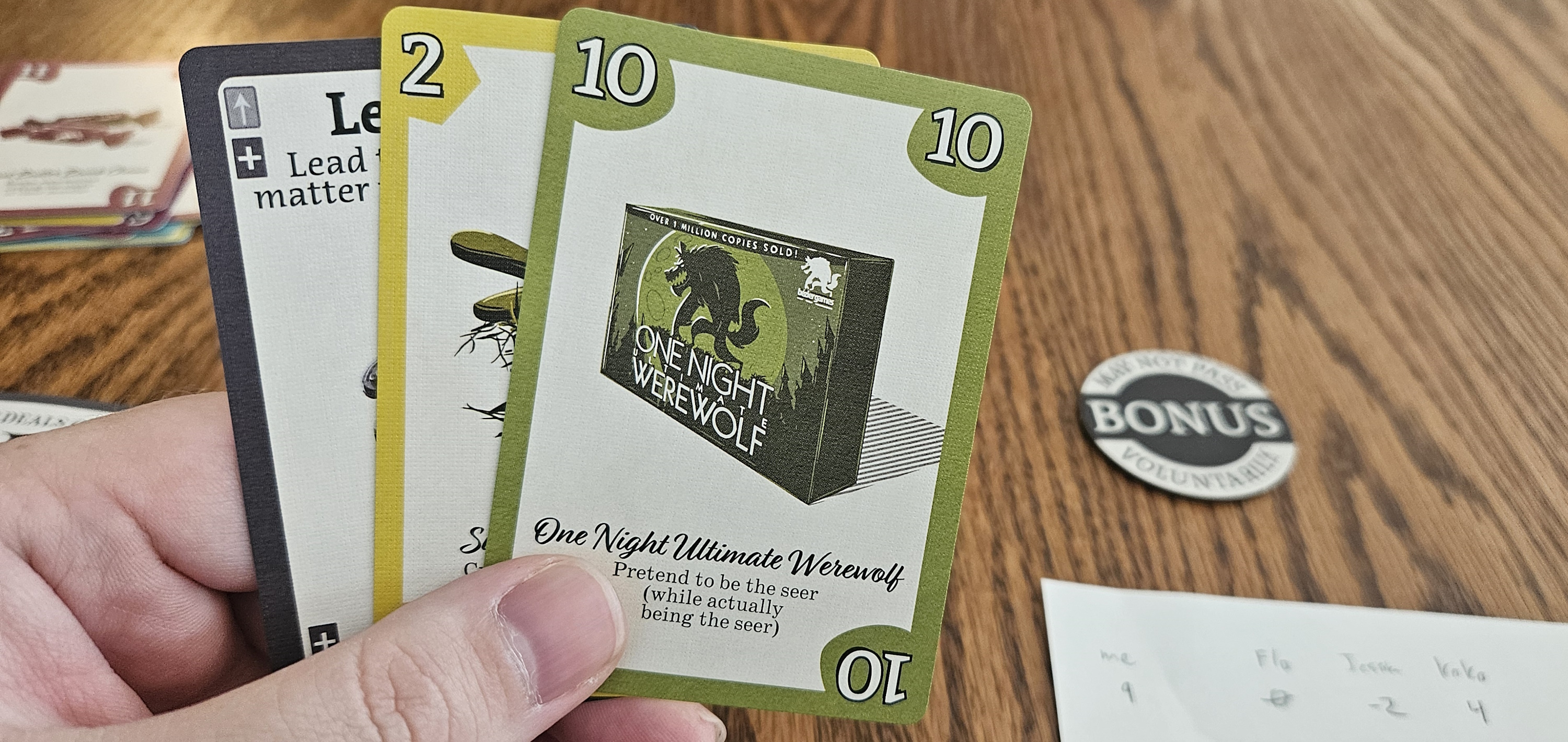
Wait… are they calling their own games chintzy catalog fodder?
The commentary isn’t strictly necessary, although I appreciate how it grounds the cards and artifacts within a rounder context. It reminds me of Muneyuki Yokouchi’s Cat in the Box, which used Schrödinger’s Cat as an explanatory gloss for its suitless cards. By speaking to something many of us will unfortunately recognize — ordering binges, whether from paper catalogs or the Bezos Enrichment Project — Seers Catalog bypasses the need to remind oneself about the particulars of its scoring. Everything you purchase confers a net negative. Unless, that is, you dig down and reduce that wishlist to the one or two items that will hold real value.
Even without its thematic touches, Seers Catalog would be a smart game. With them, it’s a memetic masterclass.
(If what I’m doing at Space-Biff! is valuable to you in some way, please consider dropping by my Patreon campaign or Ko-fi.)
A complimentary copy was provided.
Posted on August 1, 2024, in Board Game and tagged Bézier Games, Board Games, Seers Catalog. Bookmark the permalink. Leave a comment.

 SPACE-BIFF!
Leave a comment
Comments 0